
On this page
Start here
Quick answer
A rotten-egg smell from Whirlpool water-heater hot water is commonly associated with bacteria in the water and, in some models, a reaction involving the anode rod and hydrogen sulfide. Identify whether the odor is only in hot water before changing settings or parts; gas odor, leaks, or unsafe temperatures require immediate professional help.
Work through in order
Diagnostic checks
Use only checks that match the exact appliance or system and its official guide.
-
Check 1
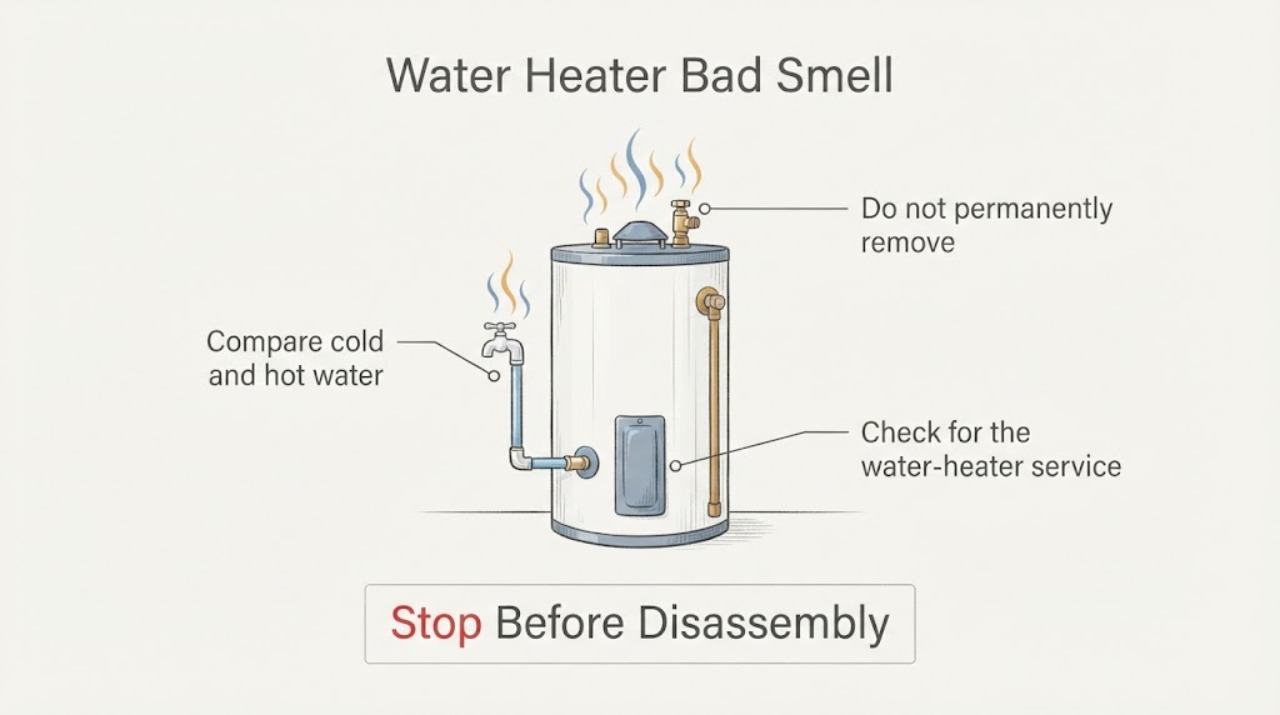
Compare cold and hot water.
Expected result: Run a cold sample and a hot sample into clean cups, then note whether only hot water smells and whether the odor is at every fixture.
Next step: Stop using the water and contact a water professional when the odor is chemical, fuel-like, or accompanied by discoloration or illness concerns.
Why this matters
Why: An odor limited to hot water points toward the water heater or hot-water plumbing; an odor in cold water requires water-supply investigation.
-
Check 2
Check for the water-heater service pattern without opening it.
Expected result: Look for a rotten-egg odor, reduced hot-water quality, visible tank or fitting leaks, and whether a softener or well supplies the home.
Next step: Use the model manual and a qualified plumber for tank treatment, water testing, or anode inspection.
Why this matters
Why: Whirlpool’s support and manual associate sulfur odor with bacteria/water conditions and anode-rod reaction; the symptom does not identify a specific part by itself.
-
Check 3
Do not permanently remove the anode rod or change temperature blindly.
Expected result: Observe the control setting and any mixing valve from outside; do not raise the tank temperature as a casual odor fix.
Next step: Have a qualified professional assess the anode, water chemistry, and temperature-control arrangement.
Why this matters
Why: The manual says anode protection must not be removed permanently, and higher temperatures increase scald risk.
-
Check 4
Check the stop conditions.
Expected result: Look for a gas smell, hissing, water pooling, a relief-valve discharge, a hot surface, or a burner/cord problem.
Next step: Leave the area for gas odor, shut off fuel only if safe, and contact emergency or qualified service according to local guidance.
Why this matters
Why: These observations indicate a gas, pressure, leak, or combustion/electrical hazard rather than a routine odor issue.
Use your observations
Decision map
Find the observation that best matches what you see, then follow the next safe action.
-
PATH 01Next step
What you see
Only hot water has a mild rotten-egg odor and there is no leak or gas smell.
Do this next
Arrange water-quality and anode evaluation; do not remove the anode permanently.
Why this path and its safety boundary
Why it matters: The water heater or hot-water plumbing is more likely than the cold supply, with bacteria or anode chemistry as documented possibilities.
-
PATH 02Next step
What you see
Both cold and hot water smell, or the odor is chemical, oily, or accompanied by discoloration.
Do this next
Stop drinking the water until the supply is assessed and contact the water utility or a qualified plumber.
Why this path and its safety boundary
Why it matters: The source may be the incoming water or plumbing and cannot be assigned to the heater from odor alone.
-
PATH 03Next step
What you see
Gas odor, hissing, a tank leak, relief discharge, smoke, or unusually hot water is present.
Do this next
Leave the area for gas odor, avoid ignition sources, and obtain qualified emergency or water-heater service.
Why this path and its safety boundary
Why it matters: This is a safety or pressure/combustion condition beyond user odor checks.
Helpful context
Understand the symptom
Identify the odor source
Do not assume every smell comes from the tank. Compare cold and hot water at more than one faucet, note whether the smell is sulfur-like, chemical, or gas-like, and check for a leak or discolored water.
When checks do not resolve it
Need a professional?
Use a qualified plumber or Whirlpool water-heater service provider for anode inspection, tank treatment, water testing, gas controls, pressure devices, or persistent odor.
Common questions
FAQ
Does a rotten-egg smell prove the anode rod is bad?
No. Whirlpool describes both bacteria/water conditions and anode-rod reaction as possible contributors. The rod and water chemistry need qualified evaluation.
Can I remove the anode rod to stop the smell?
No. Whirlpool’s manual says not to remove it permanently because it protects the tank and may affect warranty coverage.
Read the exact guide
Official sources
- Whirlpool Water Heater Owner Manual 326883-003Whirlpool Corporation · This is official manufacturer support; exact model-specific behavior and parts remain limited to the named product or manual.
- Smelly Water - Whirlpool Water HeatersWhirlpool Corporation · This is official manufacturer support; exact model-specific behavior and parts remain limited to the named product or manual.
Community feedback
Share a repair observation
Share a plain-text repair observation. Accepted observations are published automatically; this page may take a moment to update.