
On this page
Start here
Quick answer
A Whirlpool water heater that will not drain is often restricted by sediment at the drain valve or lacks a safe air path. Turn off the correct heat source, cool the water, close the cold supply, connect a secured hose and open a hot faucet as the official procedure directs. If flow remains blocked, stop rather than forcing the valve and call a qualified person.
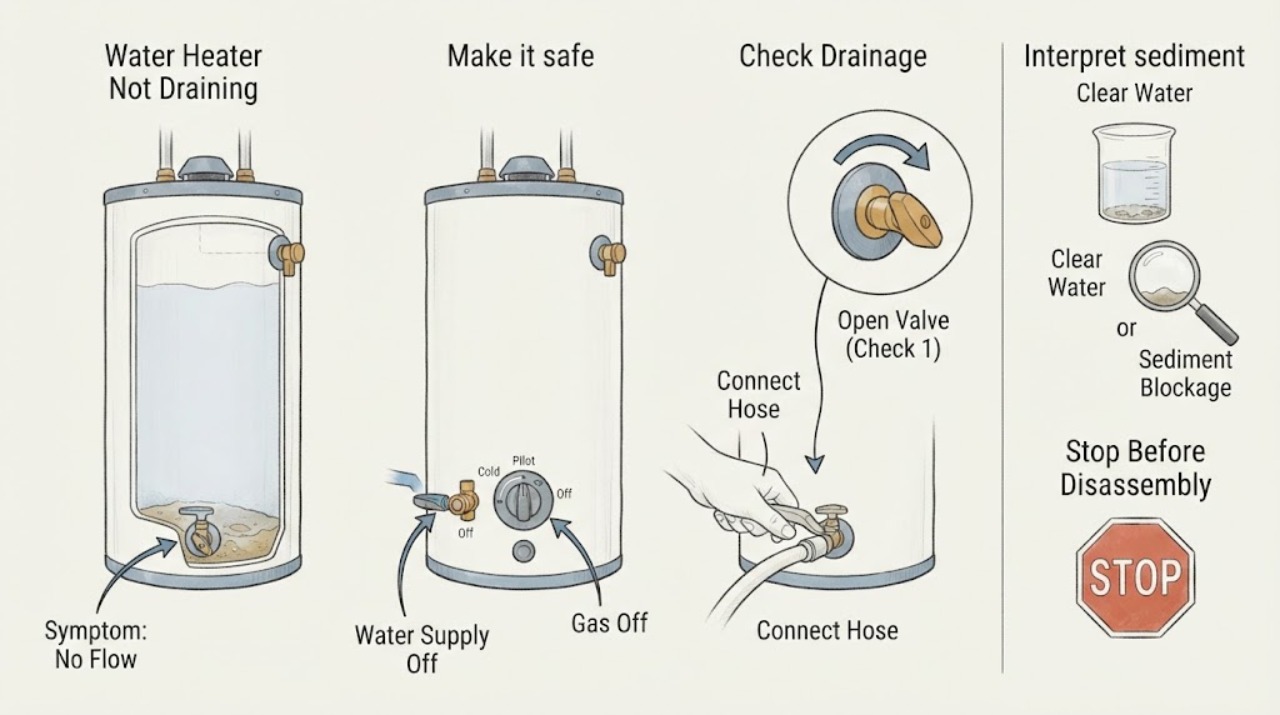
Work through in order
Diagnostic checks
Use only checks that match the exact appliance or system and its official guide.
-
Check 1
Make it safe
Expected result: Turn off the electric breaker or gas control as applicable and run hot water until cool.
Next step: Do not proceed if shutoff or power status is uncertain.
Why this matters
Why: Hot water and live power make draining unsafe.
-
Check 2
Set the drain path
Expected result: Close cold supply, connect the hose and open a nearby hot faucet.
Next step: Keep discharge secured and do not remove pressure-relief fittings.
Why this matters
Why: Steady flow means the path is open; a trickle or no flow suggests valve/sediment restriction.
-
Check 3
Interpret sediment
Expected result: Observe whether sediment appears or accumulates as flow slows.
Next step: Stop if blocked; never restore electric power to an empty tank.
Why this matters
Why: Sediment can clog a valve or form masses that stop the tank draining.
Use your observations
Decision map
Find the observation that best matches what you see, then follow the next safe action.
-
PATH 01Next step
What you see
Tank is cool, supply closed, hot faucet open, but hose has no flow.
Do this next
Have a qualified technician or plumber clear the path.
Why this path and its safety boundary
Why it matters: The drain valve or sediment is restricted.
-
PATH 02Next step
What you see
Water drains with sediment and slows as particles collect.
Do this next
Follow the exact manual flush steps and stop if the valve blocks again.
Why this path and its safety boundary
Why it matters: Sediment is the likely restriction.
-
PATH 03Next step
What you see
Someone wants to restore electric power while the tank is empty.
Do this next
Refill completely and purge air per the manual before restoring power.
Why this path and its safety boundary
Why it matters: An air-bound tank can damage the heating element.
Helpful context
Understand the symptom
Make it safe
Turn off the electric breaker or gas control as applicable and run hot water until cool.
Set the drain path
Close cold supply, connect the hose and open a nearby hot faucet.
Interpret sediment
Observe whether sediment appears or accumulates as flow slows.
Only after diagnosis
Potential parts
- water-heater drain valve
Only when qualified diagnosis finds valve damage or obstruction.
Confirm tank model and fuel type.
When checks do not resolve it
Need a professional?
Stop for hot discharge, leaking tank, stuck/damaged valve, gas odor, water near electrical parts, uncertain shutoff, or a blocked tank.
Common questions
FAQ
Why will a Whirlpool water heater not drain?
Whirlpool identifies sediment at the tank bottom as a cause of a clogged valve or no flow; call a qualified person if it remains blocked.
Can I power an empty electric heater?
No. Refill completely and remove air according to the owner guide first.
Read the exact guide
Official sources
- Draining and Flushing Your Water HeaterWhirlpool Water Heaters · Whirlpool safe water-heater draining
- Water Heater Use and Care GuideWhirlpool Water Heaters · Whirlpool gas heater drain
- Residential Electric Water Heater Use and Care GuideWhirlpool Water Heaters · Whirlpool electric heater sediment/refill
Community feedback
Share a repair observation
Share a plain-text repair observation. Accepted observations are published automatically; this page may take a moment to update.