
On this page
Start here
Quick answer
Do not begin by forcing the drain valve. Identify the exact GE model and whether it is a traditional electric/gas tank or GeoSpring hybrid, then read its installation and use instructions. Before draining, shut off the heater's energy source as the model requires, close the cold-water supply, attach a heat-rated garden hose to the bottom drain, route it to a suitable drain, and protect people and flooring from scalding water. GE says air must enter the tank through an open hot-water faucet or, with great caution, the temperature-and-pressure relief valve before opening the drain. If there is no flow, first look for a kinked hose, a blocked hose end, a closed cap/plug, a closed cold-water valve, or a drain destination that cannot accept flow; do not insert a tool into the valve, apply compressed air, remove the relief valve, or disconnect plumbing. Sediment can restrict the drain valve, but opening or replacing that valve can release hot water and damage fittings. If the valve remains blocked, the relief valve leaks or will not operate safely, the tank or connections leak, gas is suspected, or the model is a GeoSpring with condensate/drain components, stop and use qualified plumbing or GE model support. Never restore power to an electric heater until the tank is full and water runs steadily from a nearby open hot-water faucet.
Before you begin
Safety first
- Turn off energy as the exact model requires before draining and never restore electric power until the tank is full and water runs steadily from a nearby open hot-water faucet. Treat discharge as scalding, keep it away from people and electrics, do not plug the relief outlet, remove valves, force a blocked drain, disconnect hot/cold plumbing, open gas/electrical compartments, or work on a wet or leaking heater.
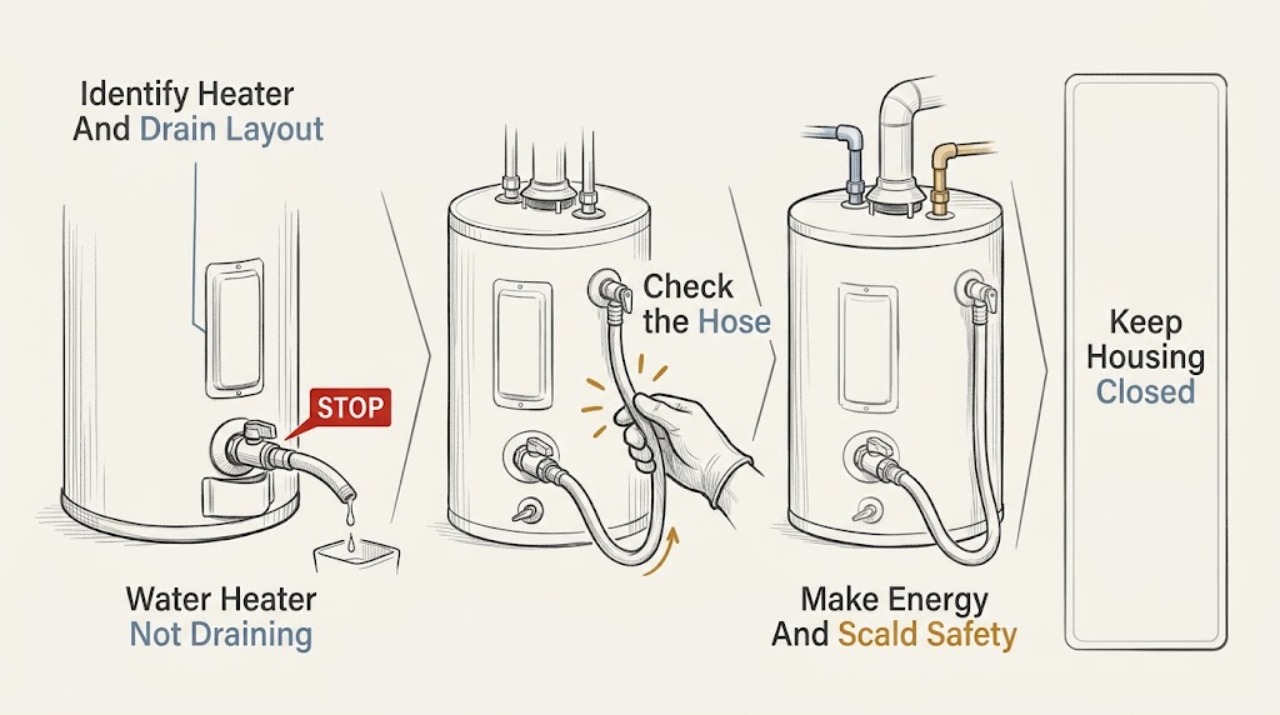
Work through in order
Diagnostic checks
Use only checks that match the exact appliance or system and its official guide.
-
Check 1
Read the rating label and model manual from a safe, dry position. Record whether the GE heater is a traditional electric tank, gas tank, or GeoSpring hybrid, where the bottom drain and cold-water shutoff are located, and whether a catch pan or condensate drain is present.
Expected result: The model and fuel type are confirmed; the drain is a brass or plastic bottom valve; the unit is a GeoSpring with additional condensate drainage; or the model cannot be identified.
Next step: Use only the matching manual's energy shutoff, drain, and refill instructions. Arrange service if identification requires removing insulation, covers, or plumbing.
Stop if: Stop for gas odor, smoke, sparks, exposed wiring, a hot/damaged connection, uncontrolled leaking, or a tank that is unstable or corroded.
Why this matters
Why: GE routes traditional and GeoSpring heaters through different support resources, and a condensate drain is not the same as a storage-tank drain. Drain-valve material and access change what a user can safely touch.
-
Check 2
Before opening any drain, turn off the heater's energy source using the exact manual and close the cold-water shutoff near the heater. Let the discharge route to a suitable drain or heat-safe pan where no person, pet, floor, or electrical equipment can be exposed.
Expected result: The energy is confirmed off; the cold-water valve is closed; the outlet cannot safely contain hot water; the valve or fittings are hot/damaged; or the fuel/energy type is uncertain.
Next step: Do not open the drain until the model-specific energy isolation and discharge path are safe. Use a licensed plumber or qualified service when fuel shutoff or hot-water containment is uncertain.
Stop if: Stop for gas odor, flame/combustion concern, smoke, sparks, exposed wiring, hot fittings, water near electrical parts, or a discharge path that cannot be controlled.
Why this matters
Why: An electric element can be damaged if powered without water, and GE warns the drain discharge may scald. An unsafe outlet or uncertain energy shutoff makes the drain attempt unsafe.
-
Check 3
With energy off and the water path isolated, attach a suitable garden hose to the bottom drain valve and route it downward to an open, suitable drain or a large heat-safe pan. Inspect only for a kinked hose, blocked hose end, closed valve, missing cap/plug, poor thread engagement, or a receiving drain that is already full.
Expected result: The hose is kinked or blocked; the receiving drain cannot accept water; the valve is visibly closed; water leaks at the connection; or the hose and destination are clear but no water flows.
Next step: Correct only a visible hose/destination issue and confirm the connection is secure. If no flow remains or water leaks at the valve/tank, stop and arrange plumbing service.
Stop if: Do not remove the valve, jam a tool into the opening, apply compressed air, loosen tank fittings, or continue with hot/uncontrolled water.
Why this matters
Why: A restriction outside the tank can imitate a blocked water heater. Leakage at the connection indicates a containment problem, while a clear hose and drain with no flow makes valve or sediment restriction more likely but does not justify forcing the valve.
-
Check 4
To relieve vacuum, open a nearby hot-water faucet and leave it open as the exact manual directs. Use the temperature-and-pressure relief valve as an air path only if the model instructions permit it and its discharge can be safely contained; do not remove the valve.
Expected result: Air enters and water begins flowing; only air sputters; the faucet is blocked or unavailable; the relief valve leaks or will not close; or no flow changes.
Next step: Keep the hot faucet open only as the manual requires and monitor the discharge. Stop if the relief valve behaves abnormally, the water is uncontrolled, or no flow follows a safe air path; use qualified service.
Stop if: Do not plug the relief outlet, remove the relief valve, operate it toward a person, or continue if hot water can scald or reach electrical equipment.
Why this matters
Why: GE identifies an open hot faucet or carefully operated relief valve as the way to admit air before draining. A relief-valve leak or failure is a separate safety issue, and unchanged no-flow after an air path points back toward the drain valve or sediment.
-
Check 5
If the heater is a GeoSpring hybrid or has more than one visible drain, match the symptom to the manual: storage-tank water should use the bottom tank drain, while condensate may use a separate drain path. Do not connect a hose to an unidentified port or treat condensate drainage as tank draining.
Expected result: The model manual identifies a tank drain; a separate condensate drain is present; water is coming from the catch pan or condensate path; or the drain port cannot be identified.
Next step: Follow the model-specific procedure or arrange GeoSpring/plumbing service. Keep energy off if tank level or electrical safety is uncertain.
Stop if: Do not disconnect condensate tubing, remove panels, tilt the heater, or operate with water near controls or electrical parts.
Why this matters
Why: GE provides separate product support for GeoSpring hybrids, whose condensate management is distinct from emptying the hot-water tank. An unidentified port or leak cannot be safely diagnosed by trial and error.
-
Check 6
If the drain remains blocked after a safe hose, destination, cold-water, and air-path check, stop rather than forcing the valve. If draining succeeds, close the drain, restore the cold-water supply, leave a nearby hot faucet open until water runs steadily, then restore electric power only after the tank is full and the exact manual permits it.
Expected result: The tank drains; only sediment-laden water trickles; the valve leaks or will not open; the faucet never produces steady water during refill; or the tank appears full but the heater is still not safe to energize.
Next step: For a blocked/leaking valve or uncertain refill, keep energy off and call a qualified plumber/service provider. For a successful refill, close the faucet only after steady flow and follow the exact restart sequence.
Stop if: Never energize an electric heater with an unfilled tank; do not restart around leaks, gas symptoms, unsafe relief-valve behavior, or water near electrics.
Why this matters
Why: A successful drain permits model-specific flushing, but a blocked or leaking valve may require replacement. GE says an electric heater must be full before power returns, using steady water at a nearby hot faucet as the fullness indication.
Use your observations
Decision map
Find the observation that best matches what you see, then follow the next safe action.
-
PATH 01Safety boundary
What you see
No water reaches the receiving drain, but the hose is kinked/blocked, the valve is visibly closed, or the receiving drain is full or obstructed.
Do this next
Correct only the visible hose, valve-position, or receiving-drain issue, maintaining safe containment, then reassess once. Escalate any leak or persistent no-flow.
Why this path and its safety boundary
Why it matters: The first restriction is external to the tank, so opening the appliance or forcing the valve would add risk without confirming a tank fault.
Safety stop: Do not use drain chemicals, compressed air, sharp tools, or valve removal to force flow.
-
PATH 02Safety boundary
What you see
The hose and outlet are clear, but flow begins only after a nearby hot faucet is opened or a safely contained, model-permitted relief-valve operation admits air.
Do this next
Continue only with the exact manual's drain sequence and scald controls. Arrange service if flow remains weak or the relief valve leaks or will not close.
Why this path and its safety boundary
Why it matters: The tank was not freely venting; GE explicitly includes an air-admission step before opening the drain. This does not prove the valve or sediment is healthy.
Safety stop: Do not remove, plug, or repeatedly operate the relief valve, and do not let hot water discharge toward people or electrical equipment.
-
PATH 03Safety boundary
What you see
Energy is off, cold water is isolated, the hose/outlet are clear, air can enter, but the bottom valve gives no flow or only a sediment-limited trickle.
Do this next
Keep energy off and arrange qualified plumbing/water-heater service for valve or sediment work. Ask the provider to use the exact model and drain-valve configuration.
Why this path and its safety boundary
Why it matters: A valve or sediment restriction is more likely, but it cannot be safely distinguished or cleared by poking into a hot tank or removing the drain valve.
Safety stop: Do not force a plastic valve, remove fittings, apply compressed air, or continue if the tank/connection begins leaking.
-
PATH 04Safety boundary
What you see
The model is GeoSpring or has an additional condensate port, and the observed water is from a condensate line, catch pan, or unidentified side drain rather than the bottom tank valve.
Do this next
Use the exact GeoSpring manual and local plumbing requirements, or arrange GeoSpring/plumbing service. Keep controls and wiring dry.
Why this path and its safety boundary
Why it matters: GE's GeoSpring support describes condensate removal separately from storage-tank draining. Trying a tank-drain procedure on a condensate port can create leaks or electrical exposure.
Safety stop: Do not disconnect tubing, remove panels, tilt the unit, or operate with condensate near electrical components.
-
PATH 05Safety boundary
What you see
The drain valve, tank, relief-valve discharge, catch pan, or water connections leak; the relief valve will not close; hot water is uncontrolled; gas is suspected; or an electric tank cannot be confirmed full before restart.
Do this next
Keep energy off when safe, do not plug the relief outlet, contain people and property away from hot water, and arrange qualified plumbing, gas, or GE service.
Why this path and its safety boundary
Why it matters: This is a containment, pressure/temperature, fuel, or dry-fire hazard rather than a routine blocked-drain check.
Safety stop: Do not energize the heater, remove the relief valve, loosen hot fittings, open gas compartments, or continue around water near electrical parts.
Helpful context
Understand the symptom
“Not draining” can be a valve, air, hose, or destination problem
A tank can fail to empty because the drain valve is closed or obstructed, the hose is kinked, the outlet is blocked, or a vacuum is not relieved. Sediment at the bottom can also limit flow. A slow drain is not permission to remove the valve while the tank is hot. First make the energy, cold-water, hose, air, and receiving-drain conditions safe and model-appropriate.
Stop when the restriction moves inside the appliance
No flow with a dry hose and no air path suggests a valve or sediment restriction, but external observation cannot distinguish a stuck valve from a tank-side obstruction. Water at the valve threads or tank base changes the priority to leak containment. Relief-valve discharge is a separate pressure/temperature issue; it must never be plugged. GeoSpring models may have condensate drains in addition to the storage-tank drain, so do not use a hybrid drain as a substitute for the tank procedure.
Drain cold and contain the discharge
Turn off energy as the exact model requires, keep people away from the hose outlet, use a suitable pan or drain, and treat all discharged water as potentially scalding until proven otherwise. Do not operate an electric heater without water, lift a relief-valve handle unless its discharge can be safely contained, plug the relief outlet, force a plastic valve, cut water lines, or open a gas or electrical compartment.
When checks do not resolve it
Need a professional?
Call qualified plumbing or GE water-heater service for a drain valve that remains blocked, any tank/connection/relief-valve leak, an unidentified GeoSpring drain path, gas or combustion concern, unsafe hot-water discharge, or uncertain refill before restart. Keep energy off for leaks, relief-valve problems, or water near electrical parts.
Safety scope: Turn off energy as the exact model requires before draining and never restore electric power until the tank is full and water runs steadily from a nearby open hot-water faucet. Treat discharge as scalding, keep it away from people and electrics, do not plug the relief outlet, remove valves, force a blocked drain, disconnect hot/cold plumbing, open gas/electrical compartments, or work on a wet or leaking heater.
Have this ready
- Exact model, heater type, drain-valve material and location, energy/cold-water shutoff state, hose and receiving-drain setup, air-path result, flow pattern, sediment, leak or relief-valve observations, catch-pan/condensate details, and whether the tank was refilled before any restart.
Common questions
FAQ
Why will my GE water heater not drain from the bottom valve?
After energy and cold-water shutoff, verify the hose and receiving drain are clear and open a nearby hot-water faucet to admit air. If there is still no flow or only sediment trickles out, the valve or sediment path may be blocked; do not poke into or remove the valve while hot. Arrange qualified water-heater service.
Should I open the relief valve to help drain a GE water heater?
GE lists a relief valve as one possible way to admit air, but the discharged water can be hot enough to scald and the outlet must not be plugged. Use the exact model instructions only when the discharge can be safely contained; do not remove the valve or continue if it leaks or will not close.
When can I turn a GE electric water heater back on after draining?
Close the drain, restore the cold-water supply, and leave a nearby hot faucet open until water runs steadily. GE says the tank must be full before electric power is returned; follow the exact model manual and do not energize a tank with uncertain water level or a leak.
Read the exact guide
Official sources
- Water Heater - Product Information, Warranty, Service and Technical SupportGE Appliances · GE traditional electric/gas and GeoSpring water heaters; exact support path depends on model and manufacture date
- Water Heater - Water Supply ConnectionsGE Appliances · GE water heaters; exact installation and local plumbing requirements vary by model and jurisdiction
- Water Heater - Draining and Flushing the Water Heater MaintenanceGE Appliances · GE storage water heaters; exact fuel type, valve, and model instructions still control
- Water Heaters - Catch Pan InstallationGE Appliances · GE water heaters installed where leaks could damage adjacent areas or lower floors; local codes apply
- GeoSpring Hybrid Electric Water Heater - Condensation RemovalGE Appliances · GE-branded GeoSpring hybrid heat-pump water heaters; condensate drainage is separate from storage-tank draining
- Water Heaters - Temperature and Pressure-Relief Valve MaintenanceGE Appliances · GE water heaters equipped with a temperature-and-pressure relief valve; exact access and service needs vary
Community feedback
Share a repair observation
Share a plain-text repair observation. Accepted observations are published automatically; this page may take a moment to update.