
On this page
Start here
Quick answer
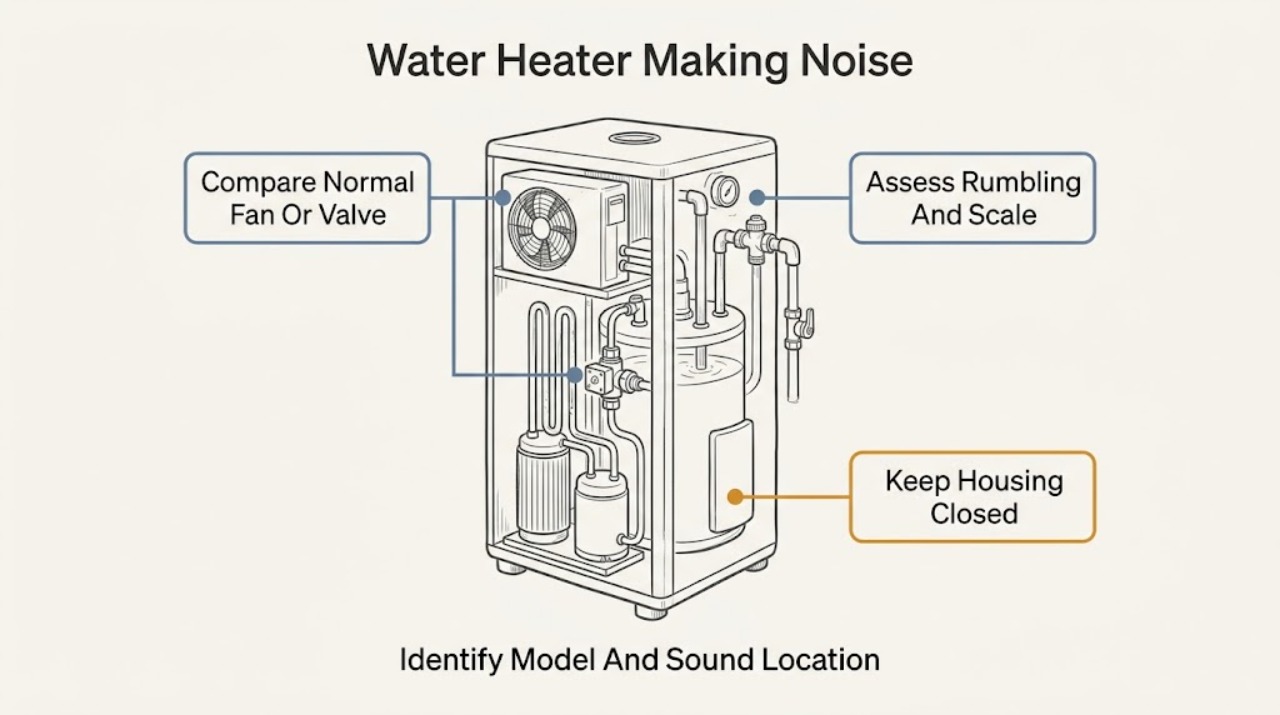
First identify the GE water-heater model and whether it is a standard electric, integrated Electronic Mixing Valve (EMV), or GeoSpring heat-pump unit; noise behavior is not interchangeable across those designs. A soft fan sound on a GeoSpring and intermittent soft EMV motor noise can be normal. A rumbling sound from an electric or EMV heater is associated by GE with scale or mineral deposits on the heating elements and requires a qualified service person or plumber to remove and clean them. Squeaking or chirping while hot water is being drawn can be plumbing-transmitted EMV noise; only model-documented setpoint or capacity changes are appropriate, and high-water-pressure concerns belong with a plumber. A popping sound on a GeoSpring can indicate heat and pressure building because a relief valve is closed or plugged. Beeping should be matched to the exact display code and manual. Stop using the heater for leaking water near electrical parts, steam or hot-water discharge, a relief-valve concern, gas or burning odor, smoke, sparks, a hot cord, or repeated breaker trips. Do not remove heating elements, open the tank, test wiring, or alter a relief valve yourself.
Before you begin
Safety first
- Do not remove heating elements, drain or open the tank, open electrical covers, test live wiring, alter the relief valve, cap a discharge, change house pressure, bypass protection, add chemicals, or work around hot water/steam without qualified instruction.
Work through in order
Diagnostic checks
Use only checks that match the exact appliance or system and its official guide.
-
Check 1
From a safe position, record the model, serial, fuel/architecture, sound location, duration, and trigger. Note whether the noise occurs while heating, while a hot-water tap is open, during a refill, with the heat-pump fan, or with a display alert. Do not remove covers or touch pipes that may be hot.
Expected result: The unit is standard electric, integrated EMV, GeoSpring heat pump, or another model; the sound is a rumble, squeak/chirp, fan/air noise, pop, hiss, or beep; and it occurs during heating, hot-water draw, or continuously.
Next step: Use the matching branch below and the exact Owner's Manual. Stop immediately if there is water, steam, gas/burning odor, smoke, sparks, or electrical heat.
Stop if: Do not open the electrical compartment, tank, relief-valve assembly, or heat-pump cabinet.
Why this matters
Why: Model and trigger determine whether GE documents the sound as normal operation, scale, plumbing/EMV interaction, pressure, filter loading, or an error. A generic “water heater noise” description is not enough to choose a part or repair.
-
Check 2
For a GeoSpring, listen from a safe distance for a steady fan/compressor sound and check whether the control mode is Standard Electric or a heat-pump mode. For an integrated EMV model, note whether a soft motor sound occurs only intermittently during valve movement. Do not place hands near the fan or hot-water lines.
Expected result: The sound matches a soft fan in a heat-pump mode; there is no sound in Standard Electric mode; or a soft intermittent EMV motor sound occurs without abnormal heat, leaks, or error codes.
Next step: Monitor a documented normal sound only. If the sound is abnormal, worsening, or accompanied by a fault or leak, leave diagnosis to an authorized servicer or plumber.
Stop if: Do not remove the fan guard, alter operating mode to suppress a hazard, or continue operation with a hot housing or leak.
Why this matters
Why: GE says some fan noise is normal on GeoSpring units, Standard Electric mode does not use the heat pump or fans, and intermittent soft EMV motor noise can be normal. A new knocking, grinding, or progressively harsh sound is not established as normal.
-
Check 3
If the sound is a low rumble, note whether it starts during heating and whether hot-water performance or the sound has changed over time. Do not remove heating elements, drain the tank, add descaler, or open the service cover.
Expected result: A rumble occurs during heating on an electric/EMV unit; it is on a GeoSpring; or it is accompanied by leaking, steam, a relief-valve discharge, unusual temperature, or an error.
Next step: Arrange a qualified service person or plumbing contractor to assess and clean elements if appropriate. For leak, steam, abnormal temperature, or relief-valve symptoms, stop use and isolate water/power only if safe.
Stop if: Do not attempt element removal, tank draining, or relief-valve repair yourself.
Why this matters
Why: GE associates rumbling with scale or mineral deposits on heating elements for electric/EMV heaters and also lists scale as a GeoSpring rumbling cause. Element removal and cleaning are professional tasks; hazard symptoms may indicate a separate pressure or safety issue.
-
Check 4
If the sound is a squeak or chirp, note whether it occurs only while drawing hot water and whether the heater has an integrated Electronic Mixing Valve. Record the user setpoint/capacity shown by the model controls; do not adjust house pressure or disassemble the valve.
Expected result: The chirp occurs only during hot-water draw on an EMV model; the sound is present with no water draw; water pressure seems abnormal; or the model is not an EMV unit.
Next step: Use only a setpoint or capacity adjustment explicitly documented for the exact EMV model. Ask a plumber to assess pressure if that is suspected; arrange service for persistent or non-trigger-specific noise.
Stop if: Do not install a pressure device, change a relief valve, or open the mixing-valve assembly without a qualified plumber.
Why this matters
Why: GE says hot-water-draw squeaking/chirping can be transmitted through plumbing from an EMV under certain conditions. A sound outside that trigger or on a non-EMV model needs a different model-specific diagnosis.
-
Check 5
If the sound is a pop, hiss, or bang, observe from a distance whether water or steam is discharging from the tank or relief-valve area, whether the noise follows heating, and whether there is a leak, scalding water, or a pressure-related display alert. Do not approach a hot discharge or touch the relief valve.
Expected result: A GeoSpring makes a pop with no visible discharge; water/steam comes from the relief-valve area; the relief valve may be closed or plugged; or the sound is a normal pipe/fan movement without hazard.
Next step: Stop using the heater for any discharge or suspected relief-valve problem and call a qualified plumber. Do not cap, plug, manually open, or replace the relief device as a DIY fix.
Stop if: Do not stand under discharge, touch hot water/steam, or restore operation after a pressure-safety event.
Why this matters
Why: GE's GeoSpring guidance associates popping with heat and pressure building when the relief valve is closed or plugged, which is a plumber-level safety concern. A sound without a hazard still needs model-specific assessment if new or loud.
-
Check 6
For a GeoSpring with a fan that has become louder over weeks or months, check the display and the exact Owner's Manual for the accessible air-filter location and cleaning procedure. For any beeping, record the complete displayed fault code before resetting or changing settings; do not open the cabinet.
Expected result: The filter alert or visible filter condition is addressed by the manual; the same noise returns; a fault code appears; or the unit has no code but noise remains abnormal.
Next step: Clean only an accessible filter as the model manual directs. If noise or a code persists, arrange service and provide the model, code, sound trigger, and safety observations.
Stop if: Do not bypass a filter alert, run with the filter removed, clear recurring codes repeatedly, or make electrical tests.
Why this matters
Why: GE says a dirty GeoSpring filter can make fans work harder and that beeping should be matched to the display code. Persistent noise, an unlisted code, or abnormal mechanical/electrical sound requires qualified service, not a part guess.
Use your observations
Decision map
Find the observation that best matches what you see, then follow the next safe action.
-
PATH 01Safety boundary
What you see
The sound is a soft GeoSpring fan in a heat-pump mode or intermittent soft EMV motor movement, with no leak, fault, abnormal heat, or harsh mechanical noise.
Do this next
Monitor it and use the exact model manual. Arrange service if the sound becomes knocking, grinding, progressively louder, or is joined by a code or performance change.
Why this path and its safety boundary
Why it matters: GE documents these sounds as normal for the corresponding architecture; no repair part is justified by the sound alone.
Safety stop: Do not remove guards or open the heater to make it quieter.
-
PATH 02Safety boundary
What you see
A low rumble occurs during heating on an electric, EMV, or GeoSpring model, without an immediate leak or pressure discharge.
Do this next
Schedule a qualified service person or plumber to assess element scale and the tank; do not remove elements or use an improvised descaling procedure.
Why this path and its safety boundary
Why it matters: Scale or mineral deposits on heating elements are more likely according to GE, but confirming the condition requires service.
Safety stop: Stop immediately if the rumble is accompanied by steam, hot-water discharge, leaking, smoke, or abnormal temperature.
-
PATH 03Safety boundary
What you see
Squeaking or chirping occurs only while hot water is being drawn and the heater has an integrated EMV.
Do this next
Use only a model-documented setpoint/capacity adjustment and ask a plumber to assess high water pressure if suspected. Call service if it persists.
Why this path and its safety boundary
Why it matters: GE says the sound may transmit through plumbing from the integrated mixing valve under certain usage conditions.
Safety stop: Do not alter the mixing valve, pressure system, or relief valve yourself.
-
PATH 04Safety boundary
What you see
A pop is accompanied by water/steam, a relief-valve concern, scalding discharge, or a GeoSpring indication of pressure-related trouble.
Do this next
Keep clear, isolate water/power only if safe, and call a qualified plumber or service technician. Call emergency services for an active hazardous release or fire.
Why this path and its safety boundary
Why it matters: This is a pressure and temperature safety concern, not a normal noise to investigate by touching the valve.
Safety stop: Do not cap, plug, open, replace, or bypass the relief device.
-
PATH 05Safety boundary
What you see
Noise is new, harsh, worsening, accompanied by a fault code, filter alert, leak, abnormal heat, electrical odor, smoke, sparks, or it remains after the model-safe checks.
Do this next
Leave internal diagnosis to an authorized servicer, plumber, or electrician as appropriate and provide the exact model, code, trigger, and recordings/observations.
Why this path and its safety boundary
Why it matters: A fan, compressor, heating element, mixing valve, control, plumbing, or pressure fault is possible, but the observed sound cannot select a part.
Safety stop: Stop using the heater for water/electrical/fire hazards and do not restore power to reproduce them.
Helpful context
Understand the symptom
Identify the heater and when the sound occurs
Record the full model and serial information, whether the unit is standard electric, integrated EMV, or GeoSpring heat pump, and where the sound is heard: tank, top fan/compressor area, pipes, or relief-valve outlet. Note whether it occurs while heating, whenever a hot-water tap opens, during refill, after a shower, or with an error code. A fan sound on a heat-pump model is different from a rumble through an electric tank, and GE's current support directs owners to the exact model manual rather than a universal noise diagnosis.
Classify the sound before touching anything
Use the sound pattern to choose a safe next step: soft fan or valve movement can be normal for the documented architecture; a rumble during heating points toward scale; a squeak or chirp only while drawing hot water points toward EMV/plumbing interaction; a sudden pop with discharge points toward pressure; and a beeping display needs an exact code. None of these observations identifies a replaceable part. Do not drain the tank, remove elements, adjust a relief valve, open an electrical cover, or change plumbing pressure without qualified help.
Stop for pressure, water, fire, or electrical hazards
Stop using the heater and keep clear for a leaking tank, water or steam discharging from the relief-valve area, a relief valve suspected closed or plugged, scalding water, smoke, burning or gas odor, sparks, a hot or damaged cord, repeated breaker trips, or water reaching electrical parts. Shut off water or power only if you can do so safely and according to the model installation instructions; do not touch wet controls. Call a qualified plumber or appliance/electrical technician, and call emergency services for fire or a gas emergency. Never cap, plug, or manually defeat a temperature-and-pressure relief device.
When checks do not resolve it
Need a professional?
Call a qualified plumber or service technician for rumbling, pressure-related popping, relief-valve discharge, EMV noise that persists, a new or worsening heat-pump fan sound, or any water-heater fault code. Stop immediately for leaks near electrical parts, steam/scalding discharge, gas or burning odor, smoke, sparks, a hot cord, or repeated breaker trips.
Safety scope: Do not remove heating elements, drain or open the tank, open electrical covers, test live wiring, alter the relief valve, cap a discharge, change house pressure, bypass protection, add chemicals, or work around hot water/steam without qualified instruction.
Have this ready
- Provide the exact model and serial information, water-heater architecture, sound type and location, trigger, duration, hot-water draw/heating relationship, display code, filter status if applicable, pressure/discharge observations, leak/odor/heat/smoke history, and any change after a model-permitted setting or filter check.
Common questions
FAQ
Is a GE GeoSpring water heater fan sound normal?
GE says some fan noise is normal when the GeoSpring compressor and fan are running. A fan that becomes louder over weeks or months may have a dirty filter, while a knocking or abnormal noise should be inspected by an authorized servicer.
Why does my GE water heater rumble when heating?
GE associates rumbling on electric and integrated EMV water heaters with scale or mineral deposits on heating elements; it also lists scale as a GeoSpring rumbling cause. Element removal and cleaning should be done by a qualified service person or plumber.
Why does my GE water heater squeak or chirp when I use hot water?
On integrated EMV models, GE says a squeak or chirp during hot-water draw can transmit through plumbing from the mixing valve. Use only model-documented setting changes and consult a plumber for suspected high water pressure.
What does popping from a GE GeoSpring water heater mean?
GE says popping can come from heat and pressure building in the tank when the relief valve is closed or plugged. Keep clear of any discharge and call a qualified plumber; do not cap or adjust the relief valve yourself.
What should I do if my GE water heater is beeping?
Record the display message or fault code and compare it with the exact model Owner's Manual. GE says model-specific codes determine the correction; a recurring or unlisted code needs service.
Read the exact guide
Official sources
- GE Profile GEOSPRING Hybrid Heat Pump Water Heater - Error, Fault or Function CodesGE Appliances · Applies to listed GE Profile GEOSPRING model eras; exact codes and actions require the model Owner's Manual.
- Water Heaters - Rumbling NoiseGE Appliances · Applies specifically to electric and integrated Electronic Mixing Valve water heaters; other GE architectures need their own manual.
- GE Profile GEOSPRING Hybrid Heat Pump Water Heater - Sounds You May HearGE Appliances · Applies to GE Profile GEOSPRING hybrid heat-pump models; do not generalize its modes or noise causes to standard heaters.
- GE Profile GEOSPRING Smart Hybrid Heat Pump Water Heater PF40S10FPYGE Appliances · Exact PF40S10FPY model identity; product specifications and modes must not be generalized to another water heater.
- Water Heater - Product Information, Warranty, Service and Technical SupportGE Appliances · GE support-routing article; contact route and product support vary by model era and region.
- Support for GE Water Heaters, Dispensers and SoftenersGE Appliances · GE water-heater support hub; exact troubleshooting and service path depends on model and region.
Community feedback
Share a repair observation
Share a plain-text repair observation. Accepted observations are published automatically; this page may take a moment to update.