
On this page
Start here
Quick answer
First identify the complete GE model and whether it is a traditional electric or gas heater or a GeoSpring hybrid. Then check the symptom: no hot water anywhere, insufficient hot water, a display or control problem, a gas-ignition symptom, or a visible leak. Confirm the documented temperature and mode settings, close any hot faucet that is running, and for an electric model check the accessible household breaker or fuse once if it is dry and safe. Do not remove covers, test heating or gas parts, or guess a reset; persistent failure, a repeat trip, gas odor, a leak, scorching, or an unfamiliar fault indication needs qualified service.
Before you begin
Safety first
- The user may identify the model and heater type, compare documented settings, close an open faucet, inspect dry accessible areas, and check one accessible breaker or fuse when safe. Qualified personnel must handle access panels, heating elements, thermostats, ECO/high-limit controls, burners, gas valves, live tests, wiring, tank draining, internal plumbing, and hybrid refrigeration or control systems.
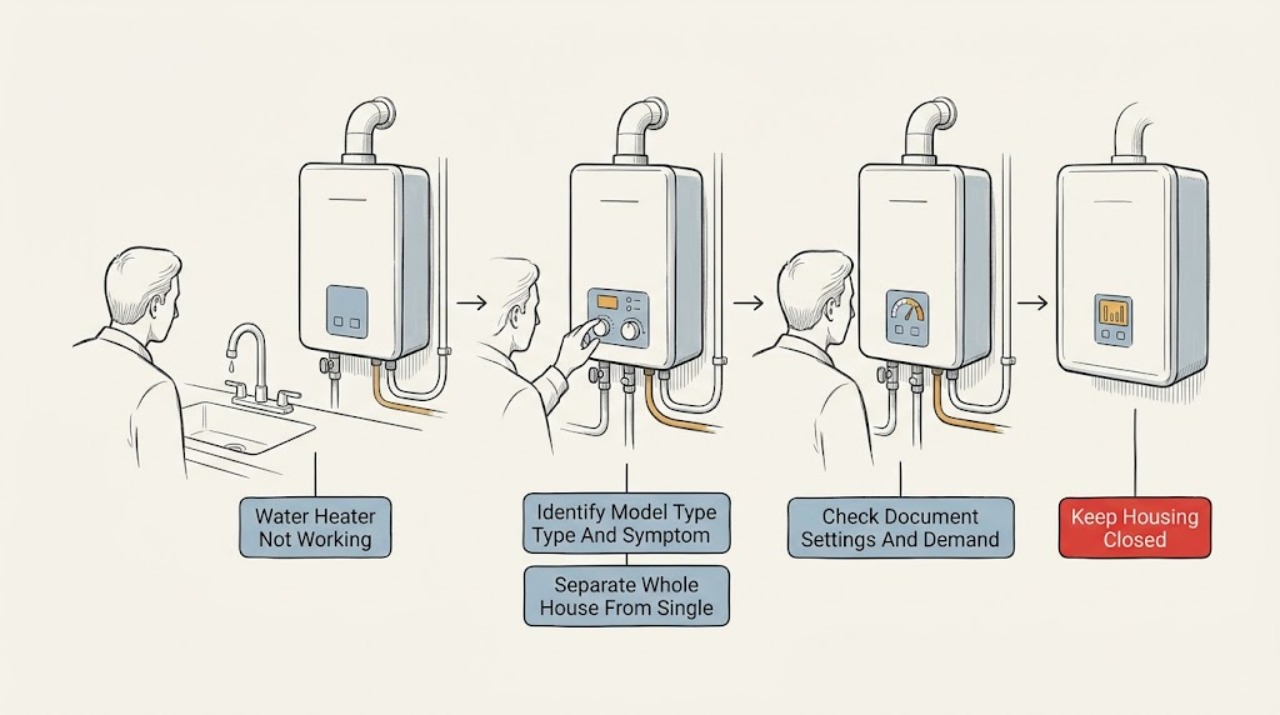
Work through in order
Diagnostic checks
Use only checks that match the exact appliance or system and its official guide.
-
Check 1
Read the complete GE model and serial information from the rating label, paperwork, or QR code without removing a cover. Note whether the heater is a traditional electric or gas unit or a GeoSpring hybrid, and record whether there is no hot water anywhere, less hot water than usual, a dark or unresponsive display, a gas-ignition symptom, or a visible leak.
Expected result: The model and heater type are known; the whole house has no hot water; only the supply is insufficient; the control is dark or shows a code; or the type is unknown.
Next step: Follow the matching branch below and retrieve the exact Owner's Manual before changing a mode, opening an access panel, or selecting a part.
Stop if: Stop for gas odor, smoke, scorching, sparks, exposed wiring, water near electrical controls, a damaged gas line, or a tank or connection that is actively leaking.
Why this matters
Why: GE directs owners to type- and age-specific support, and the symptom determines whether to check demand and settings, household power, gas instructions, or a model-specific fault. An unknown type does not justify borrowing a reset or pilot procedure from another heater.
-
Check 2
With the heater left closed and undisturbed, check more than one hot-water outlet. Confirm that hot faucets are fully closed when not being tested, and note whether another outlet produces normal hot water while one fixture remains lukewarm or cold.
Expected result: No hot outlet produces hot water; hot water returns after another faucet is closed; or another outlet is hot while only one fixture is affected.
Next step: Close the visible faucet or arrange plumbing service for a single-fixture problem. For whole-house loss, continue with the setting and supply checks without draining or opening the heater.
Stop if: Do not dismantle a faucet, adjust a tempering valve, or work on plumbing connections while the water may be hot or pressurized.
Why this matters
Why: An open or leaking hot-water faucet can consume available hot water. If one outlet works normally, the heater is less likely to be the only cause and the local faucet, mixing valve, or plumbing path becomes a more useful handoff; if every outlet is cold, continue with heater checks.
-
Check 3
Use the exact GE manual to verify the temperature setpoint, operating mode, and any integrated mixing-valve capacity setting. On an applicable model, GE says the capacity control can be set to High or X-High for more available hot water; do not copy that instruction to a model that does not have the feature. Also consider unusually cold inlet water, a recent high-demand period, exposed hot-water piping, or a recirculation system.
Expected result: The setpoint or mode was lower or different than intended; an integrated capacity setting was reduced; demand or cold inlet conditions explain the timing; or settings and use are normal but every outlet remains cold.
Next step: Restore only the documented setting and allow the heater to recover. If the correct setting does not restore hot water, proceed to the heater-type branch and arrange service rather than increasing the setting repeatedly.
Stop if: Do not exceed the model's documented setting, bypass temperature protection, open the control compartment, or touch hot water to test temperature.
Why this matters
Why: A correctable setting or temporary demand can explain insufficient hot water without proving a failed heater. Normal settings with a complete loss of hot water shift concern toward supply, ignition, high-limit, control, or another model-specific fault.
-
Check 4
For a GE electric or hybrid heater with no hot water or no display, inspect only the dry, accessible household supply path. Check the dedicated breaker or fuse and any visible service indication; if the installation instructions allow it and there is no damage, reset the breaker once. Do not remove the heater's access panels and do not test voltage at the heater.
Expected result: The breaker or fuse was open and remains stable; it trips again; the accessible supply appears normal but the heater remains unresponsive; or the unit is gas rather than electric or hybrid.
Next step: Use qualified electrical service for a dead, damaged, or repeatedly tripping circuit. Arrange GE or qualified water-heater service when supply is stable but the electric or hybrid heater remains dead or cold.
Stop if: Do not repeatedly reset protection, change a breaker or fuse rating, use an improvised connection, open a junction box, or continue after smoke, odor, heat, sparks, or water near electrical parts.
Why this matters
Why: GE lists a blown fuse, tripped breaker, or interrupted electric service as possible causes. A repeat trip or a stable supply with no operation points beyond a user reset and toward electrical or appliance service; this check does not apply to a gas heater's burner operation.
-
Check 5
If the unit is gas, use the exact model manual to identify its normal pilot or ignition indication and record what you see without removing the burner cover or opening a gas valve. If it is a GeoSpring hybrid, photograph any displayed code or mode and use the model-specific support article; do not apply a traditional gas or electric reset sequence to it.
Expected result: The gas manual documents a pilot or ignition step; gas odor or an abnormal flame is present; the hybrid shows a documented or unfamiliar code; or neither model path explains the no-hot-water condition.
Next step: For a normal documented user step, follow the exact manual once. For gas odor, abnormal flame, a recurring failure, or any hybrid code, leave the heater off and arrange qualified service; provide a code photo and model information.
Stop if: Do not relight against the manual, keep trying after ignition failure, remove a burner assembly, test gas pressure, open a gas train, or bypass a flame, temperature, or high-limit control.
Why this matters
Why: GE's support materials treat pilot-light troubleshooting and hybrid fault codes as product-specific. Gas odor or abnormal combustion is an immediate safety issue, while an unfamiliar hybrid code cannot identify a part without the exact model.
-
Check 6
From a dry, safe position, look at the visible hot and cold connections and the area around the tank for active water, a loose-looking external connection, or signs that the hot and cold lines may have been reversed after installation. Do not loosen a fitting, drain the tank, or reach behind the heater.
Expected result: There is active water, a connection appears reversed, the heater was recently installed or moved, or the visible connections are dry and correctly identified.
Next step: Close the nearby water supply only if it is clearly accessible and safe, keep the heater off, and arrange qualified plumbing or appliance service for leakage, installation, or internal-tube concerns. If dry and correctly connected, continue to service escalation when the symptom persists.
Stop if: Do not open the tank, remove a drain valve, tighten a hot fitting, work around a burner, or continue with water near electrical controls.
Why this matters
Why: GE lists reversed water connections as a possible no-hot-water cause and sends a damaged dip tube to a local installer, plumbing contractor, or service agency. Active leakage or a hidden internal fault is not a user adjustment.
-
Check 7
Stop owner troubleshooting when the model-specific setting is correct, the demand and visible connections are normal, and the heater still produces no or insufficient hot water. Give the technician the complete model and serial information, heater type and age, display or pilot observations, supply result, settings, timing, leak status, and any single reset attempted.
Expected result: A documented setting or accessible supply correction restores hot water once, or the heater remains cold, unresponsive, leaking, repeatedly tripping, code-displaying, or abnormal after the safe checks.
Next step: Keep the heater off when a hazard or persistent fault is present and arrange qualified GE, water-heater, plumbing, or electrical service according to the observed branch.
Stop if: Do not remove panels, make live measurements, test gas pressure, bypass a safety control, drain a hot tank, or order an internal part from the symptom alone.
Why this matters
Why: Persistent failure can involve heating elements, thermostats, an ECO or other safety control, burner or ignition components, hybrid controls, sensors, wiring, or plumbing. The symptom alone cannot identify a safe compatible part or an owner repair.
Use your observations
Decision map
Find the observation that best matches what you see, then follow the next safe action.
-
PATH 01Safety boundary
What you see
Another hot-water outlet is normal while one faucet or shower remains cold or lukewarm.
Do this next
Use plumbing service for the affected fixture or branch; do not dismantle the fixture while the water may be hot or pressurized.
Why this path and its safety boundary
Why it matters: The heater is supplying hot water, so a local fixture, mixing valve, or branch-plumbing issue is more likely than a complete heater failure.
Safety stop: Stop for a scalding condition, leak, or water near electrical equipment.
-
PATH 02Safety boundary
What you see
Hot water is available but runs out sooner than usual, and the model setting, demand, open faucet, cold inlet conditions, or integrated mixing-valve capacity differs from normal.
Do this next
Correct only the documented setting or visible open faucet, allow recovery, and arrange service if capacity remains abnormal under normal use.
Why this path and its safety boundary
Why it matters: A demand, setting, or distribution explanation is more likely than a completely dead heater.
Safety stop: Do not raise temperature beyond the manual or bypass a mixing or temperature control.
-
PATH 03Safety boundary
What you see
An electric or hybrid heater has no hot water and its display or controls are dark, or an accessible breaker or fuse is open or trips again.
Do this next
Reset an accessible protective device only once when dry and safe; use qualified electrical service for the circuit and water-heater service for a stable circuit with a dead unit.
Why this path and its safety boundary
Why it matters: Household supply or the appliance power/control path is more likely than a gas pilot issue. A repeat trip is not a reason to keep resetting.
Safety stop: Do not alter protection, open panels, or continue with heat, odor, sparks, or water near electrical parts.
-
PATH 04Safety boundary
What you see
A gas heater has a pilot or ignition symptom, or a GeoSpring hybrid displays a documented or unfamiliar fault indication.
Do this next
Record the model, display, and visible status, follow only the matching manual's normal user step, and arrange qualified service for gas odor, abnormal flame, recurring ignition failure, or any unresolved hybrid code.
Why this path and its safety boundary
Why it matters: The correct next step depends on the exact model and product age; a generic electric reset or another model's ignition instruction could be unsafe.
Safety stop: Do not open the burner compartment, test gas pressure, defeat flame or temperature protection, or keep trying after an ignition failure.
-
PATH 05Safety boundary
What you see
The tank or connections leak, hot and cold connections may be reversed, the correct settings and supply are present, and the heater remains cold or abnormal.
Do this next
Keep the heater off, isolate water or power only through an accessible safe control when necessary, and arrange qualified water-heater, plumbing, GE, or electrical service.
Why this path and its safety boundary
Why it matters: A plumbing, installation, heating, high-limit, burner, control, or other internal fault is more likely, and the public GE guidance does not make tank access or live testing an owner task.
Safety stop: Do not drain a hot tank, remove covers, tighten hot fittings, bypass safety controls, or order a part by symptom.
Helpful context
Understand the symptom
Identify the heater before choosing a check
GE's support path differs for traditional electric or gas water heaters and for GeoSpring hybrid heat-pump models, and it also changes with the product's age. A model number from the rating label or QR code is therefore more useful than a generic reset. The same symptom can mean a supply problem on an electric heater, a pilot or ignition issue on a gas heater, or a displayed fault or operating-mode issue on a hybrid.
A water heater can be working while hot water is simply limited
GE lists a low temperature setting, colder seasonal inlet water, open or leaking hot-water faucets, an integrated mixing-valve capacity setting, recirculation interference, and long exposed pipe runs among causes of limited hot water. Correct only a documented user setting or an obvious open faucet; do not raise a setpoint by guesswork or treat one lukewarm fixture as proof that the tank has failed.
The tank, burner, elements, and safety controls stay behind the service boundary
The public GE guidance points owners to the matching manual and qualified support for model-specific operation, pilot-light issues, leaks, noises, fault codes, and safety controls. Keep the heater off and arrange service for gas odor, water around the tank or controls, scorching, exposed wiring, a repeated breaker trip, or a manual-reset high-limit condition. Do not remove access panels, test terminals, open a gas train, or bypass a safety control.
Safety boundary
Stop conditions
- Gas odor, abnormal flame, or repeated ignition failure
- Smoke, scorching, sparks, exposed wiring, or a hot or damaged electrical connection
- Water near electrical controls or an active leak from the tank or connections
- A breaker or fuse trips again after one safe accessible check
- Any need to remove a panel, test live terminals or gas pressure, drain a hot tank, or bypass a safety control
When checks do not resolve it
Need a professional?
Arrange qualified GE or water-heater service when the exact model setting and accessible supply are normal but hot water does not recover, when a hybrid code or gas-ignition problem persists, or when a heating element, thermostat, ECO/high-limit, burner, control, sensor, wiring, or internal plumbing diagnosis is needed. Use qualified electrical service for a damaged or repeatedly tripping circuit and plumbing service for a fixture-only problem, reversed connections, or a leak. Stop immediately for gas odor, abnormal flame, smoke, scorching, sparks, exposed wiring, water near electrical controls, an active tank leak, or a hot or damaged power connection.
Safety scope: The user may identify the model and heater type, compare documented settings, close an open faucet, inspect dry accessible areas, and check one accessible breaker or fuse when safe. Qualified personnel must handle access panels, heating elements, thermostats, ECO/high-limit controls, burners, gas valves, live tests, wiring, tank draining, internal plumbing, and hybrid refrigeration or control systems.
Common questions
FAQ
Why is my GE water heater not working at all?
First identify whether it is a traditional electric, gas, or GeoSpring hybrid model and whether every hot outlet is affected. For an electric or hybrid unit, check the accessible breaker or fuse once when dry and safe; for gas or hybrid controls, use only the exact model support path. A persistent no-hot-water condition or any hazard needs qualified service.
Why does my GE water heater run out of hot water quickly?
GE lists a low temperature setting, colder inlet water, an open or leaking hot faucet, high demand, exposed piping, recirculation interference, and an integrated mixing-valve capacity setting among possible causes. Check only the settings and features your exact model documents, then arrange service if capacity stays abnormal under normal use.
Should I reset the breaker on a GE electric water heater?
If the breaker is accessible, the area is dry, and there is no damage, one reset can distinguish an interrupted household supply from a persistent heater fault. If it trips again, do not keep resetting it or change its rating; use qualified electrical and water-heater service.
Can I relight or repair my GE gas water heater myself?
Use the exact model manual only for a normal documented user step. Do not open the burner compartment, test gas pressure, work on a gas valve, or continue after ignition failure. Leave the heater off and arrange qualified service for gas odor, abnormal flame, or a recurring pilot or ignition problem.
What should I do if my GE water heater is leaking?
Keep people away from hot water and electrical controls, and stop using the heater. If a nearby shutoff is clearly accessible and safe, isolate water or power as appropriate, then arrange qualified plumbing or water-heater service. Do not loosen hot fittings, drain the tank, or remove covers to find the leak.
Read the exact guide
Official sources
- Troubleshooting for PE40M09AAHGE Appliances · The PE40M09AAH electric water-heater model only; used here to establish why the exact model must be matched, not as a universal procedure.
- Water Heater - Product Information, Warranty, Service and Technical SupportGE Appliances · GE-branded water heaters; support path varies by product type and manufacture date.
- Support for GE Water Heaters, Dispensers and SoftenersGE Appliances · GE water heaters and related products; QR and model-specific support availability varies by product.
- Water Heaters - Not Enough Water or No Hot WaterGE Appliances · GE water heaters; exact controls and installation details vary by model and fuel type.
Community feedback
Share a repair observation
Share a plain-text repair observation. Accepted observations are published automatically; this page may take a moment to update.