
On this page
Start here
Quick answer
Treat an active GE water-heater leak as a water, scald, gas, and electrical hazard before looking for a part. From a safe, dry position, note the complete model, whether it is gas, standard electric, heat-pump/GEOSPRING, tankless, or point-of-use, and where the first drop appears: hot/cold connection, temperature-and-pressure relief discharge, drain valve, top or side fitting, bottom seam, condensate path, or an external house pipe. If water is near electrical parts, the unit or area is wet, the cord or wiring is damaged, the leak is large or worsening, or you smell/hear gas, keep away and use qualified emergency, gas, plumbing, or electrical help; CPSC says to leave immediately for a suspected gas leak and not operate electronics before leaving. If it is safe to reach the external cold-water shutoff, close it, and turn off electric power at the breaker only from a dry, safe position; do not open covers or touch wet equipment. GE says water dripping down the outside is often a loose hot/cold connection and requires a qualified service person or plumber. Water from the relief valve is not a cap-or-plug repair: GE links recurring discharge to thermal expansion in a closed system and says not to plug the outlet. Condensation during first filling or a heavy draw can disappear after the water heats, but persistent dripping, a tank-bottom leak, relief discharge, or any leak that returns needs service. Do not drain a hot tank, adjust gas controls, remove electrical covers, or replace a relief valve yourself.
Before you begin
Safety first
- The owner may identify the model and visible source from a safe dry position, keep people away from hot water, close an accessible external cold-water shutoff if safe, and turn off an electric breaker only from a dry safe position. Qualified plumbing/water-heater service must handle connections, relief valves, drain valves, tank or enclosure access, heating elements, gas controls/burners, electrical panels, leak sensors, mixing valves, condensate systems, and sealed heat-pump/refrigerant work.
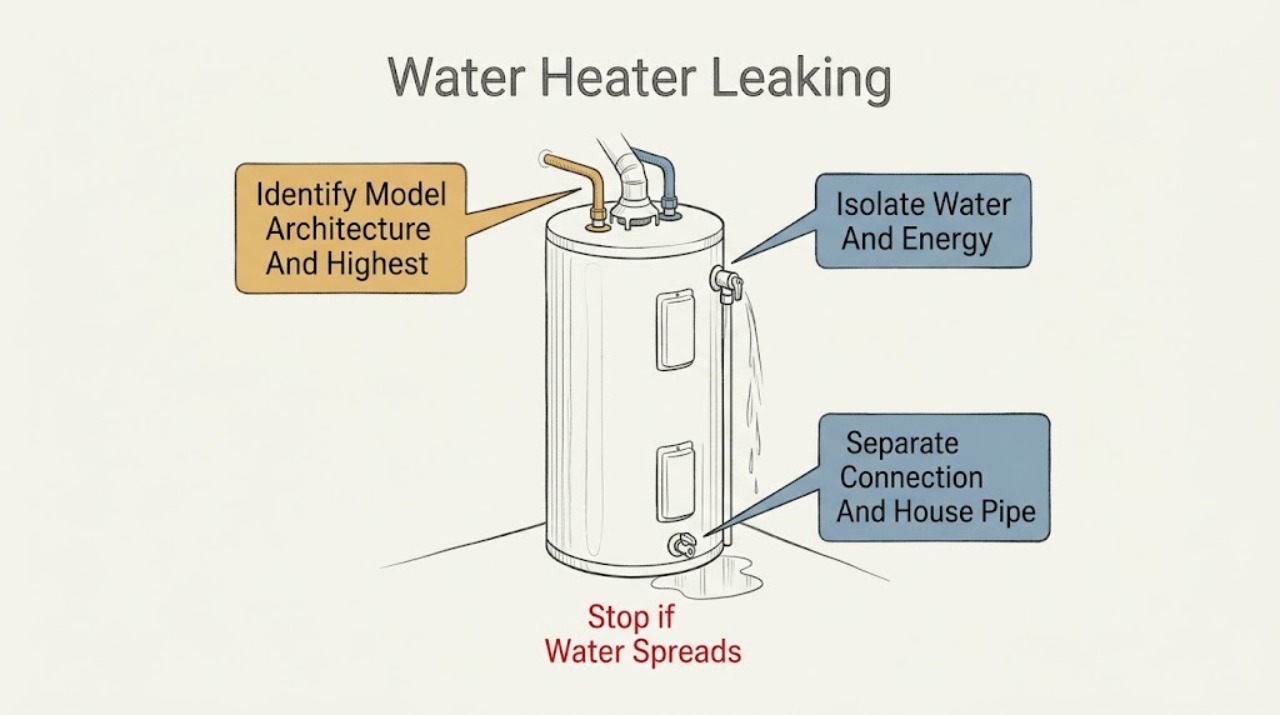
Work through in order
Diagnostic checks
Use only checks that match the exact appliance or system and its official guide.
-
Check 1
From outside the installation, record the complete GE model number, fuel/power type, and whether the unit is a tank-style gas or electric heater, GEOSPRING heat pump, tankless, or point-of-use model. Without touching hot or wet parts, identify the highest visible wet point and whether water appears only during heating, continuously, from a tube, from a fitting, or from the tank/enclosure itself.
Expected result: The first wet point is a hot/cold connection, relief-valve discharge, drain valve, condensate path, external house pipe, top/side fitting, bottom seam, or not safely visible; the leak is a drip, stream, or rapidly growing flow.
Next step: Use the symptom branch below and keep the model manual available. If the source is hidden, the flow is increasing, or the unit/area is wet near energy connections, stop observing and arrange service.
Stop if: Do not pull the unit, remove covers, touch hot discharge, or continue if there is gas odor, a wet electrical connection, smoke, damaged wiring, or a risk of scalding.
Why this matters
Why: The water source separates a connection or plumbing issue from pressure-relief discharge, normal-but-limited condensation, and a possible tank or internal-component failure. Model identity determines whether electric, gas, heat-pump, leak-sensor, and drain advice applies.
-
Check 2
If water is actively flowing and the external cold-water shutoff is reachable without stepping into water or touching the heater, close that shutoff. If the installation is electric and the breaker can be turned off from a dry, safe position, switch it off; do not touch wet plugs, panels, or wiring. For gas odor or a suspected gas leak, leave immediately and contact local gas authorities from outside without operating lights, phones, or other electronics inside.
Expected result: The flow stops or slows, the heater remains energized or cannot be safely isolated, gas odor/hearing of gas is present, or water has reached electrical equipment.
Next step: Keep people away, arrange the appropriate qualified plumbing, water-heater, gas, or electrical response, and document the model and isolation result from a safe location. Do not restore energy or water merely to repeat the leak.
Stop if: Do not touch wet equipment, operate electronics during a suspected gas leak, manipulate a gas control, or repeatedly reset a breaker that trips.
Why this matters
Why: External isolation can limit water damage, but it does not diagnose the leak. Gas odor and wet electrical equipment are emergency safety conditions, not owner troubleshooting states.
-
Check 3
With the water and energy risk controlled as far as safely possible, inspect only the visible hot-water outlet, cold-water inlet, nearby shutoff, and household supply pipe for a wet thread, split line, or drop forming at a connection. Do not loosen, tighten, or remove a fitting; use a dry towel only away from hot surfaces to identify where moisture reappears if that can be done safely.
Expected result: Water starts at a hot/cold connection, at a household pipe before it reaches the heater, from a flexible connector or shutoff, or from a point that cannot be reached safely.
Next step: Keep the water shut off and have a qualified service person or plumber correct the connection or household pipe. Give them the first wet point, whether water was hot, the model, and the isolation result.
Stop if: Do not use a wrench, cut a line, move the tank, or continue if the pipe is hot, the area is wet near electricity, or the leak is under pressure.
Why this matters
Why: GE says exterior dripping is most likely loose hot/cold connections, while a leak in the house supply line may need plumbing work. A connection source does not justify an owner tightening a hot, pressurized, or model-specific fitting.
-
Check 4
If water is coming from the temperature-and-pressure relief discharge line or the valve is popping, observe from a safe distance whether discharge is periodic during heating or continuous. Do not lift the lever, cap the outlet, insert anything into the line, or touch the water; GE warns that released water may be hot enough to scald.
Expected result: The relief line discharges during heating, drains continuously, the outlet is plugged/restricted, the discharge line is missing or unsafe, or the source is not actually the relief path.
Next step: Keep people away, leave the outlet open, and contact a plumbing contractor or qualified water-heater technician. Provide the model, fuel type, discharge timing, and whether the cold-water shutoff changed the flow.
Stop if: Never plug, cap, restrict, reroute, or replace the relief valve or discharge line yourself; do not expose anyone to the hot water.
Why this matters
Why: GE links periodic relief-valve discharge to thermal expansion in a closed system and calls the condition unacceptable. A continuous discharge or altered discharge path can indicate a relief-valve or pressure problem; it is not a normal leak to suppress.
-
Check 5
If the heater was just filled, recently installed, or has had a heavy hot-water draw, check only from a safe, dry position whether moisture is a thin film on the tank/fittings, a defined drip from the drain valve, water from a condensate route on a heat-pump model, or water emerging from the tank base/seam. Do not drain the tank or open an access panel to investigate.
Expected result: Moisture disappears after the water heats, a fitting remains wet, the drain valve drips, the condensate route overflows, or water continues from the tank body/base.
Next step: Keep energy off if the model or installation instructions require it for a leak condition, keep the cold-water supply isolated when safe, and arrange qualified service for persistent moisture, a drain-valve leak, condensate problem, or tank-body leak. Do not resume operation merely because the puddle is small.
Stop if: Do not drain a hot tank, operate an electric heater without a full tank, open the tank, touch hot condensate/discharge, or handle refrigerant or internal components.
Why this matters
Why: GE says condensation during initial filling or a heavy draw can be temporary and should disappear after heating. Persistent fitting/drain moisture or water from the tank/enclosure is not established as normal and may require plumbing or water-heater service.
-
Check 6
If the source is inside the enclosure, from the tank seam/base, from an internal water line or valve, or from a GEOSPRING leak-detection area, stop owner diagnosis. Record the exact model, fuel/power, leak rate, whether a leak sensor or automatic shutoff alert appeared, and any odor, noise, breaker, or gas symptom without restoring power or water to reproduce it.
Expected result: The leak persists after external isolation, the tank/enclosure is wet from within, a GEOSPRING sensor shut off water, the unit is gas-fired, or internal access is required.
Next step: Keep the unit out of service and arrange qualified GE/water-heater service or a licensed plumber. Use a gas professional for gas components and an electrician for unsafe electrical supply; provide the model and all observations.
Stop if: Do not remove panels, adjust gas controls, disconnect sensors, bypass an automatic shutoff, drain the tank, live-test wiring, or handle refrigerant.
Why this matters
Why: A tank, mixing valve, drain valve, leak-detection shutoff, pump/condensate path, heating component, gas assembly, or sealed heat-pump system may be involved. The visible water cannot identify a compatible replacement part.
Use your observations
Decision map
Find the observation that best matches what you see, then follow the next safe action.
-
PATH 01Safety boundary
What you see
The highest wet point is a visible hot/cold connection, shutoff, connector, or household supply pipe rather than the tank body or relief discharge.
Do this next
Keep the water supply isolated if safe and have a qualified person correct the connection or pipe. Do not tighten a hot, pressurized, or model-specific fitting yourself.
Why this path and its safety boundary
Why it matters: A loose connection or plumbing-line problem is more likely. GE specifically says outside dripping is most likely loose hot/cold connections and requires qualified service or a plumber.
Safety stop: Stop for a rapidly growing leak, scalding water, wet electrical parts, or an inaccessible source.
-
PATH 02Safety boundary
What you see
Water exits the temperature-and-pressure relief discharge line, or the valve pops or drains during heating.
Do this next
Keep the discharge path open and people away from hot water, then contact a plumbing contractor or qualified technician to correct pressure/relief conditions.
Why this path and its safety boundary
Why it matters: GE says thermal expansion in a closed system can cause relief-valve operation and calls recurring discharge unacceptable. The valve is a safety device, not a leak to plug.
Safety stop: Do not cap, plug, restrict, lift, or replace the relief valve or line as a DIY fix.
-
PATH 03Safety boundary
What you see
A thin film or light moisture appears on a newly filled heater or after a heavy draw with very cold inlet water, then disappears once the water heats.
Do this next
Monitor only from a safe position and check fittings without touching hot surfaces. Arrange service if moisture persists, returns unexpectedly, or the source changes to a defined fitting, drain, valve, or tank seam.
Why this path and its safety boundary
Why it matters: GE describes this limited pattern as possible condensation rather than a confirmed leak. It should not be used to explain persistent dripping or water emerging from the base.
Safety stop: Do not drain a hot tank, operate an electric heater without water, or ignore increasing flow because the first moisture looked like condensation.
-
PATH 04Safety boundary
What you see
Water forms at the bottom seam, from the drain valve, from inside the enclosure, or from a heat-pump condensate route and does not stop after the documented temporary-condensation condition.
Do this next
Isolate water and energy from a safe position, protect the area without touching hot water or electrical parts, and arrange qualified service. Give the technician the model and the first wet point.
Why this path and its safety boundary
Why it matters: A drain valve, tank, internal water connection, condensate path, or heat-pump component is more likely. Water at the tank body/base is not safely diagnosed by tightening an external connection.
Safety stop: Do not open the enclosure, drain the tank, touch condensate/electrical components, or restart the heater to see whether it leaks again.
-
PATH 05Safety boundary
What you see
Gas odor or hissing is present, water has reached electrical equipment, the cord/wiring is hot or damaged, smoke/sparking occurs, or the breaker trips repeatedly.
Do this next
Leave the area as appropriate, contact local gas authorities or emergency services from outside for gas symptoms, and use qualified electrical/water-heater service for wet or damaged electrical equipment. Do not restore energy or water until cleared.
Why this path and its safety boundary
Why it matters: This is an immediate safety condition, not a leak-location exercise. CPSC directs occupants to leave for a suspected gas leak and not operate electronics before leaving; wet electrical equipment can create shock and fire risk.
Safety stop: Do not touch wet equipment, operate switches or phones inside during a suspected gas leak, adjust gas controls, or reset a tripping circuit.
Helpful context
Understand the symptom
The first drop matters more than the puddle
Trace the leak only from a safe, dry position and identify the highest wet point, not merely where water collected on the floor. GE distinguishes loose hot/cold connections, relief-valve discharge, condensation during filling, and plumbing or tank problems. Water from a fitting or discharge tube has a different next step from water emerging at the tank body or from beneath the unit.
Do not assume every GE water heater is electric-tank style
GE's support site separates heat-pump, tank-style, point-of-use, and tankless water heaters, and its gas product guide describes atmospheric and power-vent gas models. GEOSPRING heat-pump models may also have wireless leak detection and automatic shutoff on applicable models. Use the exact model and installation instructions before interpreting a sensor, valve, drain, or control.
A relief valve is a safety device, not a normal drain
GE says a water heater must retain its temperature-and-pressure relief valve and that the discharge path must remain open and drain safely. Recurring discharge can indicate pressure from thermal expansion. Never cap, plug, restrict, or replace that safety path based on a leak symptom alone, and avoid the hot discharge water.
Internal, gas, and electrical work stops here
Owner checks are limited to identifying the model and water source, keeping people away from hot discharge, and using an accessible external shutoff only when it is safe. Do not remove access panels, adjust a gas valve or burner, touch wet electrical parts, drain a hot tank, or live-test a heater. A plumber or qualified water-heater service technician must handle connections, relief valves, tank openings, controls, heating elements, gas components, and sealed heat-pump systems.
Only after diagnosis
Potential parts
- model-matched hot/cold connection seal or connector
Consider only when a qualified plumber or water-heater technician confirms that an external connection or connector is the leak source.
Water-heater fuel type, pipe material, thread, temperature, and local plumbing code affect the correct fitting; a puddle alone does not establish a part. - model-matched temperature-and-pressure relief valve
Consider only after qualified service evaluates relief discharge, thermal expansion, pressure, valve condition, and the exact installation requirements.
GE requires a compliant relief valve and unobstructed discharge path; never cap, restrict, or substitute one by appearance. - model-matched drain valve
Consider only when service confirms the drain valve is the source and the tank can be safely isolated, cooled, drained, and refilled under the model instructions.
Drain-valve material, thread, access, and tank procedure vary; hot-water draining can scald and an electric heater must not be energized empty. - model-matched leak-detection shutoff or internal water component
Consider only for an applicable GEOSPRING or other documented model after qualified diagnosis confirms the sensor, shutoff, mixing valve, tank, condensate, or internal water path.
Wireless leak detection and automatic shutoff are model-dependent; do not bypass a sensor or select a component from an alert alone.
When checks do not resolve it
Need a professional?
Keep the GE water heater out of service and arrange qualified plumbing or water-heater service for any leak that persists, returns, comes from the tank/base, drain valve, internal enclosure, condensate path, or relief discharge; for a loose connection that needs tightening; or whenever internal access is required. Use gas professionals or emergency gas authorities for gas odor/hissing and qualified electrical service for water near wiring, a wet unit, a hot/damaged cord, smoke, sparks, or repeated breaker trips. Do not plug a relief outlet, adjust gas controls, drain a hot tank, energize an empty electric tank, open covers, bypass a leak sensor, or handle refrigerant.
Safety scope: The owner may identify the model and visible source from a safe dry position, keep people away from hot water, close an accessible external cold-water shutoff if safe, and turn off an electric breaker only from a dry safe position. Qualified plumbing/water-heater service must handle connections, relief valves, drain valves, tank or enclosure access, heating elements, gas controls/burners, electrical panels, leak sensors, mixing valves, condensate systems, and sealed heat-pump/refrigerant work.
Common questions
FAQ
Why is my GE water heater leaking from the top?
From a safe, dry position, identify the highest wet point. GE says outside dripping is most likely a loose hot/cold connection, but a top fitting, relief-valve discharge line, or model-specific leak-sensor/shutoff area can look similar. Keep water and energy isolated when safe and have a qualified plumber or water-heater technician identify the source; do not tighten hot or pressurized fittings yourself.
What should I do if the GE water heater relief valve is leaking?
Do not plug or cap the relief-valve outlet. GE says recurring discharge can result from thermal expansion in a closed system and calls it an unacceptable condition. Keep people away from the hot discharge and contact a plumbing contractor or qualified water-heater technician to evaluate pressure and the relief path.
Can condensation look like a GE water-heater leak?
Yes, but only in a limited pattern. GE says condensation can form when the tank is first filled or after a heavy draw with very cold inlet water and should disappear once the water heats. Persistent moisture, a defined drip, water from the drain valve, or water from the tank base needs service rather than repeated operation.
Should I turn off my GE water heater if it is leaking?
If you can do so from a dry, safe position, close the external cold-water shutoff for an active leak. For an electric model, turn off the breaker only if the panel and area are dry and safe; never touch wet equipment. A suspected gas leak requires leaving immediately and contacting gas authorities from outside, without operating electronics inside. Qualified service should determine when it is safe to restore water or energy.
Can I drain a leaking GE water heater myself?
Do not start draining a hot or actively leaking heater as a generic fix. GE warns that drained water may scald, requires power to be off before draining, and says an electric heater must be completely refilled before power is restored. A leak from a relief valve, tank body, drain valve, or internal component should be assessed by qualified service under the exact model instructions.
Does every GE water heater have the same leak repair?
No. GE supports tank-style gas and electric products, GEOSPRING heat-pump models, tankless units, and point-of-use products. Some GEOSPRING models have wireless leak detection and automatic shutoff. Confirm the exact model and fuel/power architecture before discussing a valve, sensor, drain, condensate, heating, or gas repair.
Read the exact guide
Official sources
- Water Heater - Draining and Flushing the Water Heater MaintenanceGE Appliances · GE water-heater drain safety, power isolation, scald warning, and full-tank requirement before electric operation
- Water Heater - Relief ValveGE Appliances · GE relief-valve installation and unobstructed discharge requirements
- Support for GE Water Heaters, Dispensers and SoftenersGE Appliances · GE water-heater product families, model-specific support, qualified service, and owner resources
- Water Heaters - Thermal ExpansionGE Appliances · GE closed-system thermal expansion and relief-valve operation
- GeoSpring Water HeaterGE Appliances Air and Water · GE Profile GEOSPRING heat-pump water-heater architecture and model-dependent wireless leak detection/automatic shutoff
- Water Heater - Filling the Water HeaterGE Appliances · GE water-heater filling, condensation, and persistent-fitting-leak distinction
- CPSC Urges Flood Victims to Take Steps to Prevent CO Poisoning, Electrocution, Explosion and FiresU.S. Consumer Product Safety Commission · Gas-leak evacuation and no-electronics safety guidance
- GE Appliances Gas Water Heating Product GuideGE Appliances Air and Water · GE RealMAX atmospheric and power-vent gas water-heater architecture and components
- Water Heaters - Relief Valve Popping or DrainingGE Appliances · GE water-heater relief-valve discharge, thermal expansion, and no-plug safety boundary
- Water Heaters - Temperature and Pressure-Relief Valve MaintenanceGE Appliances · GE relief-valve hot-water scald warning and thermal-expansion service boundary
- Water Heaters - Water Dripping Outside HeaterGE Appliances · GE external water-heater dripping and hot/cold connection diagnosis
Community feedback
Share a repair observation
Share a plain-text repair observation. Accepted observations are published automatically; this page may take a moment to update.