
On this page
Start here
Quick answer
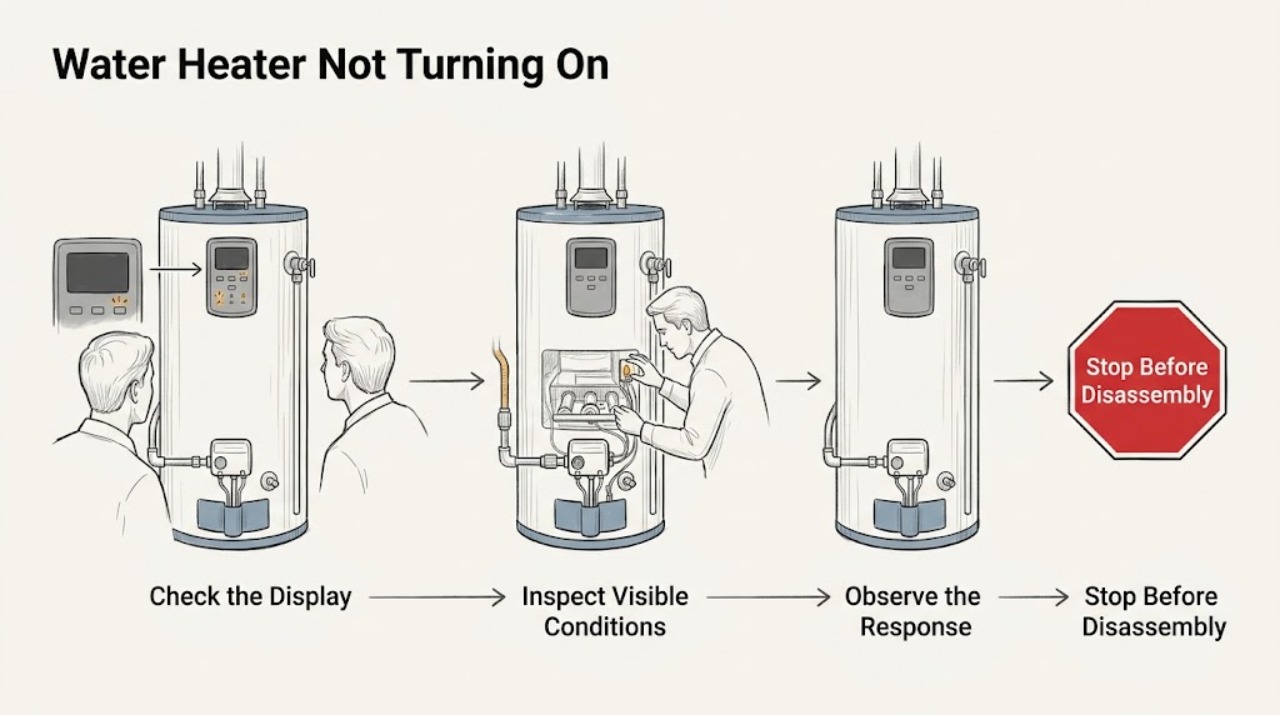
First identify the GE water-heater architecture from the rating label or exact Owner's Manual: standard electric tank, GeoSpring hybrid heat pump, electric tankless, or gas tank. A gas tank may not have the same electrical controls as an electric or hybrid unit, while tankless and hybrid models have model-specific displays, protections, and start-up behavior. For an electric or hybrid unit, check the user-accessible disconnect or breaker and any display or fault indication only when the area is dry and there is no damage; do not open covers or reset an Energy Cut Off (ECO). For a gas model, do not work on the burner, pilot, gas valve, vent, or combustion chamber; if you smell gas, hear hissing, or a carbon-monoxide alarm sounds, leave immediately and contact emergency or fuel-gas professionals from a safe location. If the supply is present but the heater remains inactive, a protective control, ignition system, heating element, sensor, or control may be involved and needs a qualified technician.
Work through in order
Diagnostic checks
Use only checks that match the exact appliance or system and its official guide.
-
Check 1
Before touching a control, identify the GE water-heater model and fuel from the rating label or exact manual. Classify it as a standard electric tank, GeoSpring hybrid heat pump, electric tankless, or gas tank, and note whether the symptom is no display, no burner/heat-pump activity, a fault message, or no hot water.
Expected result: The unit is electric or hybrid with an accessible display or disconnect; tankless electric with a display; or gas with a gas control and no comparable electrical display. The model or fuel remains uncertain.
Next step: Use the exact GE Owner's Manual and Installation Instructions for that model. If the model or fuel cannot be identified, stop at visible observations and arrange qualified water-heater service rather than guessing.
Why this matters
Why: The architecture determines which supply, status, and start-up observations are meaningful. A generic reset or ignition step could be wrong for another GE family, and an uncertain identity is not a safe basis for opening the unit.
-
Check 2
For an electric, hybrid, or tankless model only, look at the user-accessible disconnect or breaker and the external power indicator without removing covers. If the area is dry and undamaged, verify that the disconnect is in its normal operating position and that the breaker has not opened; do not repeatedly cycle it, change its rating, or use a live meter test.
Expected result: The disconnect or breaker is off/tripped, the display is completely dark, or the control shows power but reports a fault; or the supply appears normal and the unit remains inactive.
Next step: If there is no burning smell, water, heat damage, or repeated trip, follow the exact manual's single normal power-restoration instruction and observe the result. If the breaker trips again, the unit remains dead, or any hazard is present, leave it off and call a qualified electrician or water-heater technician; never bypass protection.
Why this matters
Why: A tripped or absent supply can make an electric-family heater appear dead. A normal supply with no operation points toward model-specific controls, safety protection, sensors, heating components, or internal wiring rather than a simple user setting.
-
Check 3
For a GeoSpring hybrid, after a safe power restoration check, observe the display and allow the documented start-up sequence to proceed without opening the unit. Note whether a self-check occurs, whether a fan or compressor begins later, and whether a fault such as the model-specific dry-fire indication appears. Do not interpret a short quiet interval as permission to reset an internal control.
Expected result: The unit progresses through its normal self-check/start sequence, remains dark, stops with a displayed fault, or never resumes heating after the sequence described in the exact manual.
Next step: Record the display text and timing, keep the unit in the safe state, and arrange model-specific service for a persistent fault or no-start condition. Do not open panels, defeat dry-fire protection, or keep power-cycling the heater.
Why this matters
Why: A staged response can be normal for a GeoSpring after power restoration. A persistent dark display, a fault, or failure to resume after the model's sequence makes a supply, control, water-presence, sensor, or heating-system issue more likely, but does not identify a user-replaceable part.
-
Check 4
For a gas GE water heater, look only at the external label and user-accessible control position. Do not remove a burner cover, adjust the gas valve, relight a pilot from a generic procedure, or inspect combustion with the appliance open. If you smell gas, hear hissing, see soot or flame outside the intended area, or a carbon-monoxide alarm sounds, leave immediately without operating switches or communication devices in the area.
Expected result: There is a gas odor, hissing, soot, abnormal flame, CO alarm, or other combustion warning; or there is no such warning but the gas heater has no heat or appears not to ignite.
Next step: For any gas or CO warning, evacuate and contact emergency responders or the fuel-gas supplier from a safe location; do not return until cleared. Otherwise keep the gas heater off if it will not ignite and arrange qualified gas-appliance service using the exact model information.
Why this matters
Why: Gas or combustion warnings are an emergency boundary, not a troubleshooting branch. Without those warnings, the no-heat condition can still involve pilot/ignition, gas control, airflow/venting, or a safety device that requires a qualified fuel-gas professional.
-
Check 5
Check for visible water around the tank, relief-valve discharge, condensate outlet, or floor, and for a wet electrical disconnect or control area. Do not touch electrical equipment while wet and do not test a heater that has been flooded or has water near live parts.
Expected result: Water is contacting electrical parts, the area is flooded, the relief valve is discharging, or there is no visible water and the unit is dry.
Next step: If water is near electrical parts or the heater has been flooded, stay clear, shut off power only if it can be done safely from a dry location, and call a qualified electrician/plumber. For a dry unit, continue only with the model-specific status check and service boundary.
Why this matters
Why: Moisture can create shock and equipment hazards and can also cause a protective control or electrical failure. A relief-valve or leak condition is a plumbing/safety issue, not a simple no-start reset.
-
Check 6
Do not press a hidden reset or remove an access panel. Record the model, fuel, display or fault text, breaker/disconnect state, water or gas warnings, recent outage or installation, and whether hot water was lost suddenly or gradually. Check the exact GE support page or manual for the documented next step.
Expected result: The model manual identifies an owner-level status check, or it directs service for an ECO, fault, ignition, heating, sensor, or wiring condition; the model guidance is unavailable or conflicting.
Next step: Follow only the exact model's owner-level instruction. Otherwise leave the heater off as appropriate and arrange qualified water-heater service; use an electrician for an electrical-supply fault and a fuel-gas professional for gas or combustion work.
Why this matters
Why: GE routes water-heater support by product type and production period, and the ECO guidance expressly reserves high-limit reset and cause investigation to qualified service. A generic instruction cannot establish a safe fix across GE families.
Use your observations
Decision map
Find the observation that best matches what you see, then follow the next safe action.
-
PATH 01Next step
What you see
The model or fuel cannot be identified, or the unit is being treated with a procedure from another GE water-heater family.
Do this next
Stop at visible observations, locate the exact model information, and arrange qualified water-heater service if the identity remains uncertain.
Why this path and its safety boundary
Why it matters: The symptom is too architecture-dependent for a generic reset or ignition step; wrong instructions could expose gas, high voltage, hot water, or combustion hazards.
-
PATH 02Next step
What you see
An electric, hybrid, or tankless unit has no display or no response after a safe supply check.
Do this next
Have an electrician verify the supply when the breaker or disconnect is implicated, and arrange model-specific water-heater service for a persistent appliance-linked no-start. Do not change breaker size or open covers.
Why this path and its safety boundary
Why it matters: An absent supply, circuit problem, internal protection, control, or wiring issue is possible; the observation does not prove a failed board or element.
-
PATH 03Next step
What you see
A GeoSpring display is present but the unit appears quiet after power is restored.
Do this next
Record the fault and timing, follow only the exact manual, and arrange qualified service if the unit does not resume. Never defeat dry-fire or high-limit protection.
Why this path and its safety boundary
Why it matters: A short staged start can be normal for a GeoSpring. A persistent fault or failure to resume after the model sequence points to service rather than repeated power cycling.
-
PATH 04Next step
What you see
A gas unit has an odor, hissing, soot, abnormal flame, or a carbon-monoxide alarm.
Do this next
Leave the area immediately, avoid switches, flames, and communication devices in the affected area, and contact emergency responders or the fuel-gas supplier from a safe location. Do not return until professionals clear it.
Why this path and its safety boundary
Why it matters: This is an immediate fire, explosion, or CO hazard and cannot be safely diagnosed by relighting or adjusting controls.
-
PATH 05Next step
What you see
The heater has water near electrical parts, has been flooded, or its relief valve is discharging.
Do this next
Stay clear of wet electrical equipment, isolate utilities only from a safe dry location, and call a qualified electrician/plumber or water-heater technician. Do not operate the heater until inspected.
Why this path and its safety boundary
Why it matters: The immediate issue is a shock, pressure, leak, or equipment-damage hazard; powering or resetting the heater can worsen it.
Helpful context
Understand the symptom
Start with the fuel and product family
“Not turning on” can mean no display, no burner, no fan or compressor, or no hot water. GE's water-heater range includes traditional electric and gas tanks, hybrid heat-pump units, and electric tankless models. Controls, required supply, start-up sequence, and owner-accessible checks vary by model, so record the model and serial information before following a reset or ignition instruction. Do not use a procedure from another GE water-heater family.
A quiet period is not always a failed start
A GeoSpring hybrid may perform a self-check after power is restored and can delay or stage fan and compressor operation as part of its documented start-up sequence. A gas tank may have no electronic display comparable to a hybrid or tankless unit. Treat the absence of one expected sound or screen as an observation to match against the exact manual, not as proof that a particular part has failed.
Keep high-limit, ignition, and heating work out of a user reset
A protective control that has opened is evidence that a condition needs investigation. GE specifically says the ECO high-limit control should be reset only by a qualified service technician. Covers, access panels, gas controls, heating elements, wiring, sensors, and live electrical measurements are not safe generic checks for an unidentified model. Use the exact manual for visible status information and arrange qualified service when the safe external checks do not restore operation.
When checks do not resolve it
Need a professional?
Arrange qualified water-heater service when a GE heater remains inactive after the exact model's safe external supply check, shows a fault, needs an ECO or other high-limit reset, has no hot water despite confirmed supply, or may involve an element, sensor, control, ignition system, gas valve, burner, vent, wiring, or heat-pump system. Call a qualified electrician for a breaker, disconnect, grounding, or supply problem. For gas odor, hissing, soot, abnormal flame, or a carbon-monoxide alarm, leave immediately and contact emergency responders or the fuel-gas supplier from a safe location. Do not open covers, reset the ECO, relight from a generic procedure, adjust gas controls, bypass a safety device, perform a live test, or operate a wet or flooded heater.
Common questions
FAQ
Why is my GE water heater not turning on?
The answer depends on the model family. GE sells standard electric and gas tanks, GeoSpring hybrid heat-pump units, and electric tankless heaters. A tripped supply, model-specific start sequence, fault or high-limit control, ignition system, heating component, sensor, or wiring problem can all look like a no-start. Identify the exact model first and do not use a reset or ignition procedure from another family.
Can I reset the GE water-heater ECO or high-limit control?
No generic homeowner reset should be recommended. GE says the ECO high-limit control should be reset only by a qualified service technician, and the cause of the over-temperature condition must be investigated before the heater is returned to service. Leave the heater in a safe off state and arrange qualified service.
Is a quiet GE GeoSpring water heater always failed after power is restored?
Not necessarily. GE documents a self-check and staged start for the GeoSpring hybrid family after power is restored, including an initial period before later fan/compressor activity. Match the timing and any display message to the exact model manual. A persistent fault, dark display, or failure to resume after that sequence needs qualified service rather than repeated power cycling.
Read the exact guide
Official sources
- Carbon MonoxideU.S. Consumer Product Safety Commission · Carbon-monoxide hazard from fuel-burning appliances including gas water heaters
- GE Profile GEOSPRING Hybrid Heat Pump Water Heater - Power OutageGE Appliances · GEOSPRING hybrid heat-pump power restoration and staged start behavior
- Are You Ready? An In-Depth Guide to Citizen PreparednessReady.gov · Wet-appliance, gas-odor, and electrical-safety boundaries
- Water Heater - Product Information, Warranty, Service and Technical SupportGE Appliances · GE water-heater support routing by architecture and production period
- Educational Messages Desk ReferenceNational Fire Protection Association · Fuel-gas odor, pilot, combustion-appliance, and emergency response safety
- Water Heater - Relief ValveGE Appliances · GE water-heater temperature/pressure relief-valve installation and discharge safety
- Water Heater - Energy Cut Off Control (ECO)GE Appliances · GE water-heater high-limit/ECO safety control and professional-reset boundary
- GE Appliances GeoSpring Heat Pump Water Heater Frequently Asked QuestionsGE Appliances · GE GeoSpring hybrid architecture, modes, power dependence, and model-specific behavior
- Water Heaters | GE AppliancesGE Appliances · GE water-heater product families and broad electric, gas, and tankless architecture scope
Community feedback
Share a repair observation
Share a plain-text repair observation. Accepted observations are published automatically; this page may take a moment to update.