
On this page
Start here
Quick answer
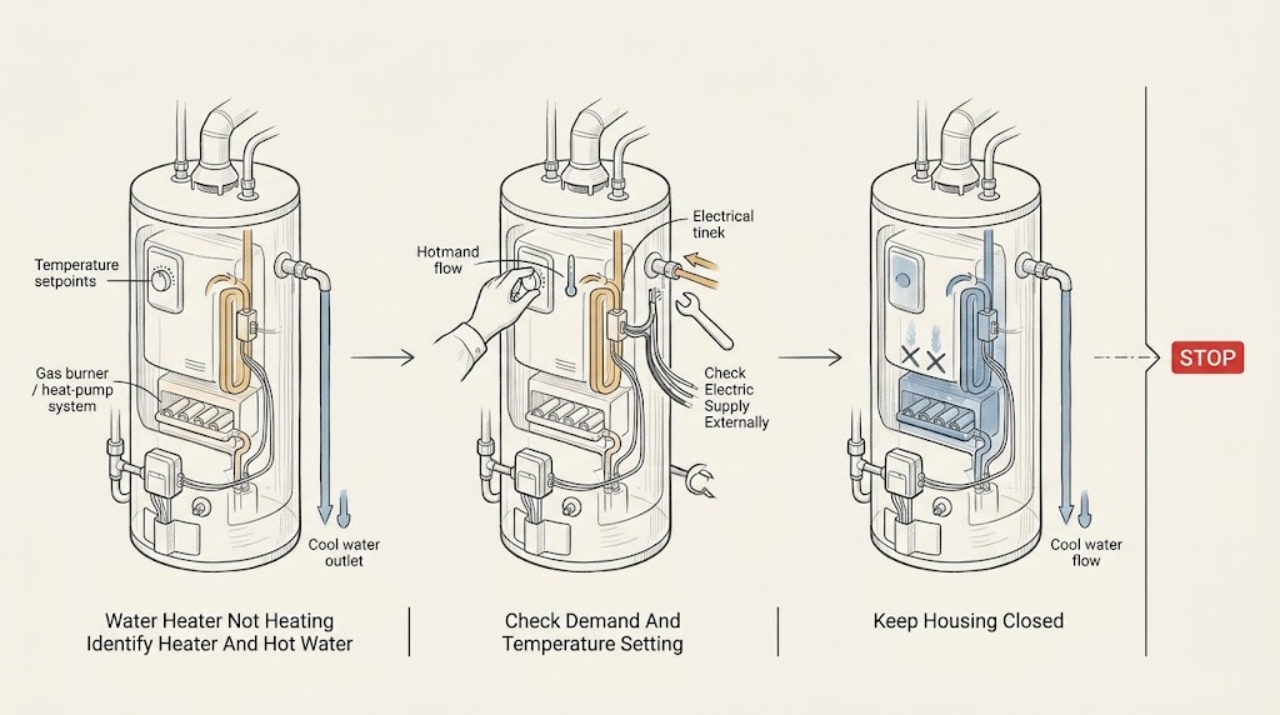
First record the exact GE model, serial information, fuel or heat-pump type, display state, and whether the complaint is no hot water at every faucet or only less hot water after heavy use. Check that all hot-water faucets are closed and that the temperature setting is not too low; a low setting, colder inlet water, a long exposed pipe, or an open faucet can look like a heater failure. If an electric model has no hot water, a tripped breaker, blown fuse, interrupted electric service, or inadequate wiring are possible, but do not open the electrical compartment or perform a live test. If the unit has a high-limit Energy Cut-Off (ECO) condition, GE says its reset and the cause of excessive temperature must be investigated by a qualified service technician before the heater is used again. Do not apply gas-pilot instructions to an electric or GeoSpring unit, and do not infer that a traditional-tank procedure applies to a hybrid heat-pump model. Stop for gas odor, combustion concerns, a relief-valve discharge, leaking tank or piping, scalding water, smoke, or damaged wiring; arrange the model-appropriate GE water-heater or qualified plumbing/electrical service.
Before you begin
Safety first
- This article covers identification, ordinary faucet and visible-plumbing observation, safe external power checks, and model-manual settings only. Do not reset ECO, open electrical or gas covers, access burners, test live circuits, enter sealed heat-pump systems, or work on hot or pressurized components.
Work through in order
Diagnostic checks
Use only checks that match the exact appliance or system and its official guide.
-
Check 1
Record the complete GE model and serial information and identify whether the heater is traditional electric, traditional gas, or GeoSpring hybrid heat pump. From safe faucet access, note whether all outlets are cold, only the first draw is short, hot water returns after recovery, or a display or fault message is present.
Expected result: No hot water anywhere, limited hot water after demand, a unit-specific code, no display or indicator, gas or heat-pump equipment, or visible water, odor, heat, or damage.
Next step: Use the matching electric, gas, hybrid, setting, or safety branch below and the exact Owner's Manual; do not mix procedures across heater types.
Stop if: Stop for gas odor, combustion or exhaust concern, smoke, sparking, scalding water, relief discharge, a leaking tank, water near electrical parts, or damaged wiring.
Why this matters
Why: GE's support and troubleshooting paths depend on heater type, model, age, and symptom. A recovery or capacity issue is not the same as a failed heating system, and a visible hazard overrides diagnosis.
-
Check 2
Confirm that hot-water faucets are fully closed and compare the displayed or dial temperature setting with the exact model manual. If the product has an integrated mixing valve or hot-water-capacity setting, record its current setting without opening plumbing or changing an unknown control.
Expected result: A hot faucet is dripping or open, the setpoint is low, a mixing-valve capacity setting is low, demand was unusually high, or controls are correct but water remains cold.
Next step: Close an obviously open faucet and make only a clearly identified model-approved setting correction; allow the unit to recover. If water stays cold with correct settings, continue to power or service checks.
Stop if: Do not raise an unknown setting repeatedly, bypass a mixing valve, touch hot piping, or continue if the water is dangerously hot or a relief device is discharging.
Why this matters
Why: GE lists open faucets, low temperature settings, and model-dependent mixing-valve capacity as causes of insufficient hot water. Heavy demand can exhaust stored hot water without proving that the heater cannot heat.
-
Check 3
For a confirmed electric or hybrid unit, check the labeled household breaker or fuse and any external service indication from a dry, safe position. Do not remove the heater's access panel or perform electrical measurements; for a gas unit, do not substitute an electrical check for a fuel or combustion diagnosis.
Expected result: The breaker is tripped, the breaker trips again, utility power is interrupted, the heater display is dark, the external supply appears normal, or the heater is gas rather than electric or hybrid.
Next step: Restore only a clearly tripped breaker once after confirming the area is dry and safe. If it trips again or the heater remains cold, leave the heater off and call qualified electrical or water-heater service; use the gas or hybrid branch for those models.
Stop if: Do not reset a repeatedly tripping breaker, replace a fuse with a different rating, open electrical covers, measure live voltage, or work on a gas line or burner.
Why this matters
Why: GE lists a blown fuse, tripped breaker, interrupted electric service, and inadequate wiring as possible causes, while fuel and combustion systems follow a different path. A repeat trip or powered heater with no heat requires service.
-
Check 4
On an electronic or GeoSpring model, record the exact display, mode, indicator, and fault code and compare them with the model manual. Confirm that the unit is not in a model-specific vacation, low-demand, or other nonstandard mode; do not enter service diagnostics.
Expected result: A code or warning is present, the display is normal, a special mode is active, the display is dark, or the code is not listed for the exact model.
Next step: Follow only a clearly identified model-manual mode correction. If the code persists, the display is dark with external power present, or the correct mode still produces no heat, arrange service with the code and model.
Stop if: Do not copy a control sequence from another GE water heater, bypass an alarm, remove a control cover, or clear a fault by repeatedly cycling power.
Why this matters
Why: GE states that service and troubleshooting depend on water-heater type and age, and that model documentation is needed for operation and fault information. An unrecognized code should not be treated as a universal heating failure.
-
Check 5
From outside the unit, inspect only visible hot- and cold-water connections, the floor around the tank, and any accessible discharge or piping for leaks, reversed labels from a recent installation, or a recirculation system that has recently changed. Do not remove fittings, drain the tank, access a dip tube, or open a gas or electrical compartment.
Expected result: A pipe or tank leaks, a relief outlet discharges, connections may be reversed after installation, a recirculation system is present, or visible plumbing is dry and correctly identified.
Next step: If a visible supply connection is leaking, isolate water only when safe and call a plumber or water-heater technician. If plumbing is dry, continue to the ECO and service boundary rather than opening the tank.
Stop if: Do not tighten hot or pressurized fittings, operate a leaking tank, block a relief outlet, drain the tank, or work near water and electricity or gas.
Why this matters
Why: GE lists reversed water connections, damaged dip tube, recirculating-system interference, and leaks or open faucets as possible explanations for inadequate hot water. Water or pressure hazards require qualified plumbing or appliance service.
-
Check 6
After the model, demand, setting, external power, mode, code, and visible-plumbing checks, document whether the water remains cold, recovers slowly, the breaker trips, an ECO or high-temperature condition is suspected, or a gas, hybrid, tank, or control component would need access.
Expected result: Hot water returns, no hot water persists, the ECO may have opened, the heater has a fault code, a burner or heat-pump system is involved, or any leak, scalding, odor, smoke, or electrical hazard is present.
Next step: Arrange model-appropriate GE water-heater service; use a licensed electrician for supply or wiring, a qualified plumber for water piping, and qualified gas service for fuel or combustion concerns. Protect occupants from hot water and isolate power, fuel, or water only when safe.
Stop if: Do not reset ECO, access a burner or heating element, test live wiring, open a sealed heat-pump or refrigerant system, bypass safety controls, or continue using a leaking, smoking, gas-odor, or scalding heater.
Why this matters
Why: Persistent no-heat symptoms can involve an element, thermostat, ECO, burner, ignition, heat-pump circuit, compressor, sensor, control, wiring, or plumbing. GE says ECO reset and high-temperature-cause investigation require qualified service.
Use your observations
Decision map
Find the observation that best matches what you see, then follow the next safe action.
-
PATH 01Safety boundary
What you see
Some hot water is available, demand was heavy, a faucet is open or leaking, the temperature setting is low, or a model-specific mixing-valve capacity setting is low.
Do this next
Close the faucet and make only a clearly identified manual-approved setting correction, then allow recovery. Arrange service if hot water remains absent or unsafe.
Why this path and its safety boundary
Why it matters: GE lists these conditions as causes of not enough hot water without proving that the heating system has failed.
Safety stop: Do not keep increasing an unknown setpoint or touch hot plumbing, a mixing valve, or a relief device.
-
PATH 02Safety boundary
What you see
A confirmed electric or hybrid model has a tripped breaker, blown fuse, interrupted service, dark controls, or suspected inadequate wiring.
Do this next
Reset one clearly tripped breaker only when dry and safe; call an electrician or water-heater technician for a repeat trip, dead supply, or wiring diagnosis.
Why this path and its safety boundary
Why it matters: GE identifies electrical supply and wiring as possible causes, but a repeat trip or internal wiring fault is not an owner repair.
Safety stop: Do not open access panels, measure live voltage, replace a fuse with a different rating, or reset a breaker repeatedly.
-
PATH 03Safety boundary
What you see
The model is traditional gas or GeoSpring hybrid heat pump rather than a standard electric tank.
Do this next
Use the exact model manual and arrange the appropriate GE water-heater service for a persistent no-heat symptom. Use qualified gas service for fuel or combustion concerns.
Why this path and its safety boundary
Why it matters: Fuel, ignition, combustion, compressor, airflow, sensor, and control paths differ from an electric heating-element path; a standard breaker or element procedure is not transferable.
Safety stop: Do not relight, open, adjust, or test a burner, gas line, compressor, refrigerant circuit, or control cabinet without qualified authorization.
-
PATH 04Safety boundary
What you see
An ECO or high-limit event is suspected, water is suddenly scalding, a safety warning is displayed, or the heater has shut off after excessive temperature.
Do this next
Stop using the heater and arrange qualified service to investigate the high-temperature cause and reset or repair the ECO.
Why this path and its safety boundary
Why it matters: GE says the ECO opens the heating circuit when water temperature becomes excessively high and requires qualified reset and investigation before reuse.
Safety stop: Do not press or bypass the ECO, remove covers, or return the heater to service without the cause being corrected.
-
PATH 05Safety boundary
What you see
Correct settings, safe external power checks, model mode, and visible plumbing checks do not restore hot water, or there is a leak, relief discharge, gas odor, smoke, sparking, damaged wiring, or tank damage.
Do this next
Isolate power, fuel, or water only when safe and arrange the appropriate qualified service; protect occupants and address any immediate gas, electrical, or scalding hazard first.
Why this path and its safety boundary
Why it matters: An internal heater, thermostat, ECO, burner, heat-pump, compressor, sensor, control, wiring, or plumbing fault may be present and cannot be identified safely without the exact model and qualified diagnosis.
Safety stop: Do not continue operation, open the tank or cabinet, perform live testing, bypass safety controls, or replace internal parts by guesswork.
Helpful context
Understand the symptom
“Not heating” can mean no hot water, recovery delay, or a heater fault
Ask whether every hot-water outlet is cold, whether only the first shower ran out, and whether hot water returns after the tank has had time to recover. GE lists open or leaking hot-water faucets, colder seasonal inlet water, long exposed piping, and capacity or mixing-valve settings as reasons for not having enough hot water. A gradual recovery after high demand is different from no heat at all.
Identify traditional electric, gas, and GeoSpring architecture
GE's support path depends on whether the product is a traditional electric or gas water heater, a current GE Profile GeoSpring hybrid heat-pump heater, or an older GeoSpring model. A breaker and heating-element path do not describe a gas or hybrid unit, and a pilot or combustion procedure should never be copied onto an electric model. Use the model label and exact manual before changing a setting or interpreting a code.
Power checks are limited to ordinary external access
For an electric unit, GE lists a blown fuse, tripped breaker, interrupted electric service, or inadequate wiring as possible causes. Check only the labeled household breaker or service status from a dry, safe position and do not remove covers. For gas or heat-pump equipment, the correct power, controls, airflow, and fuel or compressor path are model-specific; do not treat a silent unit as permission to open the burner, control, or sealed-system compartment.
ECO and high-temperature conditions are not DIY resets
GE says the Energy Cut-Off control protects against excessive water temperature by opening the heating circuit. Its reset should only be done by a qualified service technician, and the cause of the high-temperature condition must be investigated before the heater returns to service. Do not remove an access cover, press a hidden reset, or keep using a unit that has produced scalding water.
Leaks and installation conditions can imitate a heating problem
GE lists reversed water connections, an open faucet, a damaged dip tube, recirculating-system interference, and capacity or mixing-valve settings among model-dependent causes of inadequate hot water. A visible leak, relief discharge, loose connection, or water around electrical equipment is not a reason to tighten internal fittings; isolate water and power only when safe and call the appropriate qualified professional.
Safety boundary
Stop conditions
- Stop using the heater for gas odor, combustion or exhaust concerns, smoke, sparks, burning odor, damaged wiring, scalding water, relief discharge, tank leakage, or water near electrical parts.
- Do not reset or bypass the high-limit ECO; GE requires qualified service to investigate the excessive-temperature cause before reuse.
- Do not open electrical, gas, burner, heat-pump, refrigerant, control, or tank compartments, and do not perform live voltage, gas, or combustion tests.
- Do not mix traditional electric, traditional gas, and GeoSpring hybrid instructions or use another model's fault-code or control sequence.
- Do not tighten hot or pressurized fittings, block a relief outlet, drain the tank, or replace an element, thermostat, burner, compressor, sensor, control, or valve without qualified model-specific diagnosis.
When checks do not resolve it
Need a professional?
Arrange qualified GE water-heater service when a correct setting, safe external breaker or service check, model-specific mode, recovery period, and visible plumbing inspection do not restore hot water; when an ECO or high-temperature condition is suspected; or when a traditional gas or GeoSpring hybrid component would need access. Use a licensed electrician for supply or wiring and a qualified plumber for water piping or leaks. Stop immediately for gas odor, combustion concerns, smoke, sparks, burning odor, scalding water, relief discharge, a leaking tank, damaged wiring, or water near electricity.
Safety scope: This article covers identification, ordinary faucet and visible-plumbing observation, safe external power checks, and model-manual settings only. Do not reset ECO, open electrical or gas covers, access burners, test live circuits, enter sealed heat-pump systems, or work on hot or pressurized components.
Read the exact guide
Official sources
- Water Heater - Product Information, Warranty, Service and Technical SupportGE Appliances · GE Appliances support-routing guidance; service path depends on standard versus GeoSpring type and production date.
- Water Heaters - Not Enough Water or No Hot WaterGE Appliances · GE Appliances water-heater guidance; electric, gas, hybrid, mixing-valve, wiring, and piping details vary by model.
- Water Heater - Energy Cut Off Control (ECO)GE Appliances · GE Appliances water-heater safety guidance; ECO placement and reset procedure vary by model, but GE requires qualified service for reset and cause investigation.
- GE Appliance Product - How to Schedule Repair ServiceGE Appliances · GE Appliances service-routing page; water-heater online scheduling and support contacts differ from major appliance scheduling and by model age.
Community feedback
Share a repair observation
Share a plain-text repair observation. Accepted observations are published automatically; this page may take a moment to update.