
On this page
Start here
Quick answer
A water heater that is not heating should be checked by type: confirm fuel/power, thermostat setting, error or safety state, and whether the problem affects all hot water or one outlet. Check the breaker or normal control once, but do not remove access panels or test live wiring, elements, gas valves, or safety controls. Scalding, leaks, smoke, gas odor, or repeated trips require immediate service.
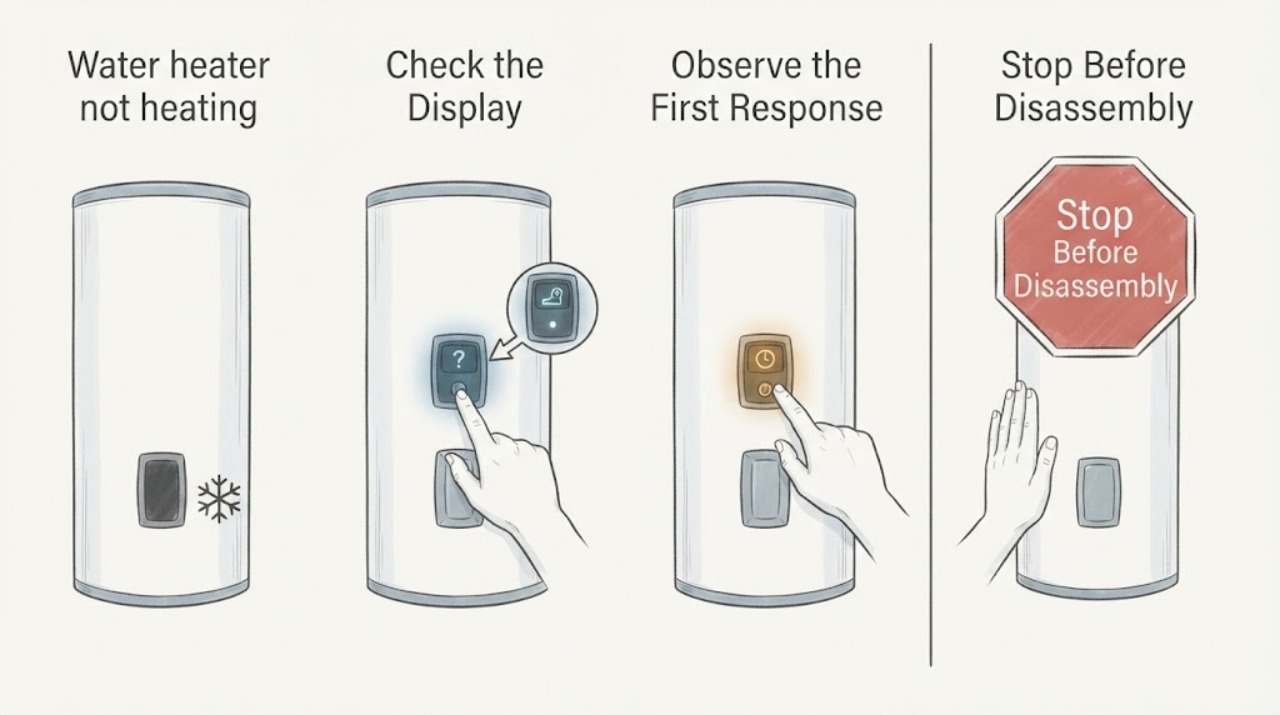
Work through in order
Diagnostic checks
Use only checks that match the exact appliance or system and its official guide.
-
Check 1
Identify heater type and scope: electric/gas/heat-pump, no hot water anywhere or one fixture, and whether display/error/pilot/indicator responds.
Expected result: Whole home is cold, one outlet is cold, display/error is present, or heater shows normal status.
Next step: Record model/serial and use the exact manual before changing settings.
Why this matters
Why: Scope separates heater-level operation from a faucet/mixing issue; status lights do not prove heating element/valve health.
-
Check 2
Check the dedicated breaker/disconnect or normal gas control position from outside without opening panels or touching fittings.
Expected result: Breaker/disconnect is off/tripped, gas control is off, or supply appears normal.
Next step: Reset only once if safe and no damage/odor is present; do not relight unfamiliar controls.
Why this matters
Why: A supply state can stop heating; a recurring trip or gas concern needs professional diagnosis.
-
Check 3
Check thermostat/setpoint and any displayed code or safety lockout using the owner controls.
Expected result: Setpoint is low, code/lockout appears, or controls are normal.
Next step: Follow only the model manual and do not bypass ECO/high-limit or pressure protection.
Why this matters
Why: A control setting or diagnostic code can inhibit heating; code meaning varies by model.
-
Check 4
After one safe correction, observe one heating cycle and check for leaks, discharge, abnormal noise, smoke, gas odor, or hot water returning.
Expected result: Heating returns, remains absent, or warning symptom appears.
Next step: Stop and arrange qualified water-heater service for persistent no heat or any safety warning.
Why this matters
Why: A successful cycle supports supply/control state; persistent no-heat needs element/burner/sensor diagnosis.
Use your observations
Decision map
Find the observation that best matches what you see, then follow the next safe action.
-
PATH 01Next step
What you see
One faucet is cold while other fixtures have hot water.
Do this next
Arrange plumbing diagnosis rather than opening the heater.
Why this path and its safety boundary
Why it matters: A local mixing valve, faucet, or plumbing issue is more likely than heater failure.
-
PATH 02Next step
What you see
Whole home is cold with normal supply and controls.
Do this next
Keep safe and arrange qualified service; do not remove panels.
Why this path and its safety boundary
Why it matters: Heating element, burner, sensor, control, or heat-pump system fault is possible.
-
PATH 03Next step
What you see
Breaker trips, ECO/high-limit locks out, or heater has leak/overheating.
Do this next
Turn off power as the manual directs and obtain qualified service.
Why this path and its safety boundary
Why it matters: Safety control or damage condition is present.
-
PATH 04Next step
What you see
Gas odor, smoke, fire, scalding discharge, or damaged wiring occurs.
Do this next
Leave gas area if necessary, isolate only if safe, and contact emergency/qualified service.
Why this path and its safety boundary
Why it matters: Immediate gas/fire/electrical boundary.
Helpful context
Understand the symptom
“Not heating” can be a supply/control problem, a single fixture mixing issue, or an internal element/burner fault.
Water heaters combine electricity/gas, pressure, and scald hazards; keep checks external and model-specific.
When checks do not resolve it
Need a professional?
Arrange qualified water-heater service when no heat persists after one external supply/control check, a code/safety lockout returns, or element, burner, sensor, valve, or wiring testing is needed.
Common questions
FAQ
Why is there no hot water anywhere?
Check heater supply/control status and any error once. Persistent whole-home no heat needs qualified service.
Can I replace an element myself?
Do not remove panels or work on live wiring; use the exact manual and qualified service.
What should I record?
Model/serial, heater type, scope of outage, breaker/control state, code, leak, and any noise/odor.
Read the exact guide
Official sources
- Water Heaters Electric Residential Use & Care ManualRheem · water heater not-heating power, thermostat, safety and professional repair
Community feedback
Share a repair observation
Share a plain-text repair observation. Accepted observations are published automatically; this page may take a moment to update.