
On this page
Start here
Quick answer
A water heater that will not turn on must be separated into electric no-power, gas ignition, and tankless no-flow cases. For an electric unit, check only the labeled breaker and whether the tank is full; do not open the cover or test live conductors. For gas equipment, do not relight or service combustion parts unless qualified. A repeat trip, gas odor, leak, or no heat after safe external checks needs professional service.
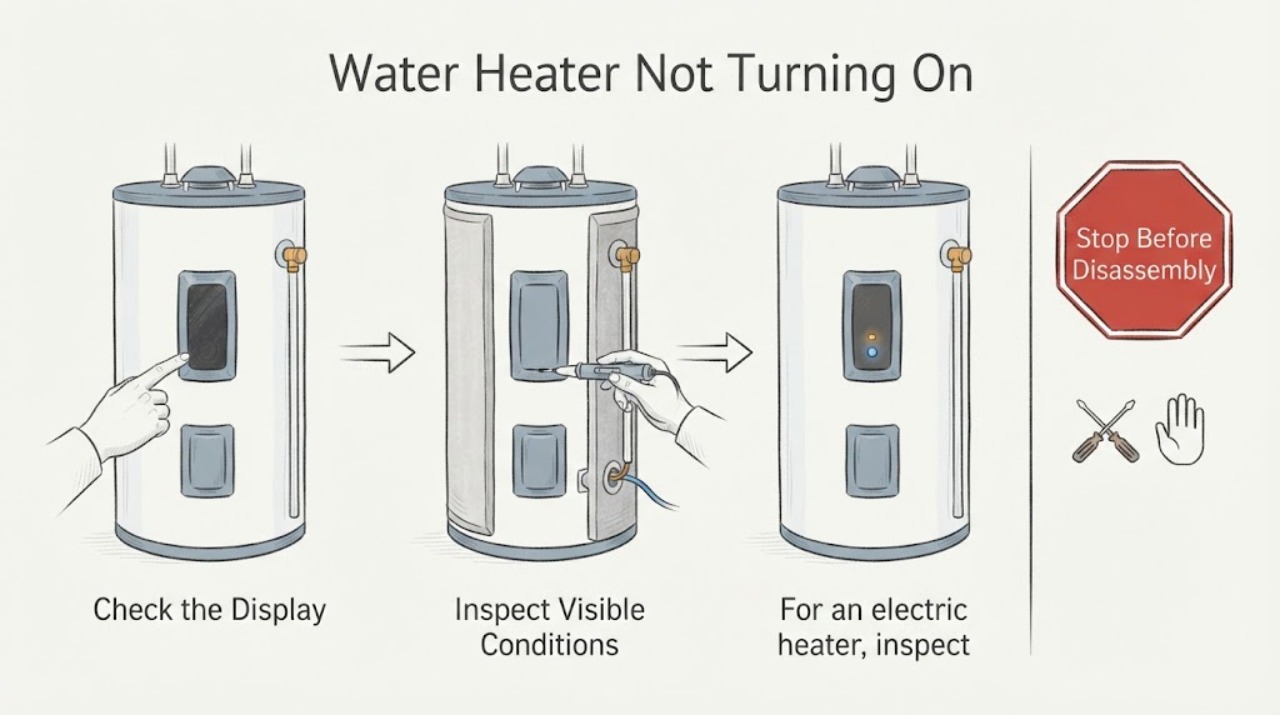
Work through in order
Diagnostic checks
Use only checks that match the exact appliance or system and its official guide.
-
Check 1
Identify electric tank, gas tank, or tankless equipment and note whether the display, pilot/ignition, breaker, or hot-water flow responds.
Expected result: No display/power, breaker trip, no ignition, or no tankless activation is observed.
Next step: Use the matching manufacturer manual and safety boundary.
Why this matters
Why: Each design has a different activation path; the symptom alone does not identify a failed element or valve.
-
Check 2
For an electric heater, inspect the labeled breaker and external disconnect without opening panels; for gas, confirm only that the supply is not deliberately shut off if no gas emergency exists.
Expected result: Breaker is off/tripped, gas controls are off, or external supply appears normal.
Next step: Restore once only when safe; never enlarge a breaker or bypass gas safety.
Why this matters
Why: External supply can prevent operation, but a repeated trip or gas fault needs professionals.
-
Check 3
For a tank heater, ensure the tank is full before any electric power is applied; for tankless, open a hot tap and observe whether adequate flow is sensed without opening the unit.
Expected result: Tank may be empty, hot water flows weakly, or the unit still does not activate.
Next step: Do not energize an empty tank or alter gas/flow controls without qualified guidance.
Why this matters
Why: Whirlpool warns electric tanks must be full to avoid dry fire; Bosch notes insufficient tankless flow can prevent activation.
-
Check 4
Record error lights, pilot/ignition sounds, temperature, recent installation or power loss, and any leaking water.
Expected result: A code or leak appears, or there is no visible safety symptom.
Next step: Provide the record and model/serial to service.
Why this matters
Why: Codes and leaks determine service urgency; no symptom after correct supply checks still requires diagnosis.
-
Check 5
Do one safe, model-documented reset only if the manual permits it and no hazard is present.
Expected result: The heater starts, or it remains inactive/trips again.
Next step: Stop and arrange service rather than repeating resets.
Why this matters
Why: A one-time reset can clear a transient control state; recurrence indicates a fault.
Use your observations
Decision map
Find the observation that best matches what you see, then follow the next safe action.
-
PATH 01Next step
What you see
Electric breaker is off and stays on after one safe restoration with a full tank.
Do this next
Monitor heating; service if it remains cold.
Why this path and its safety boundary
Why it matters: A power interruption may have caused the no-start symptom.
-
PATH 02Next step
What you see
Breaker trips again or the tank is not full.
Do this next
Leave it off and call qualified service.
Why this path and its safety boundary
Why it matters: Electrical fault or dry-fire risk exists.
-
PATH 03Next step
What you see
Tankless heater has water flow below activation or a gas ignition failure.
Do this next
Use qualified gas/water-heater service; do not open combustion components.
Why this path and its safety boundary
Why it matters: Flow/ignition conditions are preventing activation.
-
PATH 04Next step
What you see
Leak, gas odor, smoke, or scorching occurs.
Do this next
Leave/isolate only when safe and call emergency or qualified service.
Why this path and its safety boundary
Why it matters: Immediate safety boundary.
Helpful context
Understand the symptom
A water heater that will not turn on must be separated into electric no-power, gas ignition, and tankless no-flow cases. For an electric unit, check only the labeled breaker and whether the tank is full; do not open the cover or test live conductors. For gas equipment, do not relight or service combustion parts unless qualified. A repeat trip, gas odor, leak, or no heat after safe external checks needs professional service.
Identify the symptom before choosing a repair
When checks do not resolve it
Need a professional?
Stop for gas odor, leaking tank, smoke, scorching, exposed wiring, or repeated breaker trips.
Common questions
FAQ
What is the safest first check?
Start with the symptom-specific external check in this guide, keep power or fuel isolated when directed, and use the exact model manual for any control or part decision.
When should I stop troubleshooting?
Stop for smoke, burning odor, hot or damaged electrical parts, leaks near electricity, repeated breaker trips, or any condition requiring opening a sealed or energized assembly.
Should I replace a part based on the symptom alone?
No. Confirm the model and diagnostic result first; a symptom can come from several causes.
Read the exact guide
Official sources
- Electric Water Heater Repair and TroubleshootingWhirlpool Water Heaters · electric water-heater no-hot-water and power checks
- Water Heaters FAQBosch Home Comfort · gas tankless water-heater ignition and flow boundary
Community feedback
Share a repair observation
Share a plain-text repair observation. Accepted observations are published automatically; this page may take a moment to update.