
On this page
Start here
Quick answer
A bad smell associated with a water heater must first be classified by where it is noticed. A rotten-egg odor only in hot water can arise from water chemistry and the anode reaction, while a gas-like odor around the appliance is an emergency. Do not remove the anode or alter temperature settings without model-specific professional guidance.
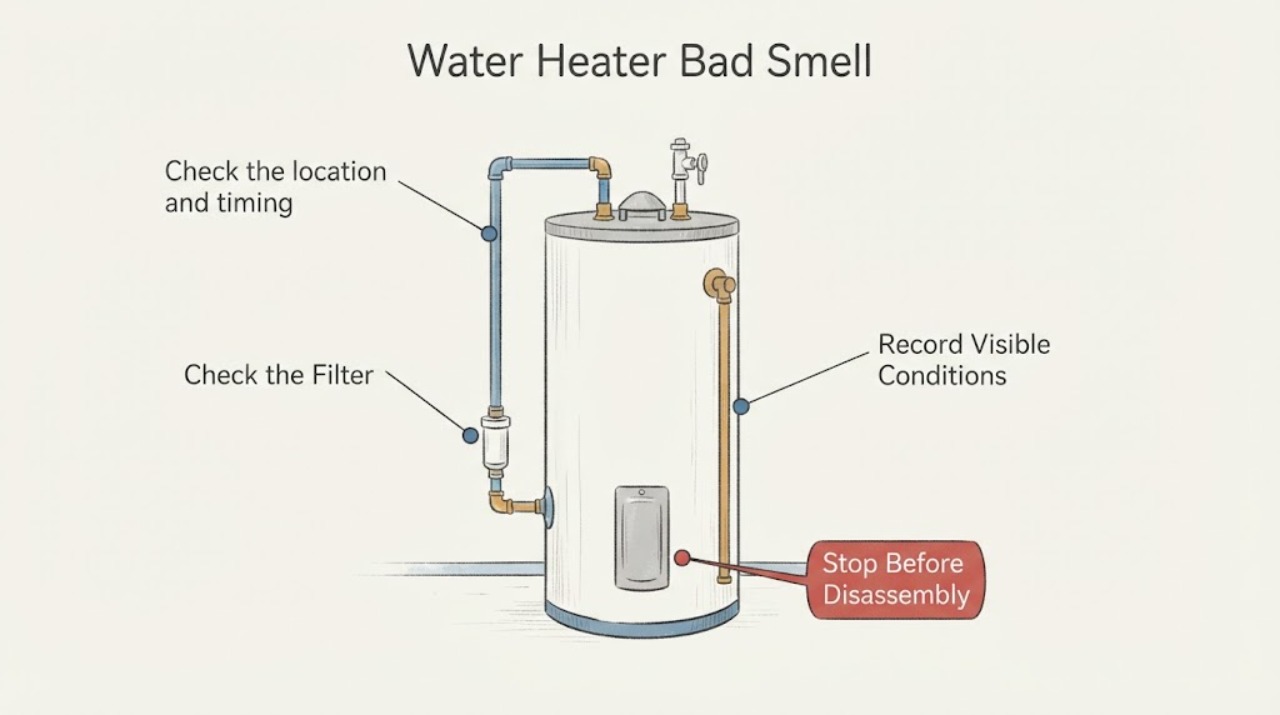
Work through in order
Diagnostic checks
Use only checks that match the exact appliance or system and its official guide.
-
Check 1
Check the location and timing without approaching a suspected gas leak: compare cold and hot taps from a safe distance and note whether the odor is in the water, around the appliance, or in the room.
Expected result: Record the visible result of this check and whether the reported symptom changes.
Next step: If the result is normal, continue to the next check; if it is abnormal, correct only the documented condition or stop for service.
Why this matters
Why: This result separates an accessible operating condition from a fault that requires model-specific diagnosis.
-
Check 2
If the odor is gas-like, do not operate switches, ignite flames, or troubleshoot the heater; leave the area and contact the gas utility or emergency service from outside.
Expected result: Record the visible result of this check and whether the reported symptom changes.
Next step: If the result is normal, continue to the next check; if it is abnormal, correct only the documented condition or stop for service.
Why this matters
Why: This result separates an accessible operating condition from a fault that requires model-specific diagnosis.
-
Check 3
For odor only in hot water, record whether every hot tap is affected, whether the smell began after installation or water-treatment changes, and whether there is discoloration or sediment.
Expected result: Record the visible result of this check and whether the reported symptom changes.
Next step: If the result is normal, continue to the next check; if it is abnormal, correct only the documented condition or stop for service.
Why this matters
Why: This result separates an accessible operating condition from a fault that requires model-specific diagnosis.
-
Check 4
Use the heater’s manual or a qualified water-heater professional to evaluate the anode, tank sanitation, mixing valve, and water supply; do not permanently remove the protective anode.
Expected result: Record the visible result of this check and whether the reported symptom changes.
Next step: If the result is normal, continue to the next check; if it is abnormal, correct only the documented condition or stop for service.
Why this matters
Why: This result separates an accessible operating condition from a fault that requires model-specific diagnosis.
Use your observations
Decision map
Find the observation that best matches what you see, then follow the next safe action.
-
PATH 01Next step
What you see
The smell is gas-like or present in the room around a gas-fired heater.
Do this next
Leave immediately, avoid flames and electrical switches, and call the gas utility or emergency service from outside.
Why this path and its safety boundary
Why it matters: This is a possible fuel leak or combustion safety event, not a water-quality troubleshooting problem.
-
PATH 02Next step
What you see
The rotten-egg smell occurs only in hot water and the cold supply does not smell.
Do this next
Arrange model-specific water-heater service to assess odor treatment and anode options.
Why this path and its safety boundary
Why it matters: A water-chemistry and anode reaction is more likely; A. O. Smith describes sulfate, low oxygen, bacteria, and active hydrogen as contributing factors.
-
PATH 03Next step
What you see
The odor is present in both hot and cold water or at multiple fixtures away from the heater.
Do this next
Stop using affected water for drinking until the water source is assessed and contact a qualified plumber or water authority.
Why this path and its safety boundary
Why it matters: The supply, drain, fixtures, or whole-house water treatment may be involved rather than the heater alone.
Helpful context
Understand the symptom
Use the ordered checks below to separate normal operating states from a fault for this appliance.
When checks do not resolve it
Need a professional?
Stop for gas odor, hissing, smoke, flame irregularity, a hot-water scald risk, or a leaking tank. Leave a suspected gas emergency and use qualified water-heater service.
Common questions
FAQ
Can I remove the anode rod to eliminate the smell?
Do not remove it permanently. The manufacturer manual says the rod protects the tank; odor treatment and any approved replacement require model-specific advice.
Should I raise the temperature to kill odor bacteria?
Do not change the set point on a generic symptom page. Higher temperatures increase scald risk and require appropriate mixing-valve and professional guidance.
What smell requires immediate evacuation?
A gas-like odor around the heater or in the room requires leaving without operating switches or flames and calling the gas utility or emergency service from outside.
Read the exact guide
Official sources
- Signature 500 Series Power Vent Residential Gas Water Heater Use and Care ManualA. O. Smith · water heater hot-water odor and anode-rod troubleshooting
Community feedback
Share a repair observation
Share a plain-text repair observation. Accepted observations are published automatically; this page may take a moment to update.