
On this page
Start here
Quick answer
First identify whether your Wolf cooktop is gas, electric, or induction and record the model, because the simmer control is different and some Wolf modules do not have a simmer setting. On a Wolf gas burner, turn the knob to the lowest detent, push in, continue turning to move the flame to the second tier, and then choose the simmer variation. If the flame is stable but the food is too hot, lower the simmer setting and use a centered, flat pan that conducts heat evenly. On electric or induction models, use the model-documented Simmer or Melt level and the correct cookware; Wolf's published indicator ranges vary by product. Stop for gas odor, an abnormal flame, a burner that will not shut off, cracked glass, smoke, burning odor, or hot/wet wiring, and arrange Factory Certified Service.
Before you begin
Safety first
- User checks are limited to identifying the model and technology, selecting the documented simmer control, observing the flame or indicator from a safe position, and correcting accessible cookware placement or a user-removable surface/filter as the exact guide permits. Do not adjust gas pressure, burner orifices, valves, air shutters, electrical connections, heating elements, induction generators, controls, or live circuits.
Work through in order
Diagnostic checks
Use only checks that match the exact appliance or system and its official guide.
-
Check 1
With the cooktop cool and dry, record the full model and serial information and classify the appliance as a gas cooktop, electric cooktop, induction cooktop, or a multi-function module. Note whether the problem affects one burner/zone or the whole unit, whether the complaint is too much heat, too little heat, or unstable cycling, and whether a dedicated Simmer control or indicator is present.
Expected result: The appliance is gas, electric, induction, or a module without a clearly labeled simmer control; one zone behaves differently from the others, or every zone has the same issue.
Next step: Use the exact model's Use and Care Guide for the identified technology. If the model or technology cannot be confirmed, stop at identification and contact Wolf service rather than applying another product's simmer procedure.
Stop if: Do not lift the glass, remove burner pans, access wiring or gas components, or test a hot surface while the model identity is uncertain.
Why this matters
Why: Wolf's gas instructions use a physical second-tier simmer flame, while electric and induction guides use different indicator ranges. Wolf also states that the IM15/S multi-function cooktop does not have a simmer setting, so a missing simmer option is not automatically a failure.
-
Check 2
For a Wolf gas burner, light it using the normal control and verify the simmer selection: turn the knob to the lowest detent, push in while continuing to turn counterclockwise so the flame moves to the second tier, then select the desired simmer variation. Watch the flame from a safe position without reaching over the burner.
Expected result: The flame moves to the lower/second tier and remains stable, the flame stays on the upper ring, the burner does not respond to the simmer detent, or the flame is uneven, lifting, yellow, or extinguishing.
Next step: If the flame is stable but the food is too hot, choose a lower simmer variation. If the flame will not enter the documented simmer range or is abnormal, turn the control off and request Wolf Factory Certified Service.
Stop if: Stop immediately for gas odor, delayed ignition, persistent clicking, an abnormal flame, smoke, or a burner that does not shut off. Do not manually light the burner or open the valve, regulator, manifold, or igniter wiring.
Why this matters
Why: Wolf identifies the second-tier flame as the gas simmer setting. A flame that stays on the upper ring may indicate the simmer detent was not selected or the model's control differs; an uneven, unstable, or abnormal flame is not a cooking adjustment problem.
-
Check 3
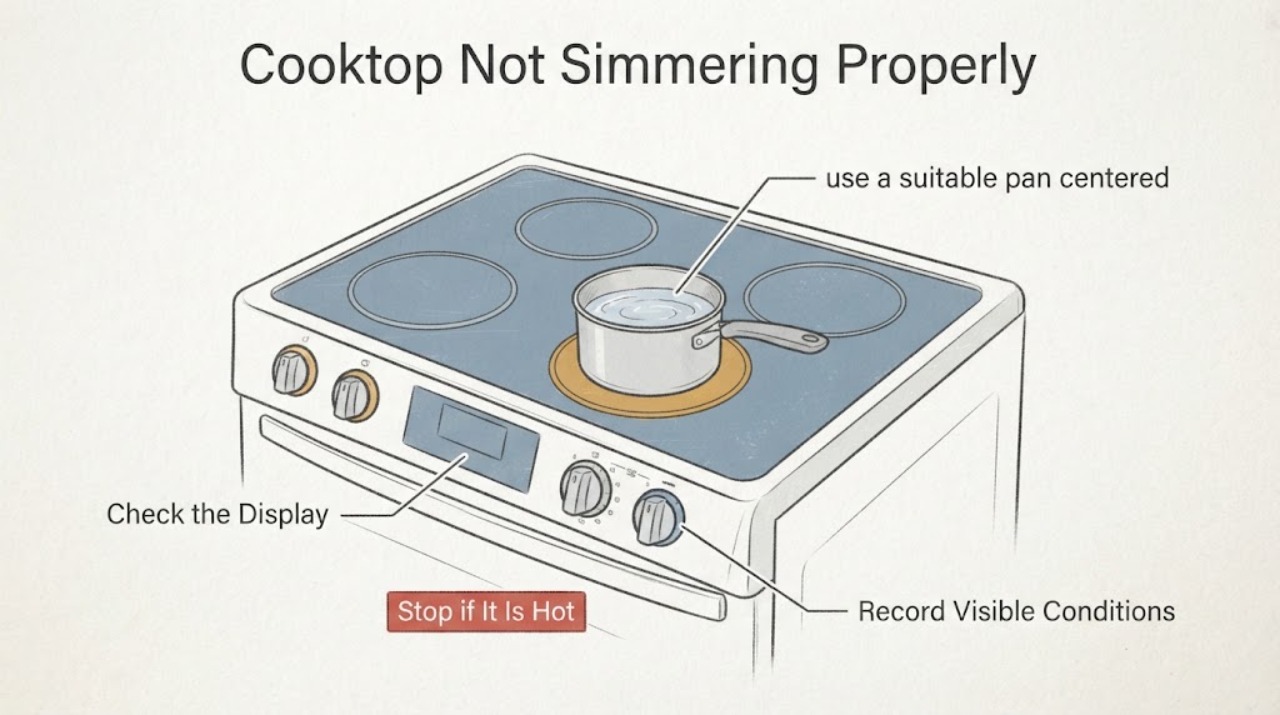
If the issue is gas simmer temperature rather than ignition, use a suitable pan centered over the burner with a flat base and keep the food load appropriate for the pan. Compare the result at one lower simmer variation before changing cookware or moving the pan; do not touch the grate or burner while hot.
Expected result: The pan is centered and flat and the food simmers evenly, the pan is warped or off-center, food burns in one area, or the surface is too hot even at the model's lowest simmer selection.
Next step: Correct only the pan position, pan condition, food load, or simmer variation and observe one cooking cycle. If a flat centered pan remains excessively hot or the burner output is unstable, stop using that burner and arrange service.
Stop if: Do not adjust the gas regulator, burner orifice, valve, air shutter, or burner manifold, and do not continue cooking with an abnormal flame or gas odor.
Why this matters
Why: Wolf's gas guidance links uneven boiling or burning to pan centering, a warped or unsupported base, and poor heat conduction. Its simmer troubleshooting also says delicate foods may need a lower simmer setting to avoid scorching, so high heat is not proof of a defective burner.
-
Check 4
For an electric or induction Wolf cooktop, select the model-documented Simmer or Melt level with the normal touch controls and use a suitable pan. On induction, use dry magnetic stainless steel or cast-iron cookware that sits flat; on electric, use the pan and level specified by the exact guide. Observe the indicator and the food response without touching the hot glass.
Expected result: The indicator and heat remain steady, the control cycles while maintaining gentle heat, the pan is not recognized, the indicator shows a different simmer range than expected, or the zone stays too hot or too cold.
Next step: Follow the exact model guide rather than copying a bar or indicator count from another Wolf series. If a suitable pan is recognized but the zone remains outside the documented simmer behavior, stop and contact Factory Certified Service.
Stop if: Do not use an empty pan, test with foil or non-magnetic cookware, clean the hot glass, open the cooktop, or probe the heating element or inverter.
Why this matters
Why: Wolf publishes different indicator ranges for different electric/induction families and requires magnetic cookware for induction. Power modulation or a product-specific indicator range can therefore be normal; a suitable pan that is not recognized or a zone that ignores the model's lowest setting points toward control, supply, cookware-sensing, or heating-zone diagnosis.
-
Check 5
After one model-appropriate simmer test, record whether the symptom follows the burner/zone or the pan, whether other zones hold their documented simmer behavior, and whether any lock, error, over-temperature indication, breaker event, or unusual sound occurs. Do not repeatedly reset the cooktop to chase a different result.
Expected result: Only one burner/zone is abnormal, every zone behaves abnormally, the result changes with a known suitable pan, the cooktop shows an error or protection state, or there is a gas/electrical safety symptom.
Next step: Provide Wolf service with the exact model, zone, control/indicator state, pan details, and observations. Keep the affected unit off when the problem persists or the product shows a fault or safety symptom.
Stop if: Do not continue testing after smoke, burning odor, cracked glass, gas odor, abnormal flame, hot or wet wiring, a stuck control, or repeated breaker operation.
Why this matters
Why: A pan-dependent result supports cookware, placement, or heat-conduction causes. A single-zone fault makes that zone's control, element, burner, or sensor path more likely; a whole-unit fault or protection event points toward supply, control, or thermal diagnosis rather than a simmer technique.
Use your observations
Decision map
Find the observation that best matches what you see, then follow the next safe action.
-
PATH 01Next step
What you see
The cooktop is gas, the flame is stable, and food is simply too hot or scorches at the normal simmer selection while the pan is flat and centered.
Do this next
Select a lower documented simmer variation and use a flat, centered pan. If the same pan remains excessively hot at the lowest model-documented setting, stop using that burner and request service.
Why this path and its safety boundary
Why it matters: Wolf's gas guide treats this as a simmer-setting or cookware/food-load decision first; delicate foods may need a lower simmer variation, and pan conductivity or position can concentrate heat.
-
PATH 02Next step
What you see
The gas knob is at the lowest detent but the user cannot move into the second-tier simmer flame, or the flame remains on the upper ring, unstable, or abnormal.
Do this next
Turn the burner off and arrange Wolf Factory Certified Service with the exact model and burner location. Do not adjust gas components or manually light it.
Why this path and its safety boundary
Why it matters: The burner is not showing the documented simmer behavior or has a gas/ignition/flame-quality issue; this is not safely resolved by changing the pan.
-
PATH 03Next step
What you see
The cooktop is electric or induction and the indicator or heat output follows the exact model's Simmer/Melt behavior with suitable cookware, even if the heat cycles rather than remaining visually constant.
Do this next
Continue with the exact model's cookware and simmer guidance. If the pan is not recognized, the zone ignores the lowest documented setting, or food remains outside the expected result, request Factory Certified Service.
Why this path and its safety boundary
Why it matters: A product-specific power range or normal modulation may explain the result. Wolf's published electric/induction guides use different indicator ranges, so another model's bar count cannot establish a fault.
-
PATH 04Next step
What you see
The appliance is an IM15/S multi-function cooktop or another model whose exact guide shows no Simmer setting.
Do this next
Use the lowest documented operating setting only if it suits the recipe, or use a cooktop module with a documented simmer function. Do not force the knob past its normal range.
Why this path and its safety boundary
Why it matters: Wolf states that the IM15/S high-output module does not have a simmer setting, so the absence of a simmer detent is an equipment feature rather than a failed control.
-
PATH 05Next step
What you see
Any technology shows gas odor, delayed ignition, abnormal flame, smoke, burning odor, cracked glass, hot or wet wiring, exposed conductors, a stuck control, or repeated breaker/protection operation.
Do this next
Stop using the cooktop, keep clear of the hazard, and arrange Wolf Factory Certified Service or qualified gas/electrical help. For an active fire or immediate gas danger, use emergency response and do not operate electrical switches near the suspected leak.
Why this path and its safety boundary
Why it matters: The issue has crossed the user-level simmer adjustment boundary and may involve gas, fire, electrical, glass, or control hazards.
Helpful context
Understand the symptom
Not simmering properly can mean two different things: the control is not actually in the product's simmer range, or the heat is correct but the pan and food respond unevenly. Wolf gas burners use a separate simmer flame tier selected by pushing and turning past the lowest detent. Wolf electric and induction controls use product-specific power indicators, and the published guides do not establish one universal simmer level for every model. Identify the technology and exact model before judging the flame or indicator.
A simmer is not always a constant rolling bubble. Wolf's gas troubleshooting guide says delicate foods may need a lower simmer setting to prevent scorching, while pan centering, a flat base, and even heat conduction affect whether food boils or burns in one area. If the correct control and pan setup do not produce the expected result, treat it as a product-specific service issue rather than opening the cooktop or adjusting gas or electrical parts.
When checks do not resolve it
Need a professional?
Call Wolf Factory Certified Service for persistent or model-inconsistent simmer behavior, a burner or zone that does not respond normally, a control or indicator fault, or any gas, fire, electrical, glass, or overheating hazard.
Safety scope: User checks are limited to identifying the model and technology, selecting the documented simmer control, observing the flame or indicator from a safe position, and correcting accessible cookware placement or a user-removable surface/filter as the exact guide permits. Do not adjust gas pressure, burner orifices, valves, air shutters, electrical connections, heating elements, induction generators, controls, or live circuits.
Have this ready
- Provide the exact model and serial information, cooking technology, affected burner or zone, whether the symptom is too hot, too cold, or unstable, the simmer control/indicator state, pan material and base condition, flame observations if gas, any error or protection indication, and the safety symptoms if present.
Common questions
FAQ
How do I select Simmer on a Wolf gas cooktop?
Turn the burner knob to the lowest detent, push in while continuing to turn counterclockwise so the flame moves to the second tier, then select the desired simmer variation. If the flame will not enter that range or is abnormal, turn the burner off and arrange Factory Certified Service.
Why is my Wolf simmer setting too hot?
First use a lower documented simmer variation and check that the pan is flat, centered, and able to conduct heat evenly. Wolf notes that delicate foods may need a lower simmer setting to avoid scorching. If a suitable pan remains too hot at the lowest model-documented setting, the burner or control needs service diagnosis.
Do all Wolf cooktops have a Simmer setting?
No. Wolf states that the IM15/S multi-function cooktop does not have a simmer setting. Electric and induction models also use product-specific power indicators and ranges, so confirm the exact model guide before treating a missing or different Simmer control as a fault.
Can an induction Wolf cooktop simmer by cycling the heat?
Follow the exact model's Simmer or Melt guidance and use suitable magnetic cookware. Wolf publishes different indicator ranges for different electric and induction families, so cycling or a different indicator count may be normal. A suitable pan that is not recognized or a zone that ignores the documented lowest setting needs Factory Certified Service.
Read the exact guide
Official sources
- Wolf Gas Surface Burner Does Not Ignite | How to GuideSub-Zero, Wolf, and Cove · Supports the safety and service boundary for gas ignition/flame problems, including a burner that fails on simmer; exact product instructions remain controlling.
- UCGWolf Appliance, Inc. · Supports the documented gas simmer troubleshooting and pan-related cooking observations for the covered guide; not a universal procedure for every Wolf model.
- CE Electric, CI Induction Cooktop, Pro IR Induction Range, and Legacy IR Induction Range Power Level IndicatorSub-Zero, Wolf, and Cove · Supports that Simmer indicator ranges are product-family specific; it should not be copied to an unverified Wolf model.
- Sealed Burner SettingsSub-Zero, Wolf, and Cove · Supports gas simmer use distinctions for the listed dual-stacked burner families; not a universal setting table for every Wolf cooktop.
- USE & CARE GUIDEWolf Appliance, Inc. · Supports induction cookware, safety, Simmer temperature-guide context, and model-specific troubleshooting; it is not a universal indicator range for every Wolf induction model.
- Wolf Gas Surface Burner OperationSub-Zero, Wolf, and Cove · Supports the gas simmer control sequence and flame-tier behavior; exact model instructions remain controlling.
- Electric Cooktop Temperature RangesSub-Zero, Wolf, and Cove · Supports model-specific electric temperature controls and service escalation; not a universal setting for every Wolf cooktop.
- Gas Surface Burners Too HotSub-Zero, Wolf, and Cove · Supports checking the correct gas type/pressure and documented burner settings, then using Factory Certified Service when the issue persists; it does not authorize gas-system adjustment.
- IM15/S Multi-Function Cooktop BTU RatingsSub-Zero, Wolf, and Cove · Exact product-family evidence that this high-output module has no simmer setting; not evidence about other Wolf cooktops.
Community feedback
Share a repair observation
Share a plain-text repair observation. Accepted observations are published automatically; this page may take a moment to update.