
On this page
Start here
Quick answer
A Wolf cooktop that is not working may be unpowered, locked, in Showroom or another control mode, using unsuitable cookware, or affected by a gas-burner or installation problem. First identify whether the surface is gas, electric, or induction and whether every zone or only one is affected. With the surface cool and dry, check the visible controls and display, verify power without opening the appliance, use the model-specific Wolf instructions for a single breaker reset, and test an induction zone only with a known induction-compatible pan. For a gas model, inspect only ordinary-access burner-cap seating and the externally visible gas-supply state when there is no gas odor. Stop immediately for gas odor, hissing, delayed ignition, abnormal flame, smoke, burning smell, arcing, damaged glass or wiring, unexpected heating, or a breaker that trips again; otherwise arrange Wolf or qualified appliance service when the safe checks do not restore operation.
Before you begin
Safety first
- This article covers identification, clean and dry control use, visible mode and display observations, one model-directed reset, induction cookware placement, and cool ordinary-access gas-burner observations only. It does not authorize gas-path work, live electrical testing, panel removal, safety bypass, or internal part replacement.
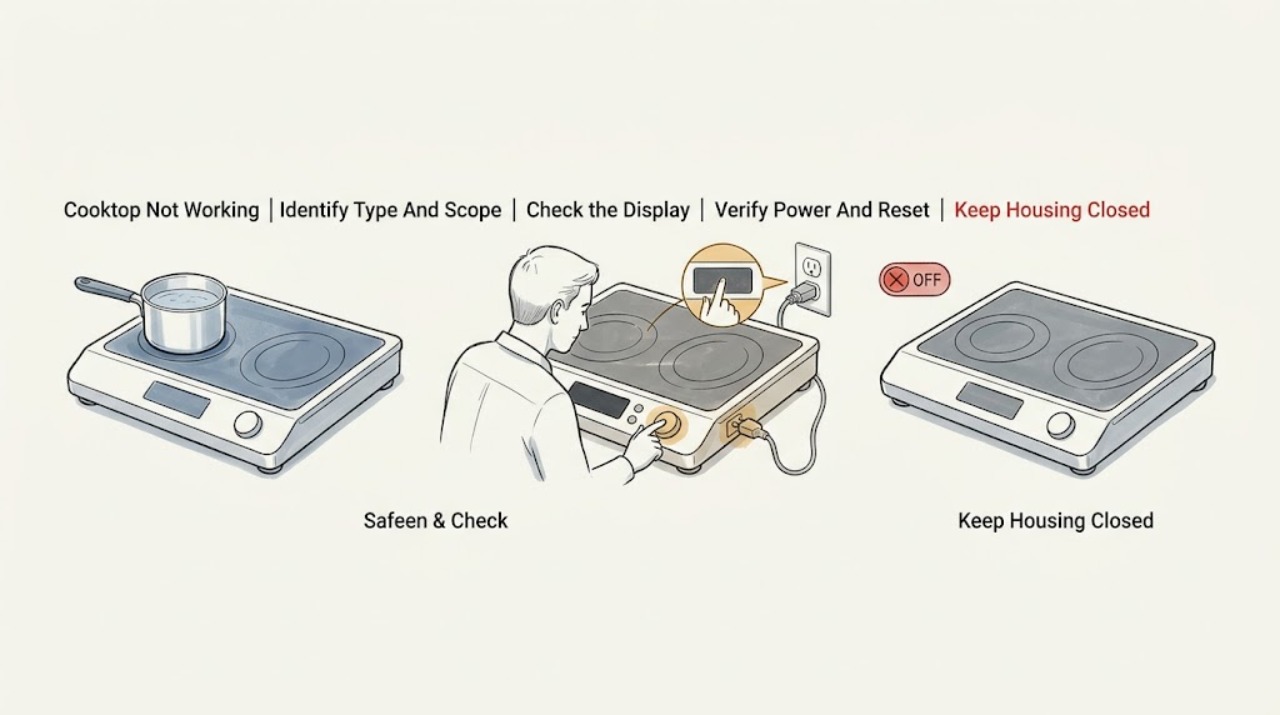
Work through in order
Diagnostic checks
Use only checks that match the exact appliance or system and its official guide.
-
Check 1
From a safe position with the cooktop off and cool, record the Wolf model and serial information from the rating plate or paperwork, identify the surface as gas, electric, or induction, and test only the normal controls without removing trim or panels.
Expected result: Record whether the display or indicator lights are present, whether touch controls or knobs respond, whether every zone is affected, and whether the failure is limited to one burner, one element, or one induction zone.
Next step: Use the matching gas, electric, or induction branch below and retain the exact model identity for the model-specific Wolf guide or service request.
Stop if: Stop if the glass is cracked, a control is loose, wiring is visible, the cooktop is unexpectedly hot, or inspection would require lifting, opening, or disassembling the appliance.
Why this matters
Why: A dark or wholly unresponsive surface points first to power, control, or installation. A responsive surface with one failed zone points toward a zone-specific component or cookware/burner path. A gas surface, radiant electric surface, and induction surface require different next checks.
-
Check 2
With clean, dry hands, operate the normal Wolf controls using a fingertip rather than a fingernail; inspect the display for a key or lock indication, a showroom indication such as Shr or SHO, or an error state, and check the exact model guide for Sabbath or other control modes.
Expected result: The lock clears and controls become normal, a showroom indication remains while controls respond, the control panel remains unresponsive, or an error returns after the model-specific mode instruction.
Next step: Follow only the exact Wolf instruction for the identified model and display; if the mode cannot be exited or the error returns, stop normal operation and arrange service.
Stop if: Do not bypass a lock or safety control, enter undocumented diagnostic sequences, or continue if the surface heats unexpectedly or shows arcing, smoke, or damaged controls.
Why this matters
Why: A lock or Showroom Mode can disable heating without proving a failed element. A persistent unresponsive panel or returning error requires service rather than repeated key sequences; the same display can have different instructions across Wolf models and serial ranges.
-
Check 3
Confirm that the home's affected circuit has not visibly tripped and that the cooktop's accessible connection is not obviously disturbed; when the area is dry and there is no damage or odor, perform one model-directed circuit-breaker reset using the Wolf guidance, then restore normal operation and retest once.
Expected result: The breaker is tripped and stays on after one reset, the display returns but heating does not, the breaker trips again, or the cooktop remains completely dark.
Next step: Record the breaker result and exact reset instruction used; arrange Wolf or qualified electrical/appliance service if the unit remains inoperative or the breaker operates again.
Stop if: Do not remove covers, touch exposed conductors, restore a breaker that trips again, or continue testing after smoke, burning smell, water contact, sparks, or visible damage.
Why this matters
Why: A stable reset can clear a transient control state, but it does not establish that an internal component is sound. A repeat trip, continuing no-power condition, or heat failure after the display returns points to an electrical, installation, control, or heating fault needing qualified diagnosis.
-
Check 4
For an induction model, place a known induction-compatible pan containing water in the center of one zone and select that zone normally; for an electric model, select one element normally with the surface clear and observe its indicator without using a pan to conceal the element.
Expected result: The induction zone senses the pan and heats, the induction display blinks or refuses to heat, the electric element glows or heats, only one zone fails, or the control responds but no zone heats.
Next step: For induction, try only the model-approved cookware and placement; for electric, do not remove or test the element. If the result remains abnormal, retain the zone pattern and arrange service.
Stop if: Stop for cracked glass, abnormal heat, smoke, burning smell, arcing, unexpected activation, or any need to access wiring, elements, coils, or the control board.
Why this matters
Why: Induction requires a suitable pan to be sensed, so a blinking or inactive zone with unsuitable or misplaced cookware does not by itself prove an appliance fault. An electric element or an induction zone that remains dead with correct settings and suitable cookware points to a zone, control, or power fault.
-
Check 5
For a gas Wolf cooktop only when there is no gas odor and the surface is cool, visually check that a burner cap is flat and seated, that the accessible igniter area is dry, and that the external gas-supply shutoff appears in its normal position; do not remove the gas connection or adjust any valve.
Expected result: The cap is visibly displaced, the igniter area is damp, the external supply state is unknown, one burner fails while others work, or all burners fail despite normal controls and no visible issue.
Next step: Allow a damp, cool accessible area to dry naturally and restore only a visibly displaced cap as the model guide permits; otherwise record the burner pattern and arrange qualified gas-appliance service.
Stop if: If there is any gas odor, hissing, delayed ignition, abnormal or yellow/unstable flame, smoke, or fire, do not light or retest the appliance; leave the area and follow the local gas supplier or emergency instructions from a safe location.
Why this matters
Why: Wolf identifies cap position and a damp igniter as possible explanations for uneven flame or failure to ignite, while a whole-cooktop failure can involve power or gas supply. A gas state that is unknown or a failure that persists after ordinary-access checks needs qualified diagnosis, not internal adjustment.
-
Check 6
After the safe checks, document the exact model, fuel type, display or error text, affected zones, breaker result, cookware result if induction, burner-cap and flame observations if gas, and any recent installation, cleaning, spill, or power event; do not repeat a failed test to obtain a different result.
Expected result: The cooktop works normally after a documented mode or reset correction, works only partially, remains unresponsive, or presents a recurring safety symptom.
Next step: Use the recorded evidence to request Wolf or qualified appliance service and keep the cooktop out of use until the professional determines that it is safe.
Stop if: Do not continue ordinary use after a repeat breaker trip, gas symptom, arcing, smoke, damaged glass, exposed wiring, unexpected heat, or unresolved control fault.
Why this matters
Why: A stable correction supports a transient mode or power state but does not justify repeated resets. Partial operation, recurrence, or a safety symptom narrows the technician's diagnostic path and should be treated as a service boundary.
Use your observations
Decision map
Find the observation that best matches what you see, then follow the next safe action.
-
PATH 01Safety boundary
What you see
Is there gas odor, hissing, delayed ignition, flame rollout, an abnormal or yellow/unstable flame, smoke, fire, or a strong burning smell?
Do this next
Stop using the cooktop, do not light any appliance or operate electrical switches, leave the area, and contact the local gas supplier or emergency service from a safe location according to local instructions.
Why this path and its safety boundary
Safety stop: Do not investigate a suspected gas leak, relight repeatedly, adjust gas components, or return to the appliance until the safety response clears it.
-
PATH 02Safety boundary
What you see
Is there smoke, arcing, exposed wiring, damaged glass, unexpected heating, water near electrical controls, or a breaker that trips again?
Do this next
Stop operating the cooktop and isolate power only when it can be done without contacting water or exposed parts; arrange qualified electrical or appliance service.
Why this path and its safety boundary
Safety stop: Do not open the cooktop, probe live circuits, restore a repeat-tripping breaker, or use a damaged surface.
-
PATH 03Safety boundary
What you see
Does the control show a lock state, or does an indication such as Shr or SHO show while controls respond but heating is disabled?
Do this next
Use the exact Wolf instructions for the model and serial range to unlock or exit Showroom Mode; verify normal operation once afterward.
Why this path and its safety boundary
Safety stop: Do not guess an undocumented key sequence or continue if the mode will not clear, an error returns, or the cooktop heats abnormally.
-
PATH 04Safety boundary
What you see
Is the surface induction and does the selected zone blink or remain inactive with no recognized, correctly placed cookware?
Do this next
Place a known induction-compatible pan as directed by the model guide and retry the single-zone observation; do not infer a board or coil failure from an unsuitable pan.
Why this path and its safety boundary
Safety stop: Do not use improvised cookware tests that require damaged glass, do not open the induction surface, and stop for heat, smoke, arcing, or burning odor.
-
PATH 05Safety boundary
What you see
On a gas model with no odor, is one burner affected with a visibly displaced cap or damp accessible igniter, or do all burners fail?
Do this next
For the one-burner case, follow the model guide for cool, ordinary-access cap seating and drying; for an all-burner failure or unknown supply state, arrange qualified service.
Why this path and its safety boundary
Safety stop: Stop immediately for gas odor, hissing, delayed ignition, abnormal flame, smoke, or any need to adjust the gas path.
-
PATH 06Safety boundary
What you see
Did the cooktop remain partially or completely inoperative after the mode, power, cookware, and ordinary-access burner checks?
Do this next
Stop troubleshooting and arrange Wolf or qualified appliance service with the model, symptom pattern, display state, and safe-check results.
Why this path and its safety boundary
Safety stop: Do not continue using a cooktop with recurring faults, a repeat breaker trip, gas symptoms, abnormal flame, arcing, smoke, damaged glass, or unexpected heat.
Helpful context
Understand the symptom
Start with the cooktop type and the scope of the failure
Wolf cooktops do not all use the same diagnostic path. Gas models use knobs, igniters, burner caps, and a gas supply; electric models use radiant heating elements; induction models require a suitable pan to be sensed. Record the exact model and serial information from the rating plate or owner documents without removing panels. Then note whether the display or indicator lights are dark, whether controls respond, whether all zones fail, and whether one burner or element is the exception. That pattern determines which safe checks are relevant and prevents applying an induction or gas instruction to the wrong surface.
A responsive display does not prove that heating is enabled
A Wolf control can appear active while the cooktop is locked or in Showroom Mode. On applicable induction models, a display such as Shr, SHO, or a similar showroom indication means the controls can work while the heating elements remain disabled. A lock, Sabbath-related setting, or unresponsive touch surface can also look like a failed cooktop. Use the exact model's instructions for changing a mode; do not guess a key sequence from another Wolf model.
Keep gas and electrical troubleshooting at the ordinary-access boundary
Wolf's gas guide states that installation and service belong to a qualified installer, service agency, or gas supplier, and that a gas odor is an immediate safety event. Do not remove a gas line, adjust a regulator or valve, probe live wiring, bypass a control, or open the cooktop. A visible cap that is not seated, a damp igniter, a no-power condition, or a mode setting can be reported to the technician; they are not permission to perform internal repair.
Safety boundary
Stop conditions
- Stop immediately for gas odor, hissing, delayed ignition, flame rollout, abnormal or yellow/unstable flame, smoke, fire, or strong burning smell; leave the area and use local gas or emergency instructions from a safe location.
- Stop for arcing, exposed wiring, damaged glass, water near electrical controls, unexpected heating, or a circuit breaker that trips again; do not open the appliance or probe live parts.
- Do not bypass a lock, Showroom Mode, interlock, or other safety control, and do not guess a model-specific diagnostic sequence.
- Do not remove gas connections, adjust regulators or valves, replace internal parts, access live terminals, or perform a repair that requires opening the cooktop.
- Do not keep operating the cooktop when safe ordinary-access checks do not restore normal operation or when the same fault returns.
Only after diagnosis
Potential parts
- model-specific gas burner cap
Consider this category only when the exact model documentation or a qualified technician confirms that a damaged or missing cap is causing the abnormal burner pattern.
Confirm the complete Wolf model, fuel configuration, burner position, and manufacturer fit information; do not substitute a visually similar cap or use the burner with an unsafe fit. - model-specific induction cookware
Consider this category only when an induction zone fails to sense the current cookware and the model guide confirms that cookware compatibility or size is the relevant branch.
Confirm the exact cooktop instructions and pan suitability before ordering; cookware does not repair a zone that fails with known suitable cookware. - model-specific cooktop control or heating component
Consider this category only after qualified diagnosis isolates the fault to a control, element, induction zone, igniter, or related component following safe power, mode, cookware, and burner checks.
Verify exact model and revision with Wolf or a qualified technician; do not choose or install an internal electrical or gas part from the symptom alone.
When checks do not resolve it
Need a professional?
Arrange Wolf or qualified appliance service when the cooktop remains unresponsive after the model-specific safe checks, only part of the surface works, a suitable induction pan is not sensed, a gas burner remains abnormal, an error or mode returns, the installation or fuel type is uncertain, or a breaker trips again. Treat gas odor, hissing, delayed ignition, abnormal flame, smoke, fire, arcing, exposed wiring, damaged glass, unexpected heating, and water near electrical controls as urgent safety boundaries.
Safety scope: This article covers identification, clean and dry control use, visible mode and display observations, one model-directed reset, induction cookware placement, and cool ordinary-access gas-burner observations only. It does not authorize gas-path work, live electrical testing, panel removal, safety bypass, or internal part replacement.
Common questions
FAQ
Why does my Wolf cooktop show a display but not heat?
A responsive display does not prove heating is enabled. Check for a lock or Showroom Mode indication, such as Shr or SHO on applicable induction models, and follow the exact model and serial-range instructions. If a suitable induction pan is sensed and the zone still does not heat, arrange service.
Why does only one Wolf induction burner not work?
First confirm that a known induction-compatible pan is centered on the affected zone and that the control is unlocked. If the zone still blinks or remains inactive while other zones work, record the cookware and display behavior and arrange model-specific service.
What can I safely check on a Wolf gas cooktop that will not work?
Only when there is no gas odor and the surface is cool, you can visually check a burner cap's seating, a damp accessible igniter area, and the externally visible supply state without removing connections or adjusting valves. Gas odor, hissing, delayed ignition, or an abnormal flame requires immediate stop and a safe-location gas or emergency response.
Should I keep resetting the Wolf cooktop breaker?
No. Use one model-directed reset only when the cooktop is dry, undamaged, and free of safety symptoms. A repeat trip, continuing no-power state, or returning failure is a service boundary, not a reason for repeated resets.
When should I stop troubleshooting a Wolf cooktop?
Stop for gas odor, hissing, delayed ignition, abnormal flame, smoke, burning smell, arcing, exposed wiring, damaged glass, water near controls, unexpected heating, or a breaker that trips again. Also stop when the safe model-specific checks do not restore operation and arrange qualified service.
Read the exact guide
Official sources
- Gas Cooktop Installation GuideWolf · Official Wolf gas cooktop installation guide for verifying visible installation context without authorizing user gas repair.
- CT Induction Cooktop Showroom ModeSub-Zero, Wolf, and Cove · Official Wolf guidance for CT induction cooktops showing Shr, SHO, 5HR, or similar showroom indications.
- Gas Cooktops Use & Care GuideWolf · Official Wolf gas cooktop use-and-care guide; exact model instructions and qualified gas service control repairs.
- Wolf Electric Cooktop Does Not WorkSub-Zero, Wolf, and Cove · Official Wolf support for electric cooktops and partial or complete no-operation symptoms.
- Wolf Touch Pad or Controls Not WorkingSub-Zero, Wolf, and Cove · Official Wolf control guidance covering cooktop touch pads and unresponsive controls.
- Electric or Induction Cooktop Not Heating ProperlySub-Zero, Wolf, and Cove · Official Wolf support for electric or induction elements that heat slowly or poorly.
- Wolf Induction Cooktop or Induction Range Cooktop Does Not WorkSub-Zero, Wolf, and Cove · Official Wolf support for induction cooktops and induction range cooktops when zones do not heat or operate intermittently.
Community feedback
Share a repair observation
Share a plain-text repair observation. Accepted observations are published automatically; this page may take a moment to update.