
On this page
Start here
Quick answer
Treat the odor by type before doing any troubleshooting. If it smells like gas or rotten eggs, the smell is present while the cooktop is off, it is excessive or does not subside, or a carbon-monoxide alarm is active, do not light anything or operate electrical switches: leave the area and contact the gas supplier or emergency services from outside. For smoke, sparks, arcing, a hot or damaged control, a cracked glass surface, an odor that returns with heat, or a cooktop that cannot be turned off, stop using it and arrange qualified service. If the cooktop is cool, dry, and free of those hazards, identify whether it is gas, electric, or induction; look for food or grease residue, melted material, or cleaner left on the surface; and clean only the model-approved areas after they cool. A brief odor during a gas burner ignition or the first use of an LP product, or an odor during an initial break-in after manufacturing residue, must still stop if it is strong or persistent.
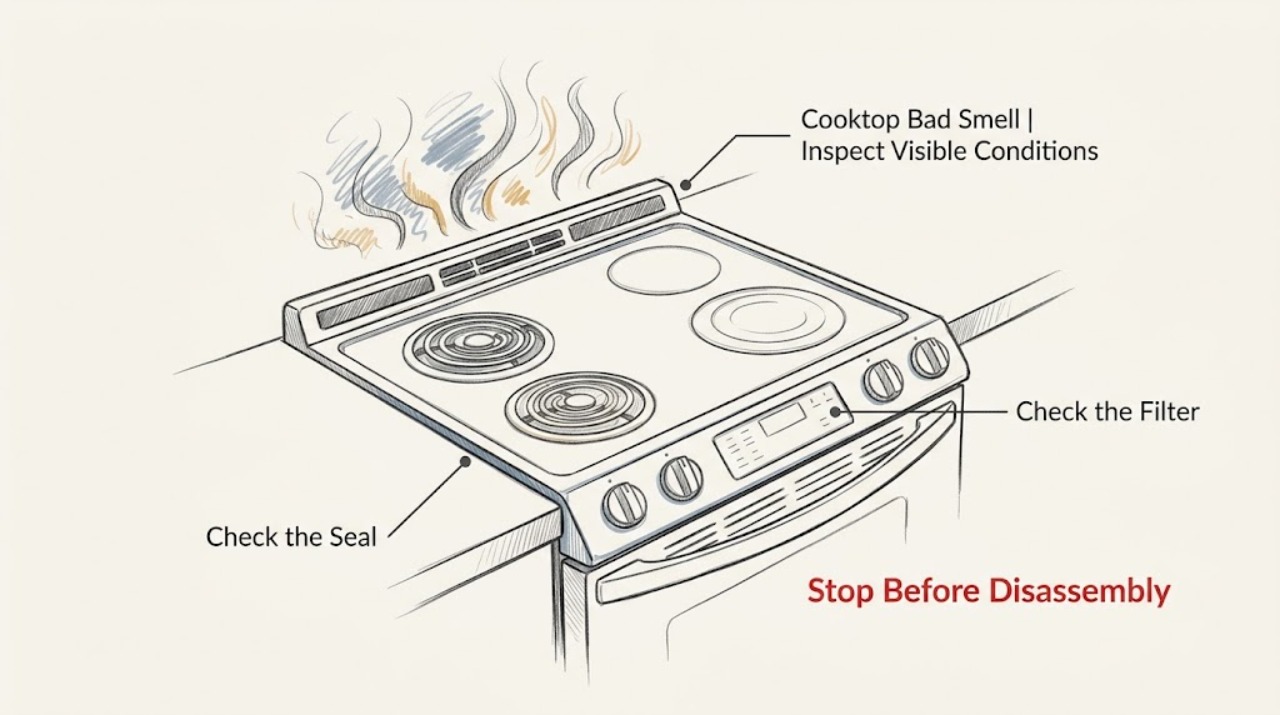
Work through in order
Diagnostic checks
Use only checks that match the exact appliance or system and its official guide.
-
Check 1
From a safe position, classify the odor and look for immediate danger without touching hot surfaces: gas or rotten-egg odor, smoke, flame outside the burner, sparks or arcing, a glowing or melting control, severe heat, a cracked glass surface, or a cooktop that will not shut off. If any is present, stop using the cooktop and do not perform further tests.
Expected result: The odor is gas-like or accompanied by smoke, sparks, arcing, unusual heat, visible melting, a cracked surface, loss of control, or a carbon-monoxide alarm; or it is a mild food, grease, cleaner, paint, or new-product odor with no hazard.
Next step: For suspected gas, do not light an appliance, touch electrical switches, or use a phone inside; leave and contact the gas supplier or emergency services from outside. For smoke, fire, sparks, arcing, or a cracked surface, leave immediate danger and use emergency help as appropriate, then arrange qualified service. Otherwise continue to identify the appliance type and source of the odor.
Why this matters
Why: Gas and electrical/fire symptoms are safety faults, not ordinary residue. A cool, controlled appliance with a non-gas odor can proceed to a limited external inspection.
-
Check 2
Identify the Wolf appliance as gas, electric radiant, or induction from the model documentation and observe when the odor appears: with the cooktop off, only during burner ignition, only after a new installation or first use, only after a spill or cleaning, or whenever a heating zone is used. Do not intentionally reproduce a hazardous odor.
Expected result: Gas odor is present while off or persists after ignition; a mild odor occurs only briefly during gas ignition or first LP use; odor follows a recent paint or wood-stain project; or odor follows a spill, cleaner, or initial break-in.
Next step: Treat any gas-like odor that is off-cycle, strong, or persistent as a gas-safety event. For a non-gas new-product or renovation odor with no warning signs, stop cooking, ventilate normally, and follow the exact use-and-care guide; for a spill or cleaner odor, wait for complete cooling before cleaning.
Why this matters
Why: Wolf says excessive or non-subsiding gas odor requires stopping use, while some odor can be noticed during gas ignition or first LP use. Wolf also notes that cooking products can heat paint or wood stain odors and that first-use cleaning removes manufacturing residue.
-
Check 3
After the cooktop is fully cool and residual-heat indicators are off, inspect only the visible surface, burner pan or grate area, control area, and the space immediately around the cooktop for food, grease, melted plastic, foil, a cleaning film, or a blocked ventilation opening. Do not scrape hot glass or remove sealed gas-burner components beyond the model instructions.
Expected result: There is visible food or grease residue, a cleaner film, or a melted item on a cool surface; or there is no visible residue and the smell returns whenever heat is applied.
Next step: If the surface is cool and the residue is accessible, clean only the parts and method listed for the exact Wolf model, rinse or remove cleaner residue as directed, and dry completely. If there is no residue, the smell returns, or the material has melted into or damaged the surface, stop and arrange qualified service rather than increasing heat or scraping aggressively.
Why this matters
Why: Residue can smoke or smell when heated. Wolf recommends cleaning its gas surfaces with model-appropriate mild products and removing cleaner residue; its induction guidance says to clean before first use, remove residue, and dry the surface. A repeat odor without visible residue is not proven to be a cleaning issue.
-
Check 4
Check the ventilation path externally: note whether the odor comes from the burner or heating surface, from the control area, or from a downdraft intake or duct. Confirm that visible filters or intake areas are not heavily soiled, and do not spray cleaner into vents or disassemble ductwork.
Expected result: The odor is localized to a visibly dirty downdraft filter or duct area, or it comes from a control, burner, element, wire, or other area with no accessible residue.
Next step: If the filter is accessible and the appliance is cool, clean it according to the model guide; persistent duct odor needs a qualified duct-cleaning provider. If the odor is from an electrical or gas component, or persists after the approved external cleaning, leave the cooktop off and arrange Wolf-qualified service.
Why this matters
Why: Wolf identifies odor from a downdraft air box or duct as potentially related to a dirty filter or duct, while an odor from a control or heating component is outside a safe consumer cleaning diagnosis.
-
Check 5
For a gas model only, record whether the odor is limited to the instant of ignition or continues while a burner is running, and whether the flame is stable and contained under the cookware. Do not repeat ignition to test it, adjust gas pressure, remove the connector, or move the appliance.
Expected result: A gas odor is excessive, continues during use, returns with the burner off, the flame is abnormal or delayed, or a carbon-monoxide alarm activates; or the odor was only a brief ignition or first-use observation and has fully stopped.
Next step: For any continuing, off-cycle, abnormal-flame, or alarm condition, leave the area, contact the gas supplier or emergency services from outside, and arrange qualified gas service. If the odor fully stopped and no hazard occurred, follow the model guide for normal operation; stop immediately if it returns.
Why this matters
Why: Wolf permits no continued use when gas odor is excessive or does not subside, and its safety guide prohibits relighting or operating electrical switches when gas is suspected. A transient first-use observation does not authorize repeated testing if the odor returns.
-
Check 6
For electric or induction models, once cool and safe, check for a visible cracked or severely pitted glass surface, a stuck control, a code, a fan or vent blocked by objects, or an odor that returns from one element. Do not remove panels or perform live electrical tests; if the cooktop is wet, damaged, arcing, or uncontrollable, do not re-energize it.
Expected result: The surface is cracked, a control is stuck, a code or over-temperature shutdown is present, an odor returns from a particular zone, or the surface is intact and the odor has gone after approved cleaning.
Next step: Keep a damaged, arcing, overheating, or uncontrollable unit off and arrange qualified service. Record the exact model, zone, code, operating state, and odor description. If it is intact and the odor has gone after the approved cool-surface cleaning, resume only according to the model guide and stop if it returns.
Why this matters
Why: Wolf says not to operate a broken glass-ceramic surface, describes overheating protection and service codes for induction models, and directs other maintenance to Factory Certified Service. A clean, intact surface with no returning odor is different from a repeat component odor.
Use your observations
Decision map
Find the observation that best matches what you see, then follow the next safe action.
-
PATH 01Next step
What you see
The odor smells like gas, is present while the cooktop is off, does not subside, or a carbon-monoxide alarm is active.
Do this next
Do not light anything or operate electrical switches. Leave immediately and contact the gas supplier or emergency services from outside; do not return to test the cooktop until the gas authority or qualified professional says it is safe.
-
PATH 02Next step
What you see
There is smoke, a flame outside the burner, sparking, arcing, a burning-plastic or electrical smell, severe heat, a cracked glass surface, or the cooktop cannot be turned off.
Do this next
Stop using it and avoid internal inspection. If there is immediate fire or smoke danger, leave and use emergency help; otherwise keep it de-energized only when that can be done safely and arrange qualified appliance or electrical service.
-
PATH 03Next step
What you see
A mild odor follows food, grease, cleaner, or a spill and the cooktop is cool, intact, and free of smoke or electrical symptoms.
Do this next
Clean only the accessible, model-approved surfaces after cooling; remove cleaner residue and dry completely. Do not apply cleaner to a hot surface or scrape a damaged glass surface.
-
PATH 04Next step
What you see
The odor began after painting or wood staining near the kitchen, or during a documented first-use/break-in period.
Do this next
Stop cooking, provide normal ventilation, and follow the exact Wolf use-and-care instructions. If the odor is strong, persists after the area has cured or the approved break-in is complete, or changes to gas/burning/electrical odor, arrange service.
-
PATH 05Next step
What you see
The smell is localized to a downdraft filter or duct and there is no cooktop smoke, gas odor, or electrical warning.
Do this next
Clean the accessible filter according to its guide. If odor remains, use a qualified duct-cleaning provider; do not disassemble ductwork or use the cooktop to mask the odor.
-
PATH 06Next step
What you see
The odor returns from a particular burner, element, control, or zone after approved cleaning, or a code or over-temperature event repeats.
Do this next
Leave the cooktop off, record the model, zone, code, and conditions, and arrange Wolf Factory Certified or other qualified service. Do not keep cycling the unit to reproduce the odor.
Helpful context
Understand the symptom
Start with the odor and the cooktop type
A gas-like odor is a leak or combustion-safety question, not a cleaning question. A burnt-plastic or electrical odor can mean an overheated control, wiring, or material on a hot zone. A food, grease, cleaner, paint, or new-product odor is more likely to involve residue, but it should only be investigated after the cooktop is cool and no warning signs remain. Wolf makes gas, electric, and induction cooktops, and their safe observations differ, so use the exact model and installation guide for any model-specific control or service step.
Keep the inspection external. Do not lift the cooktop, move a gas appliance to inspect its connector, open an electrical enclosure, probe live parts, defeat a safety control, or relight a burner to see whether the smell returns. A single safe observation can narrow the cause; repeated testing can turn a smell or heat problem into a fire, shock, or gas risk.
When checks do not resolve it
Need a professional?
Leave immediately and use gas or emergency services from outside for gas odor, a suspected leak, a carbon-monoxide alarm, smoke, or fire., Arrange qualified appliance or electrical service for a burning-plastic or electrical smell, sparks, arcing, a cracked glass surface, a stuck control, repeated overheating, a returning odor, or a breaker that trips., Use a qualified duct-cleaning provider when an odor remains in an accessible downdraft air box or duct after the approved filter cleaning., Do not move the appliance, open panels, adjust gas pressure, bypass controls, or relight a gas burner to test an odor.
Common questions
FAQ
Is a gas smell from a Wolf cooktop ever normal?
Wolf notes that some odor may be noticed during gas-burner ignition or first use of an LP product, but it says not to use the unit when the odor is excessive or does not subside. An odor while the cooktop is off, a returning odor, an abnormal flame, or a carbon-monoxide alarm requires gas-safety action rather than another test.
What should I do if my Wolf cooktop smells like burning plastic?
Stop using it and look only from a safe position for smoke, melting, sparks, arcing, unusual heat, or a damaged control or surface. Do not run it again to reproduce the smell or open panels. Arrange qualified appliance or electrical service, using emergency help for smoke or fire.
Can cleaner cause a bad smell on a Wolf cooktop?
Yes, residue from cleaning can smell when heated, and Wolf directs users to clean only after the surface has cooled, remove residue, and dry according to the model guide. If the smell persists after approved cleaning or appears with heat from one zone, stop using the cooktop and arrange service.
Why does a new Wolf cooktop smell?
Wolf's guides instruct owners to clean manufacturing residue before first use, and some initial break-in odor may occur. Follow the exact guide and normal ventilation instructions. A strong, persistent, gas-like, burning, smoky, or electrical odor is not something to burn off by repeated operation.
What if the smell comes from the downdraft instead of the cooktop?
Wolf says an odor from a downdraft air box or duct may indicate a dirty filter or duct. Clean an accessible filter according to its guide; if the smell remains, use a qualified duct-cleaning provider. Do not disassemble the duct or assume the cooktop is safe if there is also gas, smoke, or electrical odor.
When should I stop troubleshooting a Wolf cooktop odor?
Stop immediately for gas odor, smoke, sparks, arcing, severe heat, a cracked surface, an uncontrollable control, or a carbon-monoxide alarm. Also stop when an odor returns after the cooktop is cool and the approved external cleaning is complete; repeated heating is not a safe diagnosis.
Read the exact guide
Official sources
- Induction Cooktop Shuts Off during UseSub-Zero, Wolf, and Cove · Wolf induction cooktops and induction ranges; exact model and installation determine the applicable reset and service path
- Gas Range Care RecommendationsSub-Zero, Wolf, and Cove · Wolf gas ranges and related gas cooking surfaces; use the exact product guide for parts and methods
- Sealed Burner Rangetop Use and Care GuideWolf · Wolf sealed-burner gas rangetops; model-specific guides control for other Wolf gas products
- Wolf Electric and Induction Cooktops Cleaning and CareSub-Zero, Wolf, and Cove · Wolf electric and induction cooktops with glass-ceramic surfaces
- Downdraft Air Box or Duct OdorSub-Zero, Wolf, and Cove · Wolf downdraft ventilation systems connected to a cooktop or cooking product
- Gas Odor When Unit in UseSub-Zero, Wolf, and Cove · Wolf gas cooktops and other gas-burning cooking products; exact model instructions still apply
- gasU.S. Consumer Product Safety Commission · General U.S. consumer gas-appliance safety; local gas-utility and emergency instructions also apply
- Induction Cooktop Use and Care GuideWolf · Wolf induction cooktops covered by this use-and-care guide; verify the exact model
- Strong Odor When Using Cooking ProductSub-Zero, Wolf, and Cove · Wolf ovens and cooktops in areas recently painted or treated with wood stain
Community feedback
Share a repair observation
Share a plain-text repair observation. Accepted observations are published automatically; this page may take a moment to update.