
On this page
Start here
Quick answer
For a Wolf gas cooktop that will not ignite, first stop if you smell excessive or persistent gas, see an abnormal flame, or hear sparking when no burner is being used. Otherwise note whether the ignitor clicks, whether a spark is visible, and whether one burner or every burner is affected. With the control off and the cooktop cool, confirm the correct gas type, power supply, dry and clean ignitor, and correctly seated burner cap and head. If a burner still will not light after one model-appropriate attempt, leave it off and arrange Wolf Factory Certified Service; never open the gas path or defeat an ignition safety system.
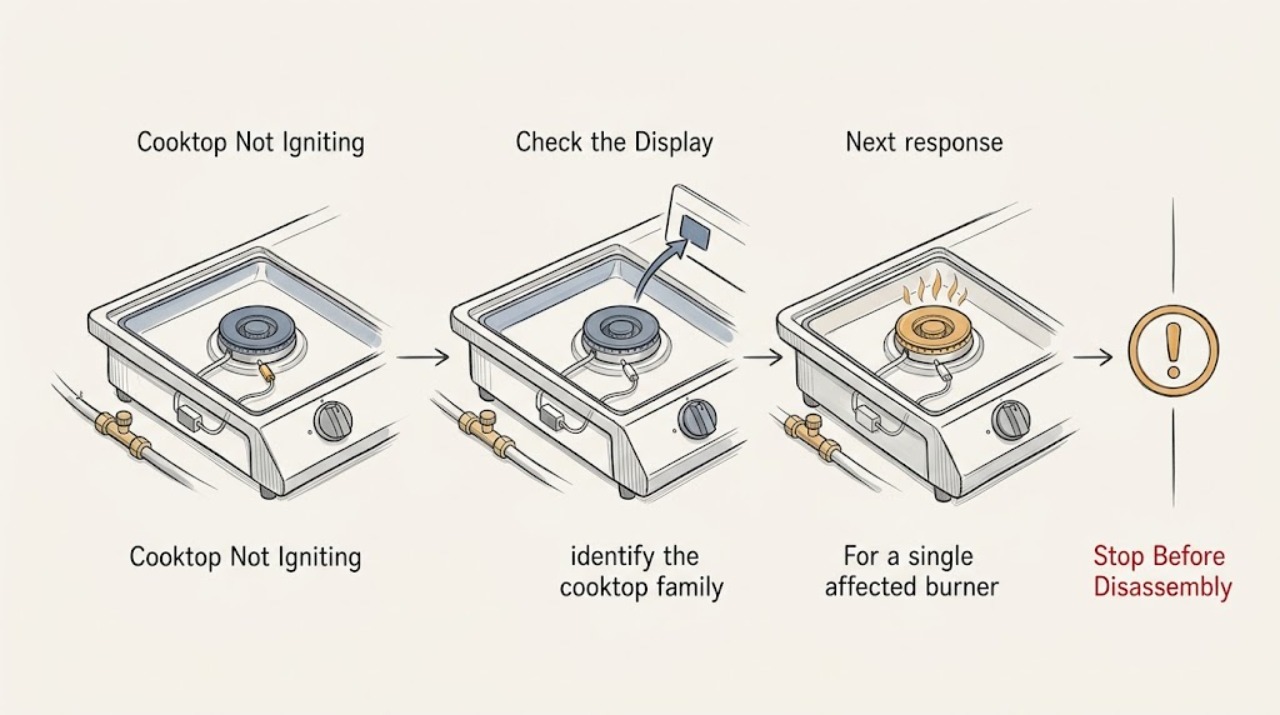
Work through in order
Diagnostic checks
Use only checks that match the exact appliance or system and its official guide.
-
Check 1
Turn every burner control to OFF and check for excessive or persistent gas odor, an abnormal flame, smoke, heat damage, or sparking while no knob is being operated.
Expected result: Gas odor remains, a carbon-monoxide alarm is active, a flame will not go out, sparking occurs at rest, or there is smoke or visible damage.
Next step: Do not try to light any burner or operate electrical switches. Leave the area, follow local gas-supplier or emergency instructions from a safe location, and arrange qualified service after the area is safe.
Why this matters
Why: This is a gas or electrical safety condition, not a routine ignition adjustment.
-
Check 2
With the cooktop off and cool, identify the cooktop family and gas type from its rating information or use-and-care guide, then check that the external power supply is present and the household protective device has not opened.
Expected result: Every burner has no click or spark, the unit has no power, the supply type does not match the installation record, or only one burner lacks a spark.
Next step: Restore only a normal external switch or protective-device state when there is no hazard. If power is absent, the device opens again, or the gas type is uncertain, leave the cooktop off and call a qualified electrician, installer, gas professional, or Wolf service.
Why this matters
Why: No click across the unit points toward power or shared ignition controls; one dead burner points toward its local electrode, switch, or burner area. A wrong gas type is an installation issue, not a knob setting.
-
Check 3
For a single affected burner, wait until it is cool, remove only the loose cap and head parts that the model guide identifies as user-removable, and check that they are clean, dry, centered, flat, and seated on the correct base.
Expected result: The cap or head is shifted, wet, dirty, cross-positioned, or has blocked visible ports; other burners ignite normally.
Next step: Clean gently as directed by the Wolf guide, allow all parts and the ignitor area to dry fully, reinstall them in their original positions, and make one normal ignition attempt. If the part is cracked, loose, or the burner still fails, stop and request service.
Why this matters
Why: A local assembly, moisture, or contamination problem can keep the spark from reaching the gas-air mixture even though the shared supply works.
-
Check 4
Operate the affected control only as the Wolf guide describes, observing whether there is a click, a visible spark, a flame, or a click that continues after a flame appears. Do not keep a control open while there is no ignition.
Expected result: There is no click or spark, there is a click and spark with no flame, or the ignitor keeps clicking after ignition.
Next step: Turn the control OFF and use the matching branch below. Do not open the gas path or attempt live electrical diagnosis; persistent clicking, a cracked electrode, or a repeated no-flame condition needs qualified service.
Why this matters
Why: No spark makes power, electrode, switch, or ignition-module causes more relevant; spark without flame makes gas flow, gas type, burner alignment, moisture, and port condition more relevant; continued clicking can follow moisture, pressure, airflow, or alignment changes.
-
Check 5
Compare the symptom across burners using only cool, dry, correctly seated parts: check whether all burners fail, one burner fails, or a burner lights on high but not at another setting. Remove an oversized pan before any normal test.
Expected result: All burners fail, only one fails, or a large pan changes the flame or clicking behavior.
Next step: Stop after the comparison rather than repeating ignition cycles. Give the result and the affected burner count to Wolf service, and use the exact product guide for the correct lighting setting.
Why this matters
Why: An all-burner failure makes shared power or gas supply more likely; a one-burner failure makes local assembly or ignitor parts more relevant; pan size and setting can change airflow and flame behavior.
-
Check 6
Inspect the knob externally for a stuck or depressed position and confirm that it springs back normally after release; also note whether sparking begins without touching a control.
Expected result: The knob stays depressed, feels stuck, or the cooktop sparks when no burner is in use.
Next step: Do not force the knob or continue testing. Keep the cooktop off, shut off the gas source if instructed and safely accessible, and arrange qualified Wolf or electrical service.
Why this matters
Why: A control or wiring fault can hold the ignition circuit active, and sparking at rest is not a normal way to operate the cooktop.
-
Check 7
After the visible checks are complete and no hazard exists, perform at most one model-appropriate power reset, then retest one burner once. Record the model, gas type, affected burner, click or spark result, flame result, and any odor.
Expected result: The burner works once, fails again, sparks continuously, shows a weak or abnormal flame, or produces gas odor without ignition.
Next step: Turn the control OFF and stop. Persistent failure, abnormal flame, continuous spark, or any concerning odor requires Wolf Factory Certified Service or the appropriate gas or electrical professional.
Why this matters
Why: A reset can clear a temporary ignition state but cannot confirm a gas-pressure, regulator, electrode, wiring, or control repair.
Use your observations
Decision map
Find the observation that best matches what you see, then follow the next safe action.
-
PATH 01Next step
What you see
Gas odor is excessive or persists, a carbon-monoxide alarm is active, a burner will not go out, or smoke or an abnormal flame is present.
Do this next
Do not light the cooktop or operate electrical switches. Leave the area and follow local gas-supplier or emergency instructions from a safe location; use qualified service once the area is safe.
-
PATH 02Next step
What you see
No burner clicks or sparks and the cooktop has no visible power.
Do this next
Check the external switch or protective device once when safe. If the supply remains absent or protection opens again, stop and call a qualified electrician or Wolf service.
-
PATH 03Next step
What you see
A single burner has no click or spark while other burners work.
Do this next
Check only its cool, dry, correctly seated cap and head. If the local ignitor remains inactive, do not open the cooktop; arrange qualified service for the electrode, switch, or ignition circuit.
-
PATH 04Next step
What you see
The ignitor clicks and sparks but no flame appears.
Do this next
Turn the control OFF. Check the correct gas type, accessible supply state, and clean dry burner assembly without opening gas connections. If the burner still will not light after one normal attempt, leave it off and request service.
-
PATH 05Next step
What you see
The burner lights but clicking continues, or clicking occurs while the burner is off.
Do this next
Turn the control OFF, let the area dry, and check the visible cap alignment. Continued or at-rest sparking is a stop point for qualified Wolf or electrical service.
-
PATH 06Next step
What you see
A flame is weak, lifting, the wrong color, or changes when a large pan is present.
Do this next
Turn the control OFF and remove the pan when cool. Do not adjust a regulator or gas connection; have gas supply, burner assembly, and ventilation conditions assessed by a qualified professional.
-
PATH 07Next step
What you see
The cooktop still will not ignite after the visible checks and one model-appropriate reset.
Do this next
Stop troubleshooting and provide Wolf service with the model, gas type, affected burners, spark result, flame result, and any code or odor. Do not disassemble the cooktop.
Helpful context
Understand the symptom
A Wolf gas cooktop uses an electric ignitor to create the spark, but the spark alone does not prove that gas is arriving or that the burner ports are assembled correctly. The useful split is: no click or spark, a click and spark with no flame, or a flame that lights and then behaves abnormally. Wolf has several cooktop and rangetop families, so model details and the gas type on the rating information matter.
The checks below are limited to the knob, visible burner parts, dry cleaning, and external supply observations. Do not remove a gas valve, regulator, injector, wiring cover, or live electrical cover. Do not keep allowing gas to flow while a burner is not lighting, and do not use a manual ignition method unless the exact product guide explicitly allows it and there is no gas odor.
Only after diagnosis
Potential parts
- surface burner cap or burner head
Relevant only when a cool visual inspection finds a damaged, incorrect, or persistently mis-seated burner part after cleaning and drying.
Confirm the exact Wolf model and burner position; appearance alone does not establish fit. - spark electrode or ignitor
Relevant only when a qualified check confirms no spark, a cracked electrode, or a local ignition fault after power and assembly checks.
Use the complete model identity and qualified fit verification before replacement. - spark switch or ignition module
Relevant only when shared or persistent clicking behavior and professional testing isolate the control path.
Electrical ratings and model fit are specific; do not infer this part from a no-flame symptom alone. - gas regulator or supply component
Relevant only when a qualified gas professional confirms supply pressure, gas type, or regulator failure after safe external checks.
Gas work and component selection require qualified installation and model-specific confirmation.
When checks do not resolve it
Need a professional?
Stop and seek qualified help for persistent or excessive gas odor, an active carbon-monoxide alarm, a flame that will not go out, abnormal flame color or lift, smoke, fire, sparking at rest, a cracked or loose ignitor, a repeated failure after one normal attempt, uncertain gas type, or any electrical supply problem. Do not open gas connections, adjust a regulator, bypass ignition safety, or work on live wiring.
Common questions
FAQ
Why does my Wolf cooktop click but not light?
A click and spark show that the electric ignitor is active, but they do not prove that gas is arriving or that the cap, head, ports, and ignitor are clean, dry, and aligned. Turn the control OFF, check only visible cool parts, and stop after one normal attempt if it still will not light.
What if there is no spark on any Wolf burner?
Check the external power state and household protective device when safe. If the cooktop still has no spark, or protection opens again, leave it off and arrange qualified electrical or Wolf service rather than opening the ignition system.
Can a wet burner stop a Wolf cooktop from igniting?
Yes. Wolf identifies a wet electrode or burner as a cause of poor ignition or continued clicking. Turn the control OFF, let the visible parts dry fully, and use only the model guide for cleaning; a cracked or loose ignitor needs service.
Why does my Wolf burner keep clicking after it lights?
Moisture, burner alignment, gas pressure, or airflow can affect the ignition signal. Turn the burner OFF, let it dry, and check visible cap alignment. Clicking while the burner is off or continued clicking after a normal check is a stop point for qualified service.
What should I do if I smell gas while the Wolf burner will not ignite?
Do not try to light the burner or operate electrical switches. Leave the area, follow local gas-supplier or emergency instructions from a safe location, and do not use the cooktop again until the gas concern has been handled and qualified service confirms it is safe.
Read the exact guide
Official sources
- Gas Odor When Unit in Use | FAQ | Sub-Zero, Wolf, and CoveWolf / Sub-Zero Group · Wolf gas odor, gas-source shutoff, carbon-monoxide alarm, and service safety boundary
- Wolf Gas Surface Burner Ignition | How to GuideWolf / Sub-Zero Group · Wolf gas burner ignition behavior, moisture, alignment, electrode condition, and service
- Wolf Gas Surface Burner Does Not Ignite | How to GuideWolf / Sub-Zero Group · Wolf gas surface-burner ignition causes, power, gas type, burner assembly, and service guidance
- Wolf CG Gas Cooktop Surface Burners Click or Do Not IgniteWolf / Sub-Zero Group · Wolf CG gas cooktop burner cleaning, drying, cap alignment, power, pan size, and service
- Wolf Gas Surface Burner Operation | FAQ | Sub-Zero, Wolf, and CoveWolf / Sub-Zero Group · Wolf gas burner control operation and correct ignition setting
- Wolf Gas Surface Burner Clicking | How to GuideWolf / Sub-Zero Group · Wolf gas burner clicking, unwanted sparking, cap alignment, and electrician or service boundary
- Gas Surface Burner Flame Location | FAQ | Sub-Zero, Wolf, and CoveWolf / Sub-Zero Group · Wolf sealed and open burner flame location, settings, and pan-related ignition behavior
Community feedback
Share a repair observation
Share a plain-text repair observation. Accepted observations are published automatically; this page may take a moment to update.