
On this page
Start here
Quick answer
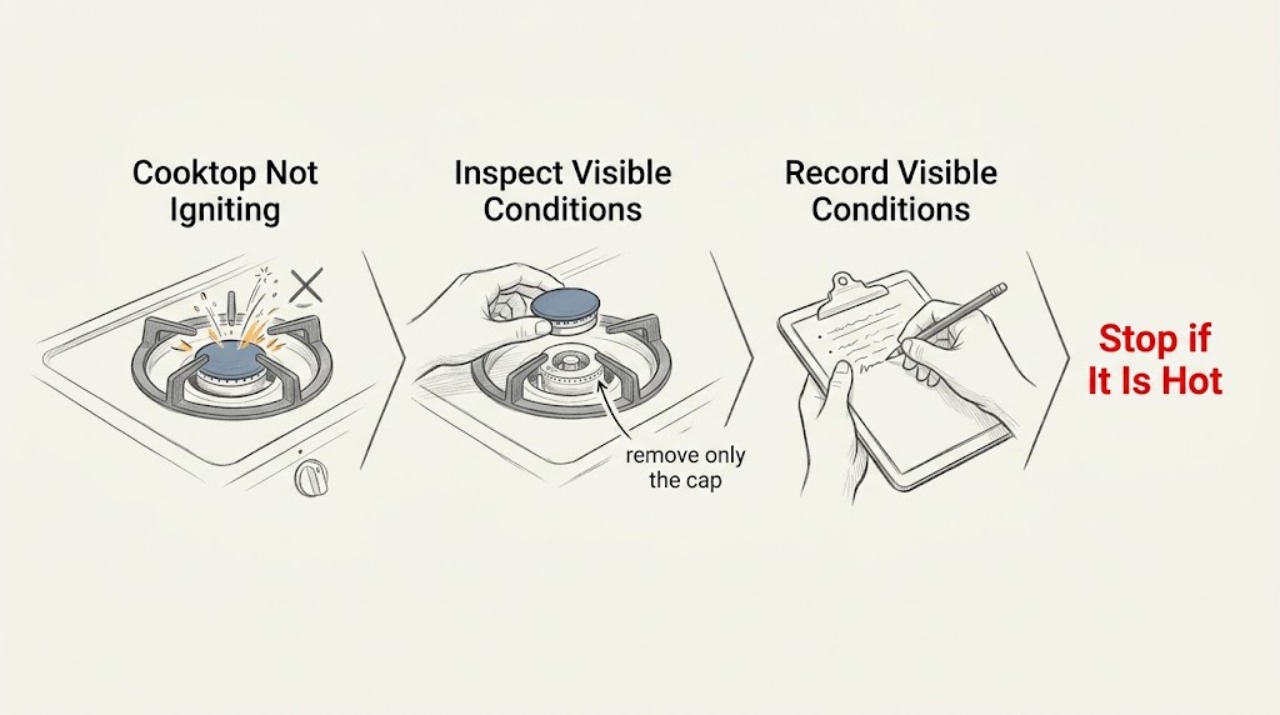
"Not igniting" applies to a gas cooktop; radiant electric and induction cooktops do not create a gas flame, so their equivalent symptom is a zone not heating. First confirm the energy type and model. On a gas cooktop, turn the control to the model's Ignite or Lite position only briefly and observe whether there is a click or spark, whether gas is heard or smelled, and whether a flame appears. Turn the control off if a burner does not light. A wet or dirty burner, blocked port, wrong or displaced cap, control lock, loss of power, or gas-supply problem can prevent ignition. Never keep releasing gas while a burner is unlit. Stop immediately for a persistent gas odor, delayed burst ignition, abnormal yellow or unstable flame, smoke, arcing, or electrical damage; leave for suspected gas leakage and contact the gas utility or emergency service from a safe location.
Work through in order
Diagnostic checks
Use only checks that match the exact appliance or system and its official guide.
-
Check 1
Read the rating label and manual to confirm whether the cooktop is gas, radiant electric, or induction. If it is not gas, stop using the word Ignite: record whether a heating zone or induction pan is not heating and switch to the model's correct support path.
Expected result: The appliance has gas burners, or it has electric/induction zones with no flame system.
Next step: For gas, continue to the click, cap, port, and supply checks. For electric or induction, keep the surface off and use the exact model manual for the no-heat symptom or arrange service.
Stop if: Do not apply a flame, open a gas supply, or remove covers on a radiant electric or induction cooktop.
Why this matters
Why: Only a gas cooktop has burner ignition, gas ports, and an igniter. Applying gas-burner checks to an electric or induction surface can create an unsafe or irrelevant test.
-
Check 2
On a confirmed gas cooktop with no suspected leak, turn one control to the exact model's Ignite or Lite position briefly, then turn it off if no flame appears. Observe whether the igniter clicks or sparks, whether the burner lights promptly, and whether all burners behave the same; never hold the control open while a burner is unlit.
Expected result: There is no click or spark, there is clicking/spark without flame, one burner fails while others work, or every burner fails.
Next step: Use the matching branch and keep each observation brief. If gas odor remains, stop all testing and follow the gas-safety branch.
Stop if: Turn the control off and stop if there is no flame, a delayed burst, persistent clicking with gas odor, smoke, arcing, or an abnormal flame.
Why this matters
Why: No click points toward power, lockout, switch, or igniter operation. Clicking without flame shifts attention to gas flow, moisture, ports, cap placement, or supply. A single failed burner differs from an all-burner failure.
-
Check 3
With the surface cool and controls off, remove only the cap and burner parts that the exact manual identifies as user-removable. Check that the cap matches its base, sits flat and centered, and that visible ports are clean and dry; after cleaning or a spill, let parts dry thoroughly before reassembly.
Expected result: The cap is wrong, tilted, loose, wet, dirty, or the visible ports are obstructed, or the parts are correctly matched, seated, and dry.
Next step: Clean and dry only as the manual permits, reinstall each matching cap and head, and make one normal brief ignition observation. If the burner still fails, stop repeated attempts and arrange service.
Stop if: Do not enlarge ports, use improvised objects, put parts in a dishwasher unless the manual allows it, or clean around a suspected gas leak or damaged igniter.
Why this matters
Why: Manufacturers identify wet or dirty ports, a misplaced electrode, and mismatched or poorly seated caps as common no-ignition causes. Correct seating can restore the flame path; a clean, dry, correctly assembled burner with no ignition needs another branch.
-
Check 4
If there is no click or no burner lights, check only the user-accessible power state and model controls: confirm the control is fully in Ignite/Lite, look for a control or cooktop lock, and check for an obvious tripped breaker or loss of power without opening the appliance. Do not reset a breaker repeatedly.
Expected result: The lock was active, the control was not in the ignition position, power is absent, or power and controls appear normal but no igniter operates.
Next step: Use the exact manual's one-time unlock or normal power-restoration step if applicable. If ignition remains absent, keep the cooktop off and arrange qualified service rather than opening it.
Stop if: Do not bypass a lockout, touch wiring, work inside the control area, or continue after a hot connection, smoke, spark, or repeated breaker trip.
Why this matters
Why: Electronic ignition needs power even when the cooktop uses gas for heat. A lockout can allow a click or display behavior while preventing ignition; persistent no-click with normal power points toward a control or igniter fault.
-
Check 5
If the igniter clicks or sparks but the burner does not light, verify only from a safe position that the household gas supply is available and the appliance's model-specific shutoff is in its normal operating position. Do not loosen a line, move the cooktop, or use a flame to find gas flow; stop the control between observations.
Expected result: All burners fail with spark, one burner fails with spark, gas supply is unavailable, or the supply appears normal but the burner still will not light.
Next step: If supply is unavailable after a recent installation, contact the installer or gas provider. If supply appears normal or the issue is one burner, stop testing and arrange qualified appliance service.
Stop if: Do not keep a knob open to purge air, relight repeatedly, alter a regulator, or inspect a connector when gas is suspected.
Why this matters
Why: An all-burner failure with spark can indicate supply or pressure; a single-burner failure points more toward that burner assembly or igniter position. Gas pressure and internal valves cannot be confirmed safely by a user.
-
Check 6
When a burner does light, observe the flame only briefly from a safe position. Note whether ignition is delayed, produces a burst, fails to stay lit, is unstable or unusually yellow, or leaves soot; stop the burner if the flame is abnormal and do not continue cooking to see whether it improves.
Expected result: The flame is prompt and stable, or it is delayed, bursting, yellow/sooty, unstable, repeatedly extinguishing, or accompanied by gas odor.
Next step: For any delayed, burst, abnormal, or unstable flame, turn the control off and arrange qualified service or gas-provider evaluation. Do not adjust the air shutter, regulator, or burner yourself.
Stop if: Stop immediately for a gas odor, delayed ignition, flame outside the burner, smoke, soot, continuous spark, or a flame that will not stay lit.
Why this matters
Why: Prompt stable ignition supports correct cap and normal operation. Delayed or burst ignition can allow gas to accumulate before lighting; abnormal color, soot, or instability can indicate fuel, air, pressure, burner, or combustion problems.
-
Check 7
If a gas smell persists with controls off, or there is hissing, smoke, arcing, damaged wiring, a hot connection, or a carbon-monoxide alarm or related symptoms, stop immediately, leave the area, and contact the gas utility or emergency service from outside or another safe location. Do not return to restart or inspect the cooktop.
Expected result: The hazard symptom is present, or the cooktop only had a brief failed-ignition attempt with no continuing odor or abnormal symptom.
Next step: For any hazard symptom, remain out until qualified responders declare the area and appliance safe, then arrange service. If no hazard symptom remains, return only to the appropriate cap, moisture, power, or service branch.
Stop if: Do not operate switches, lights, phones, flames, or the cooktop in a suspected gas leak; do not move the appliance or perform internal electrical or gas work.
Why this matters
Why: Persistent gas odor is a possible leak, while smoke, arcing, and hot electrical connections are fire or shock warnings. A carbon-monoxide alarm is urgent even though carbon monoxide itself cannot be smelled.
Use your observations
Decision map
Find the observation that best matches what you see, then follow the next safe action.
-
PATH 01Safety boundary
What you see
The appliance is radiant electric or induction rather than gas.
Do this next
Do not attempt ignition; keep the surface off and use the exact model's no-heat or cookware guidance, or arrange service.
Why this path and its safety boundary
Safety stop: Continue with gas-cooktop ignition checks.
-
PATH 02Safety boundary
What you see
One gas burner does not ignite, while other burners click and light normally.
Do this next
With the surface cool and controls off, inspect that burner's matching cap, visible ports, and moisture as the manual permits; clean, dry, reseat once, and arrange service if it still fails.
Why this path and its safety boundary
Safety stop: If every burner fails, follow the power, lock, and gas-supply branch.
-
PATH 03Safety boundary
What you see
The igniter does not click or spark when the control is correctly placed in Ignite/Lite.
Do this next
Check the model's user-accessible lock and obvious power state once; if normal power does not restore clicking, arrange qualified service.
Why this path and its safety boundary
Safety stop: Clicking without flame points toward cap, port, moisture, gas supply, or burner service checks.
-
PATH 04Safety boundary
What you see
The burner clicks or sparks but gas does not light promptly.
Do this next
Turn the control off, allow no repeated gas release, and inspect only cool, user-removable cap/port parts; arrange service if correct assembly and dryness do not resolve it.
Why this path and its safety boundary
Safety stop: A prompt stable flame can be used normally while monitoring for recurrence.
-
PATH 05Safety boundary
What you see
The flame is delayed, bursts, is yellow or sooty, unstable, or repeatedly goes out.
Do this next
Stop the burner and arrange qualified appliance or gas-provider evaluation; do not adjust gas pressure, regulators, or air settings.
Why this path and its safety boundary
Safety stop: A prompt blue-looking stable flame with no gas odor supports normal operation under the manual.
-
PATH 06Safety boundary
What you see
Gas odor remains when controls are off, or there is hissing, smoke, arcing, hot wiring, or a carbon-monoxide alarm or symptoms.
Do this next
Leave immediately, avoid switches, flames, and phones in the area, and contact gas or emergency services from a safe location; do not return to test.
Why this path and its safety boundary
Safety stop: Continue only with the applicable low-risk gas-burner checks and stop between brief observations.
-
PATH 07Safety boundary
What you see
The cap, ports, power, controls, and supply checks are correct but ignition still fails or the fault returns.
Do this next
Keep the cooktop off and arrange qualified service with the model, affected burner, click/spark result, flame behavior, and any gas or electrical symptom.
Why this path and its safety boundary
Safety stop: Document the correction and monitor normal operation under the exact manual.
Helpful context
Understand the symptom
Confirm the technology before diagnosing it. A gas cooktop has burner caps, ports, gas flow, and an igniter. A radiant electric or induction cooktop has no gas ignition system; if its zone does not heat, use the model's no-heat or cookware guidance instead. Do not try to light an electric or induction zone with a flame.
For a gas model, separate no-click from click-without-flame. No click points toward power, control lock, switch, or igniter operation. Clicking with no flame points toward moisture, a blocked port, cap placement, gas supply, or an unsafe amount of unburned gas. Turn the control off between brief observations and never continue if gas odor accumulates.
The exact manual controls cap matching, cleaning, fuel type, lockout, and service steps. User checks can cover the cool, removable cap and visible burner area when no leak is suspected. Internal igniters, valves, regulators, wiring, pressure, and any gas connector require qualified service.
When checks do not resolve it
Need a professional?
Provide the brand and model if known, gas or non-gas technology, affected burner, whether there is clicking or spark, cap and port condition, recent cleaning or spill, power result, gas-supply status, flame behavior, and any gas, smoke, heat, spark, or alarm symptom.
Have this ready
- Have the rating-label information, exact ignition position, number of failed burners, timing of any delay, photos of cool visible parts if safe, and the manual steps already completed ready for the service provider.
Common questions
FAQ
What does it mean if a gas cooktop does not ignite?
Separate no-click from click-without-flame. No click suggests power, lockout, switch, or igniter operation. Clicking without flame suggests a wet or blocked port, wrong or displaced cap, gas supply, or a burner fault. Turn the control off between brief observations and stop if gas odor remains.
Why is my burner clicking but not lighting?
Moisture after cleaning, dirt or a blocked port, a mismatched or unseated cap, loss of gas supply, or a control problem can cause this. With the surface cool and controls off, clean and dry only the user-removable parts allowed by the manual, then arrange service if the fault remains. Never keep releasing gas while it clicks.
Why do none of my gas cooktop burners ignite?
If none click, check the user-accessible power state and model lockout once. If all click but no burner lights, the gas supply or pressure may be unavailable. Do not loosen a gas connection or keep the controls open; contact the gas provider or qualified service as appropriate.
Is it safe to keep trying if a burner lights with a pop or delay?
No. Turn the control off for delayed or burst ignition, abnormal yellow or sooty flame, instability, repeated extinguishing, or persistent gas odor. These symptoms can indicate accumulated gas or a combustion or supply problem and require qualified appliance or gas-provider evaluation.
What if my electric or induction cooktop is not igniting?
Electric radiant and induction cooktops do not ignite a gas flame. Confirm the energy type and use the exact model's no-heat, power, control, or cookware guidance instead. Never apply a flame or gas-burner procedure to those surfaces.
When should I stop troubleshooting a cooktop burner?
Stop for persistent gas odor, hissing, delayed or burst ignition, abnormal flame, smoke, sparks, arcing, hot wiring, a repeated breaker trip, damaged glass, or a burner that still fails after the manual's cool, dry, correctly assembled checks. Leave immediately for suspected gas leakage and contact help from a safe location.
Read the exact guide
Official sources
- What can you do when the burner of your Samsung gas cooktop does not ignite or has other ignition issuesSamsung Support · Official gas-cooktop guidance used for general result meanings; the page concerns Samsung Canada products and exact model instructions control.
- Gas Range & Cooktop - Surface Burners Not Clicking, Not Trying to IgniteGE Appliances · Official manufacturer guidance used for no-click diagnosis; exact model instructions control.
- Burner Not Lighting - Gas CooktopWhirlpool Product Help · Official gas-cooktop guidance used for visible burner checks; the exact model manual controls cleaning tools and disassembly.
- Odors or SmellsWhirlpool Product Help · Official gas-cooktop guidance used for persistent gas-odor and flame-quality escalation; exact model instructions control.
- Carbon-Monoxide-Questions-and-AnswersU.S. Consumer Product Safety Commission · Government CO guidance relevant to suspected combustion or exhaust problems from a gas cooktop.
- Certain Older Gas Connectors May Be DangerousU.S. Consumer Product Safety Commission · Government gas-safety guidance for suspected leaks around a gas cooktop; local emergency instructions also apply.
- Gas Range & Cooktop - Common Causes for Slow Ignition, No Ignition or Clicking on Surface BurnersGE Appliances · Official manufacturer guidance used for common gas-burner no-ignition mechanisms; exact model instructions control.
- Lighting the Burners - Electronic IgnitionWhirlpool Product Help · Official gas-cooktop guidance used for the ignition control, click/spark, and cap branch; exact model instructions control.
- Burner(s) Sparking or Clicking - Gas CooktopWhirlpool Product Help · Official gas-cooktop guidance used to distinguish click/spark and moisture behavior; exact model instructions control.
- Nothing Will Work - Gas CooktopWhirlpool Product Help · Official gas-cooktop guidance used for all-burner, power, gas-supply, and lockout branches; exact model instructions control.
- CPSC Guide to Home Wiring HazardsU.S. Consumer Product Safety Commission · Government electrical-safety guidance for sparks, smoke, hot connections, damaged cords, and repeated electrical symptoms.
Community feedback
Share a repair observation
Share a plain-text repair observation. Accepted observations are published automatically; this page may take a moment to update.