
On this page
Start here
Quick answer
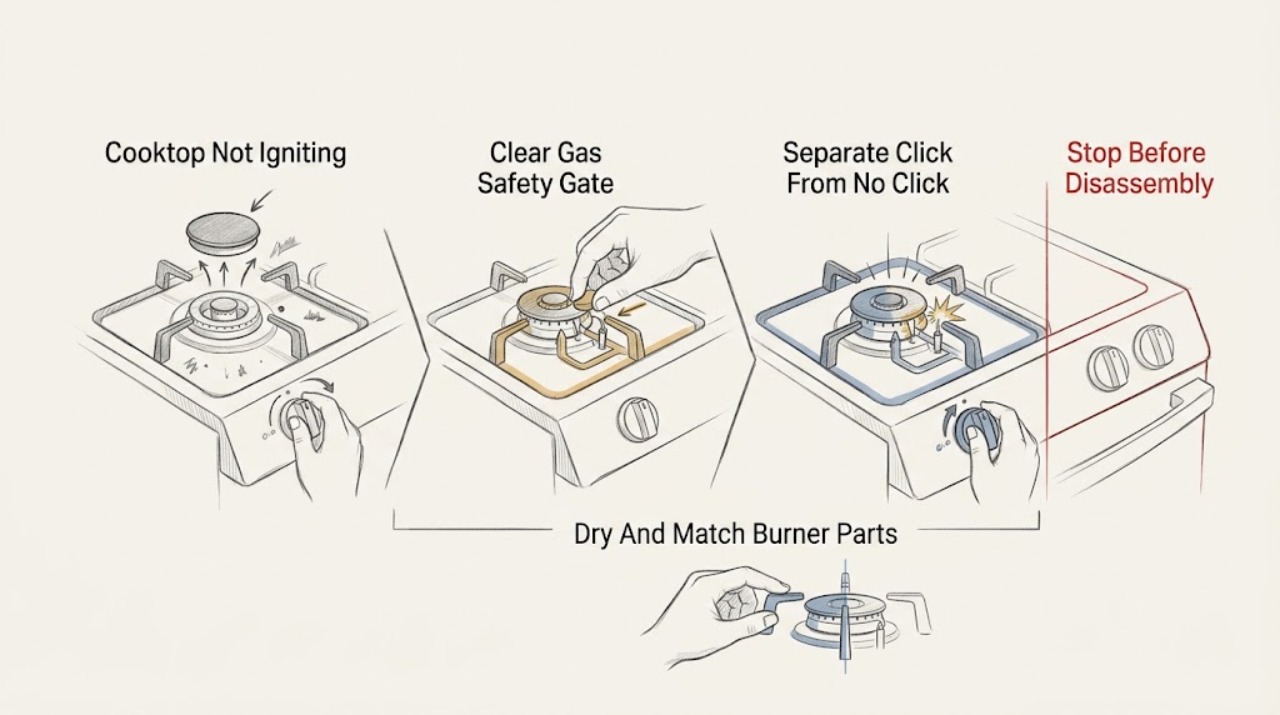
If a GE gas cooktop will not ignite, first make sure there is no gas odor. If you smell unburned gas, stop and leave rather than trying another burner. With no odor and the controls off, identify whether the selected burner clicks, confirm the correct cap and burner head are seated and dry, and check that the cooktop has power. A burner that clicks but does not light can have wet, dirty, or misaligned burner parts; no clicking on one burner points toward that burner’s ignition path, while no clicking on all burners or clicking that continues after the controls are off needs qualified service. Do not keep releasing gas into a burner that has not lit.
Work through in order
Diagnostic checks
Use only checks that match the exact appliance or system and its official guide.
-
Check 1
Before operating or cleaning anything, check from a safe distance for a rotten-egg or unburned-gas odor, and make sure the failed burner has not been left releasing gas.
Expected result: Any gas odor is present, increasing, or cannot be confidently ruled out.
Next step: Stop, avoid flames and electrical switches, leave, and contact the gas supplier or emergency responders from outside. If there is no odor, keep all controls off and continue only with the low-risk checks below.
Stop if: Stop immediately for any gas odor, fire, smoke, or illness.
Why this matters
Why: The issue is no longer a routine ignition check; unburned gas can ignite and must not be tested with another flame.
-
Check 2
With no gas odor and the cooktop area safe, identify whether the selected burner produces its normal spark clicking when its control is selected, then return the control to off if no flame appears promptly.
Expected result: There is clicking without a flame, no clicking on the selected burner, or no clicking from any burner.
Next step: Use the matching branch: inspect dry, cool, removable burner parts for the clicking case; check power and arrange service for a no-click case. Do not keep attempting ignition if gas odor appears.
Stop if: Stop all ignition attempts if gas odor appears, clicking continues after the control is off, or the burner does not light promptly.
Why this matters
Why: Clicking with no flame points toward burner moisture, blockage, or alignment; no click on one burner points toward that burner’s ignition path; no click anywhere points toward power or a shared ignition fault.
-
Check 3
Only when there is no gas odor and the controls are off and cool, disconnect power before maintenance; check whether spillover or cleaning left the burner head, ignition port, or flame ports wet or dirty, then let parts dry thoroughly and match each cap to its burner head using the model manual.
Expected result: Moisture, residue, a blocked port, or a cap that does not sit flat is found; or all parts are dry, clean, and correctly matched.
Next step: After parts are fully dry and correctly seated, make only the normal controlled ignition check if there is still no gas odor. If the burner remains unlit, arrange service rather than releasing more gas.
Stop if: Do not clean, reseat, or touch parts while hot, energized, or if any gas odor is present.
Why this matters
Why: GE lists wet or dirty ports and incorrectly matched or seated burner parts as common causes of clicking or no ignition. Correct seating is a useful low-risk check, but it does not prove the ignition or gas system is sound.
-
Check 4
For a no-click condition with no gas odor, check whether the cooktop is receiving power at its normal outlet or supply point and whether the appliance circuit has tripped, without opening the control area.
Expected result: The outlet or appliance has no power, the circuit has tripped, or other burners also have no click; alternatively power is present but the selected burner remains silent.
Next step: If power is absent, follow the home's normal electrical safety procedure and have an electrician or appliance technician assess a recurring trip. If power is present but ignition is silent, stop testing and arrange qualified appliance service.
Stop if: Do not repeatedly reset a tripping circuit, remove panels, or probe wiring.
Why this matters
Why: Loss of power can stop electric ignition across the cooktop. Power present with no click, especially on one burner, points toward an ignition component or wiring fault rather than burner-cap alignment.
-
Check 5
After the cooktop is safe to use and a qualified assessment has ruled out a gas hazard, note whether a burner lights with a stable blue flame, a long bright yellow flame, soot, delayed ignition, or clicking that persists after the control is off.
Expected result: The flame is abnormal, soot is present, ignition is delayed, or clicking continues after the control is off.
Next step: Keep the cooktop out of service and provide the observations to the gas supplier or qualified GE gas-appliance technician. Do not adjust gas components or repeat the test if odor returns.
Stop if: Stop and leave if any gas odor returns; stop use for abnormal flame, soot, delayed ignition, or persistent clicking.
Why this matters
Why: GE treats abnormal flame color or soot as a possible airflow, pressure, fuel-conversion, or orifice concern, and persistent clicking as a service condition.
Use your observations
Decision map
Find the observation that best matches what you see, then follow the next safe action.
-
PATH 01Next step
What you see
A gas odor is present, the burner may have released gas without lighting, or the odor source is uncertain.
Do this next
Leave, avoid flames and electrical switches, and contact the gas supplier or emergency responders from outside. Do not try another burner.
Why this path and its safety boundary
Why it matters: Treat the situation as a gas-safety event rather than an ignition fault.
-
PATH 02Next step
What you see
The burner clicks but does not ignite, there is no gas odor, and the failure followed cleaning or a spill.
Do this next
With controls off and cool, disconnect power, dry the parts thoroughly, and reseat the matching cap and head according to the model manual. If it still fails, arrange service.
Why this path and its safety boundary
Why it matters: Moisture, residue, blocked ports, or a mismatched cap and burner head are plausible causes.
-
PATH 03Next step
What you see
Only one burner has no click while other burners click normally and there is no gas odor.
Do this next
Confirm the cap and head are matched and seated after the cooktop is cool; if the selected burner remains silent, use qualified service.
Why this path and its safety boundary
Why it matters: The selected burner’s electrode, ignition path, or local burner setup is more likely than a whole-cooktop power loss.
-
PATH 04Next step
What you see
No burner clicks, the cooktop has no power, or the appliance circuit trips again.
Do this next
Stop resetting the circuit, do not open the appliance, and arrange appropriate electrical or qualified appliance service.
Why this path and its safety boundary
Why it matters: Power supply or a shared ignition system may be involved.
-
PATH 05Next step
What you see
Clicking continues after the control is returned to off, or a burner lights late or with soot or a long bright yellow flame.
Do this next
Keep the cooktop out of service and arrange qualified gas-appliance service; if odor appears, leave and contact the gas supplier from outside.
Why this path and its safety boundary
Why it matters: The ignition or combustion system needs professional assessment.
-
PATH 06Next step
What you see
The burner works after drying and correct seating, and the flame is normal with no returning odor.
Do this next
Use the cooktop normally while monitoring for renewed clicking, ignition delay, abnormal flame, soot, or odor; stop and arrange service if any returns.
Why this path and its safety boundary
Why it matters: A temporary moisture, residue, or alignment issue was plausible, but recurrence still matters.
Helpful context
Understand the symptom
Start with the gas-safety gate
A burner that fails to light can release gas. Before any check, confirm there is no rotten-egg or unburned-gas odor. If there is an odor, stop using the cooktop, avoid flames and electrical switches, leave the area, and contact the gas supplier or emergency responders from outside. Do not try to prove the diagnosis by lighting another burner.
Clicks separate the likely fault paths
GE gas cooktops use electric igniters. A click with no flame makes wet, dirty, blocked, or incorrectly seated burner parts more likely when the area is otherwise safe. No click on one burner narrows the concern to that burner’s electrode or ignition path; no click on any burner makes power or the shared ignition system more important. A click that continues after the control is off is a service boundary.
Dry and reseat only after the safety gate passes
If there is no gas odor and the controls are off and cool, a recent spillover or cleaning can leave moisture in the burner ports. Disconnect power before maintenance, allow parts to dry, and use the model manual to return each cap and burner head to its matching position. If the burner still does not ignite, or if the smell returns, stop and arrange service rather than repeating ignition attempts.
Safety boundary
Stop conditions
- Stop immediately and leave for any gas odor, fire, smoke, or illness.
- Do not keep attempting ignition or release gas into a burner that has not lit.
- Do not clean or reseat burner parts while they are hot, energized, or if gas odor is present.
- Do not repeatedly reset a tripping circuit, open panels, or probe appliance wiring.
- Stop use for persistent clicking after controls are off, delayed ignition, soot, or abnormal flame.
- Do not resume use after an odor returns until the gas supplier or qualified professional gives clearance.
Only after diagnosis
Potential parts
- spark ignition electrode
Consider this category only if qualified diagnosis finds that one burner has no spark after the cap, head, ports, and power are correct.
Confirm the complete cooktop model and burner position before selecting any ignition component. - spark ignition module
Consider this category only if multiple burners have no click or a qualified technician identifies a shared ignition-system fault with power present.
Ignition layouts vary by cooktop design; a qualified technician should verify the model-specific component and wiring. - burner cap or burner head
Consider this category only if a damaged or missing cap or head prevents correct seating after the parts are cool, dry, and matched.
Burner sizes and positions differ; verify the exact model and the matching burner location before replacement.
When checks do not resolve it
Need a professional?
Contact the gas supplier or emergency responders from outside immediately for any gas odor, suspected unburned gas, fire, smoke, or illness. After the gas-safety gate passes, arrange qualified appliance service for no clicking on one or all burners, a burner that still will not ignite after dry and correctly seated parts, clicking that persists when controls are off, delayed ignition, soot, or abnormal flame.
Common questions
FAQ
Why does my GE cooktop click but not light?
GE lists wet or dirty burner ports, a misplaced electrode, and a burner cap or head that is not correctly matched or seated as common causes. With no gas odor and the controls off and cool, dry and correctly reseat removable parts; persistent failure needs service.
What does it mean if there is no clicking at all?
If one burner is silent while others click, its local ignition path may be involved. If all burners are silent, check for loss of power without opening the appliance; if power is present or a circuit trips again, arrange qualified service.
Can I keep trying the burner if it does not light?
No. Stop repeated ignition attempts, especially if gas may have accumulated. If you smell unburned gas, leave and contact the gas supplier or emergency responders from outside; without an odor, arrange service if the burner does not light after the safe checks.
Is it normal for several GE burners to click?
GE explains that some sealed-burner models intentionally spark multiple igniters when one burner is selected. Clicking that continues after the control is off, however, requires service.
What if the burner lights with a yellow flame or leaves soot?
Keep the cooktop out of service and arrange qualified gas-appliance service. GE associates fully yellow flames or soot with possible airflow, gas-pressure, fuel, or orifice concerns; do not adjust those components yourself.
What information should I give the technician?
Tell the technician whether one or all burners fail, whether they click, whether the issue followed cleaning or a spill, whether power is available, and whether you observed delayed ignition, soot, abnormal flame, or any returning odor. Include the complete model and serial information.
Read the exact guide
Official sources
- Gas Range & Cooktop - One or More Burners Are ClickingGE Appliances · GE guidance on off-position clicking, moisture, and service
- Gas Range & Cooktop - Yellow Flames or Soot on Top BurnersGE Appliances · GE guidance on yellow flames and soot as combustion or fuel-conversion symptoms
- Gas Range & Cooktop - Electric Ignition for Surface BurnersGE Appliances · GE explanation of burner spark systems and persistent-clicking service boundary
- Gas Range & Cooktop - Common Causes for Slow Ignition, No Ignition or Clicking on Surface BurnersGE Appliances · GE guidance on wet or dirty burners, electrode seating, and matching burner caps and heads
- Gas Range & Cooktop - Burner Size and Normal OperationGE Appliances · GE guidance on normal blue flames and abnormal long bright yellow flames
- Gas Range & Cooktop - Surface Burners Not Clicking, Not Trying to IgniteGE Appliances · GE checks for correct burner selection, cap placement, and appliance power when burners do not click
Community feedback
Share a repair observation
Share a plain-text repair observation. Accepted observations are published automatically; this page may take a moment to update.