
On this page
Start here
Quick answer
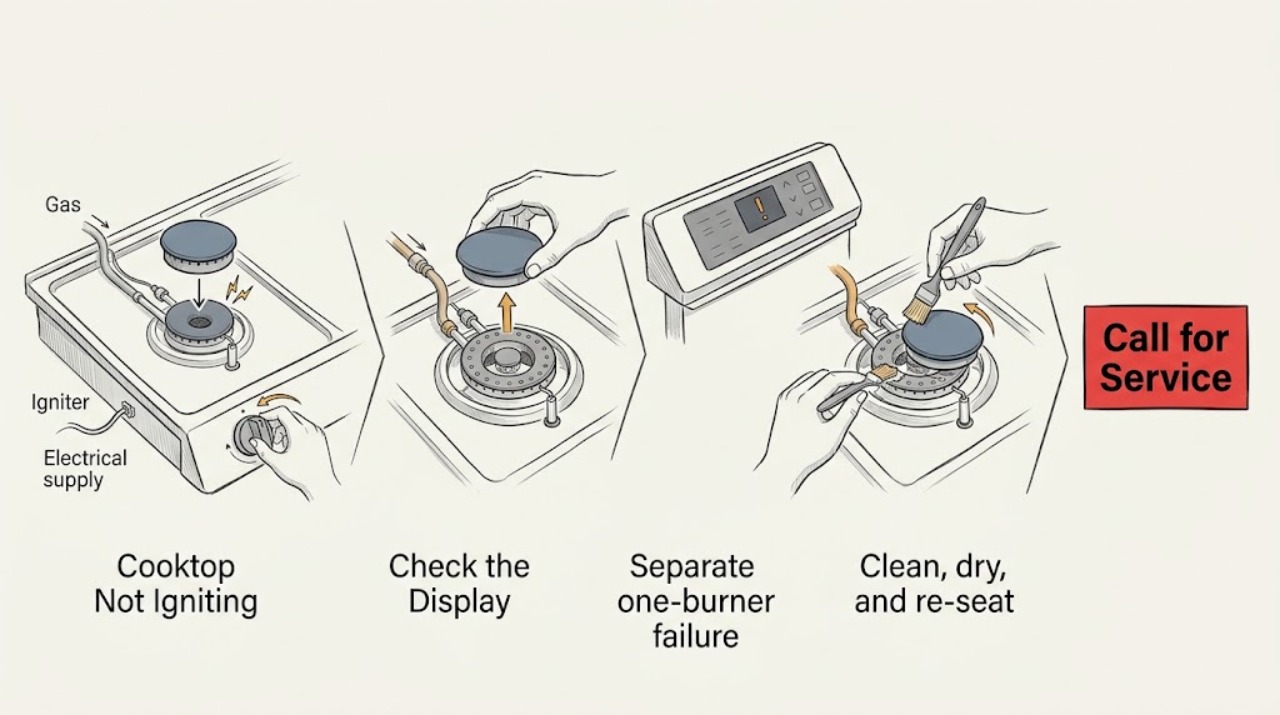
For a Thermador gas cooktop that will not ignite, first stop if you smell unburned gas, hear gas escaping, see a flare-up or delayed ignition, or the igniters continue clicking after every control is OFF. Turn the controls off, leave the area without operating switches or appliances, and contact the gas supplier or emergency help from outside. With no hazard and the cooktop cool, check the external power and gas supply, then clean and thoroughly dry the burner cap, ports, and igniter and re-seat the cap so its tabs fit the base notches. Try one burner briefly using the normal instructions. If other burners work but one does not, or if clicking, sparking, delayed ignition, an abnormal flame, or no ignition remains, stop and arrange qualified Thermador gas-appliance service; do not remove the cooktop or open a gas fitting.
Work through in order
Diagnostic checks
Use only checks that match the exact appliance or system and its official guide.
-
Screen for gas, fire, and uncontrolled ignition hazards
Before trying the knob again, observe from a safe position whether there is an unburned-gas odor, a hissing sound, a flare-up, delayed ignition, smoke, soot, an unusual flame, or clicking/sparking while every knob is OFF. Do not lean over the burners, create a flame, or touch a hot surface to investigate.
Expected result: There is gas odor or a hissing sound, a delayed ignition or flare-up, smoke or fire, an unstable flame, or clicking/sparking continues with the controls OFF; or the cooktop is simply not igniting and no hazard is present.
Next step: For any suspected gas leak, leave the building without operating electrical switches or appliances and contact the gas supplier, fire department, or emergency help from outside. With no hazard, keep all controls OFF and continue only with cool, external checks.
Stop if: Stop immediately for unburned-gas odor, hissing, delayed ignition, a flare-up, smoke, fire, an abnormal flame, or sparking/clicking that continues with all knobs OFF.
Why this matters
Why: Gas, fire, delayed ignition, flare-up, or uncontrolled sparking is a stop condition, not a cleaning opportunity. If there is no hazard, the next useful distinction is whether the problem affects one burner or all burners and whether the display or spark system has power.
-
Separate one-burner failure from a whole-cooktop supply or power issue
With no odor and the cooktop cool, note whether one burner fails or every burner fails. Check that the appliance has its normal external electrical supply and that the accessible gas shutoff is in its normal open position only if the model instructions permit that check. Do not move the cooktop, loosen a connector, adjust a regulator, or open a panel.
Expected result: Other burners ignite normally, all burners fail, the display or spark system is dead, the shutoff appears closed or uncertain, or the external power and gas positions are correct.
Next step: If the gas position is uncertain or power will not hold, stop and arrange qualified service or an electrician as appropriate. If there is no odor and the external conditions are clearly normal, inspect the accessible burner parts after they are cool.
Stop if: Stop if a breaker trips again, the gas position cannot be confirmed safely, any gas component may have been disturbed, or any odor appears.
Why this matters
Why: One failed burner makes a local cap, port, or igniter issue more likely. Failure of all burners or a dead spark system can involve the external supply, power, controls, or ignition system. An uncertain gas position is not permission to manipulate gas hardware.
-
Clean, dry, and re-seat the affected burner cap
After the burner is completely cool and its control is OFF, remove only the accessible cap and, if the model care instructions allow, clean the cap with hot soapy water and a soft cloth without soaking it. Clean the burner base with mild detergent and a soft cloth; use a stiff nylon toothbrush for visible port openings without scratching or enlarging them. Wipe the igniter carefully, remove lint, dry everything thoroughly, and return the cap with its tabs aligned to the base notches.
Expected result: The cap was wet, dirty, warped, or not seated flat; the ports were obstructed; the igniter was damp or dirty; or the parts were already clean, dry, and correctly positioned.
Next step: Allow all accessible parts to dry completely, then make one brief normal ignition attempt with a suitable pan on the grate if the manual calls for it. If it still does not ignite, or the cap cannot sit flat, stop and arrange service.
Stop if: Do not use pins, drills, knives, or wires to enlarge openings; do not touch wiring, remove the burner base assembly, or continue if gas odor, a flare, or abnormal flame appears.
Why this matters
Why: Moisture, residue, blocked ports, or a misaligned cap can prevent ignition or produce an uneven flame. If the pieces are already clean, dry, and correctly seated, repeated cleaning is unlikely to resolve a failed spark or fuel/control fault.
-
Make one brief, supervised ignition observation
Only with no gas odor and all accessible parts dry and seated, follow the exact model instructions for one ignition attempt. Observe from the side whether the affected burner produces a normal spark and lights promptly, whether it clicks without lighting, or whether it lights with a delayed whoosh, flare, or abnormal flame. Keep hands, face, and loose materials away from the burner.
Expected result: The burner lights promptly with a stable normal flame; there is no spark; there is spark but no flame; clicking continues; or ignition is delayed and accompanied by a flare, persistent odor, smoke, yellow flame, or soot.
Next step: If the burner does not light normally on this one attempt, turn the control OFF and arrange qualified Thermador gas-appliance service. Do not repeat attempts to purge gas, manually light the burner, or dismantle the gas path.
Stop if: Stop at once for delayed ignition, a flare-up, persistent gas odor, smoke, soot, a yellow or unstable flame, or continuous clicking/sparking after the control is OFF.
Why this matters
Why: A normal flame after drying and re-seating supports a moisture, residue, or cap-position explanation. No spark can involve the igniter, power, wiring, or control; spark without flame can involve the gas supply or burner path. Delayed ignition, flare, persistent odor, smoke, soot, or an unstable flame indicates unsafe combustion or fuel behavior and requires a stop.
-
Use the service boundary instead of opening the gas appliance
If the cooktop still will not ignite after the external power/supply check and one clean, dry, correctly seated burner test, record whether the failure is limited to one burner, whether a spark is present, and any fault, odor, flame, or clicking behavior. Have the complete model information ready for qualified service; do not remove the cooktop or attempt valve, regulator, or orifice work.
Expected result: The problem returns, the spark system behaves abnormally, the flame is not stable, a gas odor remains, or the cooktop works normally after the single safe retest.
Next step: Stop using the affected burner and schedule qualified Thermador service for any repeat failure or abnormal behavior. If gas odor is present, leave and contact the gas supplier or emergency help from outside; do not reproduce the symptom for the technician.
Stop if: Stop all troubleshooting for gas odor, delayed ignition, flare-up, smoke, soot, abnormal flame, persistent clicking, electrical damage, or any need to access gas or energized components.
Why this matters
Why: A repeat failure needs diagnosis of the ignition, gas supply, burner, control, or related component; the observations do not identify a safe do-it-yourself replacement. A normal retest supports closing the case while monitoring for recurrence.
Use your observations
Decision map
Find the observation that best matches what you see, then follow the next safe action.
-
PATH 01Safety boundary
What you see
Gas odor, hissing, delayed ignition, flare-up, smoke, fire, soot, or an abnormal flame is present.
Do this next
Do not try to ignite the cooktop or operate switches and appliances. Leave the area immediately and contact the gas supplier, fire department, or emergency service from outside or another safe location.
Why this path and its safety boundary
Safety stop: True
-
PATH 02Safety boundary
What you see
A burner clicks or sparks while its knob is OFF, or clicking continues after the control is returned to OFF.
Do this next
Keep the controls OFF. If there is no gas odor, allow the surface to dry fully and check cap position once; if clicking persists, stop using the cooktop and arrange authorized service. For any odor, leave immediately and call from outside.
Why this path and its safety boundary
Safety stop: True
-
PATH 03Next step
What you see
Only one burner fails while other burners ignite normally, and the cap, ports, and igniter are wet, dirty, or misaligned.
Do this next
With the cooktop cool and OFF, clean the accessible parts, dry them completely, align the cap tabs with the base notches, and make one brief model-approved retest. Escalate if it still fails.
-
PATH 04Safety boundary
What you see
All burners fail, the spark system is dead, the external power does not hold, or the gas shutoff position is uncertain.
Do this next
Do not open the appliance or manipulate gas fittings. Stop and arrange qualified appliance or electrical service after recording the model and the external observations.
Why this path and its safety boundary
Safety stop: True
-
PATH 05Next step
What you see
The burner lights promptly with a stable flame after one dry, correctly seated, model-approved retest.
Do this next
Return the control to the normal setting and monitor the burner. If clicking, odor, delayed ignition, flare-up, smoke, soot, or an unstable flame returns, stop using it and arrange qualified service.
Helpful context
Understand the symptom
Treat ignition symptoms as a gas-and-electric decision
A Thermador gas cooktop needs both a fuel path and electrical ignition. One burner failing while the others work points toward that burner’s cap, ports, or igniter; no burners working can also involve the supply or electrical feed. Use only external, model-approved observations. Do not move the appliance, remove panels, or loosen a regulator, valve, connector, or other gas fitting.
Moisture and cap position are safe first checks
Cleaning water, a boil-over, food in the ports, or a cap that is not flat can prevent the spark from lighting the gas or can make the flame uneven. Once the cooktop is off and cool, clean only the accessible burner pieces according to Thermador’s care guidance, dry them completely, and confirm the cap tabs fit the base notches. A wire or tool must never be used to enlarge a port.
Know when the test must stop
A brief start-up odor can differ from an odor that persists, returns, or accompanies delayed ignition. Continuous clicking or sparking with the controls off, a flare-up, yellow or unstable flame, smoke, or soot is not a cue to keep testing. Stop, clear the area for any suspected gas leak, and use qualified service for the appliance diagnosis.
Only after diagnosis
Potential parts
- burner cap or burner head
Consider this category only if the cap cannot seat correctly, is damaged, or qualified diagnosis links a persistent one-burner failure to the burner hardware after cleaning and drying.
Confirm the complete Thermador model and manufacturer fit information; do not substitute a cap by appearance or operate with a damaged or missing burner part. - gas igniter or electrode
Consider this category only when the model-specific diagnosis confirms no spark or an ignition fault after the igniter is clean, dry, and correctly positioned.
Verify model-specific service information and disconnect power through the approved procedure before any qualified repair; do not touch or replace energized ignition parts. - ignition control or gas valve
Consider this category only after qualified service distinguishes a control, valve, regulator, or supply fault from a cap, port, or igniter issue.
Gas-path and electrical-control components require model verification and qualified installation; never open a gas fitting or choose a component from an external appearance match.
When checks do not resolve it
Need a professional?
Call qualified Thermador gas-appliance service for persistent no-ignition, no spark, spark without flame, continuous clicking, delayed ignition, an abnormal flame, a returning fault, or any suspected gas-path or electrical fault. For suspected gas leakage, leave first and contact the gas supplier or emergency help from outside.
Common questions
FAQ
Why will one Thermador cooktop burner not ignite while the others work?
A local problem with the burner cap position, port openings, moisture, residue, or igniter is more likely when the other burners work. With the cooktop cool and no gas odor, clean and dry the accessible parts, align the cap tabs with the base notches, and make one normal retest. Persistent failure needs qualified service.
Why does my Thermador cooktop keep clicking or sparking?
Thermador lists moved caps, wet or clogged ports, damp igniters, a gas-supply condition, drafts, and model-specific re-ignition behavior among the possible causes. Check only the cool, accessible cap and drying steps once. Clicking with the control OFF that persists after drying is a service boundary; any gas odor or abnormal flame requires immediate evacuation and outside help.
Can I clear a Thermador burner port with a pin?
No. Use the manufacturer’s low-risk cleaning method for the model: a soft cloth for the cap and base and a stiff nylon toothbrush for visible port openings, followed by thorough drying. Do not gouge, enlarge, or dismantle the burner path.
What should I do if I smell gas while the Thermador cooktop will not ignite?
Do not keep trying the burner. Leave the building, do not operate electrical switches or appliances, and contact the gas supplier, fire department, or emergency service from outside or another safe location. Do not move the cooktop or inspect its connector yourself.
When should I stop troubleshooting a Thermador cooktop that will not ignite?
Stop for gas odor, hissing, delayed ignition, a flare-up, smoke, soot, an unstable or yellow flame, continuous clicking with the control OFF, electrical damage, or a failure that remains after one clean, dry, correctly seated, model-approved retest. Do not open gas or energized components.
Read the exact guide
Official sources
- Troubleshooting | Gas Cooktops & Rangetops Support | ThermadorThermador · Thermador troubleshooting for burners that do not start, clicking or intermittent sparking, unexpected or uneven flames, and gas odor.
- Certain Older Gas Connectors May Be DangerousU.S. Consumer Product Safety Commission · CPSC safety guidance to avoid moving a gas appliance or operating electrical equipment when a gas leak is suspected, and to leave the building and call from a safe location.
- Cleaning & Care | Gas Cooktops & Rangetops Support | ThermadorThermador · Thermador care instructions for burner caps, bases, port openings, and gas igniters, including thorough drying and avoiding excessive water.
Community feedback
Share a repair observation
Share a plain-text repair observation. Accepted observations are published automatically; this page may take a moment to update.