
On this page
Start here
Quick answer
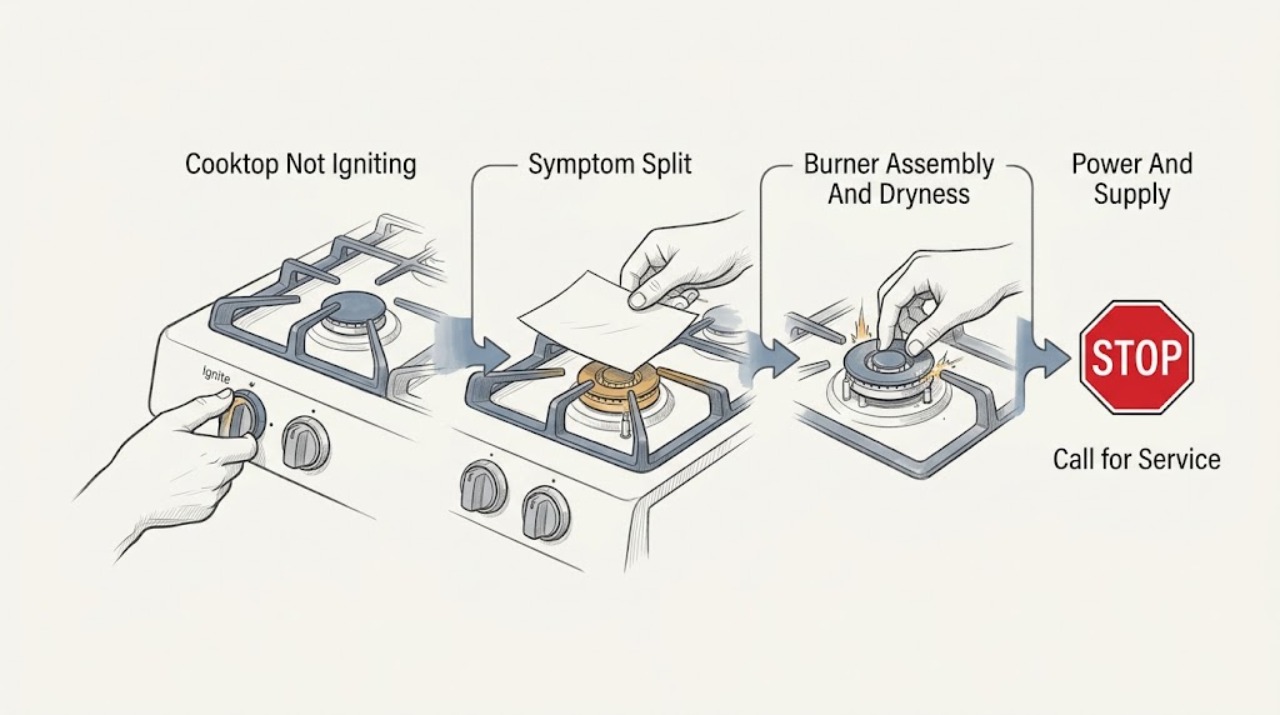
If a Miele gas cooktop will not ignite, first distinguish a burner that clicks from one with no spark, then let any spilled burner dry and check the cap, head, and flame openings for correct assembly or blockage. With the controls off and no gas odor, verify the cooktop has power and the gas supply is available without opening fittings. Turn an unsuccessful burner back to Off, ventilate, and wait at least one minute before one supervised retry. Stop after repeated failures, any flash, a persistent gas smell, or a suspected electrical fault and arrange Miele Service or a qualified gas/electrical technician.
Work through in order
Diagnostic checks
Use only checks that match the exact appliance or system and its official guide.
-
Check 1
With every control knob at Off and the surface cool, try to identify whether the affected burner makes the normal ignition clicking sound, whether another burner behaves the same way, and whether any gas odor or flash is present. Do not keep trying if gas is accumulating or a flash occurs.
Expected result: One burner clicks while the others work; several or all burners do not click; a burner clicks but never lights; or there is a gas odor, delayed ignition, or flash.
Next step: For an odor or flash, leave the controls Off, ventilate only if it is safe to do so, and arrange professional help. Otherwise continue with the cool, visible burner inspection.
Why this matters
Why: A single clicking burner suggests a local cap, opening, moisture, or alignment issue, while no clicking on multiple burners suggests shared power or ignition control. Gas odor or a flash changes the problem to an immediate safety stop.
-
Check 2
After a spill has cooled, remove only the burner parts that the exact Miele operating instructions identify as user-removable. Check that the burner cap and head are seated correctly, that the ignitor area and flame openings are clean and completely dry, and that food residue is not between the ignitor and cap. Do not enlarge openings or scrape the ignitor with a sharp tool.
Expected result: The cap or head was shifted, wet, blocked, or contaminated; or the parts are correctly seated, clean, and dry.
Next step: Correct the visible assembly and allow all parts to dry fully before a supervised retry. If the parts are clean and the burner still fails, move to the power and supply checks rather than dismantling the cooktop.
Why this matters
Why: Misalignment, moisture, residue, and blocked openings can prevent the spark from lighting the gas. If the parts are already correct and dry, cleaning is unlikely to explain a continuing no-ignition condition.
-
Check 3
With all knobs Off and no gas odor, check only the user-accessible supply points: confirm the cooktop plug or approved connection has power, see whether the relevant breaker is tripped, and verify the appliance's gas shut-off valve and propane supply status only as described in the exact model and installation instructions. Do not open gas fittings, remove covers, or make electrical measurements.
Expected result: The plug or breaker is not supplying the cooktop, the gas valve or propane supply is unavailable, or the visible power and supply checks are normal.
Next step: Restore only a clearly tripped breaker or disconnected plug when it is safe and ordinary for the installation, and have a qualified professional address gas-supply or internal electrical issues. Do not repeatedly reset a breaker that trips again.
Why this matters
Why: An interrupted electrical supply can stop electronic ignition even when gas is available, while a closed or empty gas supply can leave a spark without a flame. Normal visible supplies leave a local ignition or internal fault unresolved.
-
Check 4
Once the burner is assembled, clean, dry, and the room is free of gas odor, make one supervised ignition attempt using the exact control sequence in the Miele manual. If it fails, turn that knob to Off, ventilate the room, and wait at least one minute before a final attempt; if a flame starts but goes out, follow the model manual's hold-time instruction rather than repeatedly cycling the gas.
Expected result: The flame lights and remains stable; the ignitor clicks but no flame appears; there is no click; or the flame lights and immediately goes out.
Next step: If the final supervised attempt fails, leave the control Off and book Miele Service or a qualified technician. Do not continue attempting ignition to purge the line or bypass a safety device.
Why this matters
Why: A stable flame after drying or correction supports a local assembly or moisture cause. Continued clicking without ignition, no spark, or a flame that will not stay lit indicates a fault or safety-device issue that cannot be safely confirmed from outside the appliance.
-
Check 5
Before requesting service, record whether the failure affects one burner or all burners, whether there is clicking, the last visible cleaning or spill event, any breaker behavior, and any flash, yellow flame, or gas odor. Photograph only the cool, visible burner layout if useful; do not remove the cooktop casing or test internal components.
Expected result: The failure is repeatable after the visible checks, the breaker trips again, the flame is abnormal, the cooktop is damaged, or any gas odor or flash has occurred.
Next step: Keep the cooktop off and arrange Miele Service or a suitably qualified gas/electrical technician. If gas odor persists, leave the area and follow local emergency gas-safety guidance; do not operate switches or create a flame in the affected area.
Why this matters
Why: These results point beyond ordinary user cleaning or supply checks and can involve the ignitor, burner head, regulator, safety device, wiring, or another model-specific component. A gas or electrical safety symptom takes priority over restoring use.
Use your observations
Decision map
Find the observation that best matches what you see, then follow the next safe action.
-
PATH 01Next step
What you see
A single burner clicks, other burners work, and there is no gas odor.
Do this next
Inspect the cool cap, burner head, ignitor area, and flame openings for correct seating, residue, or moisture; dry and reassemble only as the model manual allows, then make one controlled retry.
-
PATH 02Next step
What you see
Several or all burners have no click or spark.
Do this next
Check the user-accessible plug and breaker state without opening the appliance. If power is normal or the breaker trips again, stop and book qualified service for the shared ignition system.
-
PATH 03Next step
What you see
The burner clicks but does not light after the cool, dry assembly and final supervised retry.
Do this next
Leave the control Off and request service; do not keep releasing gas or try to adjust an orifice, regulator, or gas fitting.
-
PATH 04Next step
What you see
A flame goes out immediately after lighting.
Do this next
Keep the knob depressed only for the model-specified ignition-safety period, if the manual directs it, and check for obvious cap alignment or draft. If it still goes out, stop and request service.
-
PATH 05Next step
What you see
There is a flash, persistent gas smell, visible damage, abnormal flame, or repeated breaker trip.
Do this next
Do not use the cooktop. Leave the controls Off, move away from the area if gas odor persists, and follow local emergency guidance or contact a qualified professional; do not operate electrical switches near a suspected leak.
Helpful context
Understand the symptom
Start with the symptom split
A Miele gas burner that clicks but does not light points the investigation toward the burner cap, flame openings, moisture, or the gas path. A burner with no clicking or spark points toward power or the ignition system. If every burner is affected, treat the shared power or gas supply as more likely than a single dirty burner. These are working hypotheses, not a reason to open the cooktop.
Use model-specific instructions
Miele's support pages repeatedly direct owners to the operating instructions for burner assembly and cleaning details. Burner layouts, ignition behavior, and power-failure procedures can vary by model, so use the manual for the exact cooktop rather than forcing a cap, poking an opening, or repeating an ignition sequence that does not match the controls.
A failed ignition is a stop signal
Gas that is released without a flame can accumulate. Miele says to return the control to Off, ventilate, and wait at least one minute after a failed attempt; an explosive flash or continuing gas odor requires the burner to remain off and professional help. Do not remove panels, gas fittings, or live electrical covers to continue the diagnosis.
Only after diagnosis
Potential parts
- burner cap or burner head
Consider this category only if the correct model-specific assembly is damaged or cannot seat correctly after the burner is cool, clean, and dry.
Confirm the exact Miele cooktop model and the manufacturer's parts information before ordering; do not infer fit from appearance. - ignition electrode
Consider this category only when qualified service confirms that a single burner has an ignition-electrode fault after the cap, openings, moisture, and power checks pass.
Gas and electrical work require model-specific professional diagnosis and correct Miele fitment. - ignition transformer or control component
Consider this category only when multiple burners lack spark and qualified service confirms a shared ignition-system fault.
Do not select an internal electrical component from symptoms alone; a qualified technician must verify the model and safe replacement path.
When checks do not resolve it
Need a professional?
Arrange Miele Service or a qualified gas/electrical technician when ignition still fails after the limited visible checks, or immediately for gas odor, flash, abnormal flame, visible damage, or repeated breaker trips.
Have this ready
- Provide the cooktop model and serial information, which burner or burners fail, whether there is clicking or spark, what the flame does, and whether any spill, cleaning, power interruption, flash, or odor preceded the problem.
Common questions
FAQ
Why does my Miele cooktop click but not light?
A wet or dirty burner, blocked flame openings, or a cap or head that is not seated correctly can prevent a spark from lighting the gas. With the surface cool and the controls Off, use the exact Miele manual to clean, dry, and reassemble the user-removable parts, then make only a controlled retry.
What should I do after a failed ignition attempt?
Turn the affected knob to Off, ventilate the room, and wait at least one minute before trying again. If there is a flash, persistent gas odor, or another failure after the limited retry, leave the cooktop off and arrange professional service.
Why do none of the Miele cooktop burners spark?
A shared power or ignition-system problem is more likely when multiple burners have no clicking or spark. Check only the user-accessible plug and breaker state; if power is normal or a breaker trips again, do not open the cooktop and contact Miele Service or a qualified technician.
Why does the flame go out when I release the Miele burner knob?
The burner parts may be displaced or dirty, a draft may be affecting the flame, or the ignition-safety device may not be hot enough. Follow the exact model manual's hold-time instruction; if the flame still goes out, stop using that burner and request service.
Read the exact guide
Official sources
- Miele Cooktop | The burner does not ignite when the gas cooktop is commissioned for the first time or after it has been out of use for a longer period.Miele USA · Miele gas cooktops
- Miele Cooktop | The flame goes out on the gas cooktop after being lit.Miele USA · Miele gas cooktop flame safety
- Miele Cooktop | An explosive flame/flash is generated when the gas cooktop is switched on.Miele USA · Miele gas cooktop ignition safety
- Miele Cooktop | The gas cooktop burner does not ignite.Miele USA · Miele gas cooktops
- Miele Cooktop | The ignitor on the gas cooktop burner does not function properly.Miele USA · Miele gas cooktop ignition devices
Community feedback
Share a repair observation
Share a plain-text repair observation. Accepted observations are published automatically; this page may take a moment to update.