
On this page
Start here
Quick answer
First determine whether every burner or only one is affected and whether you hear clicking. Set the affected control to the model’s Lite position only when there is no gas odor, then turn it off if the burner does not light. With the cooktop cool and power disconnected as the manual directs, check that the burner cap is present, level, dry, and seated, and clear food debris from the burner head and ignition port using Frigidaire’s approved cleaning guidance. Also check the accessible power connection and gas supply. Do not keep retrying around gas, adjust gas parts, or open the cooktop; stop for a gas smell, abnormal flame, damaged surface, or repeated failure and arrange qualified service.
Before you begin
Safety first
- The user may check the knob position, accessible power and supply, and cool removable burner parts as the exact manual permits. Do not operate switches around gas odor, open gas or electrical components, adjust pressure, bypass ignition safety parts, or use the cooktop with abnormal flames.
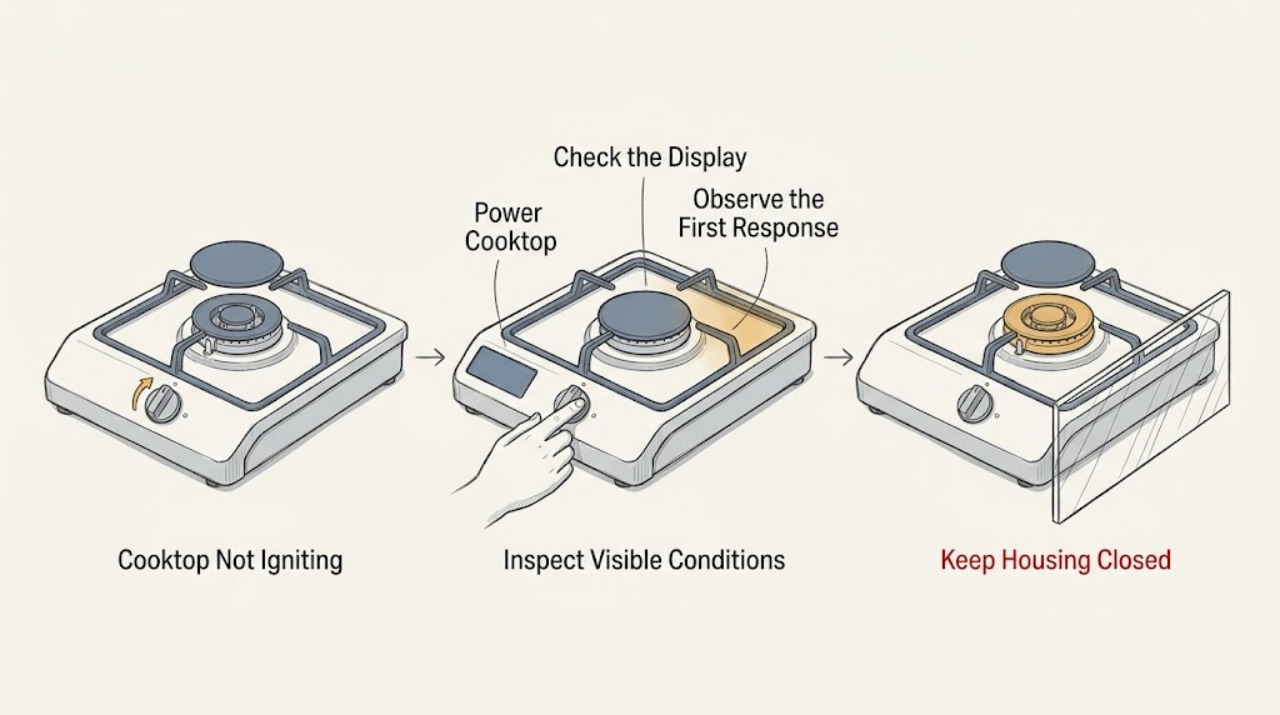
Work through in order
Diagnostic checks
Use only checks that match the exact appliance or system and its official guide.
-
Check 1
With all controls off, identify whether no burner lights, only one burner fails, or a burner lights with an abnormal flame. If there is no gas odor or other hazard, make one supervised attempt with the affected control in the model’s Lite position and note whether clicking is present.
Expected result: All burners are silent, all burners click but do not light, one burner differs, or the flame is weak, uneven, yellow, or too high.
Next step: Choose the matching branch below and avoid repeated ignition attempts if gas may have accumulated.
Stop if: Stop immediately for a gas odor, hissing, smoke, a cracked cooktop, or flame outside the burner area.
Why this matters
Why: A whole-cooktop failure makes power or gas supply more relevant; a single-burner failure makes local cap, head, slot, or ignition-port issues more relevant; abnormal flame requires a safety boundary rather than repeated ignition.
-
Check 2
Confirm the surface control knob is turned to the model’s Lite position for ignition and check that the cooktop’s accessible power cord or connection is not disconnected; do not remove a control panel or test live wiring.
Expected result: The knob was not in Lite, the power connection is loose or absent, or the knob and accessible connection are correct but there is no clicking.
Next step: Correct only an obvious user control or accessible connection and make one safe test. If there is still no clicking, stop repeated attempts and arrange qualified service.
Stop if: Stop for a damaged knob, wet controls, exposed wiring, repeated electrical trips, or any need to open the control housing.
Why this matters
Why: An incorrect control position or absent ignition power can prevent a gas burner from lighting; a correct accessible state does not identify which internal ignition component is at fault.
-
Check 3
Only when there is no gas odor, check the accessible household gas valve or bottle status identified by the installation instructions; do not loosen a fitting, adjust a regulator, or use a flame to look for a leak.
Expected result: The accessible supply is off or unavailable, the supply status is uncertain, or the supply appears on but burners still do not light.
Next step: Correct only an obvious accessible supply position covered by the model instructions. If status is uncertain or ignition still fails, leave gas components untouched and arrange qualified service.
Stop if: Stop for odor, hissing, suspected leakage, a damaged hose or fitting, or any need to open a gas component.
Why this matters
Why: A closed or unavailable supply can stop every burner; an apparently correct supply does not rule out a pressure, valve, or ignition fault inside the appliance.
-
Check 4
Turn the affected control off and let the cooktop cool. Remove only the cap and burner-head parts shown as removable in the exact manual, gently clear food debris from the head slots and ignition port, wipe them clean and dry, and reseat the cap level on the burner head.
Expected result: The cap or head was wet, dirty, clogged, missing, or misaligned, or the parts were already clean, dry, present, and level.
Next step: After the parts are dry and the area is clear, make one supervised ignition attempt if there is no gas odor. If the burner still will not light, stop and arrange service.
Stop if: Stop for a cracked cap, damaged burner head, damaged ignition electrode, broken glass, or any need to remove a fixed gas part.
Why this matters
Why: Frigidaire identifies debris, clogged ports, moisture, and an improperly seated cap as causes of poor gas flow or ignition; correctly seated clean parts with continued failure point toward supply or internal diagnosis.
-
Check 5
If the burner lights, compare the flame visually with the exact model manual and observe whether it is stable and evenly distributed around the burner; do not adjust the surface gas setting or pressure.
Expected result: The flame is stable and normal, or it is uneven, too high, yellow, yellow-tipped, noisy, lifting, or sooty.
Next step: If the flame remains abnormal after the cooled cap, moisture, port, and knob checks, stop using the cooktop and arrange qualified service.
Stop if: Stop for a yellow or sooty flame, flame outside the burner, strong odor, smoke, or a suspected fuel or pressure problem.
Why this matters
Why: A normal flame after cleaning supports ordinary supervised use; Frigidaire identifies cap seating, moisture, clogged slots or ports, and knob position as checks for uneven or too-high flames, but an unresolved abnormal flame can require service.
-
Check 6
Arrange qualified Frigidaire appliance service when one or more burners still will not ignite after the safe control, power, supply, and cooled burner-part checks, or when the fault is intermittent.
Expected result: The no-ignition symptom persists, returns after cleaning, affects all burners with correct accessible supply, or is accompanied by abnormal flame or physical damage.
Next step: Keep the affected burner or cooktop out of service when a safety symptom is present and provide the technician with the model, affected burner, clicking behavior, flame pattern, and checks performed.
Stop if: Stop for gas odor, hissing, abnormal flame, smoke, cracked glass, exposed wiring, or repeated ignition failure.
Why this matters
Why: The remaining possibilities include an ignition electrode or module, gas valve or pressure issue, wiring, installation condition, or another model-specific fault that cannot be assigned from the symptom alone.
Use your observations
Decision map
Find the observation that best matches what you see, then follow the next safe action.
-
PATH 01Next step
What you see
No burner clicks or lights.
Do this next
Arrange qualified service and follow the exact model guidance.
Why this path and its safety boundary
Why it matters: Check the accessible power connection, surface control position, and gas supply only when there is no odor. If those are correct, arrange qualified diagnosis instead of opening the cooktop.
-
PATH 02Next step
What you see
A burner clicks but does not light.
Do this next
Arrange qualified service and follow the exact model guidance.
Why this path and its safety boundary
Why it matters: Check for safe gas availability, then inspect the cooled cap, burner head, slots, and ignition port for debris, moisture, or misalignment. Stop after a limited safe attempt if it still fails.
-
PATH 03Next step
What you see
Only one burner fails while the other burners work.
Do this next
Arrange qualified service and follow the exact model guidance.
Why this path and its safety boundary
Why it matters: Focus on that burner’s removable cap, head, slots, and ignition port. Clean and dry only as the manual allows; continued failure needs service rather than a guessed part.
-
PATH 04Next step
What you see
The burner lights but the flame is uneven, too high, yellow, yellow-tipped, noisy, lifting, or sooty.
Do this next
Arrange qualified service and follow the exact model guidance.
Why this path and its safety boundary
Why it matters: Turn the burner off and do not adjust gas pressure or fuel components. If the permitted cap, moisture, port, and knob checks do not restore a normal pattern, stop using the cooktop and arrange qualified service.
-
PATH 05Next step
What you see
There is a strong gas smell, hissing, or another sign of a possible leak.
Do this next
Arrange qualified service and follow the exact model guidance.
Why this path and its safety boundary
Why it matters: Do not light the burner or operate electrical switches. Leave the area and follow local emergency or gas-supplier guidance; do not use the cooktop until the concern is repaired and cleared.
-
PATH 06Next step
What you see
The cooktop still will not ignite after safe external checks or the failure is intermittent.
Do this next
Arrange qualified service and follow the exact model guidance.
Why this path and its safety boundary
Why it matters: Keep the appliance out of service when appropriate and arrange qualified Frigidaire appliance service. Do not open the cabinet or replace an ignition or gas part from the symptom alone.
Helpful context
Understand the symptom
Use the symptom to choose the next check
If no burner clicks or lights, check the accessible power and gas paths first. If all burners click but none lights, a supply issue or a shared ignition condition is more relevant. If one burner fails while the others work, inspect that burner’s cap, head, slots, and ignition port. A flame that is uneven or too high is a separate stop-and-correct path, not proof that a new ignitor is needed.
Clean a gas burner only when it is cool
Frigidaire’s cleaning guide allows gentle cleaning of burner heads, slots, and the ignition port and warns against abrasive cleaners, oven cleaners, and steel wool around the burner head. Turn the control off, let the cooktop cool, use only the guide’s permitted method, dry the parts, and make sure the cap is seated before testing. Do not remove fixed gas parts or wiring.
Know when ignition troubleshooting must stop
Do not repeatedly release gas while trying to light a burner. If you smell gas, do not operate electrical switches or create a flame; leave the area and follow local emergency or gas-supplier guidance. A yellow or sooty flame, a cracked surface, an uncertain gas connection, or a failure that remains after safe checks needs qualified appliance service.
Safety boundary
Stop conditions
- Strong gas odor, hissing, suspected leak, or unburned gas after a failed attempt.
- Yellow, sooty, lifting, noisy, too-high, or uneven flame that does not normalize after permitted external checks.
- Cracked or damaged glass, burner cap, burner head, ignition electrode, cord, knob, or control.
- Smoke, scorching, exposed wiring, repeated electrical trips, or an overheated control area.
- Any need to open the cooktop, bypass ignition or gas safety parts, adjust pressure or fuel components, or probe live wiring.
Only after diagnosis
Potential parts
- burner cap or burner head
Consider this category only if the exact model’s removable part is missing or visibly damaged and a technician confirms that it prevents proper gas flow or seating.
Confirm the exact cooktop model and manufacturer fit information; similar-looking burner parts are not assumed interchangeable. - ignition electrode
This category is conditional on a clean, dry, correctly seated burner with a qualified diagnosis of an ignition fault; no clicking or no flame alone does not prove the electrode failed.
Confirm the model-specific part and wiring through qualified service before replacement. - spark ignition module
Consider only when multiple burners lack clicking and a technician confirms the shared ignition circuit is at fault after supply and accessible power checks.
Do not open live controls; confirm the exact model and approved replacement. - gas valve or pressure component
Only qualified service should consider this category after gas availability, flame pattern, fuel type, and pressure symptoms are assessed.
Gas components and adjustments are model- and installation-specific and must not be selected from a symptom alone.
When checks do not resolve it
Need a professional?
Arrange qualified Frigidaire appliance service when a burner or all burners still will not ignite after the safe control, power, supply, and cooled burner-part checks, or immediately for gas odor, abnormal flames, physical damage, or an internal electrical or gas fault.
Safety scope: The user may check the knob position, accessible power and supply, and cool removable burner parts as the exact manual permits. Do not operate switches around gas odor, open gas or electrical components, adjust pressure, bypass ignition safety parts, or use the cooktop with abnormal flames.
Common questions
FAQ
Why does my Frigidaire gas cooktop click but not light?
If there is no gas odor, check the accessible gas supply and then inspect the cooled burner cap, head, slots, and ignition port for moisture, debris, clogging, or incorrect seating. Stop repeated attempts if it still fails and arrange service.
What if none of the burners on my Frigidaire cooktop ignite?
Check the surface control position, accessible power connection, and gas supply only when there is no odor. If those are correct and no burner clicks or lights, request qualified diagnosis rather than opening the cooktop.
Can a dirty ignition port stop a Frigidaire burner from lighting?
Yes. Frigidaire identifies clogged ignition ports and burner-head slots as ignition problems. With the burner off and cool, use the gentle cleaning method in the official guide, dry the parts, and reseat the cap before testing.
What should I do if the flame is uneven or too high?
Turn the burner off and check only the cool cap seating, moisture, clogged ports or slots, and knob position described by Frigidaire. Do not adjust gas pressure or fuel components; stop using it and arrange service if the flame remains abnormal.
When should I stop troubleshooting a Frigidaire gas cooktop?
Stop for gas odor, hissing, yellow or sooty flames, flame outside the burner, smoke, a cracked surface, exposed wiring, repeated electrical trips, or any need to open gas or live electrical parts. Leave the cooktop out of service and arrange qualified help.
Read the exact guide
Official sources
- What should I do if some or all of my burners are not lighting?Frigidaire · Official Frigidaire support article applying to gas ranges and gas cooktops; the exact Owner’s Manual controls model-specific operation and cleaning.
- Gas Cooktop Ignition Port Cleaning GuideFrigidaire · Official Frigidaire cleaning guidance for gas cooktops and gas ranges; use the exact Owner’s Manual for removable-part access.
- What should I do if my gas flames are uneven or too high?Frigidaire · Official Frigidaire support article applying to gas ranges and gas cooktops; model instructions control the precise burner arrangement.
- RangesFrigidaire · Official Frigidaire support index linking gas cooktop ignition, flame, cleaning, manual, and service guidance.
Community feedback
Share a repair observation
Share a plain-text repair observation. Accepted observations are published automatically; this page may take a moment to update.