
On this page
Start here
Quick answer
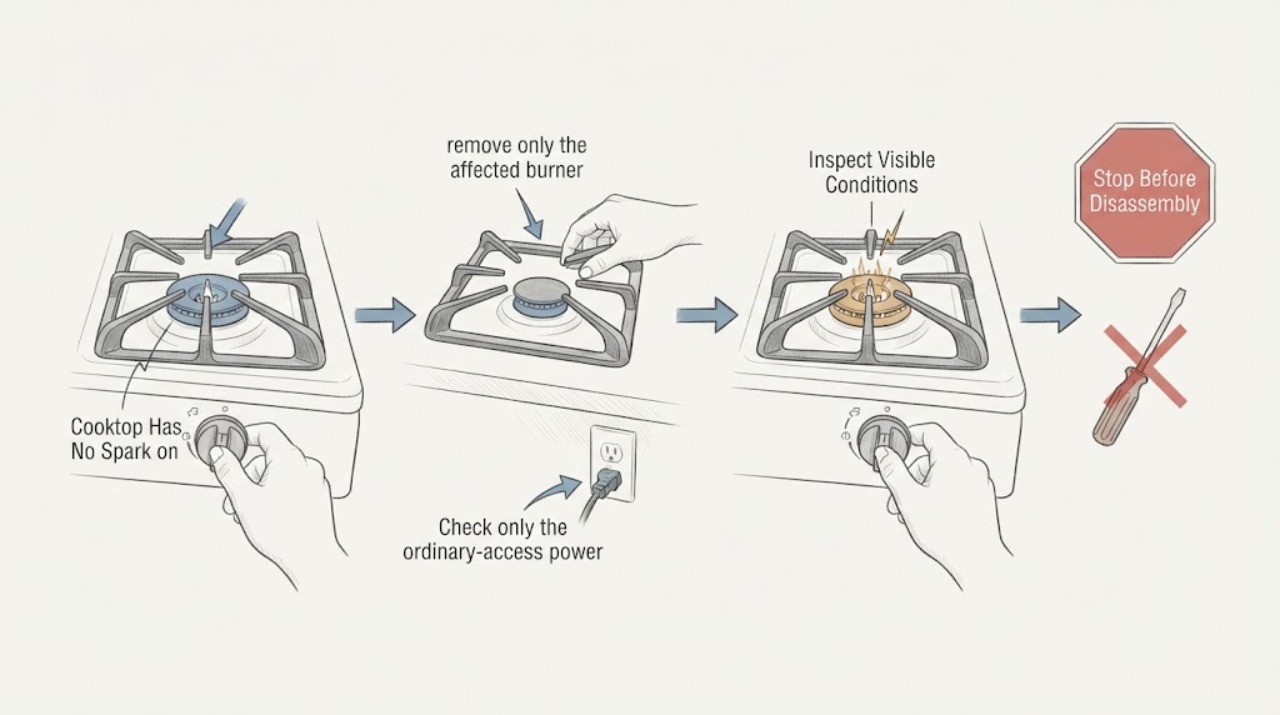
If two burners on a Wolf CT36G/S have no spark while other burners still spark, treat it as a partial ignition symptom. Wolf describes an individual spark electrode for each surface burner, so working burners make a total power loss less likely, but they do not prove which local electrode, switch, module, or burner assembly is faulty. First turn all controls off and check for gas odor or abnormal flame. When the cooktop is cool, confirm the affected caps and burner heads are clean, dry, correctly seated, and on the correct bases; make one normal ignition attempt using the model guide. If the same two burners still have no spark, stop testing and arrange Wolf factory-certified service. Do not open the cooktop, test live wiring, adjust gas pressure, or repeatedly release gas without ignition.
Work through in order
Diagnostic checks
Use only checks that match the exact appliance or system and its official guide.
-
Check 1
Turn every knob to OFF and observe from a safe position whether gas odor, an escaping-gas sound, smoke, an abnormal flame, or sparking occurs while no burner is being operated. Record the two affected burner positions and whether the remaining burners click or spark.
Expected result: Two burners lack a click or spark while others spark; all burners lack spark; a burner clicks and sparks without flame; or a hazard is present.
Next step: For a hazard, leave the area and follow local gas-supplier or emergency instructions from outside. If there is no hazard, continue only with the cool, dry assembly check.
Stop if: Do not operate switches in a gas-smelling area, repeatedly attempt ignition, or continue if smoke, abnormal flame, or sparking at rest occurs.
Why this matters
Why: A partial no-spark pattern makes a total power loss less likely, while click-without-flame shifts attention to gas flow or burner assembly. Gas or fire signs override all troubleshooting.
-
Check 2
With the cooktop off and completely cool, remove only the affected burner caps or heads that the exact Wolf guide identifies as user-removable. Check that each is clean, dry, centered, flat, and seated on its matching base, and keep the parts in their original positions.
Expected result: One or both affected assemblies are wet, dirty, shifted, cross-positioned, or rocking; or both appear correctly seated and dry.
Next step: Restore the documented arrangement, allow moisture to dry, and make one normal ignition attempt. If the two burners still have no spark, stop and request service.
Stop if: Do not open the cooktop, scrape or bend an electrode, use a flame to test gas, or alter a burner port or regulator.
Why this matters
Why: A local assembly or moisture condition can interfere with ignition or flame detection. Correctly seated, dry parts with no spark after one test make a local electrode, switch, module, or wiring fault more plausible, but do not select a part.
-
Check 3
Check only the ordinary-access power condition and gas shut-off position described by the CT36G installation guide, without moving the built-in cooktop or opening a panel. Do not repeatedly reset a breaker or disturb gas connections.
Expected result: The power cord or breaker is abnormal, the gas shut-off position is uncertain, the unit was recently installed or reconnected, or accessible supply conditions appear normal.
Next step: Correct only an obvious safe external condition allowed by the guide and make one normal test. If the supply is normal or the two-burner pattern returns, arrange Wolf factory-certified service.
Stop if: Do not test gas pressure, open gas connections, move the cooktop, access wiring, or keep resetting a tripping circuit.
Why this matters
Why: A shared power or gas condition can affect more than one burner, but working spark on other burners makes a complete ignition-power loss less likely. Installation and fuel uncertainty require qualified help.
-
Check 4
If the affected burners click and spark but do not establish a flame, turn the controls OFF and record whether the correct cap and head are fitted and whether the symptom changes with a normal pan removed. Follow the exact guide's ignition timing once only.
Expected result: There is no spark at the affected burners, there is a spark but no flame, ignition occurs and then goes out, or the flame is abnormal.
Next step: Turn the control OFF after the permitted attempt. Arrange qualified Wolf service for a repeated no-spark or no-flame result or any abnormal flame.
Stop if: Do not keep a knob open while gas is not igniting, relight repeatedly, or adjust the gas train.
Why this matters
Why: No spark keeps the local ignition path in focus; spark without flame makes gas supply, head position, moisture, and ports more relevant. A flame that is yellow, lifting, noisy, or unstable is not a setting to correct casually.
-
Check 5
Prepare a service record with the complete CT36G/S model and serial information, natural-gas or LP designation, affected burner positions, click/spark result on each burner, recent cleaning or spill, and any breaker, flame, or odor event.
Expected result: The same two burners remain inactive after the documented cool, dry, external checks, or the symptom changes between burners or after a power event.
Next step: Keep the cooktop off and contact Wolf factory-certified service or a qualified gas-appliance technician.
Stop if: Do not remove covers, bypass ignition safety, or substitute an electrode, switch, or module by appearance.
Why this matters
Why: Persistence or movement of the partial pattern indicates a fault that cannot be safely localized from the outside; service needs the identity and pattern to select the correct diagnostic path.
Use your observations
Decision map
Find the observation that best matches what you see, then follow the next safe action.
-
PATH 01Next step
What you see
Two burners have no click or spark while the other Wolf CT36G/S burners still spark, and the affected caps or heads are wet, dirty, shifted, or incorrectly seated.
Do this next
Correct only the documented cool, dry, matching assembly arrangement and make one normal attempt. If both burners remain inactive, arrange service.
Why this path and its safety boundary
Why it matters: The partial pattern and local assembly condition make a local burner-area or moisture issue plausible; a total power loss is less likely, but the internal cause is not proven.
-
PATH 02Next step
What you see
Two burners have no spark, other burners spark, and both affected assemblies are clean, dry, correctly seated, and still fail after one normal attempt.
Do this next
Keep the cooktop off and contact Wolf factory-certified service with the affected positions and complete model and serial details.
Why this path and its safety boundary
Why it matters: A local electrode, switch, ignition-module, or wiring fault remains possible. Wolf's individual-electrode design supports the partial-pattern distinction but does not identify which part failed.
-
PATH 03Next step
What you see
No burner sparks, the breaker or accessible power is abnormal, the gas shut-off is uncertain, or the cooktop was recently installed or reconnected.
Do this next
Check only ordinary-access supply conditions permitted by the installation guide. If power or gas remains uncertain, use a qualified electrician, gas professional, or Wolf service.
Why this path and its safety boundary
Why it matters: A shared supply or installation condition is more likely than a two-burner local pattern.
-
PATH 04Next step
What you see
A burner sparks but will not light, keeps clicking after ignition, has a yellow or unstable flame, or there is gas odor, smoke, or sparking while all controls are OFF.
Do this next
Turn controls OFF. For persistent gas odor, leave immediately and contact the gas supplier or emergency services from outside; for other hazards, keep the cooktop off and arrange qualified service.
Why this path and its safety boundary
Why it matters: This is a gas, combustion, or electrical safety condition rather than a simple no-spark comparison.
Helpful context
Understand the symptom
Classify the partial no-spark pattern first
Write down which burners fail and which still spark. Two non-sparking burners with working burners are a different observation from every burner having no spark, and from a burner that sparks but does not light. Wolf's guide says each surface burner has a spark electrode and recommends checking operation individually and in combination. That supports using the affected-burner count to choose the next safe observation, while leaving internal ignition diagnosis to service.
Keep the model and fuel configuration matched
Confirm CT36G/S and the natural-gas or LP configuration from the rating plate and the exact regional guide. Wolf places the rating plate on the underside and says gas conversion must be performed by certified service. A model or fuel mismatch can make a spark symptom look like a burner problem, so do not apply a different Wolf model's adjustment or wiring information.
When checks do not resolve it
Need a professional?
Stop and seek qualified Wolf or gas-appliance service for repeated partial no-spark, no-flame after one normal attempt, abnormal or unstable flame, sparking at rest, gas odor, smoke, damaged parts, uncertain gas type, a tripping circuit, or any need to open the cooktop or test gas or live electrical circuits.
Common questions
FAQ
If two burners have no spark, does that prove the ignition module is bad?
No. Wolf's individual spark-electrode design makes the affected-burner count useful, but it cannot identify an electrode, switch, module, wiring, or burner-assembly fault. Use only the cool, dry, correctly seated checks in the guide, then arrange service if the pattern persists.
Should I keep turning the knob until the burner lights?
No. Follow the exact CT36G/S guide's ignition procedure once. Turn the control OFF if ignition does not occur, and do not repeatedly release gas without ignition or test with a flame.
Can I replace the spark electrode myself?
Do not open the cooktop or substitute an ignition part by appearance. Wolf directs owners to factory-certified service when the cooktop still does not operate properly after the listed checks.
What should I tell Wolf service?
Give the complete model and serial numbers, fuel type, affected burner positions, which burners still spark, whether the affected caps and heads were clean and dry, and any recent spill, installation, power, flame, or odor event.
Read the exact guide
Official sources
- Intl Gas Cooktops UCIWolf Appliance / Sub-Zero Group · Opened official Wolf gas-cooktop use-and-care guidance for the CT gas-cooktop platform; it describes an electrode at each burner and directs model-specific verification for regional variants.
- 36" Gas Cooktop (CT36G) Sales, Feature, and Accessory InformationSub-Zero, Wolf, and Cove · Opened official CT36G support page confirming the CT36G family and directing owners to factory-certified parts and service for model-specific assistance.
- UCGWolf Appliance / Sub-Zero Group · Opened the official Wolf gas-cooktop installation and service guide; it explicitly covers the CT36G model and instructs owners to use factory-certified service when listed checks do not restore operation.
Community feedback
Share a repair observation
Share a plain-text repair observation. Accepted observations are published automatically; this page may take a moment to update.