
On this page
Start here
Quick answer
Do not treat every cooktop smell as the same problem. First identify whether the cooktop is gas, radiant electric, or induction, and whether the smell is new-appliance odor, food or cleaner residue, melted plastic, a sharp burning/electrical odor, or gas/exhaust. A slight temporary odor on a new cooktop can come from new parts or insulation, but a lingering odor is not typical. Let the surface cool before cleaning and use only the exact manual's approved method. Stop immediately for smoke, sparks, arcing, melted plastic, a sharp burning smell, abnormal heat, damaged glass or wiring, or persistent gas/exhaust odor. If gas is suspected, leave without operating switches, flames, or phones in the area and contact the gas utility or emergency service from a safe location.
Work through in order
Diagnostic checks
Use only checks that match the exact appliance or system and its official guide.
-
Check 1
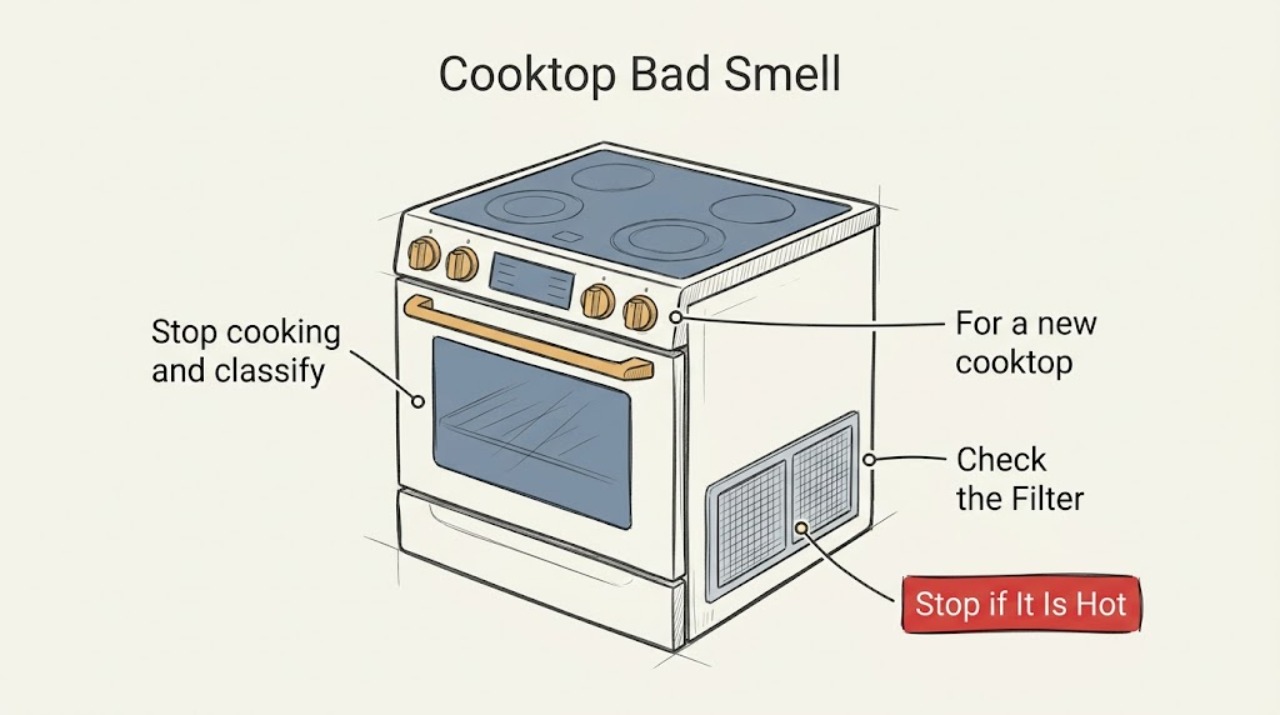
Stop cooking and classify the smell from a safe position. Note whether it smells like food or cleaner, new insulation, hot plastic, hot wiring, gas, or exhaust; whether it occurs only when a zone is on; and whether there is smoke, flame outside the burner, sparking, arcing, unusual heat, a cracked surface, or a tripped breaker.
Expected result: The smell is mild and tied to a new cooktop or a known spill, or it is sharp, worsening, persistent, or accompanied by smoke, sparks, heat, damage, or gas/exhaust symptoms.
Next step: For any gas/exhaust, smoke, spark, arcing, hot-electrical, melted-plastic, or damaged-glass symptom, keep the cooktop off and follow the relevant safety branch. Otherwise continue by confirming the energy type and model.
Stop if: Do not restart the cooktop or touch the surface while hot when a sharp burning odor, smoke, spark, arc, abnormal heat, melted plastic, cracked glass, or gas/exhaust odor is present.
Why this matters
Why: A temporary new-part or residue odor can follow a low-risk cool-and-clean path. Smoke, electrical symptoms, damaged glass, abnormal heat, and suspected gas are stop conditions rather than troubleshooting clues.
-
Check 2
Read the rating label and owner manual to confirm gas, radiant electric, or induction operation and the exact model. Compare the smell's timing with the manual, and check that all controls are fully off. Do not remove the cooktop, move a gas appliance, expose wiring, or attempt electrical testing.
Expected result: The cooktop is new, the smell is limited to initial use or a known installation residue, or the odor does not match the manual or continues after the controls are off.
Next step: If the manual supports a limited first-use procedure and there are no safety symptoms, follow it once while present. If the model cannot be identified or the smell is persistent or unexplained, stop using the cooktop and arrange qualified service.
Stop if: Do not assume an unbranded or unspecified cooktop is gas, electric, or induction, and do not borrow a reset or cleaning procedure from another model.
Why this matters
Why: Manufacturers describe a slight first-use odor from new parts or insulating material, but a lingering or unexplained odor needs service evaluation. A generic procedure cannot replace model-specific fuel and surface instructions.
-
Check 3
For a new cooktop or a smell that began after installation, remove cookware and packaging from the cool surface and inspect only for visible shipping material or residue. If the manual permits a first-use run, ventilate the room, remain present, and use the stated mode briefly; stop at once if the smell becomes sharp, smoke appears, or heat is abnormal.
Expected result: The mild odor fades after the permitted first-use procedure, or it lingers, intensifies, appears on an established appliance, or transfers to the room or cookware.
Next step: If the smell fades with no safety symptom, use the cooktop normally under the manual. If it persists or changes character, stop testing and arrange qualified service rather than repeating high-heat cycles.
Stop if: Do not perform this branch for a gas odor, an established cooktop with a new burning smell, smoke, sparks, arcing, melted plastic, or damaged glass.
Why this matters
Why: GE states that a slight smell can be normal when a new cooktop heats new parts and insulating materials, while a lingering odor is not typical. This does not explain smoke, electrical odor, or a gas leak.
-
Check 4
If the smell is food-like, chemical, or plastic-like and there is no smoke or electrical symptom, let the cooktop and cookware cool completely. Remove the pan, look for a spill, cleaner film, sugary residue, or plastic on the surface, and clean only with the exact manual's approved product and method. Do not heat the surface to burn residue away.
Expected result: The odor source is visible and disappears after cool, manual-approved cleaning, or no residue is visible and the smell returns when a zone is used.
Next step: If cleaning removes the odor and the surface is undamaged, monitor normal use. If the odor returns, stop using the cooktop and arrange qualified service; do not scrape damaged glass or open the appliance.
Stop if: Stop cleaning if the surface is hot, cracked, wet near controls, smoking, sparking, or coated with material that cannot be removed without force or an unapproved chemical.
Why this matters
Why: Food, cleaner, melted plastic, and pan residue can produce odor as they heat. A recurring odor without visible residue may originate below the surface or in an electrical component and cannot be safely confirmed by a user test.
-
Check 5
For a gas cooktop, determine whether the smell occurs only briefly during normal burner ignition or remains when every control is off. Without moving the appliance or testing a connector, check only that controls are off and that burner caps are seated as the manual permits when the surface is cool and there is no suspected leak.
Expected result: The odor is present while the cooktop is off, persists after controls are off, or comes with hissing, soot, abnormal yellow flames, or symptoms of combustion; or it is only a brief ignition odor with normal flame and no residual smell.
Next step: For any persistent gas/exhaust concern, leave immediately and use the emergency gas branch. For a brief ignition odor only, follow the exact manual's burner-cap and fuel-type guidance; if it repeats abnormally, arrange qualified service.
Stop if: Do not light a burner, operate switches, use a phone in the building, move the appliance, or loosen a gas connection when a leak is suspected.
Why this matters
Why: Whirlpool distinguishes occasional slight odor during use from gas odor when the cooktop is not in use. A gas or combustion concern cannot be cleared by relighting, moving the appliance, or inspecting the connector yourself.
-
Check 6
For radiant electric or induction cooktops, leave the controls off and inspect only the cool visible surface and nearby user-accessible power connection. Look for a cracked glass surface, melted plastic, scorch mark, damaged cord or plug, repeated breaker trip, or odor localized to the control area; do not open the housing or run a zone to reproduce it.
Expected result: There is damage, a hot or damaged connection, smoke, sparking, arcing, repeated trip, or a persistent odor from below the surface; or the surface is intact and a known residue has been removed.
Next step: For any electrical warning sign or persistent odor, keep the cooktop off and arrange qualified appliance or electrical service. If only residue was present and the odor is gone, resume use only after the surface is clean and dry.
Stop if: Do not reset a repeatedly tripping breaker, bypass a control, touch a hot or damaged plug, attempt electrical testing, or remove the cooktop.
Why this matters
Why: Electrical warning signs point to a hazard requiring isolation and qualified assessment, while a known surface residue may be resolved by the manual's cool cleaning procedure. An intact appearance does not prove internal safety.
-
Check 7
If the odor remains after the applicable low-risk checks, record the energy type, model, zone, cookware, cycle or heat setting, when the odor starts, whether it is in the room or on food, and every visible safety symptom. Arrange qualified service for internal wiring, controls, igniters, regulators, induction electronics, coils, damaged glass, or an inaccessible source.
Expected result: The symptom is repeatable or unexplained, or it has completely disappeared after an approved cleaning or first-use procedure with no safety event.
Next step: Keep the cooktop off for the persistent or hazardous outcome and provide the symptom record to qualified service. Monitor only the normal operation that the manual supports after a resolved residue or approved first-use odor.
Stop if: Do not replace an unconfirmed component, bypass a safety device, dismantle the cooktop, or continue test cycles after a hazardous smell or electrical event.
Why this matters
Why: Persistent or unexplained odor needs model-specific diagnosis; absence of a visible mark does not make an electrical or gas fault safe to investigate by repeated use.
Use your observations
Decision map
Find the observation that best matches what you see, then follow the next safe action.
-
PATH 01Safety boundary
What you see
The cooktop is new and has only a slight temporary odor from first use, with no smoke, sparks, abnormal heat, gas symptom, or electrical warning.
Do this next
Follow the exact model manual's limited first-use guidance once, remain present, and stop if the odor becomes sharp or any unsafe symptom appears.
Why this path and its safety boundary
Safety stop: Do not normalize the odor; use the residue, gas, electrical, or service branch that matches the observations.
-
PATH 02Safety boundary
What you see
The smell is food, cleaner, melted plastic, or pan residue and the cool visible surface is undamaged.
Do this next
Clean only with the approved manual method, remove all residue, and do not heat the surface until it is clean and dry.
Why this path and its safety boundary
Safety stop: A persistent or unexplained odor requires qualified service rather than a hotter test cycle.
-
PATH 03Safety boundary
What you see
A gas cooktop smells like gas while off, after all controls are off, or has hissing, soot, abnormal flame, or combustion symptoms.
Do this next
Leave immediately, do not use flames, switches, or phones in the area, and contact the gas utility or emergency service from a safe location.
Why this path and its safety boundary
Safety stop: For only a brief ignition odor, follow the exact manual's burner and fuel-type guidance and arrange service if the odor is abnormal or recurring.
-
PATH 04Safety boundary
What you see
A radiant electric or induction cooktop has smoke, sparks, arcing, melted plastic, a hot or damaged plug, scorch marks, repeated breaker trips, or a sharp electrical odor.
Do this next
Stop use, isolate power only from a safe position if that can be done without approaching the hazard, and arrange qualified appliance or electrical service.
Why this path and its safety boundary
Safety stop: Continue only with cool, manual-approved surface checks for a known residue.
-
PATH 05Safety boundary
What you see
The glass is cracked, pitted, wet near controls, or has melted plastic that cannot be removed safely by the manual method.
Do this next
Keep the cooktop off and arrange qualified service; do not scrape damaged glass, apply heat, or open the housing.
Why this path and its safety boundary
Safety stop: A clean, intact surface can return to normal use only when the odor is gone and the manual's conditions are met.
-
PATH 06Safety boundary
What you see
The odor persists or returns after the approved cleaning or first-use path, or its source cannot be identified.
Do this next
Keep the cooktop off and arrange qualified service with the model and symptom record.
Why this path and its safety boundary
Safety stop: Document the resolved residue or first-use condition and monitor normal operation without adding unapproved cleaners.
Helpful context
Understand the symptom
The energy type changes the safe decision. Gas burners can produce a brief ignition-related odor, but gas detected while the cooktop is not in use or after all controls are off must be treated as a possible leak. Radiant and induction surfaces can smell after a spill or new installation; smoke, arcing, melted plastic, or a sharp electrical smell is never a normal test result.
A cool surface and the correct manual are prerequisites for cleaning. A food spill, sugary material, cleaner film, pan residue, or plastic can heat and smell again until completely removed. Do not use an unapproved chemical, abrasive, or improvised tool, and do not heat the surface to see whether an unexplained smell returns.
Because the brand and model are not specified here, use the appliance's rating label and owner manual for controls, burner-cap placement, cookware requirements, and cleaning products. User checks end at the cool cooking surface, removable gas cap where the manual permits, controls, and visible power or gas symptoms; internal wiring, regulators, igniters, coils, and damaged glass require qualified service.
When checks do not resolve it
Need a professional?
Provide the brand and model if known, gas/radiant-electric/induction type, affected zone, cookware, heat setting, odor description, timing, whether controls were off, visible residue or damage, breaker events, and any smoke, spark, flame, or gas observation. Treat suspected gas or exhaust as an emergency and remain out of the area.
Have this ready
- Have the rating-label information, installation or first-use timing, exact odor type, whether it follows a pan or room, cleaning performed under the manual, fuel type, and all observed safety symptoms ready for the service provider.
Common questions
FAQ
Is a smell from a new cooktop normal?
A slight temporary odor can come from new parts and insulating material during first use. It should not be used to explain a lingering smell, smoke, sparks, abnormal heat, electrical odor, melted plastic, or gas odor. Follow the exact model manual once and arrange service if the smell persists.
What should I do if my gas cooktop smells like gas?
If the smell remains when the controls are off or you suspect a leak, leave immediately. Do not use a flame, light switch, electrical device, or phone in the area, and do not move the cooktop or loosen its connector. Contact the gas utility or emergency service from a safe location.
Can a food spill or melted plastic cause a cooktop smell?
Yes. Food, sugary residue, cleaner film, pan residue, or plastic can smell as it heats. Let the surface cool and use only the model-approved cleaning method. Do not heat the cooktop to burn residue away, and stop if the glass is damaged or the smell is electrical.
Should I keep using an electric or induction cooktop with a burning smell?
No. Stop for a sharp burning or electrical smell, smoke, sparks, arcing, melted plastic, abnormal heat, a hot or damaged plug, scorch marks, or repeated breaker trips. Keep it off and arrange qualified appliance or electrical service; do not open the cooktop or repeat the test.
When does a cooktop odor require service?
Arrange service when the odor lingers or returns after approved cleaning, starts on an established appliance without a visible residue, comes from below the surface, or is accompanied by damage, smoke, sparks, heat, abnormal flame, repeated breaker trips, or a suspected gas or exhaust symptom. Gas concerns require emergency handling from outside the area.
Read the exact guide
Official sources
- Electric Range & Cooktop - Glass Cooktop Cleaning InstructionsGE Appliances · Official glass-cooktop cleaning guidance used for the residue branch; products and procedures vary by model.
- Ranges and Cooktops - Odor From New CooktopGE Appliances · Official manufacturer guidance used for the limited new-cooktop branch; exact model instructions control for an unspecified cooktop.
- Certain Older Gas Connectors May Be DangerousU.S. Consumer Product Safety Commission · Government guidance applicable to suspected gas leaks at a gas cooktop; local emergency instructions also apply.
- Odors or SmellsWhirlpool Product Help · Official manufacturer gas-cooktop guidance used to distinguish brief use-related odor from gas odor when the appliance is off; exact model instructions control.
- CPSC Guide to Home Wiring HazardsU.S. Consumer Product Safety Commission · Government electrical-safety guidance for deciding when sparks, smoke, heat, damaged cords, or repeated electrical symptoms require stopping use and professional assessment.
Community feedback
Share a repair observation
Share a plain-text repair observation. Accepted observations are published automatically; this page may take a moment to update.