
On this page
Start here
Quick answer
A bad smell from a KitchenAid cooktop is safe to investigate only after you identify the odor and rule out gas or electrical danger. Turn the controls off and note whether the smell occurs only while cooking, remains when the cooktop is off, follows a spill or cleaning, comes from the downdraft filter, or resembles unburned gas or hot insulation. KitchenAid says gas odor when the cooktop is in use can sometimes be slight, but gas odor while the appliance is off after confirming no burner was accidentally left on requires immediate gas-safety action. For a non-gas odor, let the surface cool, inspect and clean only visible user-accessible residue or burner caps according to the model manual, and check a downdraft grease or charcoal filter if fitted. If the odor is gas-like, acrid, electrical, accompanied by smoke, sparks, flame outside the burner, a hot connection, or a damaged surface, stop using the cooktop and arrange qualified gas, appliance, or electrical service.
Before you begin
Safety first
- This article covers odor timing, dry visible residue and burner-cap observations, and model-approved downdraft filter checks. Do not test gas leaks with flame, open gas or electrical components, adjust pressure, reach into fans, or operate a damaged surface.
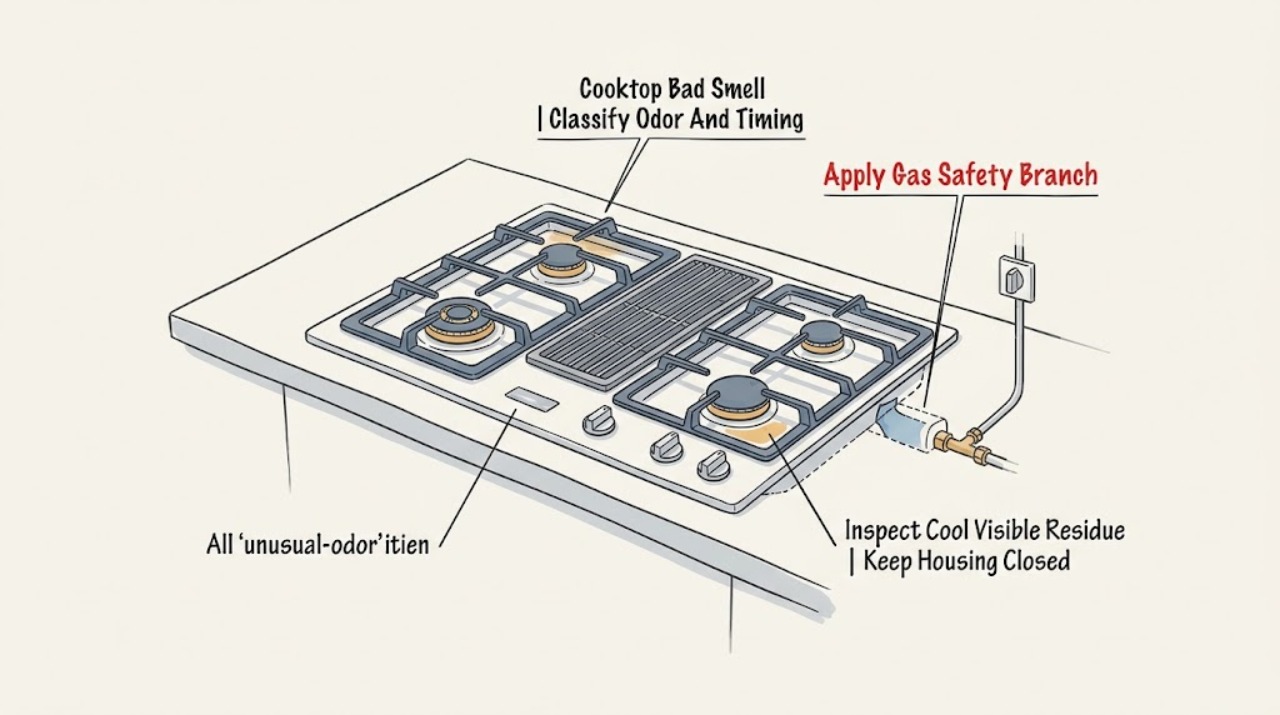
Work through in order
Diagnostic checks
Use only checks that match the exact appliance or system and its official guide.
-
Check 1
Turn every cooktop control off and, without leaning over the appliance, note the odor's character and timing: food or grease, gas-like, paint or chemical, hot plastic or electrical, or smoke. Record whether it occurs only with a flame or heat, after a spill or cleaning, during downdraft operation, or while the cooktop is off.
Expected result: The smell is gas-like while off, appears only over a burner, follows a visible spill, comes from the vent, or is acrid, electrical, smoky, or accompanied by heat.
Next step: If the odor is gas-like, smoky, electrical, or unclear, stop using the cooktop and follow the corresponding safety branch. Continue with visible checks only for a clearly non-hazardous cooking or filter odor after the appliance is cool.
Stop if: Do not relight burners, operate electrical switches, use a lighter, or repeatedly reproduce an unexplained odor.
Why this matters
Why: Timing separates visible residue or ventilation from gas-supply and electrical branches. KitchenAid specifically treats unexplained gas odor while the cooktop is off as an emergency path; an acrid or smoky smell can indicate overheating or an electrical fault even without visible flame.
-
Check 2
If the smell resembles unburned gas, confirm only from a safe position that no surface burner was accidentally left on. Do not touch switches, ignite anything, or search for a leak; if the odor remains, leave the area and follow local gas-emergency instructions.
Expected result: A control was accidentally on and the odor clears after it is safely turned off, or no control was on and the gas-like odor remains.
Next step: For an odor that remains or returns, stay away from the cooktop and contact the gas supplier or qualified gas service from a safe location. Do not return to troubleshoot until cleared.
Stop if: Do not use a phone in the building, operate a switch, use a flame, or restart the cooktop to verify that the smell is gone.
Why this matters
Why: A mistakenly open burner can explain a short-lived odor, but persistent gas smell with all controls off may indicate a supply or appliance leak. KitchenAid directs the user not to light appliances or touch electrical switches in that situation.
-
Check 3
Only after ruling out gas and electrical danger and after the appliance is cool, inspect the visible glass, grates, burner caps, and surrounding counter for food, grease, cleaner residue, or a displaced cap. Clean and dry only the user-accessible parts and method specified by the exact KitchenAid manual.
Expected result: A spill or grease film is visible, a cap is wet or not seated, ports have visible residue, the surface is clean, or the smell persists after the residue is removed and parts are dry.
Next step: Let cleaned parts dry fully, reassemble only as the manual shows, and perform one attended normal-use check. If the smell returns, stop and arrange service rather than increasing cleaning intensity.
Stop if: Do not clean hot parts, put wet caps back, enlarge ports, use harsh chemicals near controls, or remove burner bases, valves, injectors, or wiring.
Why this matters
Why: KitchenAid says a clean, correctly seated burner cap helps avoid poor ignition and uneven flames and that food or debris in ports can impair operation. Persistent odor after visible residue is gone points toward the flame, gas type, ventilation, or an internal appliance issue.
-
Check 4
If the smell is cooking vapor or grease and the cooktop has downdraft ventilation, turn the fan system off before removing its filter. Check whether the grease filter is dirty or incorrectly installed, whether a recirculating charcoal filter is due for model-specific replacement, and whether a strong room draft or blocked air path is interfering.
Expected result: The filter is grease-loaded, absent, flat or incorrectly positioned, the charcoal filter is saturated, the fan is off, airflow is restricted, or the filter and airflow are normal.
Next step: Clean or replace the filter only as the exact model manual permits, reinstall it correctly, and operate the vent before and after cooking as instructed. Arrange service if the fan, filter housing, duct, or odor problem remains abnormal.
Stop if: Do not reach into a moving fan, wash an electrical motor, alter ductwork by guesswork, or continue if the odor is gas-like, smoky, or electrical.
Why this matters
Why: KitchenAid says a clean, correctly installed filter and suitable room airflow improve odor removal; restricted or misdirected ventilation can leave cooking odors in the room. A normal vent path makes the cooktop, burner, spill, or gas/electrical branches more important.
-
Check 5
After the safe visible checks, record the exact KitchenAid model, odor timing, affected burner or zone, flame behavior if gas, filter state if vented, recent installation or painting, and any smoke, heat, sound, or error. Do not open the cooktop or operate it repeatedly to reproduce the odor.
Expected result: The odor disappears after visible residue or filter maintenance, returns during normal cooking, follows a yellow or unstable flame, persists while off, or is accompanied by smoke, sparks, hot plastic, or a damaged surface.
Next step: Keep the cooktop off for a persistent or hazardous odor and arrange qualified KitchenAid appliance, gas, or electrical service. Provide the model, odor pattern, and safe checks performed.
Stop if: Do not continue cooking, remove panels, adjust gas pressure, probe wiring, or use a damaged glass, burner, cord, or filter housing.
Why this matters
Why: Recovery after a safe external correction supports residue, burner assembly, or ventilation. A returning odor, abnormal flame, or off-cycle smell may involve gas type, pressure, burner, vent, control, wiring, or another internal fault; a smoky or electrical symptom is an immediate stop condition.
Use your observations
Decision map
Find the observation that best matches what you see, then follow the next safe action.
-
PATH 01Safety boundary
What you see
A gas-like odor remains after confirming that no surface burner was accidentally left on.
Do this next
Do not light an appliance or touch electrical switches; leave the area and contact the gas supplier or emergency service from a safe location.
Why this path and its safety boundary
Why it matters: KitchenAid treats this as a possible gas-supply or appliance leak, not as a burner-cleaning issue.
Safety stop: Do not return to test, use a lighter, operate a phone or switch in the building, or restart the cooktop until cleared.
-
PATH 02Safety boundary
What you see
The odor began after a spill or cleaning and visible food, grease, cleaner, moisture, or a displaced cap is present.
Do this next
Let the cooktop cool, clean and dry only visible user-accessible parts under the exact manual, reseat the correct cap, and perform one attended check.
Why this path and its safety boundary
Why it matters: Residue, wet parts, or incorrect cap placement can create odor, poor ignition, or uneven flame without proving an internal failure.
Safety stop: Arrange service if odor returns, the flame is abnormal, or the cause is behind a burner base, valve, or control.
-
PATH 03Safety boundary
What you see
The smell is cooking vapor or grease, occurs with a downdraft cooktop, and the filter or airflow is dirty, restricted, or incorrectly configured.
Do this next
Turn the fan off before filter removal, clean or replace the model-approved filter, reinstall it correctly, and follow the exact ventilation instructions.
Why this path and its safety boundary
Why it matters: Odor removal may be limited by filter loading, recirculating-filter saturation, room drafts, make-up air, or an obstructed vent path.
Safety stop: Do not alter ductwork, reach into a fan, or use ventilation troubleshooting to explain a gas-like, smoky, or electrical odor.
-
PATH 04Safety boundary
What you see
The odor began with a new installation or after painting or staining, and there is no gas-like, smoky, or electrical symptom.
Do this next
Stop using the cooktop if the odor is strong or unclear, ventilate safely, and consult the exact installation and use instructions or qualified service.
Why this path and its safety boundary
Why it matters: KitchenAid says paint or stain odors can react with gas burner flames; installation conditions and the exact manual still control the safe assessment.
Safety stop: Do not dismiss an odor as “new” when it resembles gas, burning insulation, or smoke, or when it persists with the cooktop off.
-
PATH 05Safety boundary
What you see
The flame is yellow, sooting, noisy, unstable, or the odor persists after visible cleaning and correct ventilation.
Do this next
Keep the cooktop off and arrange qualified KitchenAid gas-appliance service with the model and symptom record.
Why this path and its safety boundary
Why it matters: Gas type, regulator or supply pressure, burner, valve, ignition, vent, control, or another internal problem may be involved; sight and smell do not identify the failed part.
Safety stop: Do not adjust gas pressure, injectors, air shutters, valves, wiring, or continue cooking with an abnormal flame.
-
PATH 06Safety boundary
What you see
There is smoke, sparking, burning-plastic or electrical odor, abnormal heat, a damaged cord or connection, water near controls, or a cracked surface.
Do this next
Turn controls off and use a safe accessible disconnect only if it can be reached without contacting the hazard; arrange qualified appliance or electrical service.
Why this path and its safety boundary
Why it matters: Fire, shock, burn, and glass-injury prevention take priority over further odor diagnosis.
Safety stop: Do not touch wet electrical parts, operate the cooktop, restart to reproduce the odor, or remove the top.
Helpful context
Understand the symptom
The odor's timing is the first diagnostic clue
A smell that appears only when a burner is lit can come from a spill, burner cap or port condition, gas type or flame issue, or recently applied paint or stain reacting with the flame. A smell that persists while the cooktop is off must be treated differently, especially if it resembles unburned gas. A hot plastic, acrid, or electrical smell is not normal cooking odor and should not be chased by repeated tests.
Venting can spread or retain cooking odors
If the KitchenAid cooktop has a downdraft, a dirty or incorrectly installed grease filter, saturated recirculating charcoal filter, room drafts, restricted make-up air, or adjacent cabinetry can reduce odor removal. KitchenAid advises turning the ventilation system off before removing a filter and using the exact model's maintenance instructions. A filter issue does not explain an unburned-gas or electrical smell from the appliance itself.
Do not clean through a gas or electrical hazard
Let burners, grates, caps, and the glass cool before visible cleaning, and keep removable parts dry before reassembly. Do not use a flame to look for a leak, touch wet ignition parts, open a control or gas manifold, or remove an electrical panel. KitchenAid's gas guidance says not to light an appliance or touch electrical switches when unexplained gas odor remains; leave the building and contact the gas supplier or emergency service from a safe location.
Safety boundary
Stop conditions
- Stop immediately for unexplained gas odor, gas flow without ignition, smoke, sparks, burning-plastic or electrical odor, a hot connection, or a cracked surface.
- Do not light an appliance, use a flame to test a leak, operate switches during a gas odor, or repeatedly restart the cooktop to reproduce a smell.
- Do not clean hot parts, reinstall wet caps, enlarge burner ports, adjust gas pressure or injectors, or remove valves, panels, wiring, or the cooktop top.
- Turn a downdraft system off before filter removal and use only the exact KitchenAid model manual for filter, burner, cap, vent, and cleaning procedures.
- Arrange qualified KitchenAid gas, appliance, or electrical service when odor persists after safe visible checks, the flame is abnormal, ventilation remains faulty, or internal diagnosis is needed.
Only after diagnosis
Potential parts
- KitchenAid-compatible grease or charcoal ventilation filter
Consider this category only if the odor is cooking vapor or grease and inspection shows a loaded, saturated, damaged, or model-due filter after the fan and air path are checked.
Confirm the exact KitchenAid model, vent configuration, filter type, and manufacturer instructions before cleaning or replacing a filter. - KitchenAid-compatible burner cap or burner-head assembly
Consider this category only if qualified diagnosis confirms a damaged or model-specific cap or head after cool, visible seating and cleaning checks.
Confirm the exact KitchenAid model, burner position, cap shape, and manufacturer fit information before ordering. - KitchenAid-compatible igniter or electrode
Consider this category only if qualified diagnosis confirms an ignition or electrode fault after gas availability, burner assembly, and odor safety checks.
Confirm the exact KitchenAid model, ignition type, connector, and approved service procedure before replacement. - KitchenAid-compatible burner control valve or regulator component
Consider this category only when qualified gas testing links an abnormal flame or persistent odor to the correct valve or regulator component.
Confirm the exact KitchenAid model, gas type, component position, fittings, and qualified installation requirements; do not adjust or replace gas components as a user test.
When checks do not resolve it
Need a professional?
Arrange qualified KitchenAid service when a non-hazardous odor persists after visible residue, burner-cap, and model-approved filter checks, or when the flame is yellow or unstable, the vent does not remove odor, or an internal gas, control, or electrical diagnosis is needed. Stop immediately for unexplained gas odor, smoke, sparks, burning electrical odor, a hot connection, water near controls, or a damaged surface; use qualified gas or electrical emergency service as appropriate.
Safety scope: This article covers odor timing, dry visible residue and burner-cap observations, and model-approved downdraft filter checks. Do not test gas leaks with flame, open gas or electrical components, adjust pressure, reach into fans, or operate a damaged surface.
Common questions
FAQ
Is a slight gas smell from a KitchenAid cooktop always dangerous?
KitchenAid says a slight gas odor can sometimes occur while using a gas cooktop, but gas odor while the cooktop is off after confirming no burner was left on requires immediate gas-safety action. Do not light an appliance or touch electrical switches; leave the area and contact the gas supplier or emergency service from a safe location.
Why does my KitchenAid cooktop smell after a spill?
Food or grease on a cool, visible surface, burner cap, or port can create odor and poor flame behavior. Let the appliance cool, clean and dry only the user-accessible parts named in the exact manual, and stop if the odor returns or the flame is abnormal.
Can a dirty KitchenAid downdraft filter cause a bad smell?
Yes, a grease-loaded or saturated recirculating filter can reduce odor removal. KitchenAid recommends turning the downdraft system off before removing a filter and following the exact model instructions for cleaning or replacement. This does not explain an unburned-gas or electrical odor.
Read the exact guide
Official sources
- Not Removing Odor or Vapor - DowndraftKitchenAid · Applies to KitchenAid induction cooktops with a downdraft or recirculating installation; exact model instructions control filter service.
- KitchenAid Product Help and ManualsKitchenAid · Applies to locating the exact KitchenAid cooktop documentation and service path when odor persists or the model is unknown.
- Gas Cooktop Owner's Manual 8286868KitchenAid · A KitchenAid gas-cooktop manual used for general troubleshooting and safety semantics; the user's exact model manual controls final steps.
- Odors or Smells - Product HelpKitchenAid · Applies to KitchenAid gas cooktop odors; exact model installation and use instructions control final procedures.
- Not Removing Odors or Vapors - Electric CooktopKitchenAid · Applies to KitchenAid cooktops with the described downdraft ventilation; the exact model determines filter and installation details.
- Preventative Maintenance - CooktopsKitchenAid · Applies to KitchenAid cooktop maintenance; the exact model manual controls removable parts and cleaning method.
Community feedback
Share a repair observation
Share a plain-text repair observation. Accepted observations are published automatically; this page may take a moment to update.