
On this page
Start here
Quick answer
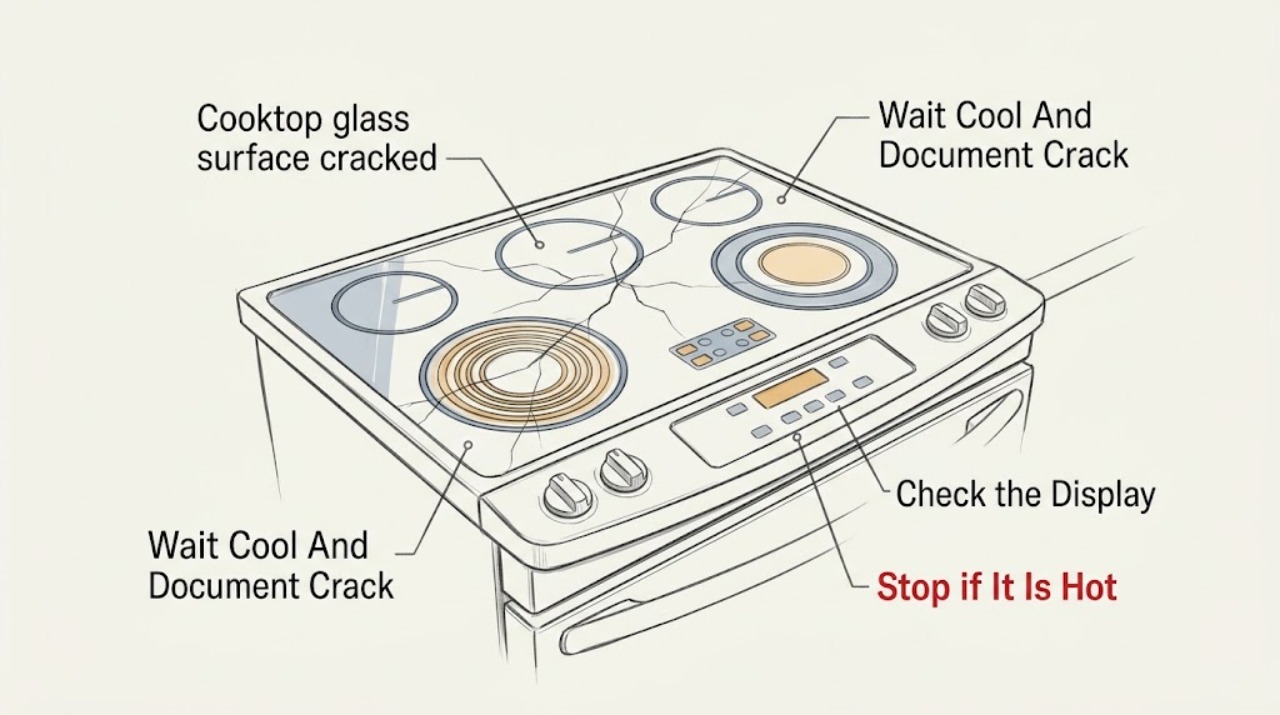
Do not cook on a KitchenAid cooktop with a cracked glass surface. KitchenAid's cooktop safety guidance warns that cleaning solutions and spillovers can penetrate a broken cooktop and create an electric-shock risk, and directs the owner to a qualified technician. Turn every control off, keep cookware and liquids away, and wait for the surface to become cool before documenting the crack. A hairline scratch, surface mark, chip, and full-depth crack are not interchangeable: do not scrape, tape, glue, polish, or test a suspected crack by heating it. If glass is loose or shedding, a zone will not turn off, controls are exposed or wet, there is smoke, a burning smell, sparks, shock, or a gas odor on a gas model, leave the appliance off and use qualified or emergency help appropriate to the hazard. The exact model determines whether the repair is a glass-top assembly, control, heater, seal, or another approved component; do not order a part from the appearance alone.
Work through in order
Diagnostic checks
Use only checks that match the exact appliance or system and its official guide.
-
Check 1
Turn every cooktop control to OFF using the normal controls and remove people, cookware, and liquids from the area without touching the suspected crack or a hot surface.
Expected result: Note whether all heating zones stop, a zone stays hot or on, a control is unresponsive, glass fragments are loose, or smoke, odor, sparks, shock, or gas odor is present.
Next step: Keep the cooktop off and keep people away. Use qualified or emergency help appropriate to active fire, gas odor, shock, sparks, or uncontrolled heating; do not continue to test controls.
Stop if: Do not touch hot glass, loose shards, exposed conductors, or a burner that remains energized; do not pour water on the cooktop or attempt to contain a gas leak yourself.
Why this matters
Why: A controllable surface with no active hazard can be left undisturbed for a cool visual record. A zone that will not turn off, loose glass, liquid entering the break, or an electrical or gas warning is an immediate stop-and-service condition.
-
Check 2
After the controls are off and the cooktop is cool to the touch, photograph the suspected damage from a safe position and note its location relative to zones and touch controls without pressing, scraping, or flexing the glass.
Expected result: Distinguish a line that appears to pass through the glass, a chip or missing fragment, a surface scratch or residue, and a crack that reaches an edge, control area, or heating zone.
Next step: Keep the appliance off, protect people from loose fragments without pressing on the surface, and provide the photos and model marking to qualified service.
Stop if: Do not scrape an uncertain crack, use a razor or abrasive cleaner, tape over it, glue it, or lift the glass to inspect underneath.
Why this matters
Why: A true break or missing glass means the cooktop must not be used. A mark that appears superficial still cannot be safely classified by force or heat testing; the model manual or technician should decide whether it is cosmetic damage or a structural break.
-
Check 3
From above and without moving the cooktop, observe whether a spill, cleaner, or condensation has reached the crack, controls, seams, or underside-visible edge; do not wipe liquid into the break or disassemble the unit.
Expected result: Record a dry isolated crack, wet controls, liquid in or beneath the break, a crack at the edge, or a panel that is flashing, beeping, or no longer responding normally.
Next step: Leave the cooktop off and arrange qualified appliance service. Do not clean the crack, remove panels, or restore power to see whether the controls recover.
Stop if: Do not touch wet controls with wet hands, use a cloth to push liquid into the break, or handle exposed wiring or glass fragments.
Why this matters
Why: Liquid exposure increases the electric-shock and control-damage concern identified in KitchenAid's safety guidance. A dry crack is still unsafe to cook on, while wet or unresponsive controls require a stricter stop boundary.
-
Check 4
Record what happened immediately before the damage and which zones or indicators were already affected, using only the appliance's current safe-off state; do not turn a zone on to compare heating.
Expected result: Note impact, thermal event, spill, a zone that stopped heating, a zone that stayed on, a breaker event, error indicator, or no change in controls before the cooktop was turned off.
Next step: Give the timeline, model, photos, and control observations to service. Keep all zones off until the surface and underlying assemblies are inspected.
Stop if: Do not energize another burner, reset a tripped circuit repeatedly, or remove knobs, trim, glass, or control covers.
Why this matters
Why: Impact or thermal history helps a technician inspect the glass and support. A zone or control symptom may indicate additional component or wiring damage, but it does not identify a part and should not be reproduced.
-
Check 5
Locate the exact KitchenAid model and owner's manual from the rating information without moving the damaged appliance or searching beneath the glass, then compare the visible damage with the manual's safety and service instructions.
Expected result: Record whether the unit is induction, electric radiant, or another model family, whether the manual calls the surface a glass or ceramic-glass top, and whether it explicitly directs immediate technician service for a break.
Next step: Arrange qualified KitchenAid appliance service with the model marking and damage photos. Do not attempt a glass-top replacement or internal diagnosis as a user repair.
Stop if: Do not move a built-in cooktop by pulling its power cable, lift the surface, or access the junction box unless qualified service is performing the work.
Why this matters
Why: Cooktop construction and approved repair parts vary by model. The general KitchenAid safety boundary remains no cooking on a broken surface; model-specific instructions control whether a qualified technician must replace a complete top or another assembly.
-
Check 6
Keep the cooktop out of use and prepare a service note containing the model, crack location and extent, photos, liquid or impact history, control and zone behavior, and any breaker or error observation.
Expected result: A complete note should distinguish a stable visible crack from spreading or loose glass, liquid exposure, a zone that remained energized, and any smoke, odor, sparks, shock, or gas concern.
Next step: Leave the appliance off until qualified service clears it or completes the model-approved repair. Keep children and pets away from the damaged surface.
Stop if: Do not resume cooking because the crack looks small, a different zone appears to work, or a reset temporarily changes the display.
Why this matters
Why: These details help service plan a safe inspection of the glass, heating zones, controls, seals, and wiring. They do not justify a temporary patch, continued cooking, or ordering a part without model confirmation.
Use your observations
Decision map
Find the observation that best matches what you see, then follow the next safe action.
-
PATH 01Next step
What you see
The surface has a visible crack, chip with missing glass, or loose fragment, all controls are off, and there is no active smoke, odor, spark, shock, uncontrolled heating, or gas concern.
Do this next
Keep the entire cooktop off, keep people away from the damage, and arrange qualified KitchenAid appliance service with the model and photos.
-
PATH 02Next step
What you see
Liquid has reached the crack, controls, or seams, or the panel is wet, flashing, beeping, or unresponsive after the break.
Do this next
Do not touch or operate the cooktop; keep it off and arrange qualified appliance or electrical service. Do not wipe liquid into the break or remove the glass.
-
PATH 03Next step
What you see
The mark may be a scratch, stain, or chip, but the owner cannot confidently determine that the glass is intact without pressing, scraping, or heating it.
Do this next
Leave the controls off, use only the model manual's intact-surface cleaning guidance when there is no suspected break, and ask qualified service to assess an uncertain crack or chip before cooking.
-
PATH 04Next step
What you see
A crack is accompanied by a zone that will not heat or turn off, a recurring error, a breaker trip, or controls that behave differently from normal.
Do this next
Keep the complete appliance off and arrange qualified appliance or electrical diagnosis. Do not energize another zone or open the control area to isolate the fault.
-
PATH 05Next step
What you see
The KitchenAid model is gas and there is gas odor or abnormal flame, or any model has smoke, sparks, shock, active fire, exposed wiring, uncontrolled heat, or loose glass that could injure someone.
Do this next
If safe, turn controls off, leave the area for gas odor or active fire, keep people away, and use emergency or qualified help appropriate to the hazard. Do not touch the damaged cooktop until cleared.
Helpful context
Understand the symptom
Treat a true crack as a safety defect
A broken cooktop is not a cosmetic cleaning problem. KitchenAid's safety instructions for an induction cooktop say not to cook on a broken surface because spillovers or cleaning solutions can penetrate the break and create an electric-shock risk. The correct first decision is whether the appliance can be left safely off, not whether another burner still appears to work. Do not place a pan over the crack or cover it with tape, foil, a mat, or a repair compound.
Check the surface only when cool and off
After all controls are off and the cooktop is cool, photograph the line, chip, crater, or loose fragment from above without pressing on it. A surface scratch or cooking residue may look different from a crack, but do not scrape an uncertain area to prove it. KitchenAid's cleaning guidance is for intact ceramic glass and calls for the controls to be off and the surface cool; it is not a repair method for broken glass.
Do not use the other zones as a workaround
A crack can allow liquid to reach parts below the surface even if only one cooking area looks damaged. Do not test another zone, wipe liquid into the crack, lift the glass, or remove knobs and panels. If the controls cannot turn all zones off or the surface is wet, leave the area safe and have the appliance evaluated before any further use.
Record the model and repair clues
The replacement may involve the complete glass-top assembly, a surface-heating component, an electronic control, or a seal, depending on the model and the damage. KitchenAid's support pages repeatedly point to the owner's manual and model-specific service path for control, power, overheating, and reset behavior. Provide the model marking, whether the crack is spreading or loose, which zones respond, whether any liquid reached the line, and whether the crack appeared after impact or heat. A technician should decide the repair after inspection.
Safety boundary
Stop conditions
- Do not cook on a broken KitchenAid cooktop. Stop for liquid entering the break, loose or shedding glass, a zone that will not turn off, smoke, burning odor, sparks, shock, exposed wiring, abnormal flame, gas odor, or a recurring breaker trip.
- Do not scrape, sand, tape, glue, polish, patch, lift, or press a suspected crack; do not test another zone, remove the glass or control panel, or perform live electrical work.
- A safe user check is limited to turning controls off, keeping the area clear, waiting for the surface to cool, documenting the damage from above, and locating the exact model manual. Glass-top, heating, control, seal, and wiring work belongs to a qualified technician.
Only after diagnosis
Potential parts
- KitchenAid ceramic-glass cooktop top assembly
Relevant only after a qualified inspection confirms that the glass-top assembly is cracked or structurally damaged and identifies the model-specific replacement path.
Confirm the exact KitchenAid model and approved assembly; do not infer fit from dimensions, color, or a visually similar top. - KitchenAid surface heating element or zone assembly
Relevant only when a technician finds an independently failed or damaged heating zone in addition to, or caused by, the cracked surface.
Match the exact model, zone position, electrical configuration, and approved component; a crack does not prove the element failed. - KitchenAid cooktop electronic control or touch panel
Relevant only when qualified diagnosis confirms control or interface damage after the glass, moisture, lock, and supply conditions are evaluated.
Confirm exact model fit and diagnostic evidence before replacement; do not replace a control because one indicator flashed after a spill. - KitchenAid cooktop seal or insulation assembly
Relevant only if service finds a damaged seal or insulation that must be renewed with the glass or underlying assembly to restore the model's safe installation.
Use only the exact model's approved seal or insulation and qualified installation procedure; do not use household caulk or an improvised gasket.
When checks do not resolve it
Need a professional?
Arrange qualified KitchenAid appliance service for any confirmed or uncertain crack, chip with missing glass, spreading line, loose fragment, liquid exposure, or damage near controls or a heating zone. Arrange electrical help for a recurring breaker trip or suspected supply problem, and use emergency help for gas odor, active fire, shock, smoke, sparks, or uncontrolled heating. Keep the entire cooktop off until the technician clears it; provide the model, photos, crack location, liquid or impact history, zone behavior, and any display or breaker observation.
Common questions
FAQ
Can I still use another burner if only one area of my KitchenAid cooktop is cracked?
No. KitchenAid's safety manual says not to cook on a broken cooktop because spillovers and cleaning solutions can penetrate the break and create an electric-shock risk. Keep the entire cooktop off until a qualified technician evaluates it; do not test another zone as a workaround.
Is a hairline mark on a KitchenAid glass cooktop always a crack?
Not necessarily, but do not press, scrape, heat, tape, or polish an uncertain mark to find out. Photograph it when the controls are off and the surface is cool, locate the model manual, and have qualified service assess any suspected break before cooking.
What if liquid reached the crack in my KitchenAid cooktop?
Keep the controls off and do not wipe liquid into the break, restore power, or open the cooktop. Liquid penetration increases the electrical and control risk identified in the safety manual; leave it off and arrange qualified appliance or electrical service.
Can I repair a cracked KitchenAid cooktop with glue, tape, or a sealant?
No. A patch does not restore the glass's structural or electrical safety and can conceal liquid penetration. Do not modify the surface; provide the exact model and photos to a qualified technician for the approved assembly-level repair.
Why did my KitchenAid cooktop crack?
Possible histories include impact, thermal stress, an unsuitable or damaged item, or an underlying installation or component issue, but the visible crack alone cannot establish the cause. Record what happened before the damage and let qualified service inspect the glass and supporting assemblies.
Should I reset a KitchenAid cooktop after it cracks?
No reset should be used to make a broken surface safe. Keep the appliance off. A model-specific reset may exist for an unrelated control or overheating code, but a crack, liquid exposure, uncontrolled zone, or recurring breaker problem requires service rather than repeated power cycling.
When is a cracked KitchenAid cooktop an emergency?
Treat gas odor, smoke, active fire, sparks, shock, exposed wiring, uncontrolled heating, a severe hot spot, or loose falling glass as an immediate hazard. If safe, turn controls off, leave the area for gas odor or fire, keep others away, and use emergency or qualified help appropriate to the hazard.
Read the exact guide
Official sources
- C82 - Electric CooktopKitchenAid · KitchenAid electric cooktop overheating, cookware, reset, and service guidance
- Element(s) Not Working - Glass CooktopKitchenAid · KitchenAid glass-cooktop control lock, power, reset, and model-specific service guidance
- Owner's ManualKitchenAid · KitchenAid induction cooktop safety and model-specific service boundary
- Cleaning Ceramic Glass CooktopsKitchenAid · KitchenAid ceramic-glass cooktop care and intact-surface cleaning conditions
Community feedback
Share a repair observation
Share a plain-text repair observation. Accepted observations are published automatically; this page may take a moment to update.