
On this page
Start here
Quick answer
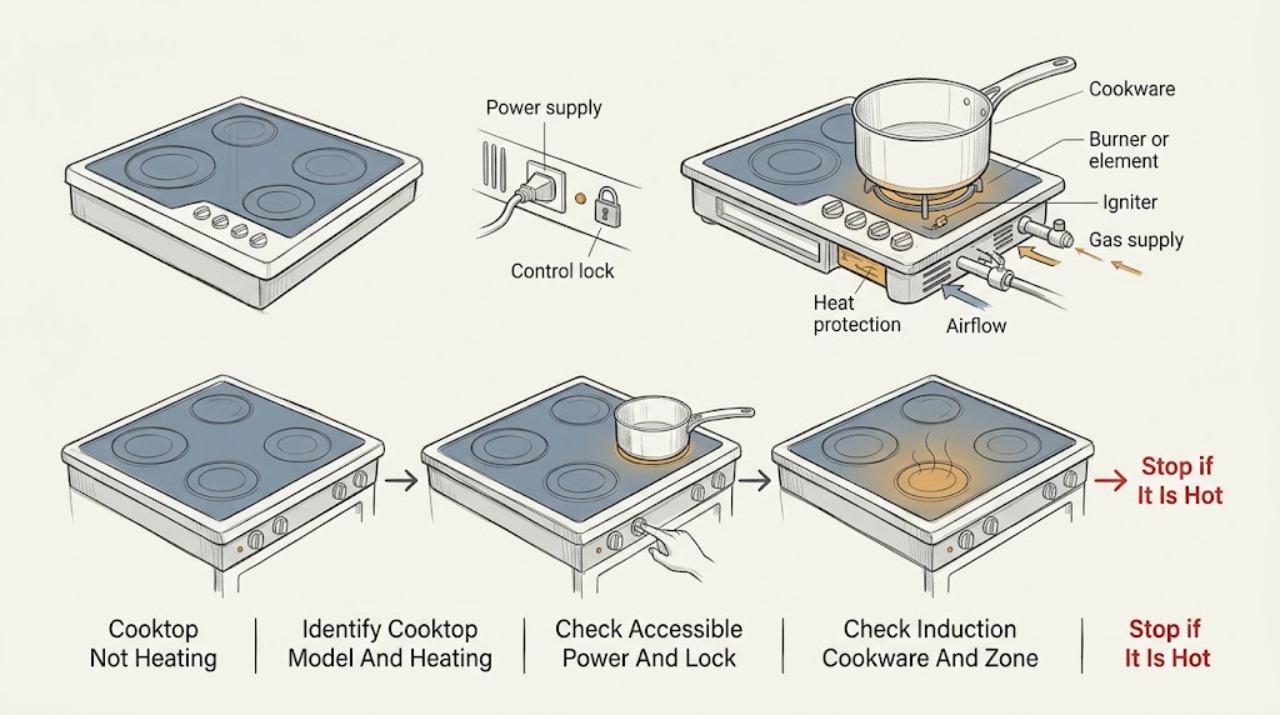
A Wolf cooktop that is not heating needs a different check for gas, electric, and induction models. First record the exact model and whether the whole unit or one zone is affected. With the surface cool and dry, check the accessible breaker or power state, control lock, control response, and correct normal activation. For induction, place a correctly sized induction-compatible pan on the zone; the burner will not heat without a sensed pan. For electric, select the zone and a heat level; a pan is not required on models that use exposed electric elements. For gas, check only the documented external supply and let a damp igniter dry; do not open the gas path or keep trying to ignite. Stop immediately for gas odor, delayed ignition, abnormal flame, glass damage, smoke, arc or spark, hot wiring, or a repeated breaker trip. If one safe external check does not restore heat, arrange Wolf Factory Certified Service.
Work through in order
Diagnostic checks
Use only checks that match the exact appliance or system and its official guide.
-
Check 1
From a dry, stable position with the surface cool, record the complete Wolf model and serial information, identify whether the cooktop is gas, electric, or induction, note whether one zone or the whole unit is affected, and record every display symbol, blink, error, hot-surface indicator, or unusual sound.
Expected result: The unit is gas, electric, or induction; all zones are cold or only one is cold; controls are dark, locked, blinking, or responsive; and an error or over-temperature indication is present or absent.
Next step: Use only the normal checks that match the identified technology and exact model. Keep cookware off the surface while classifying the controls. If a hazard, cracked glass, or unsafe connection is present, stop and arrange qualified help.
Stop if: Stop for gas odor, smoke, burning odor, abnormal flame, arc or spark, hot or wet wiring, cracked glass, exposed conductors, repeated breaker operation, or an unstable installation.
Why this matters
Why: A dark whole-unit symptom points first to power or control state. An induction-only blink can mean cookware is not sensed. A single cold electric or gas zone points toward that zone's component or assembly. An over-temperature state may be protective, while an error that returns needs service.
-
Check 2
Check the accessible household breaker or fuse and the cooktop's normal power control only from a dry, cool position. Look for a lock symbol and use the exact model's normal unlock control; do not remove trim, lift the glass, or access a terminal block.
Expected result: The breaker or fuse is open, the display is dark, the lock clears, the display remains locked, the breaker opens again, or the control returns after one safe reset.
Next step: Correct only an obvious accessible power state and perform no more than one model-appropriate reset. If the breaker trips again, the display stays dark, or the lock will not clear, keep the cooktop off and arrange electrical or Factory Certified Service.
Stop if: Stop for a repeated breaker trip, hot or wet connection, damaged cord or switch, smoke, burning odor, exposed wiring, or any need to open the electrical compartment.
Why this matters
Why: Wolf lists loss of power and lock mode among common causes for electric and induction cooktops that do not heat. A repeated trip or abnormal connection indicates a fault, not a reason to keep resetting. A normal display with a locked control needs an unlock path rather than a part replacement.
-
Check 3
For an induction Wolf cooktop, place one clean, flat-bottomed, induction-compatible pan centered on the affected zone, then select the zone and a normal power level. Keep the pan in contact with the surface and do not use the glass as a preheat target without cookware.
Expected result: The control blinks until a pan is placed, heat begins with a suitable pan, the pan is not recognized, the zone shuts off during use, or multiple zones fail together.
Next step: Center the pan and use only the model-approved cookware size and material. If a suitable pan is not recognized, the zone remains cold, or the unit shuts down repeatedly, allow it to cool once if relevant and arrange service.
Stop if: Stop for cracked glass, smoke, arc or spark, burning odor, repeated breaker operation, abnormal heat, or any need to lift the glass or access a generator or live circuit.
Why this matters
Why: Wolf says induction burners do not heat without a sensed compatible pan. A blink that clears with the correct pan points to cookware sensing or placement; failure with a known suitable pan points toward power, control, generator, or zone diagnosis. A shutdown during heavy use may be thermal protection.
-
Check 4
For an electric Wolf cooktop, clear the zone, touch the normal ON/OFF control for the affected element, and complete the activation by selecting the model's heat level. Observe whether the indicator responds and whether the element heats normally; do not touch the element or lift the surface.
Expected result: The indicator does not respond, the indicator responds but the element stays cold, only one element is affected, all elements are affected, or the unit turns off after heavy use.
Next step: Let a hot unit cool completely before one safe retest, and verify that accessible ventilation openings are not blocked only as the manual permits. If a selected element remains cold or the whole unit fails, arrange service rather than accessing wiring.
Stop if: Stop for cracked glass, smoke, arc or spark, hot wiring, burning odor, repeated trip, a stuck control, or any need to test or replace an element while energized.
Why this matters
Why: Wolf's electric guidance treats lock mode, power, and proper control operation as initial checks for one or several cold elements. A responsive control with one cold element points toward that element or its control path; a whole-unit failure points toward supply or control. A heat-related shutdown may be protective.
-
Check 5
For a gas Wolf cooktop, from a safe position verify the normal external power state, confirm the burner cap and ring are centered and seated, and let a recently wet igniter or burner dry completely. Use the exact model's normal knob operation only; do not manually light a burner or open the gas supply components.
Expected result: The igniter clicks and a normal flame appears, the igniter clicks without a flame, there is no click, the flame is uneven or abnormal, the burner is wet, or several burners are affected.
Next step: Turn the control off if ignition is not promptly normal, ventilate without operating electrical switches if gas is suspected, and arrange qualified gas-appliance service for persistent or abnormal ignition. Do not keep retrying.
Stop if: Stop immediately for gas odor, delayed ignition, flame lift or unusual color, smoke, persistent clicking, a stuck knob, or any need to open the valve, regulator, burner manifold, or igniter wiring.
Why this matters
Why: Wolf states that its gas igniters are electric and need power, while damp or misaligned burner parts can prevent ignition. Clicking without ignition can leave unburned gas; an abnormal flame or a no-click condition can require gas, electrical, igniter, regulator, or control diagnosis.
-
Check 6
If a Wolf electric or induction cooktop stopped after several zones or high power were used, turn it off, remove cookware, allow the surface and accessible underside area to cool, and verify that the model-permitted ventilation openings are not blocked. Do not bypass a thermal control or use a fan or liquid to force cooling.
Expected result: The unit works again after cooling, a vent is blocked, one zone still fails, all zones remain off, an over-temperature code remains, or the unit becomes abnormally hot again.
Next step: Use the cooktop only within the model's normal operating guidance. If the fault returns after one cool-down and safe retest, keep it off and arrange Factory Certified Service.
Stop if: Stop for smoke, burning odor, glowing or damaged glass, arc or spark, abnormal cabinet heat, repeated breaker operation, or any need to open the underside or bypass protection.
Why this matters
Why: Wolf documents heat-protection shutdown for heavy induction or electric use and lists over-temperature states in its guide. Recovery after cooling supports protective behavior; repeated or immediate overheating, a persistent code, or a single failed zone needs service.
-
Check 7
Arrange Wolf Factory Certified Service when the cooktop remains cold after one safe power, lock, normal activation, cookware, gas, and cooling check, when one zone repeatedly fails, or when a warning or thermal shutdown returns. Provide the full model and serial information, technology type, affected zones, display evidence, cookware or burner observations, and the exact safe steps performed.
Expected result: One zone or the whole unit remains cold, an error returns, induction cookware is not sensed, an electric element never responds, gas ignition is abnormal, or the unit overheats or shuts down again.
Next step: Keep the cooktop off and isolate power only when safe. For gas symptoms, leave the controls off and use emergency or utility guidance from a safe location when appropriate. Arrange qualified Wolf service and do not continue testing.
Stop if: Do not continue after gas odor, abnormal flame, smoke, burning odor, arc or spark, cracked glass, hot or wet wiring, repeated breaker operation, or any need to access an internal component.
Why this matters
Why: Remaining causes can include a generator, element, igniter, switch, sensor, control, regulator, wiring, or supply fault. The symptom does not identify a compatible part and does not justify opening the cooktop.
Use your observations
Decision map
Find the observation that best matches what you see, then follow the next safe action.
-
PATH 01Next step
What you see
Gas odor, delayed ignition, abnormal flame, smoke, burning odor, arc or spark, cracked glass, hot or wet wiring, exposed conductors, or repeated breaker operation is present.
Do this next
Arrange qualified service and follow the exact model guidance.
Why this path and its safety boundary
Why it matters: Stop using the cooktop and do not relight, reset, or retest it. Move away from the hazard; isolate power or gas only from a safe position, avoid operating electrical switches when gas may be present, and contact the appropriate emergency, utility, electrical, or qualified appliance service.
-
PATH 02Next step
What you see
The whole cooktop is dark, the breaker or fuse is open, or a lock symbol prevents normal controls.
Do this next
Arrange qualified service and follow the exact model guidance.
Why this path and its safety boundary
Why it matters: Check the accessible power state and the exact model's normal unlock procedure once. A repeated trip, dark display with apparent supply, or lock that will not clear needs qualified service.
-
PATH 03Next step
What you see
An induction control blinks or a zone does not heat until a pan is present.
Do this next
Arrange qualified service and follow the exact model guidance.
Why this path and its safety boundary
Why it matters: Center one clean, flat, induction-compatible pan and select the zone and power level. If the indicator continues to blink with suitable cookware, arrange service; do not preheat the empty glass or access the generator.
-
PATH 04Next step
What you see
An electric zone's indicator does not respond, responds without heat, or only one element is cold.
Do this next
Arrange qualified service and follow the exact model guidance.
Why this path and its safety boundary
Why it matters: Use the normal ON/OFF and heat-level controls once, then allow a hot unit to cool before one retest. Persistent single-zone or whole-unit failure needs service; do not lift the surface or test the element.
-
PATH 05Next step
What you see
A gas burner clicks without a normal flame, does not click, has an uneven flame, or was recently wet.
Do this next
Arrange qualified service and follow the exact model guidance.
Why this path and its safety boundary
Why it matters: Turn the control off and allow accessible damp parts to dry only when there is no gas odor or other hazard. Persistent no-ignition, repeated clicking, or abnormal flame requires qualified gas-appliance service; do not open the gas path.
-
PATH 06Next step
What you see
An electric or induction unit shuts down after heavy use, shows an over-temperature state, or resumes only after cooling.
Do this next
Arrange qualified service and follow the exact model guidance.
Why this path and its safety boundary
Why it matters: Turn it off, remove cookware, allow complete cooling, and check only model-permitted accessible ventilation. One recurrence after a safe retest needs service; never bypass thermal protection.
-
PATH 07Next step
What you see
Power, lock, normal activation, cookware or burner assembly, and one safe cooling check are correct but one zone or the whole cooktop remains cold.
Do this next
Arrange qualified service and follow the exact model guidance.
Why this path and its safety boundary
Why it matters: Stop at external checks and arrange Wolf Factory Certified Service for control, element, generator, igniter, regulator, wiring, or supply diagnosis. Do not choose a part from the symptom alone.
Helpful context
Understand the symptom
Identify the heating technology first
Wolf cooktops may be gas, electric, or induction, and the same symptom has different meanings. Induction zones need a sensed compatible pan and do not preheat empty. Electric elements heat when correctly selected even without a pan. Gas units need electrical power for their igniters as well as an available gas supply. The model and serial information control the exact button, lock, error, and service procedure.
Separate one-zone faults from whole-unit faults
If every zone is cold and the controls are dark, start with power and lock mode. If the display works but one zone is cold, compare the affected zone with another only through normal operation: induction cookware sensing, electric element activation, or gas ignition evidence. A whole-unit failure after a breaker event points in a different direction from one zone that fails while the others work.
Heat protection can look like a failure
Wolf documents automatic shutdown or reduced operation when induction components become too hot, especially during heavy use or when ventilation under the cooktop is restricted. Let the unit cool, keep the vents accessible if the manual permits an external check, and make one safe retest. Do not defeat thermal protection or continue using a cooktop that repeatedly overheats.
Gas and electrical safety come before diagnosis
For gas, do not dismantle the burner, regulator, valve, or igniter, and do not keep trying after an abnormal flame, delayed ignition, or gas odor. For electric and induction, do not access terminals, live wiring, generator modules, or glass beneath the surface. A cracked cooktop, smoke, arc, hot connection, or recurring breaker trip is a stop condition.
Safety boundary
Stop conditions
- Gas odor, delayed ignition, repeated clicking, abnormal flame, smoke, burning odor, or sparking outside normal ignition.
- Cracked or shattered glass, exposed conductors, a hot or wet cord, outlet, switch, cabinet, or control, or a breaker that opens again.
- Water or spill near electrical controls, an unstable installation, a stuck knob, or any attempt to bypass a safety device.
- A zone or surface is abnormally hot, an over-temperature state returns, or the unit shuts down repeatedly.
- Any need to open a gas valve or regulator, lift the glass, access an element, igniter, generator, terminal, sensor, or live circuit.
- The cooktop remains cold after one safe technology-specific check or a warning or fault returns.
Only after diagnosis
Potential parts
- cooktop control or touch control
Consider this category only after qualified testing links an unresponsive or incorrect control symptom to the exact model after power and lock checks.
Confirm the complete Wolf model, technology type, revision, connector, and manufacturer fit information before any repair. - induction generator or electric heating element
Consider this category only after qualified diagnosis confirms a persistent single-zone or whole-unit heating fault with supply and controls verified.
Confirm the complete model, affected zone, electrical requirements, and approved service method; internal cooktop work is not a user repair. - gas igniter or burner control component
Consider this category only after qualified gas-appliance testing confirms an ignition or burner-control fault after safe external assembly and drying checks.
Confirm the exact Wolf model, fuel type, burner position, gas requirements, and manufacturer fit information; do not access the gas path while energized.
When checks do not resolve it
Need a professional?
The exact model or heating technology is unclear, or the rating or installation information cannot be safely verified., The whole cooktop is dark, a breaker trips again, a lock will not clear, or controls remain unresponsive., An induction zone does not sense suitable cookware, an electric element remains cold, or one zone repeatedly fails., A gas burner will not ignite normally, keeps clicking, has an abnormal flame, or the supply or igniter state is uncertain., The unit overheats or shuts down repeatedly, or smoke, odor, gas, glass, wiring, or food-surface safety is in doubt.
Common questions
FAQ
Why is my Wolf cooktop on but not heating?
Identify whether it is gas, electric, or induction, then check lock mode, normal activation, and whether one zone or every zone is affected. Induction needs a sensed compatible pan; electric activation uses the zone control and power level; gas needs safe ignition and supply. Persistent failure needs service.
Why is my Wolf induction burner blinking with no heat?
Wolf says a blinking control commonly means the zone is not sensing compatible cookware. Center a suitable pan and select the zone and power level. If it keeps blinking with suitable cookware, stop and arrange Factory Certified Service.
Does a Wolf electric cooktop need a pan to heat?
Wolf's electric-burner guidance says an electric burner produces heat when correctly turned on, even without a pan. Follow the normal ON/OFF and heat-level sequence, but do not touch the element or test it if the glass or wiring is damaged.
Why does my Wolf cooktop shut off during cooking?
On electric or induction products, heavy use or excessive heat can trigger protective shutdown, and induction also turns off when cookware is removed. Turn the unit off, remove cookware, let it cool, and make one safe retest. Recurrence needs service.
What should I do if my Wolf gas cooktop clicks but does not heat?
Turn the control off. If there is no gas odor or other hazard, an accessible damp igniter or mis-seated burner part may need to dry or be correctly seated according to the model guide. Do not keep trying to ignite, open the gas path, or continue after an abnormal flame or odor; arrange qualified service.
Read the exact guide
Official sources
- UCGWolf · Wolf gas cooktop use-and-care and troubleshooting guidance
- Wolf Induction Cooktop or Induction Range Cooktop Does Not Work | FAQSub-Zero, Wolf, and Cove · Wolf induction cooktop and induction range power, lock, cookware, Showroom Mode, reset, and service guidance
- Induction Cooktop Burner Blinking and No Heat | FAQSub-Zero, Wolf, and Cove · Wolf induction burner blinking, cookware sensing, reset, and service guidance
- Induction Cooktop Burner Operation | FAQSub-Zero, Wolf, and Cove · Wolf induction burner cookware-sensing behavior and normal operation
- Wolf Electric Cooktop Does Not Work | FAQSub-Zero, Wolf, and Cove · Wolf electric cooktop power, lock mode, reset, single-zone, and poor-heating guidance
- Wolf Gas Surface Burner Does Not Ignite | How to GuideSub-Zero, Wolf, and Cove · Wolf gas burner power, igniter, burner assembly, gas supply, and qualified-service guidance
- Electric Cooktop Burner Operation | FAQSub-Zero, Wolf, and Cove · Wolf electric cooktop normal zone activation and pan behavior
- Induction Cooktop Shuts Off during Use | FAQSub-Zero, Wolf, and Cove · Wolf induction or electric cooktop thermal shutdown, cookware contact, reset, and service guidance
- Wolf Gas Surface Burner Operation | FAQSub-Zero, Wolf, and Cove · Wolf gas burner normal knob and flame-setting operation
- Wolf Gas Surface Burner Clicking | How to GuideSub-Zero, Wolf, and Cove · Wolf gas burner clicking, sparking, moisture, assembly, power, and service guidance
- Induction CooktopWolf · Wolf induction cooktop use-and-care, over-temperature, power-supply, vent, and service guidance
Community feedback
Share a repair observation
Share a plain-text repair observation. Accepted observations are published automatically; this page may take a moment to update.