
On this page
Start here
Quick answer
First identify whether the cooktop is gas, electric radiant, or induction, because a cold burner, a cycling radiant element, and a pan that an induction zone cannot detect need different checks. Confirm the selected zone and setting, check the appliance's power or gas supply from a safe external position, and look for a lock, pause state, error display, wet controls, or cookware mismatch. On a gas unit, stop immediately for a gas odor, delayed ignition, or abnormal flame. On an electric or induction unit, stop for smoke, arcing, a cracked glass surface, uncontrolled heat, or repeated breaker trips. Use only the model instructions for a single documented reset; persistent failure needs qualified service.
Work through in order
Diagnostic checks
Use only checks that match the exact appliance or system and its official guide.
-
Identify the affected zones and heating type
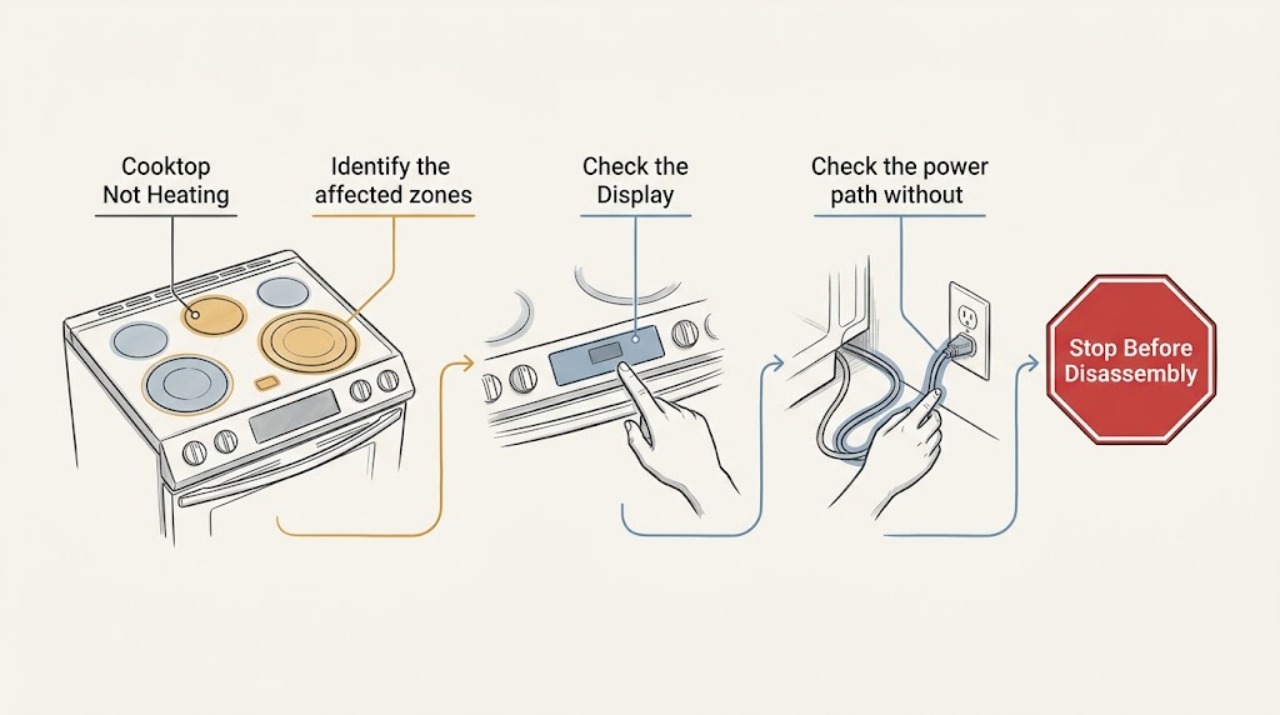
With the cooktop off and safe to approach, record whether the problem affects one zone or every zone. Identify the appliance as gas, electric radiant, or induction from the model information and surface layout, and note whether the display or indicator lights respond.
Expected result: Only one zone is cold, all zones are cold, the controls are dark, or the controls respond but the selected zone stays cold.
Next step: Follow the matching branch below and the exact model instructions. Do not use a code or procedure from a different heating type or brand.
Why this matters
Why: A single-zone failure points toward that zone or its control path, while a dark or whole-panel failure first requires a power or control-state check. Induction adds pan recognition; gas adds fuel and ignition behavior.
-
Confirm the selected zone and control state
Select the affected zone deliberately and set a normal heat level using the model's controls. Check for a lock, pause, demo, timer, or error indication, and make sure the panel is dry and free of food, cleaner residue, or an object covering a touch key.
Expected result: The zone begins heating after the correct selection and setting, or the controls remain locked, flash, show an error, or ignore input.
Next step: Clear only an external obstruction when the surface is cool and dry, then use the model's documented unlock or pause procedure. If the controls still reject input, stop and arrange service.
Why this matters
Why: A wrong zone or active lock can look like a heating failure. Wet or obstructed controls can also prevent input on some cooktops; a persistent error requires the model-specific explanation rather than a guessed code.
-
Check the power path without opening the appliance
For an electric or induction cooktop, observe whether the appliance display is powered and whether its dedicated breaker has tripped. If the area is dry and there is no smoke, odor, arcing, or visible damage, restore a tripped breaker only as a single normal household reset; do not remove covers or handle internal wiring.
Expected result: The panel remains dark, the breaker trips again, the panel powers up but heating is absent, or the cooktop works after the reset.
Next step: If the breaker trips again or the fault returns, leave the cooktop out of service and arrange qualified electrical or appliance diagnosis. If power is present, continue with the heating-type check.
Why this matters
Why: A dark panel suggests a supply or control problem, while a repeat trip is a stop-use signal. A reset that restores operation does not prove the underlying fault is gone if the symptom returns.
-
Check induction cookware and zone placement
If the unit is induction and the controls respond, use a pan confirmed by the model instructions to be induction-compatible. Center its flat base over the affected zone, use a size appropriate to that zone, and avoid an empty-pan trial. Compare the result with a known suitable pan on another zone only when the surface is cool and no hazard is present.
Expected result: The zone heats with suitable centered cookware, or it stays cold and continues to show a pan-recognition symbol or error with suitable cookware.
Next step: Correct the pan or placement if that resolves the issue. If a suitable pan is not detected, stop repeated trials and provide the model, zone, display, and cookware result to qualified service.
Why this matters
Why: A non-magnetic, poorly sized, warped, or off-center pan can prevent an induction zone from transferring heat. Failure with suitable cookware shifts suspicion toward the zone, sensor, power, or control path.
-
Check electric radiant or gas burner behavior
For electric radiant or coil cooking, observe whether the selected element warms gradually or cycles instead of glowing continuously; verify the element is seated only if the model is a removable-coil design and the cooktop is cool. For gas, observe from a safe position whether the burner clicks and produces a stable flame after the control is turned on briefly; do not continue if there is a gas odor, delayed ignition, or abnormal flame.
Expected result: The radiant element cycles and warms, the gas burner has no click, clicks without lighting, lights unevenly, or all gas burners are affected.
Next step: For a cool removable coil, correct only obvious seating if the manual permits it. For gas, turn the control fully Off after a failed brief attempt and use the model's burner guidance; persistent ignition or flame problems need qualified service.
Why this matters
Why: Temperature-limiting electric elements can cycle during normal operation. On gas equipment, the click, flame, cap alignment, burner ports, and supply are separate clues; one failed burner differs from a whole-cooktop supply or ignition issue.
-
Cool an overheated unit and use one documented reset
If the cooktop stopped after high heat or shows an error, turn the controls Off and let the surface and accessible surrounding area cool completely. Look only for an external obstruction near the accessible underside or a hot pan near the controls. When cool, dry, intact, and hazard-free, follow the exact model instructions for one documented reset.
Expected result: Heating returns after cooling and the documented reset, or the error, cold zone, or shutdown returns under ordinary use.
Next step: If the issue returns, stop use and arrange qualified service. Do not bypass thermal protection, open the appliance, or attempt an internal electrical or gas repair.
Why this matters
Why: Overheating, hot cookware near controls, restricted airflow, or an automatic protection state can temporarily stop heating on some models. A returning fault is not fixed by repeated resets.
Use your observations
Decision map
Find the observation that best matches what you see, then follow the next safe action.
-
PATH 01Next step
What you see
The panel is dark or every zone is cold on an electric or induction cooktop.
Do this next
Check the appliance's external power state and any tripped dedicated breaker only when the area is dry and free of hazard. A repeat trip or dark panel after the permitted check requires service.
-
PATH 02Next step
What you see
The controls respond but one induction zone does not heat.
Do this next
Use a suitable centered pan and check the exact model's pan-recognition and error guidance. If a suitable pan remains undetected, stop and arrange qualified diagnosis.
-
PATH 03Next step
What you see
An electric radiant or coil element cycles while warming, or appears less red than expected.
Do this next
Compare the behavior with the model instructions; cycling can be normal on temperature-limiting elements. If the zone stays cold or the control causes abnormal heat, stop and request service.
-
PATH 04Next step
What you see
A gas burner does not click, clicks without a flame, has an uneven flame, or the whole gas cooktop is affected.
Do this next
Turn the control Off after a brief safe attempt and use the exact model burner and supply guidance. Do not open gas components; persistent ignition or flame problems require qualified service.
-
PATH 05Next step
What you see
An error, lock, wet panel, or overheating indication remains after the cooktop is cool and externally clear.
Do this next
Record the complete display and model, use only the model-specific procedure, and perform at most one documented reset. If the indication returns, leave the cooktop out of service.
-
PATH 06Next step
What you see
There is a gas odor, delayed ignition, abnormal flame, smoke, arcing, cracked glass, uncontrolled heat, or repeated tripping.
Do this next
Stop all testing. For gas odor, avoid electrical switches and flames, leave the area, and seek emergency or gas assistance from a safe location. For smoke, arcing, damaged glass, uncontrolled heat, or repeated trips, keep clear and arrange appropriate emergency or qualified service.
Helpful context
Understand the symptom
Start by naming the failure
Not heating can mean one zone is weak, the whole panel is inactive, a gas burner clicks without a flame, or an induction zone does not recognize a pan. Record which zones are affected and whether the controls light up. Do not assume that a radiant element must glow continuously: some electric cooktops cycle their elements while regulating temperature.
Keep the checks external and model-specific
The model number and heating type determine the correct control sequence and code meaning. A clean, dry panel, a correctly selected zone, an appropriate pan, and clear accessible airflow are reasonable external checks. Internal wiring, gas components, power modules, and damaged glass belong with qualified service.
Safety boundary
Stop conditions
- Stop immediately for a gas odor, delayed ignition, uncontrolled or abnormal flame, smoke, or any sign of fire.
- Stop and keep clear for arcing, a burning odor, a cracked or shattered glass surface, uncontrolled heating, or repeated breaker trips.
- Stop after one model-documented reset if the cold zone, error, shutdown, or abnormal control behavior returns.
- Do not open the cooktop, disturb internal wiring or gas components, bypass a safety device, or continue tests on a wet or damaged appliance.
Only after diagnosis
Potential parts
- radiant or coil heating element
Consider only when a qualified diagnosis identifies a single electric zone element as the failed component after control and power checks.
Confirm the complete model and manufacturer fit information before ordering any component. - induction zone or power module
Relevant only when a suitable centered pan is not detected or a qualified diagnosis identifies a persistent zone or power-module fault.
Induction internal work requires qualified service and exact model confirmation. - gas igniter or burner control component
Relevant only for a confirmed gas model after the burner cap, ports, and safe external observations do not explain the ignition failure.
Gas-system components require exact model confirmation and qualified installation. - temperature sensor or control interface
Consider only when a recurring error or abnormal heating is tied to the sensor or control path by model-specific diagnosis.
Do not infer fit or failure from a generic no-heat symptom.
When checks do not resolve it
Need a professional?
Arrange qualified appliance service when a zone remains cold with suitable settings and cookware, a gas burner continues to fail after safe external checks, an error or lock state cannot be resolved from the exact model instructions, or the fault returns after cooling and one documented reset. Use emergency or gas-safety assistance from a safe location for gas odor, smoke, fire, or other immediate hazards.
Common questions
FAQ
Why is only one cooktop zone not heating?
First confirm the correct zone and setting, then distinguish electric cycling, induction pan recognition, or gas ignition behavior. If one zone stays cold with the correct external conditions, provide the model and zone details to qualified service.
Why does an electric element not stay red?
Some temperature-limiting electric elements cycle on and off and may not glow continuously. If the zone never warms, the control behaves abnormally, or there is smoke or damage, stop use and arrange service.
Why does an induction cooktop not heat my pan?
The pan may be unsuitable, too small, warped, or off-center for that zone. Use cookware approved by the exact model instructions and center it; continued failure with suitable cookware needs qualified diagnosis.
What should I do if a gas cooktop will not heat?
A single burner may involve ignition, cap alignment, or blocked ports, while a whole-unit failure may involve supply or control. Turn the control Off after a brief safe check and stop immediately for gas odor, delayed ignition, or abnormal flame.
Can I reset a cooktop that stopped heating?
Only when the surface is cool, dry, intact, and free of smoke, odor, sparks, or uncontrolled heat, and only if the model instructions document a reset. Use it once; a returning fault or repeated trip requires service.
Read the exact guide
Official sources
- Bosch Cooktop & Rangetop Error CodesBosch · Manufacturer-specific examples of separate electric, induction, and gas cooktop error paths, wet controls, overheating, locks, and persistent-fault escalation
- Bosch Electric Cooktop TroubleshootingBosch · Manufacturer-specific electric cooktop power, control-lock, overheating, ventilation, cooling, and service guidance; not universal across brands
- Electric Range & Cooktop - Induction Burners Not Working or Flashing Power LevelGE Appliances · Manufacturer-specific induction cookware compatibility, zone placement, power, controls, and service guidance
- Recognizing and Responding to Pipeline EmergenciesU.S. Department of Transportation, Pipeline and Hazardous Materials Safety Administration · Gas-odor emergency response: avoid electrical switches and flames, leave the area, and seek help from a safe location
- Not Powering On - Electric CooktopWhirlpool · Manufacturer-specific electric cooktop power, coil seating, temperature-limiting cycling, control settings, one-time reset, and service guidance
- Bosch Gas Cooktop & Rangetop TroubleshootingBosch · Manufacturer-specific gas cooktop supply, ignition, burner cap, burner-port, flame, and service guidance; not universal across brands
Community feedback
Share a repair observation
Share a plain-text repair observation. Accepted observations are published automatically; this page may take a moment to update.