
On this page
Start here
Quick answer
For a GE cooktop that is not heating, first determine whether one surface unit, the warming zone, or every unit is affected. With the controls off and the surface cool, verify the correct control, power supply, burner or module seating, and a flat smooth pan; a warming zone may not glow red even when it is operating. If a correctly selected unit stays cold, a breaker trips again, or built-in wiring needs inspection, stop and arrange qualified appliance service.
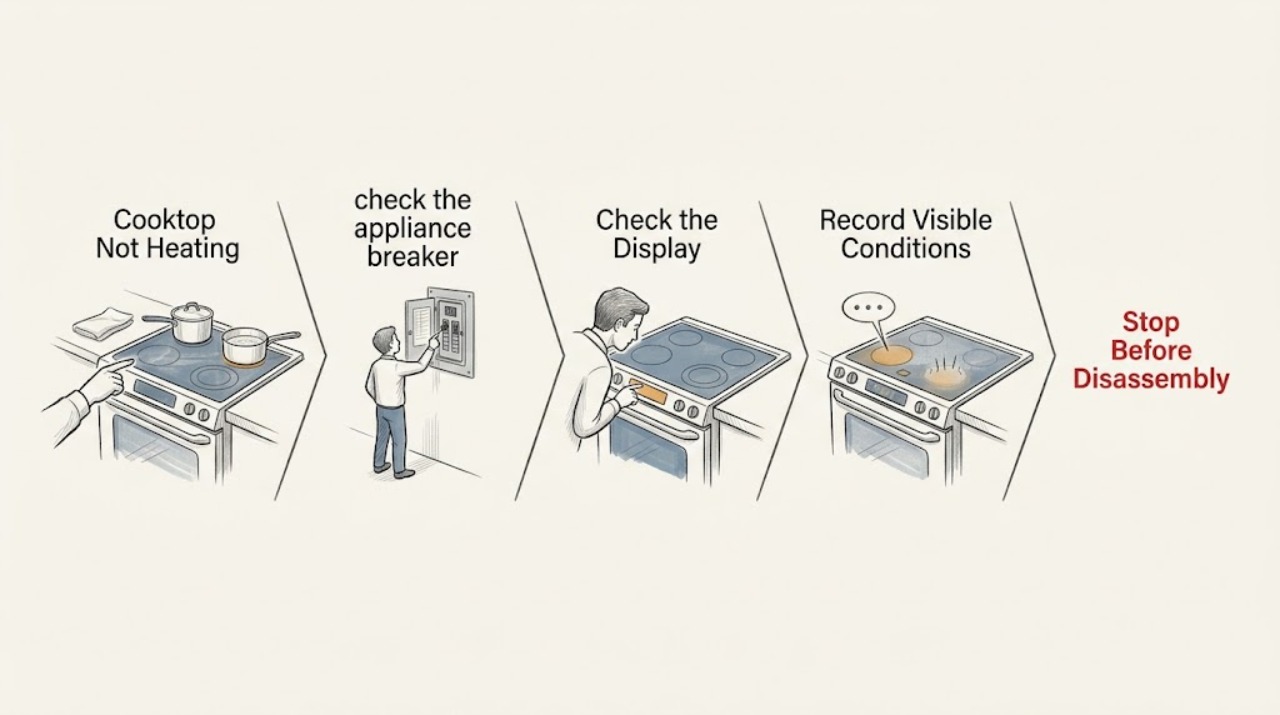
Work through in order
Diagnostic checks
Use only checks that match the exact appliance or system and its official guide.
-
Check 1
Record which surface units are affected and whether the issue is no heat, weak heat, or a warming-zone indication that is not glowing.
Expected result: One cooking zone is cold while the others work; several zones are cold; or only the warming zone appears inactive.
Next step: Use the matching branch below, then test the control and cookware before considering a component fault.
Why this matters
Why: A single-zone symptom narrows the fault to that unit or its local control path. A whole-top symptom makes supply, installation, or shared control more likely. A warming zone may be operating without a red glow.
-
Check 2
With the cooktop controls Off, check the appliance breaker or fuse and confirm that the appliance has power without opening the appliance or disturbing fixed wiring.
Expected result: The breaker is tripped or a fuse is open; the breaker resets and the cooktop returns; or the breaker trips again immediately.
Next step: If safe, reset the breaker once. If it trips again, leave the cooktop off and arrange qualified service; do not repeatedly reset it or inspect live wiring.
Why this matters
Why: A tripped protective device can explain an all-cold cooktop. A repeat trip indicates an electrical fault or unsafe load condition rather than a normal heating symptom.
-
Check 3
Select the control that corresponds to the affected zone and set it to a normal heating setting, following the markings for that model.
Expected result: The correct zone responds, or the selected zone remains cold while another zone responds to the same control.
Next step: Turn the control Off and continue with the pan test or removable-unit check; do not remove knobs or open the control panel.
Why this matters
Why: A control-to-zone mismatch can make a working unit look dead. If the correct control still produces no warmth, the issue is not explained by selection alone.
-
Check 4
On a radiant or induction zone, place a suitable pan with a flat, smooth bottom on the affected cooking area and repeat the test at a normal setting.
Expected result: The zone heats with the flat pan, or it remains cold or weak with the known-suitable pan.
Next step: If the flat-pan test restores heat, use compatible flat cookware. If it does not, stop user troubleshooting and document the result for service.
Why this matters
Why: Improper pan contact can prevent efficient heating or make a smooth-top sensor cycle. Remaining cold with suitable cookware points back to the unit, control, sensor, or power path.
-
Check 5
For an accessible plug-in coil or removable module, turn controls Off, wait for it to cool, disconnect power as directed by the model, and verify that the unit is seated firmly.
Expected result: The coil or module was loose; it now works after correct reseating; or it is already seated and remains cold.
Next step: Do not force the connector or use a damaged unit. If the design permits, perform the matching-receptacle swap in the next action; otherwise arrange service.
Why this matters
Why: A loose plug-in connection can interrupt heating. If proper seating changes nothing, the fault may be in the element/module or its receptacle and needs model-specific diagnosis.
-
Check 6
Only on a user-removable coil or module design, move the suspect unit to another matching receptacle of the same size and type after power is Off and the unit is cool.
Expected result: The same unit works in the other receptacle; or it remains cold in the other receptacle.
Next step: Return the unit only when cool and power is isolated. Have a qualified technician confirm the receptacle, switch, element, or module before replacement.
Why this matters
Why: If the unit works elsewhere, the original receptacle, switch, or control path becomes more likely. If the symptom follows the unit, the unit itself becomes more likely. This is a directional test, not a part-identification result.
-
Check 7
If this is a range with a working clock or display but all top burners are dead, treat the supply and installation path as a separate branch.
Expected result: The display works while every top burner fails, or the display and burners are both dead.
Next step: Do not pull out a built-in appliance or open its terminal area. Arrange qualified appliance or electrical service to verify installation and supply.
Why this matters
Why: GE identifies an improperly wired power cord as one possible reason top burners fail while the clock works. Both display and burners being dead makes a broader power interruption more likely.
-
Check 8
For a warming zone, judge heat with an appropriate pan and the model's normal low-heat behavior instead of using the surface glow as the only test.
Expected result: The pan warms even though the zone does not visibly glow, or the pan remains cold and another burner may also be affected.
Next step: If it is warm, no repair is indicated from the missing glow alone. If it is cold, stop and provide the model and test result to a service professional.
Why this matters
Why: A warming zone can operate at low wattage without glowing red. A definitely cold zone is abnormal, especially when other surface units also fail.
-
Check 9
Stop immediately if there is smoke, sparking, a burning smell, a damaged glass surface, exposed wiring, or a breaker that will not remain reset.
Expected result: Any visible or audible electrical hazard is present, or the appliance becomes unusually hot outside the cooking area.
Next step: Turn controls Off, isolate power only if it can be done without contact with damaged parts, keep people away, and arrange qualified service. Do not operate the cooktop again until it is assessed.
Why this matters
Why: These signs exceed a safe cookware or control check and can indicate an electrical, heating, or structural hazard.
-
Check 10
Prepare the model identity and a concise symptom record before requesting service.
Expected result: You can state the cooktop or range model, unit type, affected zone, control setting, cookware used, breaker behavior, and any removable-unit swap result.
Next step: Keep the cooktop Off if the unit remains cold or unsafe, and give the record to the service professional.
Why this matters
Why: These observations let a technician separate a cookware or seating issue from a local unit, control, receptacle, sensor, or supply fault without guessing at a replacement.
Use your observations
Decision map
Find the observation that best matches what you see, then follow the next safe action.
-
PATH 01Next step
What you see
All surface units and the display are dead
Do this next
Check the accessible breaker or fuse once if safe. If power is present but the cooktop remains dead, arrange service without opening the appliance.
Why this path and its safety boundary
Why it matters: A supply interruption, breaker/fuse issue, or installation problem is more likely than one failed burner.
-
PATH 02Next step
What you see
A range display works but every top burner is dead
Do this next
Stop at external checks and have qualified service verify the supply and installation.
Why this path and its safety boundary
Why it matters: GE notes improper power-cord wiring as one possible cause of this pattern.
-
PATH 03Next step
What you see
One plug-in coil or module is cold and works in a matching receptacle
Do this next
Have a technician confirm the local circuit before replacing any component.
Why this path and its safety boundary
Why it matters: The original receptacle, switch, or control path is more suspect than the moved unit.
-
PATH 04Next step
What you see
One plug-in coil or module remains cold after a matching-receptacle swap
Do this next
Arrange model-specific diagnosis; do not infer fit or replace a part solely from this test.
Why this path and its safety boundary
Why it matters: The symptom follows the unit, so the element or module is more suspect.
-
PATH 05Next step
What you see
A radiant or induction zone works with a flat smooth pan
Do this next
Use suitable flat cookware and follow the model instructions.
Why this path and its safety boundary
Why it matters: Cookware contact or compatibility was contributing to the apparent heating problem.
-
PATH 06Next step
What you see
A radiant or induction zone remains cold with a suitable flat pan
Do this next
Stop testing and arrange qualified service.
Why this path and its safety boundary
Why it matters: The pan test did not explain the fault; the heating unit, control, sensor, or supply path needs diagnosis.
-
PATH 07Next step
What you see
The warming zone does not glow but the pan warms
Do this next
Use heat behavior and the model instructions, not glow alone, to judge operation.
Why this path and its safety boundary
Why it matters: The low-wattage warming zone may be operating normally.
-
PATH 08Next step
What you see
The warming zone and another cooking unit are definitely cold
Do this next
Leave the affected controls Off and arrange service.
Why this path and its safety boundary
Why it matters: This is more than an indicator-light expectation and may involve a shared supply or control fault.
-
PATH 09Next step
What you see
The breaker trips again after one safe reset
Do this next
Leave the appliance isolated and arrange qualified service; do not keep resetting the breaker.
Why this path and its safety boundary
Why it matters: A repeat protective-device trip is an electrical fault boundary, not a normal heating behavior.
-
PATH 10Next step
What you see
Smoke, sparking, a burning odor, exposed wiring, or damaged glass is present
Do this next
Stop operation, isolate power only when safe, keep clear, and obtain professional assessment.
Why this path and its safety boundary
Why it matters: The cooktop may present an electrical, heating, or structural hazard.
Helpful context
Understand the symptom
Start by separating a dead unit from a weak-heating unit
Note the cooktop type (plug-in coil, smooth-top radiant, induction, or a removable module), which zone is affected, and whether the symptom is no heat or slow heat. A single cold zone points toward that zone's element, receptacle, switch, control, or sensing path; every zone being cold points first toward power, installation, or a shared control problem. The checks below are limited to user-accessible controls, cookware, breakers, and removable units described by GE guidance.
Use the control and cookware that the unit expects
On a cooktop with separate knobs or touch zones, confirm that the control actually matches the cold surface unit and is set above Off. For radiant or induction surfaces, test with a pan having a flat, smooth bottom. GE notes that an uneven pan can make a smooth-top unit's heat sensor cycle off; a correct pan can distinguish cookware behavior from a heating-system fault.
Know when the warming zone is behaving normally
A warming zone is designed for low heat and may not glow red like a cooking element. Judge it by whether it warms an appropriate pan under the setting and instructions for that model, not by glow alone. If the zone definitely stays cold, or other surface units also fail, treat that as a service symptom.
For a removable coil or module, test seating without live work
Turn all controls Off, allow the surface to cool, and disconnect power before removing or reseating a plug-in coil or removable module. If the design permits it and the unit is the same size and type, moving the suspect unit to a matching receptacle can show whether the symptom follows the unit. Do not force a connector, remove a built-in cooktop, or open a receptacle.
Only after diagnosis
Potential parts
Only after a technician confirms that the symptom follows the unit and verifies the exact model.
Only after a qualified technician confirms that a matching-receptacle test or other diagnosis isolates the local control path.
Only after the zone is confirmed cold under the model's expected test and the exact model is diagnosed.
Only after professional diagnosis of a radiant or induction zone that stays cold with suitable cookware.
When checks do not resolve it
Need a professional?
Call for qualified appliance service when a correctly selected unit remains cold with suitable cookware and proper seating., Call when all top burners fail, the breaker trips again, the display and burners show a supply problem, or fixed wiring and a receptacle need inspection., Call immediately for smoke, sparking, a burning odor, exposed wiring, damaged glass, or any other visible hazard.
Have this ready
- The full model identity and whether the appliance is a cooktop or range
- The affected zone count and whether the symptom is no heat, weak heat, or warming-zone behavior
- The control setting, pan type and flatness, and whether correct seating changed anything
- Breaker or fuse behavior, display status, and any matching-receptacle swap result
- Any smoke, sparking, odor, surface damage, or visible wiring concern
Common questions
FAQ
Why is my GE warming zone not glowing red?
GE states that a warming zone operates at low wattage and may not glow red. Check whether an appropriate pan warms as expected; lack of warmth, especially with another failed unit, needs service.
Why does one GE smooth-top burner heat weakly or cycle off?
A flat, smooth pan is important for smooth-top operation. An uneven pan can affect heat sensing and make the unit cycle off; if a suitable pan stays cold, arrange diagnosis.
Should I open my GE cooktop to test the element?
No. Keep controls Off for removable-unit checks and do not open a built-in cooktop, receptacle, or fixed wiring. A cold unit that survives the external checks should be assessed by qualified service.
Read the exact guide
Official sources
- Electric Range & Cooktop - Surface Burners Not Heating WellGE Appliances · GE guidance for electric coil, smooth-top radiant, and related surface-heating symptoms; exact controls and unit design vary by model.
- Range - Warming Zone Not WorkingGE Appliances · Applies only when the GE appliance has a warming zone; indicator and heat behavior vary by model.
- 49-8672-2GE Appliances · Older GE modular electric cooktop and range guidance; use the exact model manual when instructions differ.
- Electric Range - Surface Burners Not Heating or WorkingGE Appliances · GE troubleshooting for top burners that do not heat; power-cord and clock behavior applies to ranges with those features.
Community feedback
Share a repair observation
Share a plain-text repair observation. Accepted observations are published automatically; this page may take a moment to update.