
On this page
Start here
Quick answer
First determine whether the Frigidaire cooktop is gas, radiant electric, or induction, and whether every zone is affected. With the surface cool and no electrical or gas hazard, verify the controls are actually on, the user-accessible power supply has not been interrupted, and the cookware matches the surface. A glass or radiant element may cycle on and off while regulating heat, but a zone that stays cold, a blank or locked control panel, repeated breaker trips, a cracked glass surface, or a gas burner that will not ignite needs the applicable service branch rather than repeated testing.
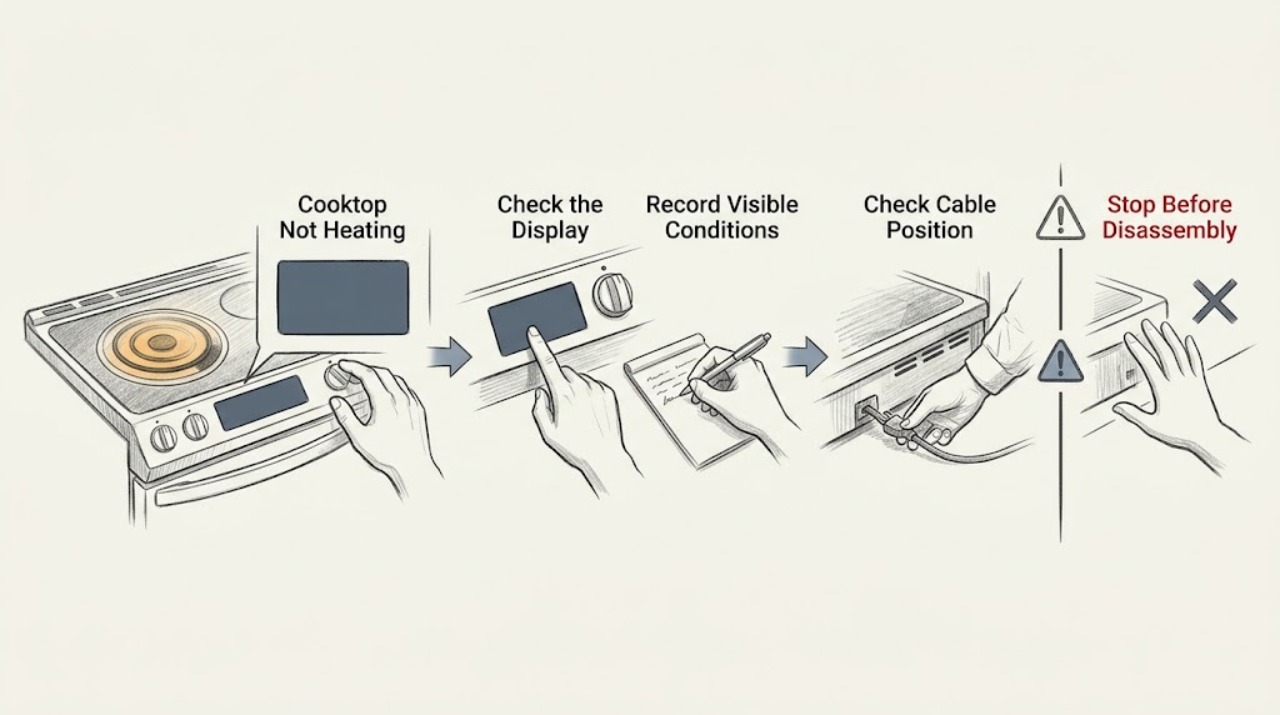
Work through in order
Diagnostic checks
Use only checks that match the exact appliance or system and its official guide.
-
Check 1
Before testing, turn the cooktop controls off and look only from the normal user position for a cracked glass surface, smoke, sparking, exposed damage, a burning-electrical smell, a gas odor, or a breaker that trips again. Keep hands away from the surface if it is hot or damaged.
Expected result: There is a gas odor, smoke, sparking, visible electrical damage, a cracked surface, or repeated protection-device trips.
Next step: Stop using the cooktop. For an active or unaccounted-for gas odor, leave and contact the gas supplier or emergency services from outside; for electrical damage, smoke, sparking, or repeated trips, leave the circuit off and arrange qualified service. Do not open the appliance.
Why this matters
Why: This is a safety or installation concern, not an ordinary heating adjustment; continued energizing or relighting can increase risk.
-
Check 2
With no immediate hazard, identify whether the unit is gas, radiant electric, or induction from its controls or model manual. Record whether the display is blank, the controls are lit but unresponsive, all zones fail, or only one zone fails; on gas, record whether there is no clicking, clicking without flame, or an uneven flame.
Expected result: The failure affects the entire cooktop, a control panel, one electric zone, an induction pan-detection condition, or a gas burner ignition/flame condition.
Next step: Follow the matching branch below and use the exact model manual for control symbols. Do not substitute gas checks for an electric or induction model.
Why this matters
Why: A whole-unit or control symptom points toward power, lockout, or control logic; a single-zone symptom points toward that zone's element or burner path; gas ignition and induction cookware have separate branches.
-
Check 3
If the cooktop is electric or induction and the panel is blank or every zone stopped working, check the dedicated user-accessible switch or breaker position without removing a cover. If the model has an accessible plug, verify it is connected; otherwise do not attempt to access hardwired connections. If the exact model permits a reset, disconnect power only by the normal plug or breaker method for the period stated by Frigidaire or the manual, then restore it once.
Expected result: The panel returns after the reset, the breaker trips again, or the panel remains blank with normal household power available.
Next step: If it trips again or stays blank, leave the cooktop unused and arrange qualified appliance/electrical service. If the panel returns, test one zone using the correct surface-specific branch; do not keep cycling a tripping breaker.
Why this matters
Why: A successful reset suggests a temporary control lockout or interruption; a repeated trip or persistent blank panel suggests a supply, wiring, control, or internal fault rather than a pan problem.
-
Check 4
For a powered unit, wipe moisture or food from the user-facing touch controls and confirm the intended zone and heat setting are selected. Check the manual for a control-lock or lockout indication. On a glass surface, wait until it is cool before cleaning accessible residue; do not scrape, lift, or disassemble the cooktop.
Expected result: The lock indicator clears and the zone responds, the display remains locked or unresponsive, or the zone indicator shows on but the surface stays cold.
Next step: Use the model-specific unlock procedure once. If controls remain unresponsive or an enabled zone stays cold, stop user diagnosis and schedule service rather than opening the panel.
Why this matters
Why: A lock or wet control can prevent a heat command from being accepted; an accepted command with no heat points to a zone, power, or internal control problem. A hot-surface indicator may remain until the glass cools and is not itself proof that the selected zone is heating.
-
Check 5
For a glass, radiant, or induction surface, use a clean, flat-bottomed pan of the type and size specified in the exact Frigidaire manual, centred on the marked zone. Do not judge a radiant element by a brief off cycle; observe whether the pan eventually heats. For induction, follow the manual's cookware requirement and look for a no-pan or unsuitable-pan indication rather than forcing a setting.
Expected result: A suitable flat pan heats normally, a smaller or uneven pan heats slowly or cycles more often, or the induction control continues to report no usable cookware.
Next step: Use the manual-approved pan and placement. If a correct setup still fails, record the zone and any displayed indication and arrange service; do not bypass pan detection or test with improvised metal objects.
Why this matters
Why: Pan geometry and suitability affect heat transfer; on induction, cookware detection can prevent energy from being delivered. If the correct pan and placement still leave one zone cold, cookware is no longer the leading explanation.
-
Check 6
Only for a gas Frigidaire cooktop with no gas odor and a cool surface, verify the control is set to the model's lighting position and that the accessible burner cap is present, level, and seated. Inspect the visible burner head and ports for food residue; clean only as the model manual directs, using non-abrasive methods, and allow parts to dry before retrying.
Expected result: The burner lights with a stable flame, it clicks but does not light, there is no clicking, the ports are obstructed, or the flame remains uneven or abnormal.
Next step: If it still will not light, the flame is abnormal, or any gas odor appears, turn the control off and stop. Do not manually light, adjust jets or pressure, loosen fittings, or move the appliance; use the gas-safety or qualified-service branch.
Why this matters
Why: A displaced cap or blocked port can interrupt gas flow and ignition. No spark, repeated failure, or an abnormal flame after the accessible cleaning check points toward ignition, power, gas supply, or combustion service—not a user adjustment.
-
Check 7
Stop troubleshooting when a correct control and cookware setup still leaves a zone cold, a reset does not restore the panel, a breaker trips again, a gas burner has no spark or abnormal flame, or the cooktop has visible damage or an active odor.
Expected result: The failure persists after the applicable non-invasive check, or a safety, installation, or internal-component warning remains.
Next step: Keep the affected cooktop or zone out of service and schedule a qualified appliance technician; an electrician or gas supplier may be needed for the supply-side symptom. Provide the exact model, surface type, affected zone, display behavior, reset result, and any odor or flame observation.
Why this matters
Why: The remaining causes may include an element, limiter, induction power electronics, touch/control board, ignition system, burner valve, wiring, or supply condition that requires model-specific testing.
Use your observations
Decision map
Find the observation that best matches what you see, then follow the next safe action.
-
PATH 01Next step
What you see
Gas odor, smoke, sparking, exposed damage, cracked glass, or repeated breaker trips is present
Do this next
Stop immediately. Leave an active gas-odor situation and contact the gas supplier or emergency services from outside; for electrical damage or smoke, keep the circuit off and arrange qualified service. Do not test again.
-
PATH 02Next step
What you see
All electric or induction zones are dead and the display is blank
Do this next
Check only the normal user-accessible power source and perform one model-approved reset. If the breaker trips again or the display remains blank, stop and arrange qualified appliance/electrical service.
-
PATH 03Next step
What you see
The control panel is lit but locked or does not accept touches
Do this next
Dry the control area and use the exact model's lockout/unlock procedure once. Persistent lockout or unresponsive controls require service; do not remove the control panel.
-
PATH 04Next step
What you see
A radiant glass element cycles off and on while the pan eventually heats
Do this next
Treat the cycling as normal regulation. Use a flat pan suited to the zone; seek service only if the zone stays cold or cannot maintain heat after the normal cycle.
-
PATH 05Next step
What you see
An induction zone responds but reports no suitable cookware or does not heat a manual-approved pan
Do this next
Recheck the exact manual's cookware type, flatness, size, and centred placement. If the correct pan is still not detected or the zone stays cold, stop and arrange model-specific service; do not bypass detection.
-
PATH 06Next step
What you see
A gas burner has a seated cap and clear visible ports but still does not ignite, or the flame is uneven or abnormal
Do this next
Turn the control off and stop. Do not manually light or alter gas components; arrange qualified gas-appliance service, and use the emergency gas-supplier path for any active or unaccounted-for gas odor.
-
PATH 07Next step
What you see
Only one electric, radiant, or induction zone remains cold while other zones work
Do this next
After one correct cookware/control test, treat the symptom as zone-specific and arrange qualified service. Do not assume that replacing a generic element will fit the exact model.
Helpful context
Understand the symptom
Start with the symptom, not a replacement part
A cooktop that is completely blank has a different first branch from a single cold zone. Note the fuel or surface type, whether the display responds, whether one or all zones fail, and whether there is a fault indication. Do not remove the glass, reach under the cooktop, or test exposed wiring; the model's Use and Care Manual controls the exact controls and installation details.
A radiant element may cycle normally
On a smooth radiant glass surface, the element can glow or heat in cycles even on a high setting. Frigidaire describes that cycling as a way to maintain heat and protect the surface, with more frequent cycling possible when a pan is smaller than the element or its bottom is not flat. The meaningful failure is a zone that remains cold or cannot recover heat, not every brief off period.
Gas and induction need different observations
A gas cooktop must establish a stable flame; check only cool, accessible burner parts and never adjust gas fittings or pressure. An induction surface may show controls responding while the cookware interface refuses to heat; use only the pan type and placement described in the exact manual. If the controls are lit but a correct setup still produces no heat, stop at the service boundary.
Only after diagnosis
Potential parts
- radiant surface heating element or limiter
Consider only if a qualified diagnosis finds that one radiant zone receives the required control command but the element or limiter does not heat; a cold zone alone does not identify the failed component.
Confirm the exact Frigidaire model, element size, connector arrangement, and approved fit information before ordering or installing. - induction heating assembly or power module
Consider only after cookware, controls, and supply checks pass and qualified testing links the no-heat symptom to the induction circuit.
Induction modules and assemblies are model-specific and require qualified electrical diagnosis and installation. - surface control or touch-control board
Consider only when the panel remains unresponsive or fails to send a heat command after power and lockout checks, as confirmed by a technician.
Match the exact model and revision; do not infer board fit from appearance or a similar cooktop. - gas igniter, burner head, or burner valve
Consider only for a gas model when qualified testing identifies an ignition, burner, or valve fault after the cap and visible-port checks; no flame does not prove which part failed.
Gas parts must match the exact model and fuel configuration and require qualified installation and leak/combustion checks.
When checks do not resolve it
Need a professional?
Stop and arrange qualified service for a zone that remains cold after the model-correct control and cookware checks, a blank or persistently locked panel, a reset that does not restore operation, a breaker that trips again, a gas burner with no spark or abnormal flame, or any suspected internal wiring or component fault. For gas odor, smoke, sparking, cracked glass, or other immediate hazards, stop using the cooktop and use the applicable gas-supplier, emergency, or electrical safety route without testing further.
Common questions
FAQ
Why does my Frigidaire glass cooktop turn a burner on and off?
Radiant elements on a smooth glass surface are designed to cycle on and off to regulate heat and protect the cooktop. More frequent cycling can occur with a pan that is smaller than the zone or has an uneven bottom. If the pan never heats or the zone stays cold, that is a different service symptom.
What should I check when every Frigidaire electric cooktop zone stops heating?
Check the normal user-accessible power source and use one model-approved reset if the manual permits it. A breaker that trips again or a display that stays blank points to a supply, wiring, or internal control issue and should not be tested repeatedly.
Could the pan be the reason my Frigidaire cooktop is not heating?
Yes. Frigidaire advises that cookware affects glass-cooktop heating performance and that flat-bottomed cookware transfers heat more evenly. Use the exact manual's cookware requirements; if a suitable pan is correctly placed and one zone stays cold, arrange service rather than assuming the pan is at fault.
What can I do if a Frigidaire gas cooktop burner clicks but does not light?
With no gas odor and the surface cool, verify the cap is seated and the visible burner ports are not clogged, cleaning only as the model instructions allow. Turn the control off and stop if it still will not ignite, the flame is abnormal, or any gas odor appears; do not manually light or adjust gas components.
Read the exact guide
Official sources
- Gas Cooktop Ignition Port Cleaning GuideFrigidaire · Official Frigidaire guidance for gas cooktops and gas ranges; clean only accessible parts and use the model instructions.
- Range Error Code F40 / F41 - Cooktop Lock OutFrigidaire · Official Frigidaire support for electric ranges and electric cooktops showing the stated lockout condition; exact model controls take precedence.
- Ranges - Why does my surface element appear to go on and off on my ceramic glass cooktop?Frigidaire · Official Frigidaire explanation for radiant elements on smooth ceramic glass surfaces; it does not diagnose an induction or gas model.
- Ranges - No HeatingFrigidaire · Official Frigidaire owner-support article for electric coil and glass cooktop/range symptoms; exact model instructions take precedence.
- What should I do if some or all of my burners are not lighting?Frigidaire · Official Frigidaire support for gas ranges and gas cooktops; apply only to a gas model and follow the exact Owner's Manual.
Community feedback
Share a repair observation
Share a plain-text repair observation. Accepted observations are published automatically; this page may take a moment to update.