
On this page
Start here
Quick answer
First identify whether the Bosch cooktop is electric/radiant, induction, or gas, and whether one zone or all zones are affected. From normal user controls only, check power, the control or child lock, a wet or covered touch panel, displayed error codes, and whether the unit is cooling after overheating. For induction, confirm the pan is magnetic, centered, and the correct size; for gas, check only normal knob and burner-cap position when cool and do not continue if there is gas odor. A cracked glass surface, sparking, smoke, a hot or discolored outlet or cord, repeated breaker trips, an incorrect-voltage code, gas odor, or persistent no-heat condition requires stopping and arranging qualified Bosch or electrical/gas service.
Before you begin
Safety first
- User checks are limited to normal controls and accessible observation; internal electrical, glass, and gas work requires qualified service.
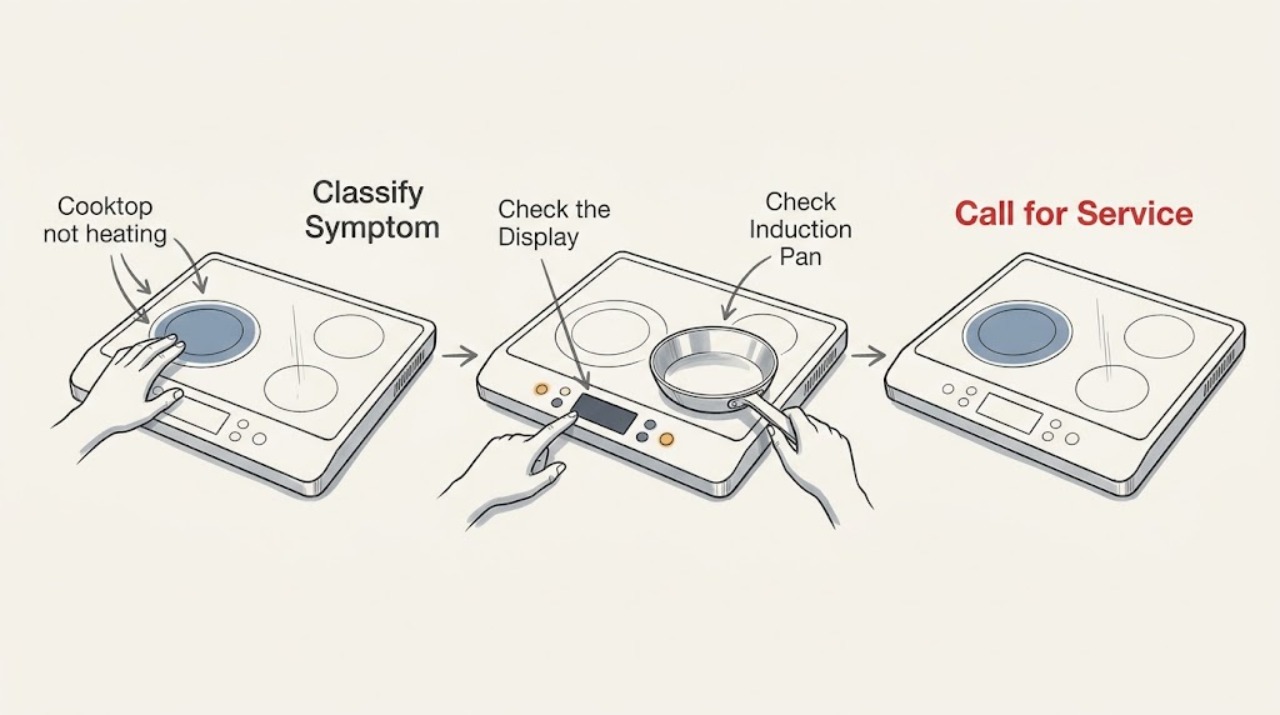
Work through in order
Diagnostic checks
Use only checks that match the exact appliance or system and its official guide.
-
Check 1
With the cooktop off and cool enough to observe safely, identify whether it is electric/radiant, induction, or gas, and note whether one zone or all zones fail. Record the display, indicator lights, sounds, and any recent power interruption or prolonged high-heat use.
Expected result: One zone is cold while other zones work; all zones are inactive; an error or lock symbol appears; or a gas burner has no normal ignition or flame.
Next step: Continue only with the matching electric, induction, gas, and control checks below. Stop for a crack, smoke, sparks, gas odor, or an unsafe hot or damaged surface.
Stop if: Stop immediately for gas odor, smoke, sparks, a cracked or unstable glass surface, or a hot/discolored cord, outlet, or control area.
Why this matters
Why: A single-zone symptom narrows the issue to that zone or its detection path, while an all-zone symptom makes shared power, controls, lock/demo mode, or an operating fault more important. The cooktop type determines whether cookware or ignition checks are relevant.
-
Check 2
Using only normal access, check that the cooktop is connected as designed, test the outlet with another suitable device only when it is a normal plug-in model, and look at the breaker or fuse position. Check that the child/control lock, pause function, or demo mode is not active, and dry or clear an accessible touch panel if it is visibly wet or covered. Read and record any displayed error code before attempting one normal power reset permitted by the product instructions.
Expected result: The outlet is dead or the breaker has tripped; a lock, demo, pause, wet-panel, or object condition is shown; an error returns after a normal reset; or controls and power appear normal.
Next step: If the supply is absent, the breaker trips again, or an error returns, leave the appliance off and arrange qualified electrical/Bosch service. If controls recover, test only the relevant type-specific branch once.
Stop if: Do not remove panels, access wiring, measure live voltage, or repeatedly reset a breaker.
Why this matters
Why: A lost supply or control lock can prevent every zone from heating without a failed heating element. A recurring error, a supply-voltage warning, or a breaker that trips again indicates an electrical or control fault rather than a reason to keep resetting it.
-
Check 3
For an induction Bosch cooktop, place a cool, dry pan that is known to be compatible on the affected zone, centered and within the zone's intended size, then select the zone and a normal power setting. If needed, hold a household magnet against the outside of the pan bottom while the pan is off the cooktop.
Expected result: The magnet sticks and the zone recognizes and heats the centered pan; the magnet does not stick or the pan is not detected; the pan is detected but the zone remains cold; or an F/U/E code appears.
Next step: Try one known-compatible pan on one affected zone only. If it still does not heat, stop testing and provide the pan result and code to Bosch or a qualified appliance professional; do not open the cooktop.
Stop if: Stop if the glass is cracked, the surface becomes abnormally hot or smells burnt, or the cooktop sparks or trips the breaker.
Why this matters
Why: No magnetic attraction, an incorrect size, or off-center placement can explain an induction zone that does not start. Detection with no heating, a recurring code, or failure with a known-compatible pan points toward the cooktop rather than the cookware.
-
Check 4
For an electric or radiant Bosch cooktop, make sure the affected surface is cool, inspect it from above for obvious visible damage, and select the affected zone using its normal control. Compare the indicator behavior and heat response with a working zone without touching the surface or trying to access the element underneath.
Expected result: The indicator does not respond; the indicator responds but the zone stays cold; the element shows visible damage or the glass is cracked; or the zone heats normally after the control/power issue is cleared.
Next step: If the zone remains cold or any element or glass damage is visible, leave it off and arrange qualified service. Do not remove the glass or test the element live.
Stop if: Stop for cracked glass, exposed or damaged element material, smoke, burning odor, or any need to open the appliance.
Why this matters
Why: No control response suggests a supply, lock, or control issue; an active control with no heat or visible element damage can require component-level diagnosis. A normal result shifts attention to the original power, pan, or operating-condition observation rather than authorizing internal repair.
-
Check 5
For a gas Bosch cooktop, confirm only from a normal, accessible position that the burner knob is aligned to the intended setting and the accessible gas supply valve is in its usual open position; with the burner cool, observe one normal ignition attempt for clicking and a stable flame. Do not remove gas fittings or adjust the regulator.
Expected result: There is no click, no ignition, a weak or uneven flame, a burner cap that is visibly out of position, a normal flame, or any gas odor.
Next step: Turn the knob off. If there is gas odor, do not operate switches or make another attempt; leave the area and contact the appropriate emergency gas service from a safe location. For persistent no-click, no-ignition, or abnormal flame without odor, arrange qualified gas/appliance service.
Stop if: Stop immediately for gas odor, hissing, a flame outside the burner, repeated failed ignition, smoke, or any need to disconnect gas components.
Why this matters
Why: No click can indicate an ignition or control issue, while no flame or an uneven flame can involve supply or burner-position/cleanliness concerns. Gas odor is an immediate safety condition, not a troubleshooting branch.
-
Check 6
If the cooktop stopped after extended high settings, switch it off using the normal control, keep the area clear, and allow it to cool without covering the ventilation openings. Record whether operation returns after cooling and photograph the display or model label without removing anything.
Expected result: The cooktop resumes normally after cooling; an overheating or continuous-operation code remains; the no-heat condition returns; or the surface, control area, cord, or outlet is discolored or damaged.
Next step: If the symptom returns or a code remains, leave the cooktop off and arrange service. Give the provider the exact code, affected zone, cooktop type, model, timing, and results of the power, pan, or ignition checks.
Stop if: Stop for smoke, burning odor, hot/discolored wiring or controls, a cracked surface, repeated shutdown, or a breaker trip.
Why this matters
Why: A temporary overheat or continuous-operation shutdown can clear after cooling, but recurrence or a persistent code needs diagnosis. Visible heat damage or repeated shutdown is not a reason to keep operating the appliance.
Use your observations
Decision map
Find the observation that best matches what you see, then follow the next safe action.
-
PATH 01Next step
What you see
There is gas odor or hissing, smoke, sparking, burning odor, a hot/discolored outlet or cord, a cracked glass surface, or a repeated breaker trip.
Do this next
Stop using the cooktop, keep clear of the hazard, and arrange appropriate emergency gas, electrical, or qualified appliance help from a safe location. Do not reset the breaker again or open the appliance.
Why this path and its safety boundary
Why it matters: The condition may involve an immediate gas, fire, shock, or glass-injury hazard that normal user checks cannot resolve.
-
PATH 02Next step
What you see
All zones are inactive and the outlet/breaker, lock, demo mode, pause state, wet panel, or displayed code indicates a shared supply or control condition.
Do this next
Clear only the accessible lock, panel, or object condition described by the instructions. If power is absent, the breaker trips again, or the code returns, leave the appliance off and call qualified service.
Why this path and its safety boundary
Why it matters: A shared control or supply condition is more likely than several independent heating-zone failures.
-
PATH 03Next step
What you see
The affected appliance is induction and a zone fails to detect a pan, while another compatible centered pan works.
Do this next
Use compatible magnetic cookware centered on the zone and follow the normal power control. If a known-compatible pan is detected but still does not heat, arrange appliance service.
Why this path and its safety boundary
Why it matters: Cookware material, size, or placement is the likely explanation for that test result, not proof of a failed cooktop part.
-
PATH 04Next step
What you see
An electric/radiant zone has normal control response but stays cold, or visible element/glass damage is present.
Do this next
Leave the affected zone off, do not remove the glass or make live measurements, and arrange qualified Bosch/appliance service.
Why this path and its safety boundary
Why it matters: The symptom is consistent with a zone-level or internal fault that cannot be safely confirmed by external observation.
-
PATH 05Next step
What you see
A gas burner does not click or ignite, has an abnormal flame, or a gas-related code returns without a gas odor.
Do this next
Turn the knob off and arrange qualified gas/appliance service. If odor or hissing appears, switch to the urgent-hazard branch immediately.
Why this path and its safety boundary
Why it matters: Ignition, burner positioning/condition, supply, or control diagnosis may be needed, and gas components are not a DIY disassembly branch.
-
PATH 06Next step
What you see
The cooktop stopped after prolonged high heat and resumes after it cools, with no damage, odor, recurring code, or repeated shutdown.
Do this next
Use normal settings and clear ventilation space. If the no-heat symptom recurs or an error remains, stop and arrange service rather than repeatedly cycling power.
Why this path and its safety boundary
Why it matters: A protective temperature or continuous-operation condition may have cleared, but recurrence still needs attention.
Helpful context
Understand the symptom
Start by identifying the cooktop type
A Bosch electric or radiant cooktop normally transfers heat through an energized surface element, an induction cooktop detects compatible cookware and heats the pan magnetically, and a gas cooktop depends on ignition and a stable flame. Note the exact affected zone, whether other zones work, what the display shows, and whether the symptom began after cleaning, a power event, or prolonged high heat. This pattern determines which safe branch applies; it does not by itself identify a failed part.
Keep the checks external and low risk
Use only normal controls and accessible observations. Do not remove the cooktop, open a control box, perform live voltage testing, disconnect gas piping, adjust a regulator, or work on a cracked surface. If the panel is hot, smoking, sparking, or smells of gas, stop rather than trying another reset.
Use the result to choose the next step
A lock, demo mode, wet panel, temporary overheat condition, or undetected induction pan may be correctable through the normal controls and manual. A supply or voltage warning, repeated breaker trip, failed ignition, damaged glass, or a zone that remains cold after the safe checks points to qualified service. Record the model label, code, affected zone, timing, and what you observed so the technician can start with a useful symptom history.
Safety boundary
Stop conditions
- Do not open the cooktop, remove the glass or control panel, handle internal wiring, perform live electrical measurements, or select a replacement part from the symptom alone.
- Do not disconnect gas piping, adjust a gas regulator, or continue ignition attempts when a burner does not light normally.
- Stop for gas odor or hissing, smoke, sparks, burning odor, a hot or discolored cord/outlet/control, repeated breaker trips, incorrect-voltage codes, severe overheating, or a cracked or unstable glass surface.
- Stop and arrange qualified Bosch, appliance, electrical, or gas service when a zone remains cold after the applicable safe check, an error returns, or the cause is not clear.
When checks do not resolve it
Need a professional?
Call promptly for gas odor, sparks, smoke, a cracked glass surface, repeated breaker trips, incorrect-voltage or recurring error codes, abnormal gas ignition, or a persistent cold zone.
Safety scope: User checks are limited to normal controls and accessible observation; internal electrical, glass, and gas work requires qualified service.
Have this ready
- Provide the exact Bosch model, cooktop type, affected zone(s), error code or indicator behavior, timing, recent power or high-heat event, and results of the power, cookware, electric-zone, or gas-ignition observations.
Common questions
FAQ
Why does my Bosch induction cooktop turn on but not heat the pan?
Check whether the pan is magnetic, centered, dry, and the right size for the zone. A magnet that does not stick or a pan that is not detected points to cookware compatibility or placement; a known-compatible pan that is detected but stays cold points toward cooktop service.
Should I keep resetting the breaker if the Bosch cooktop is not heating?
No. Check the normal breaker position once and follow the product instructions for any permitted reset. If it trips again, shows an incorrect-voltage indication, or the error returns, leave the cooktop off and arrange qualified electrical or appliance service.
Can a child lock or demo mode make every Bosch cooktop zone appear not to heat?
Yes, a lock or demo state can prevent normal operation. Use only the normal control sequence documented for the model; do not open the panel. If the lock/demo indication clears but the zones remain cold, continue to the applicable service branch.
What should I do if a Bosch gas cooktop will not ignite?
Turn the knob off after the normal observation. No click, no ignition, or an abnormal flame needs qualified gas/appliance service; gas odor or hissing is an urgent stop condition, so do not operate switches or attempt another ignition.
Is a cracked Bosch cooktop surface safe to keep using?
No. Stop using a cracked surface and arrange qualified service. Do not remove the glass, probe the damage, or try to confirm the heating element with live testing.
Read the exact guide
Official sources
- Bosch Gas Cooktop & Rangetop TroubleshootingBosch · Bosch gas cooktops; gas supply, ignition, burner-cap alignment/cleanliness, and professional gas-regulator boundary.
- Bosch Cooktop & Rangetop Error CodesBosch · Bosch electric, induction, and gas cooktop error and indicator patterns.
- Bosch Electric Cooktop TroubleshootingBosch · Bosch electric cooktops; power, child lock, error display, overheating, and cracked-surface guidance.
- Bosch Induction Cooktop TroubleshootingBosch · Bosch induction cooktops; power, controls, cookware detection, placement, overheating, and cracked-surface guidance.
Community feedback
Share a repair observation
Share a plain-text repair observation. Accepted observations are published automatically; this page may take a moment to update.