
On this page
Start here
Quick answer
A Miele cooktop that is not heating may have lost power, be locked or in a demonstration setting, be rejecting the cookware on an induction model, or be cycling because its normal temperature or overheating protection is active. First identify whether the cooktop is electric/ceramic, induction, or gas; check the display and breaker without opening the appliance; then follow the matching check below. If the display stays dead, the breaker trips again, the glass or cord is damaged, there is smoke or a burning/gas odor, or the cooktop still will not heat after it has cooled, stop using it and arrange qualified Miele service or an electrician. [Sources: miele-cooktop-support, miele-km562x-manual, miele-induction-manual, miele-gas-burner-support]
Before you begin
Safety first
- Do not remove covers, access live or internal wiring, alter gas fittings, or continue operating a damaged or gas-smelling appliance.
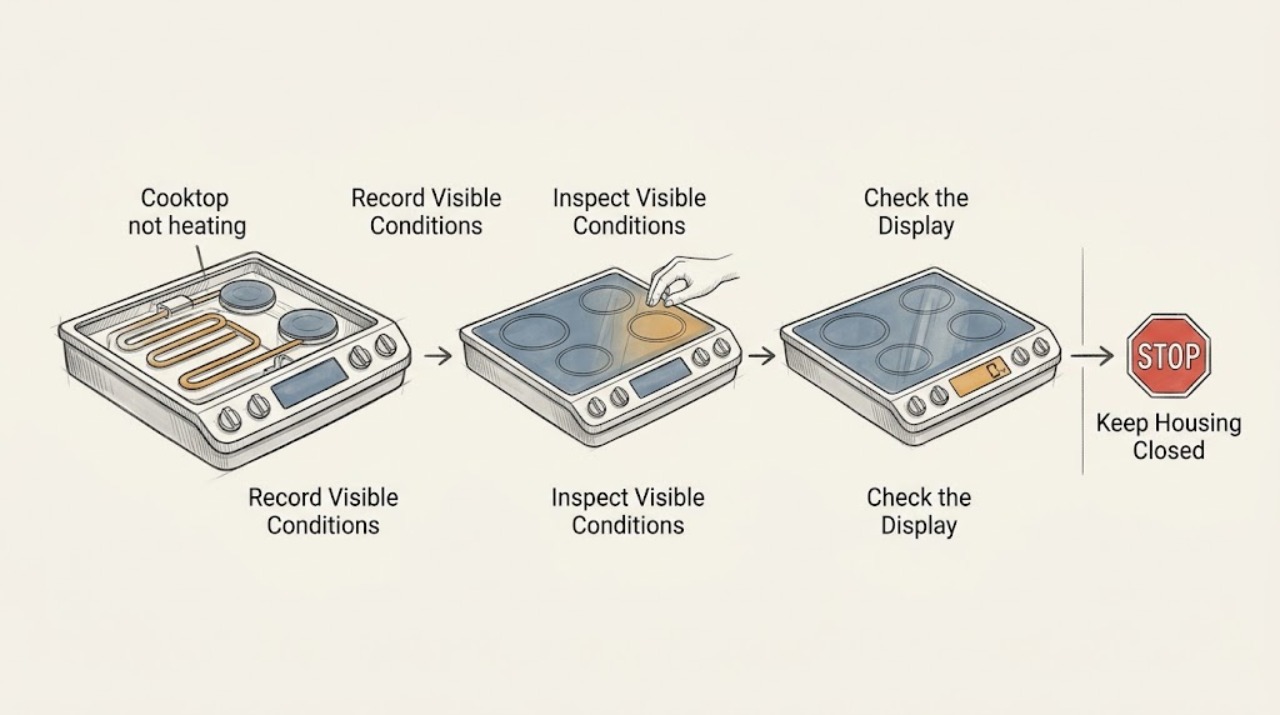
Work through in order
Diagnostic checks
Use only checks that match the exact appliance or system and its official guide.
-
Check 1
Turn every cooking control to off and let the surface cool. Without touching a hot zone, record whether the cooktop is electric/ceramic, induction, or gas; whether all zones or only one fail; whether the display shows a symbol or code; and whether there is smoke, a burning smell, a gas odor, a crack, liquid in the controls, or a damaged cord.
Expected result: A safety warning, a cracked surface, liquid around controls, smoke, a burning odor, or a gas odor is present; or the appliance is unexpectedly hot.
Next step: Stop testing. If it can be done without reaching over heat or water, turn the appliance off at its normal control and isolate its external supply; leave a gas-smelling area and contact the appropriate emergency gas service. Otherwise arrange qualified appliance service, and do not remove covers.
Why this matters
Why: This is not a routine heating diagnosis. Continued operation could create a burn, electrical, or fire hazard.
-
Check 2
With the cooktop cool and dry, operate a normal control and observe the display or power indicator. Check the appliance's external breaker or GFCI only from a safe position and only when there is no sign of water, smoke, heat damage, or a gas problem. If a breaker or GFCI is tripped, restore it once only if the model instructions permit it; do not open the appliance or replace internal fuses.
Expected result: The display remains completely dark, the cooktop does not respond, or the breaker/GFCI trips again.
Next step: Leave the cooktop off and have a qualified electrician or Miele service technician check the supply and appliance. If the display returns and only one heating method still fails, continue with the matching branch below.
Why this matters
Why: The cooktop may not be receiving power, or a persistent electrical fault is present; a control setting cannot correct that condition.
-
Check 3
For a radiant or ceramic electric Miele cooktop, place a suitable, dry, flat pan on the affected zone and select a normal setting. Watch the element indicator and the pan's heating response rather than expecting uninterrupted glow; do not heat an empty pan or leave oil unattended.
Expected result: At a lower or middle setting the element cycles on and off but the pan gradually heats, or the zone resumes after the ceramic surface cools.
Next step: Use the zone only with suitable cookware and supervised food. If it cuts out at the highest setting, turn it off, allow it to cool, and retry once; if it will not heat after cooling or the protection repeatedly activates, stop using that zone and book service.
Why this matters
Why: Timed cycling is the electronic heat-output regulation described by Miele. Cycling at the highest setting can also indicate overheating protection rather than an immediately failed element.
-
Check 4
For an induction Miele cooktop, center one suitable induction pan on the zone, make sure its base is dry and large enough, and use food or liquid in the pan rather than testing with an empty pan. Observe whether the pan-recognition symbol clears and whether the power level remains active.
Expected result: A pan-recognition symbol flashes, the zone turns off, or every pan behaves the same way; alternatively, the zone works after a compatible pan is centered.
Next step: Use the compatible pan that the model manual specifies and avoid empty cookware or unattended high heat. Turn affected controls to off and let the coil and electronics cool; if recognition fails with suitable cookware or protection returns after the cause is removed, arrange Miele service.
Why this matters
Why: A flashing recognition symbol points to no pan, an unsuitable pan, or a pan that is too small. Repeated shutdown after empty-pan, high-fat, or post-power-failure heating can be overheating protection; successful heating with the correct pan points away from a cooktop heating fault.
-
Check 5
For a gas Miele cooktop, only when there is no gas odor and the area is ventilated, turn the affected control off and inspect the removable burner cap and visible burner openings. If the model instructions allow, clean away residue and thoroughly dry the cap and openings before reinstalling the cap so it sits securely; keep the igniter dry and do not loosen or remove fixed gas parts.
Expected result: The cap was wet, dirty, loose, or misaligned and the burner works normally after it is dry and correctly seated; or it still will not ignite, ignites late, burns unevenly, or produces a gas odor.
Next step: If the burner remains faulty, turn it off and arrange Miele service. If gas is smelled at any point, do not ignite or operate controls, leave the area, and contact the appropriate emergency gas service from a safe location.
Why this matters
Why: Miele identifies dirty or wet burner components and a wet igniter as causes of ignition trouble. Persistent failure is a technical or gas-system problem, not a reason to keep repeating ignition attempts.
Use your observations
Decision map
Find the observation that best matches what you see, then follow the next safe action.
-
PATH 01Next step
What you see
All zones and the display are dead
Do this next
Do not open the cooktop or keep resetting the protective device.
Why this path and its safety boundary
Why it matters: Treat this as a supply or appliance fault. Check the external breaker/GFCI once only under the safety limits above; a repeat trip or a dark display requires a qualified electrician or Miele service.
-
PATH 02Next step
What you see
One radiant zone cycles at normal settings and the pan heats
Do this next
Continue only with suitable cookware and supervision, then stop using the zone if the symptom persists.
Why this path and its safety boundary
Why it matters: The cycling is consistent with electronic heat regulation. If cycling occurs at the highest setting, allow the ceramic surface to cool; recurring overheating protection or failure to recover requires service.
-
PATH 03Next step
What you see
An induction zone shows pan recognition or does not heat a suitable pan
Do this next
Record the display symbol and model number for Miele service; do not dismantle the cooktop.
Why this path and its safety boundary
Why it matters: Re-center a dry compatible pan and avoid empty cookware. If the symbol remains with suitable cookware, or the zone repeatedly shuts down after cooling, treat it as a service fault.
-
PATH 04Next step
What you see
A gas burner is wet, dirty, or misaligned but there is no gas odor
Do this next
Stop immediately if gas is smelled; leave the area and seek emergency gas assistance from a safe location.
Why this path and its safety boundary
Why it matters: Clean and thoroughly dry only the removable parts allowed by the model instructions, then seat the cap correctly. No ignition, delayed ignition, or uneven flame after that check requires service.
-
PATH 05Next step
What you see
There is a crack, smoke, burning odor, water in controls, cord damage, or repeated protective-device trips
Do this next
Stop using it, isolate the external supply only when safe, and arrange qualified appliance or electrical service; do not remove panels or attempt an internal repair.
Why this path and its safety boundary
Why it matters: The appliance is outside safe user troubleshooting.
Helpful context
Understand the symptom
Do not judge a cooktop only by whether the glass looks warm. Radiant and induction models transfer heat differently, and a radiant element can cycle on and off while maintaining a selected power level. An induction zone can show a setting without heating when it cannot recognize the pan. A gas cooktop needs a stable, correctly assembled burner and a dry igniter.
Use the exact operating instructions for the model before changing a lock, demonstration setting, or installation control. The checks below are limited to external observation, normal controls, cookware, and removable burner parts; internal electrical, gas, and control repairs require qualified service.
Only after diagnosis
Potential parts
- radiant heating element or heat-control component
Consider this only if a qualified diagnosis finds that one electric zone has correct external power but does not heat after cookware and overheating checks are normal.
Confirm the exact Miele model and the manufacturer's fit information before ordering any component. - induction coil, temperature sensor, or pan-detection component
Consider these only when a suitable centered pan is not recognized or a zone repeatedly enters protection after the documented user checks, and a technician identifies the failed circuit.
Induction components vary by model and position; use the model's service documentation to confirm fitment. - gas igniter or burner component
Consider this only when the burner parts are clean, dry, and correctly assembled but a qualified technician confirms an ignition or burner fault.
Gas parts require model-specific identification and qualified installation; do not substitute an unverified component.
When checks do not resolve it
Need a professional?
Call qualified Miele service or an electrician when the display remains dark, the breaker or GFCI trips again, a zone fails after cooling and a cookware check, an induction zone rejects known-compatible cookware, or a gas burner still fails after its removable parts are clean, dry, and correctly seated. Stop immediately for smoke, a burning smell, a cracked cooktop, liquid in controls, cord damage, or any gas odor. Do not remove covers, work on internal wiring, alter gas components, or keep repeating ignition attempts.
Safety scope: Do not remove covers, access live or internal wiring, alter gas fittings, or continue operating a damaged or gas-smelling appliance.
Common questions
FAQ
Why does my Miele electric burner turn on and off instead of staying red?
At ordinary settings, electronic heat-output regulation can cycle the element and still heat the pan. Cycling at the highest setting can indicate overheating protection; let the surface cool and stop using the zone if the behavior repeats or it does not recover.
Why does my Miele induction cooktop show a setting but not heat the pan?
The pan may be absent, too small, or unsuitable for induction. Center a dry compatible pan and do not use an empty pan; if recognition still fails, arrange service.
Is it safe to keep resetting the breaker when a Miele cooktop will not heat?
No. Check the external protective device only within the safety limits above and do not keep resetting it. A repeat trip or a dark display needs a qualified electrician or Miele service.
What should I do if a Miele gas cooktop smells like gas?
Do not ignite the burner or operate electrical controls in the area. Leave, avoid creating sparks, and contact the appropriate emergency gas service from a safe location.
Read the exact guide
Official sources
- 12449750-03Miele · Miele induction cooktop operating instructions for pan recognition, demonstration mode, and overheating protection
- Miele Range | Burners not igniting properly | Miele USAMiele USA · Miele gas range/cooktop burner cleaning, drying, reassembly, and technical-service guidance
- S:\Tech Writing\Data\Cooktop\us\vp\Km56_knebel_us.vpMiele USA · Miele KM 562x electric/ceramic cooktop operating instructions and troubleshooting
- Troubleshooting for All problem with Miele Cooktop | Miele USAMiele USA · Miele cooktop troubleshooting topics, including cooktop does not get hot and cooking zones will not switch on
Community feedback
Share a repair observation
Share a plain-text repair observation. Accepted observations are published automatically; this page may take a moment to update.