
On this page
Start here
Quick answer
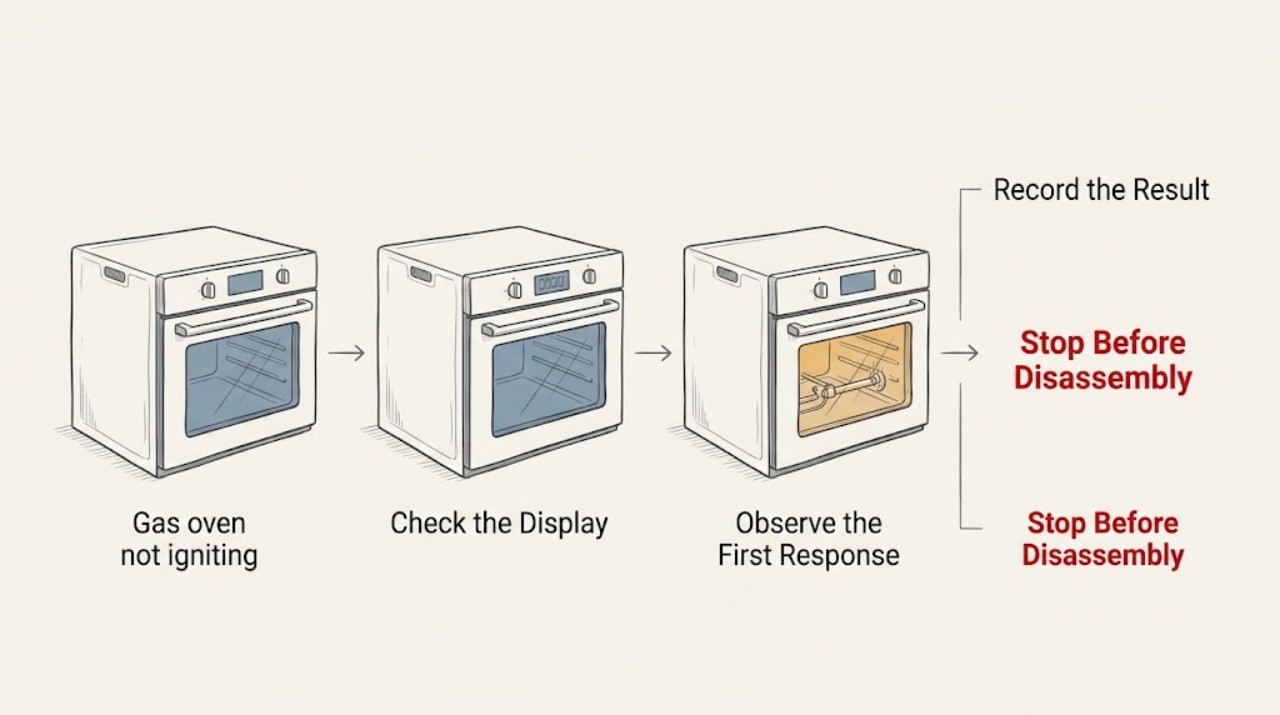
Do not keep trying to light a Wolf gas oven if you smell gas, hear a delayed bang, see an unusual flame, or the ignitor clicks without ignition. Turn the control off, leave the area if the odor is strong or persistent, and contact gas or emergency help from a safe location; do not test for a leak, use a flame, or open the gas path. If there is no odor or other hazard, confirm the control is on the intended bake or broil mode, note whether the display and preheat indicator respond, and make only one normal start attempt while observing from a safe position. Wolf says an oven burner normally lights in about 30 to 45 seconds, but a longer delay or repeated failure needs service. A Wolf gas oven needs electrical power for its ignitor and must not be manually lit during a power outage.
Work through in order
Diagnostic checks
Use only checks that match the exact appliance or system and its official guide.
-
Check 1
Before another start, stand clear of the oven and check for gas odor, smoke, soot, an unusual flame, a loud pop, a door movement, or continuous clicking with no ignition. If any is present, leave the control OFF and stop the check.
Expected result: A persistent gas odor without a flame, delayed bang, door movement, smoke, or abnormal flame is a hazard sign. No odor or abnormal sign allows only a limited external observation of the controls.
Next step: For odor, smoke, a bang, abnormal flame, or ongoing clicking without ignition, ventilate only if this can be done without operating electrical switches, leave if needed, and contact gas or emergency help from a safe location. Do not test for a leak or retry the oven.
Why this matters
Why: Unburned gas or abnormal combustion can create fire, explosion, burn, or carbon-monoxide risk; it is not a normal ignition branch.
-
Check 2
With the oven cool and no hazard sign, identify the selected function and temperature, check that the control knob or touch control is not stuck, and note whether the display and preheat indicator respond. Do not remove a control, panel, burner, or door component.
Expected result: A responsive preheat indicator means the control is calling for heat. No display or no response points first toward power, control, lock, or model-specific operating state rather than proving a gas fault.
Next step: Record the mode, setting, display state, and any code or indicator pattern. Use the model-specific Wolf guide or arrange service; do not force a knob or bypass a lock.
Why this matters
Why: The symptom separates a no-command condition from a commanded-but-unlit burner and prevents an incorrect ignition diagnosis.
-
Check 3
If the home has power and the area remains free of odor, smoke, heat, moisture, and abnormal sound, confirm the oven is receiving power from its normal, clearly labeled control without opening the appliance or panel. If there was an outage, leave the oven control OFF until power is stable.
Expected result: A dark display or absent preheat response after an outage supports a power or control-state branch. Wolf states that the oven ignitor requires electricity and that the oven must not be manually lit during an outage.
Next step: Do not manually light the oven. If the display remains unavailable or the oven does not recover after a normal, safe power restoration, leave it unused and request appliance service; involve an electrician if the supply or circuit is also abnormal.
Why this matters
Why: No electrical ignition means gas may not be safely ignited; power restoration does not prove the ignitor, valve, or control is healthy.
-
Check 4
When there is no gas odor or abnormal noise, make one normal bake or broil start attempt using the documented control sequence while watching from a safe position; do not hold the control open, add a flame, or repeat the attempt.
Expected result: Wolf describes normal oven ignition as approximately 30 to 45 seconds. A prompt flame supports normal ignition timing; no flame, continuous clicking, or a substantially longer delay supports an ignition or supply fault.
Next step: Turn the control OFF if ignition does not occur within the normal sequence or if any odor, pop, unusual flame, or repeated clicking appears. Leave the appliance unused and arrange Wolf-qualified service.
Why this matters
Why: The timing and sound distinguish a normal ignition sequence from delayed ignition or a component fault without exposing the user to repeated gas release.
-
Check 5
From outside the appliance, record whether any surface burners work, whether only bake or only broil fails, whether the gas supply was recently changed, and whether the oven is a gas or dual-fuel model. Do not adjust a regulator, disconnect a line, or inspect an internal valve.
Expected result: A single oven function failing differs from the whole appliance having no power or gas response. A recent fuel conversion or uncertain gas type is relevant because Wolf directs the user to verify the type on the rating information.
Next step: Provide the model and serial information, function affected, outage history, gas-type history, and exact sound or timing to service. Do not alter fuel settings or continue testing a suspected supply problem.
Why this matters
Why: Scope and installation history help service distinguish an oven ignition component from a wider power, fuel, or configuration issue.
-
Check 6
Prepare a service handoff with the model and serial information, selected mode, display or indicator state, whether power was interrupted, ignition timing, clicking or bang, flame appearance, odor, and which functions or surface burners respond. Keep the oven unused until the cause is cleared.
Expected result: A clean symptom record can show no-power, no-gas, control, ignitor, valve, connection, delayed-ignition, or function-specific patterns. Wolf directs service when the burner remains inoperative or ignition is delayed.
Next step: Arrange Wolf Factory Certified Service or another qualified appliance professional. If there is gas odor, smoke, a bang, abnormal flame, or suspected carbon monoxide, use emergency or gas-safety help first from outside the hazard area.
Why this matters
Why: These causes require model-specific diagnosis and may involve gas and electrical systems that are unsafe for a general user to open or adjust.
Use your observations
Decision map
Find the observation that best matches what you see, then follow the next safe action.
-
PATH 01Next step
What you see
There is a persistent gas odor, no ignition after gas release, a loud bang, door movement, smoke, soot, abnormal flame, or continuous clicking.
Do this next
Arrange qualified service and follow the exact model guidance.
Why this path and its safety boundary
Why it matters: Turn the control off if it is safe to do so, do not operate electrical switches or use a flame, leave the area when necessary, and contact gas or emergency help from a safe location. Do not retry the oven or search for the leak.
-
PATH 02Next step
What you see
The display or preheat response is absent, especially after a power outage.
Do this next
Arrange qualified service and follow the exact model guidance.
Why this path and its safety boundary
Why it matters: Treat it as a power or control-state branch. Do not manually light the gas oven; leave it unused and arrange appliance or electrical service as appropriate.
-
PATH 03Next step
What you see
The controls call for heat but no flame appears within the normal ignition sequence, or ignition is repeatedly delayed.
Do this next
Arrange qualified service and follow the exact model guidance.
Why this path and its safety boundary
Why it matters: Stop use and arrange Wolf-qualified service for the ignitor, valve, control, connection, gas supply, or model-specific issue. Do not keep cycling the oven.
-
PATH 04Next step
What you see
Only bake, only broil, or one oven function fails while other functions respond.
Do this next
Arrange qualified service and follow the exact model guidance.
Why this path and its safety boundary
Why it matters: Record the affected function and arrange service; do not infer that a working surface burner proves the oven ignition path is safe.
-
PATH 05Next step
What you see
A recent installation, fuel conversion, outage, or uncertain gas type preceded the failure.
Do this next
Arrange qualified service and follow the exact model guidance.
Why this path and its safety boundary
Why it matters: Give the model, rating information, fuel history, and outage details to a qualified professional. Do not adjust the regulator, fuel conversion, valve, or internal wiring.
Helpful context
Understand the symptom
“Not igniting” can mean no display or response, a control that calls for heat but produces no flame, clicking with no flame, or ignition that is late and noisy. Those symptoms do not justify taking apart the oven. The safe goal is to identify the mode, power state, ignition behavior, and hazard signs so a Wolf-qualified appliance professional can diagnose the ignitor, gas valve, control, supply, or wiring.
Wolf gas oven ignition is electrically initiated. A surface burner may have different outage guidance, but Wolf says a gas oven cannot be manually lit without power. Do not improvise a manual-lighting method, repeatedly cycle the control, or continue using an oven that releases gas without promptly igniting.
Safety boundary
Stop conditions
- Stop immediately for gas odor, smoke, soot, a loud bang, door movement, abnormal flame, continuous clicking without ignition, suspected carbon monoxide, electric shock, arcing, a hot or damaged cord, or repeated circuit interruption.
- Do not manually light the Wolf gas oven during a power outage, use a match or lighter, test for a gas leak, repeatedly cycle the control, hold a valve open, adjust gas pressure, disconnect a gas line, or open the appliance or electrical panel.
- Leave the oven unused when ignition is delayed, fails more than once, the display is unavailable, the gas type is uncertain, or any person cannot remain outside the hazard area while help is contacted.
Common questions
FAQ
Why is my Wolf gas oven not igniting?
Possible causes include no power, no gas, an ignitor or valve problem, a loose connection, a control issue, or delayed ignition. Record the mode, timing, display response, sound, and odor, then stop using the oven if ignition fails or is delayed.
Can I light a Wolf gas oven with a match during a power outage?
No. Wolf states that its gas oven ignitor requires electricity and that there is no manual way to light the oven without power. Keep the oven off during the outage and arrange service if it does not recover safely.
What if the Wolf oven clicks but does not light?
Do not keep cycling the control. If there is gas odor, a bang, smoke, an abnormal flame, or continued clicking without ignition, stop immediately and seek gas-safety or emergency help from a safe location. Otherwise leave the oven unused and arrange qualified service.
Read the exact guide
Official sources
- Gas Oven Burner OperationSub-Zero, Wolf, and Cove · Wolf gas oven burner timing and stop-use guidance
- Gas Oven Bake Burner Not WorkingSub-Zero, Wolf, and Cove · Wolf gas oven ignition symptoms, causes, timing, and service boundary
- Gas Range Delayed Ignitions - Tests and Examinations of RangesU.S. Consumer Product Safety Commission · Gas oven delayed-ignition and accumulated-gas hazard research
- Gas Oven Delayed IgnitionSub-Zero, Wolf, and Cove · Wolf delayed-ignition symptoms, fuel-type verification, and service escalation
- Wolf Gas Oven Reignition After Power OutageSub-Zero, Wolf, and Cove · Wolf gas oven electrical ignition and power-outage safety
Community feedback
Share a repair observation
Share a plain-text repair observation. Accepted observations are published automatically; this page may take a moment to update.