
On this page
Start here
Quick answer
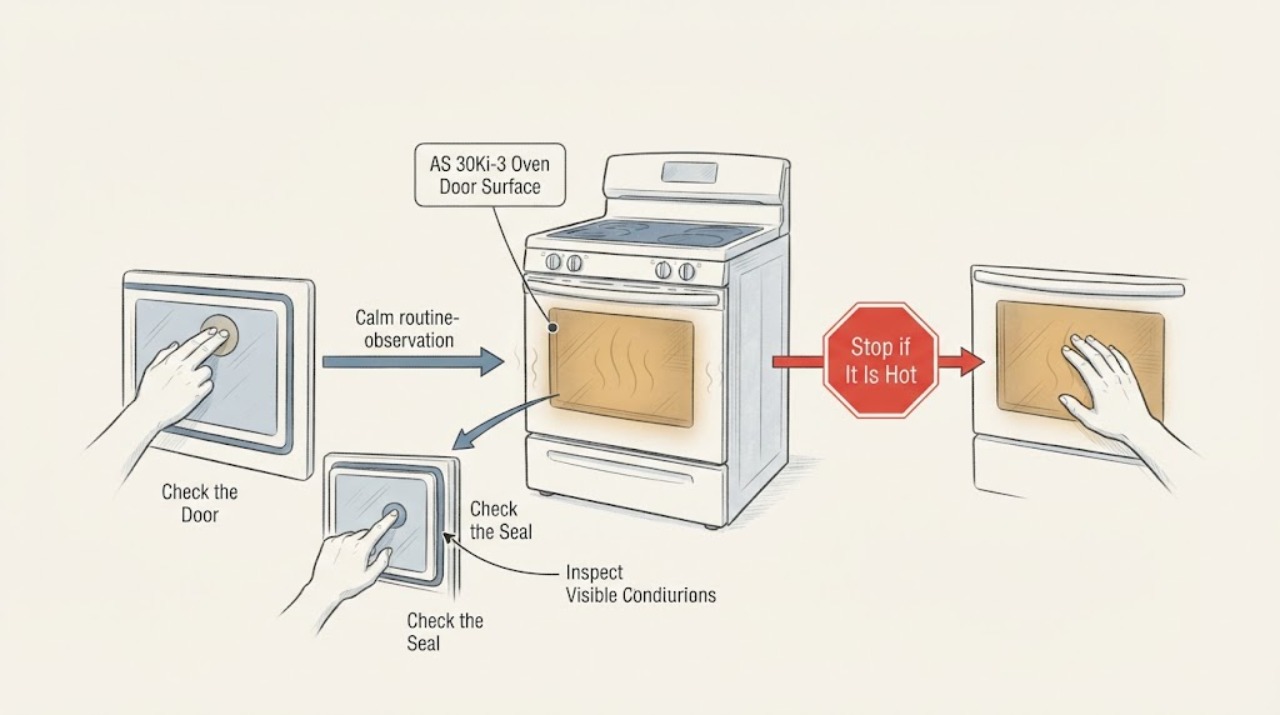
A 188°F door reading while a Wolf AS 30Ki-3 is baking at 450°F is a safety observation to document, but it is not a manufacturer pass/fail threshold for this old range. Wolf says oven temperature and operating time can raise the surface temperature of the door, handle, bullnose, knobs, and control panel; it also lists improperly installed racks or rack guides, a damaged gasket, and a misaligned door as possible causes. Wolf does not publish a universal door-surface temperature limit on that guidance: if residual heat seems excessive or the door or handle is too hot to safely touch, it directs the owner to Factory Certified Service. Let the appliance cool, do only external visual checks, and do not remove the door, change insulation, or install an R304 gasket based on this symptom alone.
Work through in order
Diagnostic checks
Use only checks that match the exact appliance or system and its official guide.
-
Check 1
Stop using the oven for the moment if the door or handle is too hot to touch safely, if anyone could contact the hot surface, or if there is smoke, scorching, or a gas smell. Keep people away from the range and allow it to cool without touching the door or attempting another bake.
Expected result: The door or handle cannot be touched safely, the heat appears excessive compared with prior use, or a smell, smoke, scorching, or other abnormal condition is present.
Next step: Keep the oven out of use and arrange Factory Certified Service. Do not try to improve cooling by removing the door, changing insulation, or operating with the door open.
Stop if: Do not touch the hot surface or continue troubleshooting if there is smoke, scorching, a gas smell, or any risk of a burn.
Why this matters
Why: Wolf treats excessive residual heat or a door or handle that is too hot to safely touch as a service condition; the 188°F report does not supply a user-adjustable threshold.
-
Check 2
Only after the range is fully cool, inspect the closed door from the outside. Look for a visibly uneven gap, a door that does not sit squarely, a gasket that is torn, displaced, or visibly damaged, or anything preventing the door from closing normally. Do not remove the door or pull the gasket out.
Expected result: The door is visibly misaligned, does not close normally, or the gasket is visibly damaged or displaced.
Next step: Leave the oven unused and give the technician the model, serial number, photographs of the external condition, and the 450°F/188°F event details. Do not adjust hinges or install a replacement gasket yourself.
Why this matters
Why: Wolf lists door misalignment and gasket damage among possible causes of excessive exterior heat, but this observation does not identify a repair part or prove that a newer gasket design fits the AS30Ki-3.
-
Check 3
With the oven cool, verify from the front that each rack and rack guide is seated in its intended position and that no pan, foil, or other object is obstructing the door's closing path. Do not run the oven with a loose rack or an object caught against the seal.
Expected result: A rack or guide is visibly out of position, or an object is preventing normal door closure; alternatively, everything appears correctly seated and the door closes squarely.
Next step: If the obstruction can be removed without touching damaged or hot parts, remove it only while the oven is cold. If the door still feels excessively hot or the issue returns, stop use and arrange service; do not alter the door or insulation.
Why this matters
Why: Wolf identifies improperly installed racks or rack guides as a possible contributor to exterior heat. Correct seating can remove that external cause, but an intact-looking rack setup does not establish that the old door is safe at a particular temperature.
-
Check 4
Record the exact mode, setpoint, approximate run time, room conditions, whether the oven was preheated, where the surface was measured, and whether the door or handle was safe to touch. Photograph the model and serial plate when the range is cool and accessible; do not repeat a hot-surface test just to obtain another number.
Expected result: The surface reading changes with mode, runtime, ambient conditions, or measurement location, or the door remains unusually hot across comparable uses.
Next step: Give the complete record and the exact AS30Ki-3/serial information to Factory Certified Service. Ask the technician to assess the door, gasket, alignment, rack guides, and heat path for this legacy model before any part is selected.
Why this matters
Why: Wolf says temperature, mode, operating time, ambient room temperature, measurement timing, and measurement method affect oven heat and cooldown; a surface reading alone cannot prove an internal failure or a universal limit.
Use your observations
Decision map
Find the observation that best matches what you see, then follow the next safe action.
-
PATH 01Next step
What you see
The door or handle is too hot to safely touch, or residual heat seems excessive even though the exact temperature limit is unknown.
Do this next
Keep the oven out of use after it cools enough to isolate it safely and arrange service; do not remove the door or alter insulation.
Why this path and its safety boundary
Why it matters: Wolf's public guidance treats that pattern as a Factory Certified Service condition and provides no user troubleshooting for it.
-
PATH 02Next step
What you see
A cool external inspection finds a damaged gasket, a visibly misaligned door, or a rack/rack-guide obstruction.
Do this next
Leave the range unused if the door does not close normally or the gasket is damaged, and provide the evidence to Factory Certified Service for model-specific assessment.
Why this path and its safety boundary
Why it matters: These are the specific external contributors Wolf names for a hot oven exterior, but they do not identify an AS30Ki-3-compatible replacement part.
-
PATH 03Next step
What you see
The door closes squarely, the gasket and racks look intact, and the surface is hot but still safely touchable.
Do this next
Keep a written record of comparable use and ask Factory Certified Service to review the legacy range if the heat is a new change, feels excessive, or creates a burn risk. Do not upgrade the gasket or door without exact fitment evidence.
Why this path and its safety boundary
Why it matters: Wolf says exterior heat varies with oven temperature, mode, runtime, and ambient conditions, but it does not publish a universal AS30Ki-3 door-surface threshold; this pattern cannot be labeled normal or defective from the measurement alone.
-
PATH 04Next step
What you see
The oven remains warm after it is switched off but there is no unsafe contact, visible damage, smoke, or gas smell.
Do this next
Allow it to cool without touching hot surfaces. If the heat persists excessively or the door becomes unsafe to touch, use the service boundary above.
Why this path and its safety boundary
Why it matters: Wolf says an oven can retain heat for several hours and has no fixed complete-cooldown time; this does not answer whether the reported door surface is acceptable during baking.
Helpful context
Understand the symptom
The assigned report is specific: the front door was measured at 188°F while baking at 450°F, with the top measured separately. That number is a reported observation, not a Wolf specification. Wolf's opened guidance covers Wolf wall ovens and range ovens at the family level, but it does not establish that 188°F is either acceptable or defective for the AS30Ki-3. Keep the decision tied to whether heat is excessive, whether the door or handle can be safely touched, and whether the door, gasket, and rack installation show an external problem.
AS30Ki-3 is an older Wolf AS Series gas range model. Wolf's current public support path identifies the old model family and provides general exterior-heat guidance, while its service-manual FAQ says technical service manuals are not public. Do not use a newer Wolf door design, an R304 gasket listing, or a generic door-disassembly instruction to infer compatibility with this range.
When checks do not resolve it
Need a professional?
Arrange Factory Certified Service before further baking if the door or handle is too hot to safely touch, residual heat seems excessive, the door is misaligned, the gasket is damaged, the range produces smoke or scorching, or a gas smell is present. The public Wolf pages do not prove that an R304 gasket or any newer door/insulation component fits AS30Ki-3.
Common questions
FAQ
Is 188°F on the AS30Ki-3 door automatically unsafe or proof that the gasket has failed?
No universal AS30Ki-3 door-surface limit was found in Wolf's opened guidance, and the reading alone does not prove a failed gasket. Wolf says exterior heat varies with temperature and runtime, but directs owners to Factory Certified Service if residual heat seems excessive or the door or handle is too hot to safely touch.
Can I replace the old V-shaped gasket with an R304 gasket or a newer Wolf door gasket?
Do not assume that fit. AS30Ki-3 is an older 2000–2001 AS Series model, and the public Wolf guidance does not establish cross-model gasket compatibility. Have Factory Certified Service identify the correct repair path from the model and serial plate.
What should I check before calling service?
After the range is fully cool, make only external observations: whether the door closes squarely, whether the gasket is visibly damaged, and whether racks or rack guides are seated and unobstructed. Record the mode, 450°F setting, run time, room conditions, measurement location, and whether the door or handle was safe to touch. Do not remove the door, pull the gasket, adjust hinges, or alter insulation.
Read the exact guide
Official sources
- Wolf Specifications, Use and Care Guide, and Installation Guide LibrarySub-Zero, Wolf, and Cove · Opened Wolf page directs owners to the official specification library for product guides and model-specific information. It is used only to document the official lookup path, not to claim that an AS30Ki-3 manual was found or that a newer model's instructions apply.
- Wolf Oven Warm When Not in UseSub-Zero, Wolf, and Cove · Opened Wolf FAQ supports the limited statement that an oven may retain heat for several hours and has no fixed complete-cooldown time; it does not classify the reported 188°F door reading during baking.
- Older AS Series Gas Range Model TimelineSub-Zero, Wolf, and Cove · Opened Wolf page explicitly lists AS 30Ki 3 / AS30Ki-3 as an AS Series gas range made from 2000 through 2001. It establishes legacy model identity only; it does not provide door-surface limits, gasket fitment, or repair procedures.
- Wolf Oven Exterior Is HotSub-Zero, Wolf, and Cove · Opened Wolf FAQ covers both wall-oven and range-oven exterior heat. It supports the listed contributors (rack/rack-guide installation, gasket damage, door alignment), the effect of temperature and operating time, and the Factory Certified Service boundary. It does not publish a universal door-surface limit or an AS30Ki-3-specific gasket/door specification.
- Sub-Zero, Wolf, and Cove Service ManualsSub-Zero, Wolf, and Cove · Opened Wolf support page states that technical service manuals are not public and directs owners to user guides, official support answers, or Factory Certified channels. It supports the decision not to provide a door-disassembly or insulation procedure; it does not diagnose the AS30Ki-3.
- Wolf Oven Temperature IssueSub-Zero, Wolf, and Cove · Opened Wolf FAQ supports recording preheat, mode, measurement timing/method, and operating conditions; it says measured temperature is not identical to setpoint and routes persistent temperature issues to Factory Certified Service. It is not evidence for a door-surface threshold or internal failure.
Community feedback
Share a repair observation
Share a plain-text repair observation. Accepted observations are published automatically; this page may take a moment to update.