
On this page
Start here
Quick answer
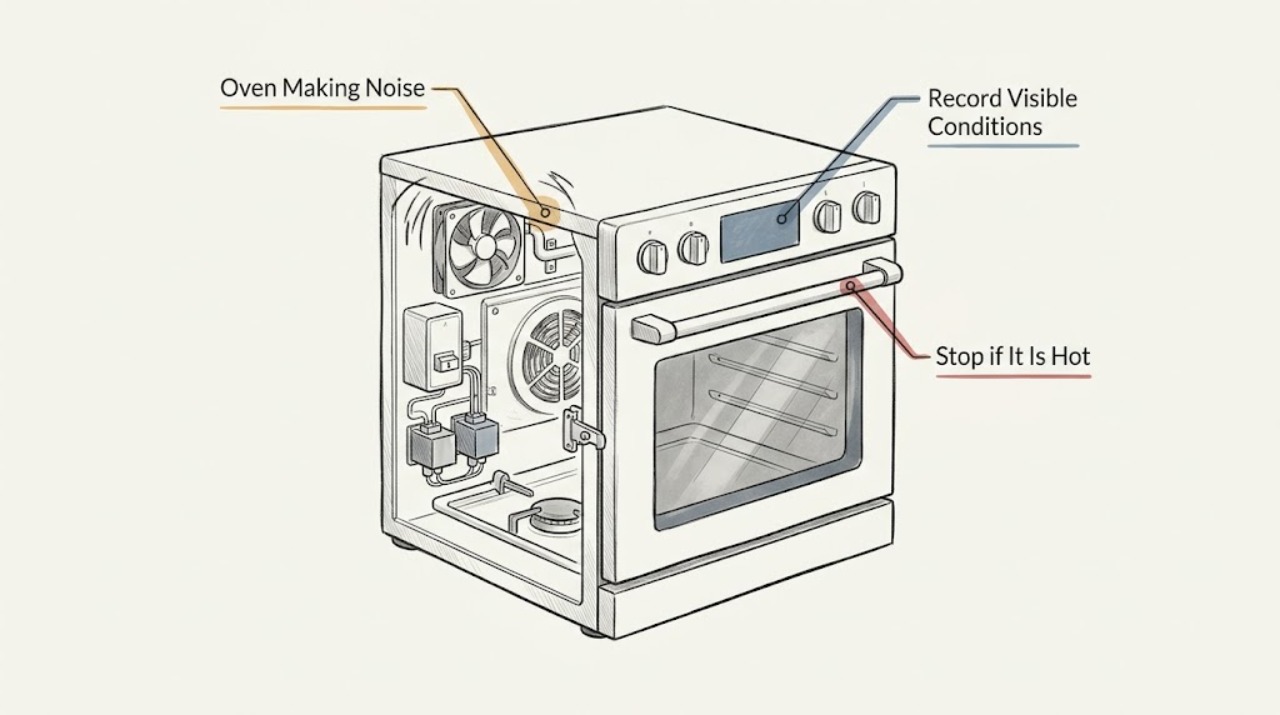
A Wolf oven can make normal fan, relay, latch, stepper-motor, burner, or thermal-expansion sounds during preheat, cooking, self-clean, and cooldown. First record the sound, location, oven mode, fuel type, and whether it changes with the door or controls. A steady fan during preheat or after shutdown, a brief relay click, a gas burner whoosh at ignition or reignition, or a light pop as a new cavity heats and cools may match Wolf's operating guidance. Stop using the oven for smoke, gas odor, delayed ignition or a loud bang, arcing, a hot or damaged cord or outlet, scraping or grinding, a fan that has changed and affects performance, or noise that is paired with abnormal heating. Use only the exact model guide for any reset; if the noise is new, worsening, unusually loud, or affects cooking, arrange qualified Wolf service rather than opening the oven.
Work through in order
Diagnostic checks
Use only checks that match the exact appliance or system and its official guide.
-
Check 1
From a safe position, record whether the noise starts at power-up, preheat, burner ignition, convection, door movement, self-clean, cooldown, or after the oven appears off; identify whether it comes from the cavity, control area, rear, lower area, or door.
Expected result: Write down the sound description—whir, hum, click, tick, pop, bang, whoosh, whistle, rattle, scrape, grind, or electrical crackle—and whether the sound is brief, rhythmic, constant, or changing with heat or fan speed.
Next step: Keep the notes with the exact model and fuel type and use the matching branch below; do not deliberately rerun a hazardous noise.
Stop if: Stop immediately for smoke, gas odor, an explosive bang, arcing, a hot or damaged electrical connection, a burning smell, or uncontrolled heating.
Why this matters
Why: The stage and location separate fan, relay, latch, thermal, burner, and mechanical paths. A new or worsening sound, especially with reduced heating or a safety symptom, is not established as normal by its name alone.
-
Check 2
Read the rating label and owner guide without removing a panel, then record the Wolf series or model, electric or gas or dual-fuel identity, single or double oven arrangement, selected mode, and whether it is a convection-steam model.
Expected result: Note whether the guide lists a cooling fan, convection fan, gas burner, motorized latch, or steam exhaust mechanism for this exact appliance; capture any display message exactly.
Next step: Use only the model-specific operating and troubleshooting guidance for the observed configuration before attempting a reset or cleaning cycle.
Stop if: Stop if the model or fuel identity is uncertain, a warning message is present, or the guide does not cover the noise and mode combination.
Why this matters
Why: The same sound can be normal in one Wolf configuration and evidence of a fault in another. A gas-burner whoosh does not apply to an electric oven, and a stepper-motor explanation does not apply when the appliance has no steam function.
-
Check 3
Observe the fan from outside the oven during preheat, convection, and cooldown without touching the grille or reaching through the door; compare the noise with the fan stage and selected mode.
Expected result: A smooth airflow sound that begins in preheat, continues after cooking, or changes as the oven cools is different from rubbing, squealing, rattling, banging, or a high-pitched sound that is new or tied to poor cooking performance.
Next step: If the sound follows the documented fan stages and the oven performs normally, follow the model guide and monitor; if it rubs, scrapes, changes abruptly, or affects heating, keep the oven out of use and request service.
Stop if: Do not obstruct a vent, insert an object into a grille, touch a moving fan, or continue if there is smoke, burning odor, exposed damage, or severe vibration.
Why this matters
Why: Wolf states that convection and cooling fan noise can be normal during and after use, and that cooling fans operate as a safety measure. An unusual sound or affected oven performance needs service rather than a user fan repair.
-
Check 4
If the noise is a click or tick, note whether it occurs once or in a short pattern when a control changes, heating cycles, the door locks, or a steam program starts or stops; observe from outside the closed appliance.
Expected result: A brief click with otherwise normal operation can match a relay, control board, motorized latch, or steam-oven stepper mechanism. Repetitive loud clicking, grinding at the door, an error, a door that cannot close or unlock, or a change in cooking points to a fault.
Next step: Use the exact model guide for one permitted power reset only if there is no active safety symptom; arrange service if the click returns or the latch, controls, or cooking performance is affected.
Stop if: Do not force the door, bypass its latch, open the control area, or keep restoring power to a repeating click.
Why this matters
Why: Wolf identifies several click-producing mechanisms as normal in ordinary operation, but its guidance directs service when the noise is unusually loud, unresolved, changed over time, or accompanied by performance problems.
-
Check 5
Record whether a pop, ping, or light bang occurs only while a new cavity heats or cools, and check from outside whether racks, trays, a stone, or a loose external item are visibly contacting or vibrating.
Expected result: A sound limited to heat-up or cooldown with normal temperature control can match cavity expansion and contraction. A worsening sound, repeated impact, loose or damaged rack, persistent bang during operation, smoke, or loss of heat is a different result.
Next step: When cool, reposition only plainly accessible racks or cookware according to the manual; stop and arrange service for a damaged cavity, persistent impact, or any performance change.
Stop if: Do not reach into a hot cavity, remove heated panels, pry a rack, or run self-clean solely to test a worsening bang.
Why this matters
Why: Wolf describes some preheat and cooldown popping as normal thermal movement, especially on a newer oven, but directs service if it worsens or fails to dissipate. Contact with cookware or a loose accessory can add a mechanical noise without proving an internal failure.
-
Check 6
For a confirmed Wolf gas or dual-fuel model only, note whether a whoosh, poof, pop, or low hum happens exactly at burner ignition, reignition, or flame extinction; observe the flame only through the normal viewing path and without attempting a second test.
Expected result: A brief ignition or reignition sound with a stable normal flame and no odor may match the manufacturer's operating description. Delayed ignition, a large bang, repeated rapid reignition, an irregular flame, soot, gas odor, or a sound unrelated to flame changes is abnormal.
Next step: Stop the gas oven for an abnormal result, ventilate only if safe without operating electrical switches, leave the area for a strong or persistent gas odor, and arrange qualified gas-appliance service from a safe location.
Stop if: Never look for a gas leak, use a flame, repeatedly ignite the burner, disassemble the gas path, or operate electrical switches when gas odor is present.
Why this matters
Why: Wolf describes whooshing, poofing, popping, and humming as possible gas-burner sounds, but says a substantial change in reignition pattern or concern about operation needs inspection.
-
Check 7
When the oven is cool and isolated, inspect only visible, user-accessible items such as racks, trays, a bake stone, door trim, and the surrounding grille for looseness, contact marks, food debris, or a displaced part.
Expected result: Record whether the sound follows a loose accessory or door movement, whether a grille is blocked, and whether there are scorch marks, metal dust, broken glass, a bent rack, or a damaged seal.
Next step: Remove only a loose item that the manual identifies as user removable; leave the oven isolated and request service for damage or an internal-sounding noise.
Stop if: Do not remove panels, fan covers, burner parts, insulation, door hardware, or glass; do not probe, scrape, or reach past the normal user-accessible area.
Why this matters
Why: A loose accessory may explain a rattle, but scorch marks, grinding residue, broken glass, a damaged seal, or noise that persists with all accessible items clear suggests internal fan, latch, drive, control, or cavity service.
-
Check 8
If there is no gas odor, smoke, arcing, abnormal heat, visible damage, or loss of control, apply at most one power reset that the exact Wolf guide permits for the recorded symptom; otherwise leave the appliance isolated.
Expected result: Record whether the noise disappears and whether the oven completes a normal mode without a new sound, error, odor, fan problem, or heating change; a returning noise counts as unresolved.
Next step: Keep the oven out of use and arrange qualified Wolf service for a returning, worsening, or performance-affecting noise; provide the model, fuel, mode, sound pattern, and safe observations.
Stop if: Do not repeat resets, run an unattended test, bypass a safety device, open the cabinet, or continue after any hazardous symptom.
Why this matters
Why: A reset can clear a transient control state but cannot prove that a fan, relay, latch, burner, wiring, or cavity problem is repaired. Wolf's noise guidance provides no further user troubleshooting when unusual noise remains.
Use your observations
Decision map
Find the observation that best matches what you see, then follow the next safe action.
-
PATH 01Next step
What you see
The sound is smooth airflow during preheat, convection, self-clean, or cooldown, and oven performance and safety indicators are normal.
Do this next
Follow the exact Use and Care Guide and monitor the pattern; arrange service if the sound becomes rubbing, rattling, unusually loud, or performance changes.
Why this path and its safety boundary
Why it matters: Wolf documents convection and cooling fan noise during and after use, including fan operation intended to manage heat.
-
PATH 02Next step
What you see
The noise is a brief click or tick linked to a control change, heating cycle, latch movement, or steam program, without an error or performance change.
Do this next
Use the model guide; if the sound is repetitive, loud, changed, or paired with a latch or cooking problem, stop and request service.
Why this path and its safety boundary
Why it matters: Relays, switches, motorized latches, and a steam-oven stepper mechanism can make operating sounds on applicable models.
-
PATH 03Next step
What you see
A light pop or ping occurs only during preheat or cooldown, especially on a newer cavity, with no smoke or performance change.
Do this next
Monitor through ordinary safe use and follow the model guide; arrange service if the sound worsens, persists as a severe bang, or affects operation.
Why this path and its safety boundary
Why it matters: Cavity expansion and contraction can create normal thermal popping.
-
PATH 04Next step
What you see
A confirmed gas model makes a brief whoosh, poof, pop, or hum exactly when the burner ignites, reignites, or extinguishes, with a stable flame and no odor.
Do this next
Do not repeat a deliberate ignition test; stop and arrange qualified gas-appliance service for delayed ignition, a large bang, irregular flame, soot, or changed operation.
Why this path and its safety boundary
Why it matters: Wolf describes these sounds as possible normal gas-burner operation, while a major change in reignition pattern needs inspection.
-
PATH 05Next step
What you see
The noise is grinding, scraping, severe rattling, electrical crackle, or a loud or worsening bang, or it comes with smoke, gas odor, arcing, abnormal heat, visible damage, repeated power trips, or poor cooking.
Do this next
Stop using the oven and arrange qualified appliance service; leave for a strong gas odor, smoke, fire, or immediate electrical hazard and use local emergency procedures from a safe location.
Why this path and its safety boundary
Why it matters: The sound may involve a fan, motor, latch, relay, burner, wiring, or cavity problem that is not a safe user repair.
Helpful context
Understand the symptom
The stage and sound matter more than the word noisy
A fan that starts in preheat, runs during convection, or continues through cooldown is a different observation from a grinding sound that follows the fan speed. A click at startup or shutdown may be a relay, latch, or steam-oven stepper mechanism, while a whoosh or small pop may be tied to gas ignition. Record when the noise begins, where it comes from, and whether cooking performance changes before deciding that a part has failed.
Keep Wolf model and fuel differences visible
Wolf makes electric ovens, gas ranges, dual-fuel ranges, and convection-steam models with different fans, controls, burners, and exhaust paths. The official noise pages repeatedly direct the owner to the Use and Care Guide for model details. Do not transfer a gas-burner explanation to an electric oven, or a steam-oven stepper explanation to a conventional model.
A normal sound still has a safety boundary
Normal operation is not a license to ignore a new pattern. If the sound is paired with gas odor, smoke, arcing, visible damage, abnormal heat, a repeated electrical trip, or loss of temperature control, stop the oven and keep clear. Do not remove panels, reach into a hot cavity, inspect a gas path, or keep resetting power to make an unexplained noise recur.
Only after diagnosis
Potential parts
- cooling or convection fan assembly
Consider only after the exact model's service diagnosis links a persistent rubbing, rattling, or failed fan pattern to the fan assembly.
Fan layout and fit vary across Wolf series; confirm the full model and manufacturer service information before any part decision. - relay or control board
Consider only when a qualified diagnosis connects abnormal clicking, switching, or loss of heating control to the relay or control circuit.
A click can be normal, so do not select a control part from sound alone; verify model-specific fit and diagnosis. - motorized door latch
Consider only when door-lock or unlock behavior, a grinding click, or a model error identifies the latch mechanism as the service cause.
Latch design differs by oven series and self-clean configuration; do not force or bypass the door lock. - gas burner or ignition components
Consider only for a confirmed gas model after qualified diagnosis of delayed ignition, abnormal reignition, flame instability, or an identified burner or ignition fault.
Gas-path and ignition work is professional service; confirm model and fuel configuration without attempting internal repair.
When checks do not resolve it
Need a professional?
Stop the oven and seek prompt qualified help for smoke, fire, gas odor, delayed ignition, an explosive bang, irregular flame, arcing, a hot or damaged cord or outlet, repeated power trips, severe grinding or scraping, visible damage, uncontrolled heating, or a noise that is new, worsening, or affecting cooking. Leave the area for an immediate gas or electrical hazard and use local emergency procedures from a safe location.
Have this ready
- Give the service provider the model and serial information, fuel type, oven mode, sound location and description, when it starts and stops, any display message, whether performance changed, and safe photos or recordings made without approaching a hazard.
Common questions
FAQ
Is a Wolf oven fan noise normal after the oven is turned off?
It can be. Wolf says convection and cooling fans may run during and after use, and the cooling fan may continue while the oven reaches a safe condition. A smooth sound that follows the expected stage is different from rubbing, banging, or a new sound that affects oven performance.
Why does my Wolf oven click during cooking?
A click may come from a control or relay board, relay switch, motorized door latch, or an applicable steam-oven stepper mechanism. Brief clicks linked to normal operation may be expected, but repetitive or unusually loud clicking, a door problem, an error, or changed cooking needs service.
Is popping during Wolf oven preheat dangerous?
A light pop during preheat or cooldown can result from cavity expansion and contraction, especially on a newer oven. Stop and arrange service if the sound worsens, becomes a severe bang, persists with poor cooking, or comes with gas odor, smoke, arcing, or visible damage.
Is a whoosh or poof normal on a Wolf gas oven?
Wolf says a whoosh or poof can occur when a gas burner ignites or reignites, and a pop can occur when the flame goes out. A large bang, delayed ignition, irregular flame, soot, strong gas odor, or a changed reignition pattern is not a reason to keep testing; stop and seek qualified gas-appliance service.
Should I open the oven or keep resetting power to locate the noise?
No. Use only the exact model guide for one permitted reset when no hazard is present. Do not open panels, reach near fans or gas parts, bypass a latch, or repeatedly restore power. A noise that returns or affects operation needs qualified diagnosis.
Read the exact guide
Official sources
- Wolf Oven NoisySub-Zero, Wolf, and Cove · Wolf ovens and ranges; overview of fan, popping, banging, rattling, clicking, whooshing, and service guidance
- Oven Fan NoiseSub-Zero, Wolf, and Cove · Wolf convection and cooling fan operation during and after oven use
- Electric Oven Clicking NoiseSub-Zero, Wolf, and Cove · Wolf electric ovens; relay, control, switch, latch clicking, and limited reset or service guidance
- Wolf Oven Popping NoiseSub-Zero, Wolf, and Cove · Wolf oven cavity popping during preheat and cooldown
- Convection Steam Oven Stepper Motor NoiseSub-Zero, Wolf, and Cove · Wolf convection-steam ovens; stepper motor and exhaust slide sounds
- Gas Oven Burner Noise during UseSub-Zero, Wolf, and Cove · Wolf gas oven and range burner ignition, reignition, flame extinction, and service guidance
Community feedback
Share a repair observation
Share a plain-text repair observation. Accepted observations are published automatically; this page may take a moment to update.