
On this page
Start here
Quick answer
A Hotpoint oven noise is easier to judge by when it occurs and whether heat, ignition, or a safety symptom changes with it. A cooling fan can continue for up to 30 minutes after the oven is switched off and may cycle on and off during that period, which Hotpoint describes as normal. A brief click, hum, tick, or metal expansion sound should be compared with the selected mode and the exact model manual rather than guessed at. Stop using the oven for scraping or grinding, repeated loud bangs, delayed ignition, smoke, burning or gas smell, visible arcing, abnormal heat, or a breaker that trips again. Do not remove panels, reach into a fan, or open a gas path; arrange qualified appliance service, and use a Gas Safe registered engineer for domestic gas work where applicable.
Work through in order
Diagnostic checks
Use only checks that match the exact appliance or system and its official guide.
-
Check 1
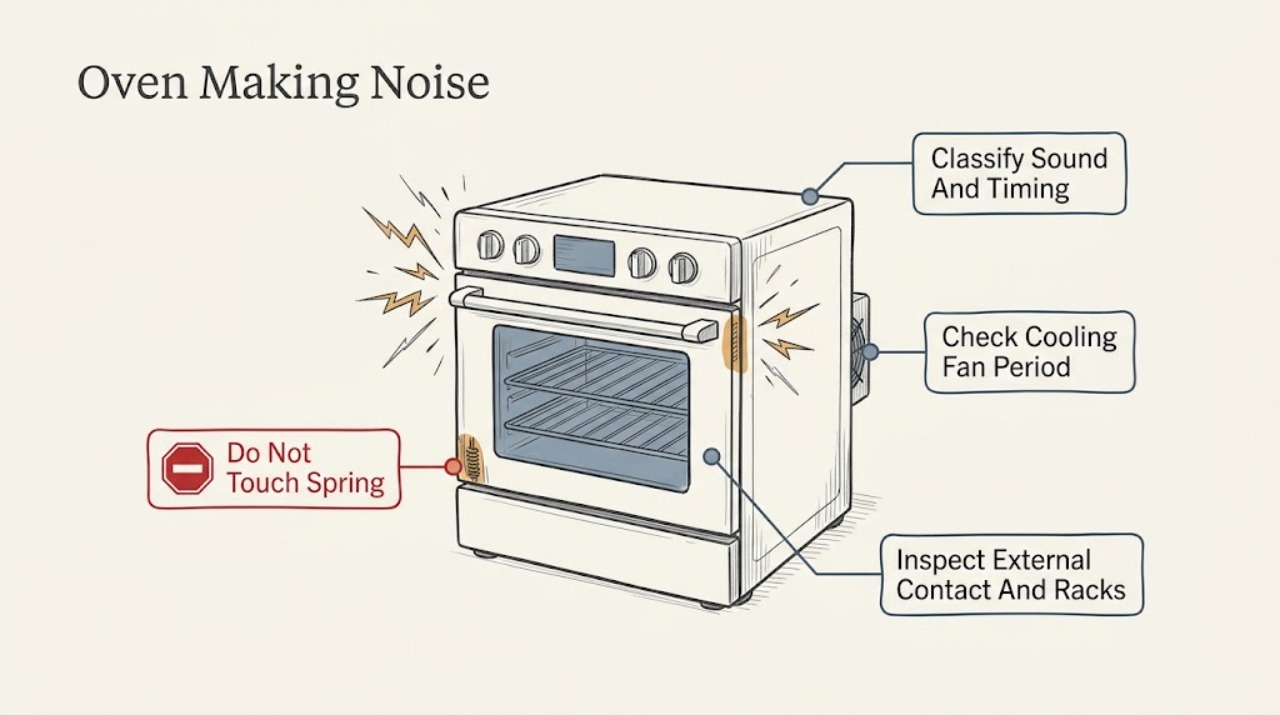
From a safe position, identify the noise as a fan whoosh, hum, click, tick, rattle, scrape, grinding sound, repeated clicking, delayed ignition, or bang; note whether it occurs during preheat, a cooking mode, burner ignition, door movement, or the cooling period after switch-off.
Expected result: The noise is a fan that cycles after switch-off; a short click or tick linked to a mode change or heating; a vibration or rattle linked to a shelf or door; or a new scrape, grind, repeated loud click, delayed ignition, or bang.
Next step: Use the timing and symptom branch below. Make a safe recording if useful, but do not approach moving parts or repeat a gas ignition attempt to reproduce the sound.
Why this matters
Why: Hotpoint describes a cooling fan that can run and cycle for up to 30 minutes after switch-off as normal. The other sound categories need their own branch, and a noise paired with a change in heating or ignition is not a simple volume complaint.
-
Check 2
If the oven was recently used, switched off, or still feels warm, observe the cooling-fan noise from outside for up to the period stated in the exact manual; keep the vents clear and do not reach through them or remove a cover.
Expected result: The fan starts or cycles during cooling and stops within Hotpoint's described window, or it continues with scraping, grinding, smoke, a burning smell, or abnormal heat.
Next step: For a quiet fan that completes its cooling period, monitor it. For scraping, grinding, persistent abnormal noise, or any heat or odor warning, stop using the oven and arrange qualified service without opening the fan area.
Why this matters
Why: Hotpoint says the cooling fan may run for up to 30 minutes after switch-off and may switch off and on to protect the controls. A damaging sound or safety symptom changes the decision from normal cooling to service.
-
Check 3
When the oven is off and fully cool, look for a loose or poorly seated shelf, tray, door trim, or visible object contacting the cavity or door; close the door normally and check that nothing is obstructing the external ventilation openings.
Expected result: A rack, tray, door part, or visible object moves or contacts another surface, or there is no visible external contact but the noise continues during heating or fan operation.
Next step: Reseat only a cool, removable rack or tray and make one normal observation. If the noise remains, requires appliance movement, or comes from behind a panel, stop and arrange service; do not bend trim or dismantle the door.
Why this matters
Why: A loose external item can create a rattle or vibration, but an internal fan, relay, element, or door assembly cannot be identified safely by sound alone. No visible contact makes a component or installation diagnosis more likely.
-
Check 4
Using the normal controls once and from a safe distance, note whether the oven reaches the selected temperature, whether the fan follows the selected fan-assisted mode, and whether the sound starts or stops when the mode is cancelled; do not open electrical or gas compartments.
Expected result: Heating and mode changes are normal with only a brief click, hum, or heat-related tick; the oven does not heat, the fan scrapes, a relay-like click repeats, or the noise is paired with uneven heating or a fault display.
Next step: If the sound is brief and the oven performs normally, monitor and record it. If performance is abnormal or the noise is persistent, stop using the affected mode and arrange a qualified Hotpoint appliance service visit.
Why this matters
Why: A sound that follows a normal mode or cooling event can be documented for the model manual. A sound paired with lost heat, repeated control cycling, a fault display, or mechanical rubbing needs professional diagnosis rather than more test cycles.
-
Check 5
For a gas model, stop immediately if you smell gas, hear a delayed ignition or loud bang, see an abnormal flame or soot, the burner repeatedly fails to light, or the noise is accompanied by a carbon-monoxide alarm or illness symptoms.
Expected result: A gas odor, delayed ignition, abnormal flame, soot, repeated failed ignition, alarm, or possible exposure is present.
Next step: Stop using the oven. If gas is suspected, leave the area and follow local gas-emergency guidance; do not operate electrical switches, use a flame, retry ignition, or inspect the gas path. Arrange a Gas Safe registered engineer where applicable.
Stop if: Stop and seek gas-safety or emergency assistance from a safe location.
Why this matters
Why: These signs can indicate an unsafe appliance or combustion problem. HSE says not to use a gas appliance suspected to be unsafe until it has been checked by a Gas Safe registered engineer.
-
Check 6
Stop immediately for smoke, a burning smell, visible arcing or sparking, a hot or damaged plug or cord, abnormal overheating, a shattered door or glass panel, water near electrical parts, or a breaker that trips again.
Expected result: The hazard persists, the oven is visibly damaged, or the noise cannot be isolated without removing a cover, touching wiring, reaching into a fan, or opening a gas path.
Next step: Stop using the oven and keep people away. Isolate power at the normal switch or breaker only if it is safe and dry to do so; never touch water, damaged wiring, or an arcing component. Arrange qualified appliance service, and use a Gas Safe registered engineer for gas work where applicable.
Stop if: Stop and call qualified service; do not restore power or gas until the appliance is assessed.
Why this matters
Why: These are fire, electric-shock, hot-surface, moving-part, or gas-safety conditions beyond a user-level noise check. Repeatedly restoring power or restarting ignition can increase the hazard.
Use your observations
Decision map
Find the observation that best matches what you see, then follow the next safe action.
-
PATH 01Next step
What you see
A fan runs or cycles for up to about 30 minutes after the oven is switched off and there is no scraping, odor, smoke, or overheating.
Do this next
Treat the behavior as the cooling function described by Hotpoint, keep ventilation clear, and monitor whether it ends within the model's stated period.
-
PATH 02Next step
What you see
A brief click, hum, or heat-related tick occurs during a mode change or normal heating and the oven heats normally.
Do this next
Record the timing and compare it with the exact model manual. Do not label it a failed relay or element without a service diagnosis; arrange service if it becomes persistent, loud, or performance changes.
-
PATH 03Next step
What you see
A cool shelf, tray, door trim, or visible object is loose or contacting another surface.
Do this next
Reseat only the removable item when cool and make one normal observation. Persistent vibration or a source behind a panel requires service.
-
PATH 04Next step
What you see
The sound is scraping, grinding, a repeated loud click, or a persistent abnormal hum, especially with poor heating or a fault display.
Do this next
Stop using the affected mode and arrange qualified appliance service. Do not reach into a fan or remove an oven panel to locate the sound.
-
PATH 05Next step
What you see
A gas oven has a gas odor, delayed ignition, a loud bang, abnormal flame, soot, repeated ignition failure, or a carbon-monoxide warning.
Do this next
Stop using the appliance, leave the area if gas is suspected, follow local gas-emergency guidance without operating switches, and use a Gas Safe registered engineer where applicable.
-
PATH 06Next step
What you see
Smoke, burning smell, arcing, abnormal heat, a damaged power part, water near electrical parts, shattered glass, or a repeat breaker trip is present.
Do this next
Stop immediately, keep clear, isolate power only if safe and dry, and arrange qualified service. Do not use the oven again until assessed.
Helpful context
Understand the symptom
Start with timing, not volume
Listen from a safe position and note whether the sound begins during preheat, when a fan starts, when a burner attempts ignition, while the oven is cooling, or after the controls are switched off. A steady low hum, a single click, a short tick as materials heat, a fan whoosh, scraping, a repeated relay-like click, and a bang have different decision paths. Record whether the oven still heats evenly, whether the flame establishes normally on a gas model, and whether the sound stops when the mode is cancelled.
A fan after switch-off may be a cooling function
Hotpoint says modern appliances can use a cooling fan to prevent the controls becoming too hot. The fan may run for up to 30 minutes after the oven is switched off and may switch off and on during that period. That information applies to the described cooling-fan behavior; a new scraping, grinding, burning smell, or fan noise that continues with another fault should not be dismissed as normal.
Gas sounds require an ignition and gas-safety boundary
On a gas Hotpoint oven, distinguish the expected start sequence from a delayed ignition or loud bang. Do not keep retrying if gas is smelled, ignition is delayed, the flame is abnormal, or a bang occurs. HSE says not to use a gas appliance suspected to be unsafe until it has been checked by a Gas Safe registered engineer. If gas is suspected, follow local emergency guidance from a safe location; do not operate electrical switches or inspect the gas path yourself.
Keep diagnosis external
The safe user-level check is to identify the sound, look for visible obstruction around the door and racks, confirm that cookware or shelves are seated without contact, and consult the exact model manual. Hotpoint's cooking-appliance guidance directs users to the manual for installation requirements and to service when the self-help information does not resolve the issue. Internal fan, relay, heating-element, wiring, and gas-valve work belongs to a qualified technician.
Only after diagnosis
Potential parts
- cooling or convection fan assembly
Consider only if a qualified technician confirms a fan-related scrape, abnormal bearing noise, or fan fault after ruling out a normal post-use cooling cycle and visible obstruction.
Confirm the complete model and manufacturer fit information; do not infer a fan failure from sound alone or reach into the fan. - relay, control module, or thermostat component
Consider only if a technician confirms repeated control cycling or a switching or temperature-control fault together with the noise.
Internal controls carry electrical and heat hazards; use model-specific diagnosis and qualified service rather than a sound-based part selection. - gas ignition or burner component
Consider only for a gas model after a Gas Safe registered engineer confirms delayed ignition or burner-system damage and declares the appliance safe to repair.
Gas-path work is professional work; confirm the exact model and engineer's qualified diagnosis before any part is considered.
When checks do not resolve it
Need a professional?
Arrange qualified Hotpoint appliance service when scraping, grinding, repeated loud clicking, or persistent humming remains after safe external checks; when a fan appears to rub; when heating or mode operation changes; or when diagnosis would require a cover, control, fan, heating element, wiring, or gas-path access. For domestic gas work, use a Gas Safe registered engineer where applicable.
Common questions
FAQ
Is it normal for a Hotpoint oven fan to keep running after switch-off?
Hotpoint says a cooling fan can run for up to 30 minutes after the oven is switched off and may cycle on and off while protecting the controls. Scraping, grinding, smoke, burning smell, or abnormal heat is not a reason to assume the noise is normal; stop and arrange service.
What does a clicking or ticking Hotpoint oven sound mean?
Note whether it is brief and linked to a mode change or normal heating, or whether it repeats, becomes loud, or accompanies poor heating. Compare the timing with the exact model manual. Do not label a relay or element as failed from sound alone; persistent noise requires qualified diagnosis.
Should I keep using a Hotpoint gas oven that bangs when it lights?
No. Treat delayed ignition or a loud ignition bang as a stop condition, especially with a gas odor, abnormal flame, soot, or repeated failed ignition. HSE says not to use a gas appliance suspected to be unsafe until it has been checked by a Gas Safe registered engineer.
When does a Hotpoint oven scraping or grinding noise need service?
Stop using the affected mode when scraping or grinding persists, appears to come from a fan or behind a panel, or occurs with poor heating, abnormal heat, smoke, or an odor. Do not reach into a fan or remove panels; arrange qualified appliance service.
What should I do if a noisy Hotpoint oven smells of gas or burning?
Stop immediately. For suspected gas, leave the area and follow local gas-emergency guidance without operating electrical switches or retrying ignition. For burning smell, smoke, arcing, abnormal heat, or a repeat breaker trip, keep clear and isolate power only if safe and dry, then arrange qualified service.
Read the exact guide
Official sources
- Gas & Electric Cooker Troubleshooting & RepairHotpoint · Hotpoint gas and electric cooking-appliance installation, ignition, fan, and service guidance
- Hotpoint Oven Troubleshooting & RepairHotpoint · Hotpoint oven troubleshooting, cooling-fan behavior, cooking modes, and service escalation
- Gas safety - Home ownersHealth and Safety Executive · UK domestic gas-appliance safety, suspected unsafe appliances, suspected leaks, and qualified gas-engineer boundaries
Community feedback
Share a repair observation
Share a plain-text repair observation. Accepted observations are published automatically; this page may take a moment to update.