
On this page
Start here
Quick answer
Many GE oven noises are normal: a cooling or convection fan, temperature-control clicks, and occasional popping or crackling as metal heats and cools. First identify whether the sound is tied to preheat, a heating cycle, convection, self-clean, or the fan running after cooking. Stop using the oven and arrange service for grinding, scraping, a boom or delayed ignition, electrical buzzing or arcing, a burning smell, melted controls, or an unburned-gas odor. Never remove panels or work near a hot or energized oven to locate a noise.
Work through in order
Diagnostic checks
Use only checks that match the exact appliance or system and its official guide.
-
Record the sound and the operating state
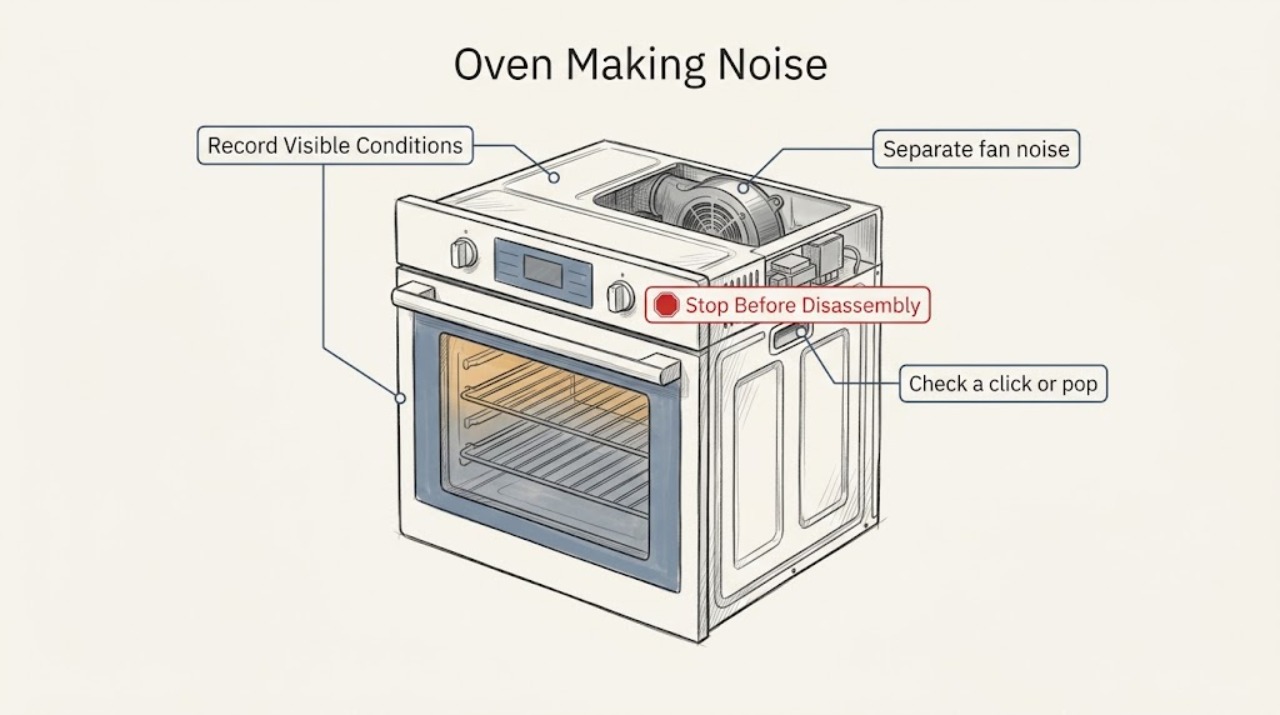
From a safe position, note whether the oven is electric, gas, or dual-fuel if known, and describe the sound as a hum, fan rush, click, pop, crackle, hiss, scrape, grind, boom, or electrical buzz. Note whether it occurs during preheat, bake, broil, convection, self-clean, after shutoff, or when a burner cycles.
Expected result: The sound is brief and tied to a documented cycle, or it is new, harsh, continuous, or unrelated to an expected control or fan event.
Next step: Use the matching sound path below. If the sound is accompanied by gas odor, smoke, sparks, or a boom, skip testing and follow the stop branch.
Why this matters
Why: Cycle-linked fan, relay, igniter, and metal movement sounds can be normal. A persistent or harsh noise needs a component and safety diagnosis rather than repeated operation.
-
Separate fan noise from a mechanical noise
If the oven is cool enough to observe safely, listen from outside while the cooling or convection fan runs. Note whether the sound is a smooth airflow that changes speed or continues briefly after shutoff, or a scrape, grind, rattling vibration, or intermittent mechanical knock. Do not remove a fan cover, touch blades, or insert a tool.
Expected result: The sound is a smooth fan rush that follows the selected mode or cool-down, or it is rough, scraping, grinding, or accompanied by vibration.
Next step: If the fan sound matches the cycle and the oven heats normally, consult the manual for expected operation. If it scrapes, grinds, or persists with cooling problems, stop using the oven and arrange service.
Why this matters
Why: GE documents fan operation during cooking and cool-down as normal on many models. A rough mechanical sound may indicate a fan obstruction, worn motor, loose mount, or another internal fault that is not a user-accessible adjustment.
-
Check a click or pop against the heat cycle
Listen without opening the door during a normal, supervised bake or broil cycle only if no safety warning is present. Note whether clicks repeat as the temperature is regulated and whether occasional pops or crackles coincide with the oven heating, cooling, or cleaning. Do not use self-clean as a test for an unexplained noise.
Expected result: The click follows the heating cycle, or the pop is occasional and occurs as the oven heats or cools; alternatively the sound is a sharp bang, repeated electrical snap, or new loud crack.
Next step: Treat documented cycle sounds as normal only when the oven otherwise operates correctly. Stop the oven and arrange service for a boom, electrical snapping, visible damage, or a sound that changes the cooking result.
Why this matters
Why: GE describes relay or temperature-control clicks and metal expansion sounds as normal. A sharp bang, electrical snap, or worsening crack can indicate delayed ignition, arcing, a damaged component, or a structural problem.
-
Check gas ignition symptoms without relighting
On a gas GE oven, observe only from outside whether the burner ignites promptly during a normal start and whether clicking or a small cycling sound stops once the flame is established. Never place a hand near the burner, use a match or lighter, or open panels to inspect an igniter.
Expected result: The sound is a brief cycle click with stable heating, or there is a boom, delayed ignition, repeated clicking, unstable flame, or a smell of unburned gas.
Next step: For a boom, delayed ignition, persistent clicking, or unstable flame, turn the oven off and arrange gas-appliance service. For an unburned-gas odor, avoid electrical switches and open flames, leave the area, and contact the gas supplier or emergency service from a safe location.
Why this matters
Why: GE identifies a normal ignition/cycling click but says a boom or delayed ignition requires service. An unburned-gas odor is not normal and must be treated as a gas safety issue, not a noise to troubleshoot.
-
Look for external heat or electrical warning signs
After turning the oven off and allowing it to cool, look from outside for a melted knob, smoke residue, scorch mark, discolored control area, damaged cord, or a breaker that trips during use. Do not touch hot surfaces, remove panels, reset a repeatedly tripping breaker, or investigate energized wiring.
Expected result: The exterior is intact and cool, or there is a hot, melted, discolored, smoky, sparking, or repeatedly tripping condition.
Next step: Leave the oven off and arrange qualified appliance or electrical service when any warning sign is present. If there is no warning sign, continue with the model and cycle comparison only.
Stop if: Stop immediately for smoke, sparks, exposed wiring, a hot cord, or an active electrical fault; disconnect power only from a safe location and seek qualified service.
Why this matters
Why: A sound plus heat damage, arcing, or an electrical interruption is not a normal fan or metal-expansion sound. It indicates a safety or control fault requiring professional inspection.
-
Check the model manual and operating result
Find the exact model number and compare the observed fan, relay, ignition, and cool-down behavior with the owner's manual. Note whether the oven reaches and holds heat, whether the sound stops after the documented cool-down, and whether any display message appears. Do not dismantle the appliance to read a hidden label or access a suspected part.
Expected result: The sound matches the model's documented operation and cooking is normal, or the sound remains unexplained or the oven heats poorly.
Next step: Monitor a documented normal sound without forcing a repair. For a persistent or performance-related noise, provide the model, fuel type, cycle, sound description, and safety observations to a qualified technician.
Why this matters
Why: GE has model-dependent fan and convection behavior, so a model manual is the authority for normal timing. An unexplained sound with poor heating, odors, or repeated faults needs a service diagnosis.
Use your observations
Decision map
Find the observation that best matches what you see, then follow the next safe action.
-
PATH 01Next step
What you see
The oven makes a smooth fan sound during cooking or briefly after shutoff, and it heats normally.
Do this next
Treat the fan as potentially normal for that model and consult the owner's manual for the expected cool-down behavior. Arrange service only if the sound becomes rough, persistent, or changes oven performance.
-
PATH 02Next step
What you see
Clicks repeat with temperature regulation, or occasional pops and crackles occur while metal heats or cools.
Do this next
These sounds can be normal when the oven otherwise performs correctly. Stop and request service if the sound becomes a bang, electrical snap, or is accompanied by damaged controls or poor heating.
-
PATH 03Next step
What you see
A gas oven produces a boom, delayed ignition, repeated clicking after ignition, unstable flame, or a strong unusual sound.
Do this next
Turn the oven off and arrange qualified gas-appliance service. Do not relight, adjust the burner, or remove panels to inspect the igniter.
-
PATH 04Next step
What you see
There is an unburned-gas or rotten-egg odor.
Do this next
Do not touch electrical switches or use an open flame. Leave the area, ventilate only if it can be done safely, and contact the gas supplier or emergency service from outside the affected area.
-
PATH 05Next step
What you see
The sound is scraping, grinding, rattling, or accompanied by smoke, arcing, a melted control, hot cord, or repeated breaker trips.
Do this next
Stop using the oven, keep clear of hot or energized parts, and arrange qualified appliance or electrical service. Do not repeat the cycle to reproduce the noise.
-
PATH 06Next step
What you see
The sound remains unexplained and the oven is not heating, is overheating, or displays a fault.
Do this next
Leave the appliance off and provide the model, fuel type, cycle, display state, sound timing, and any odor or temperature symptom to a qualified technician.
Helpful context
Understand the symptom
Normal sounds depend on the oven type and cycle
GE ranges and wall ovens can use convection fans, control-cooling blowers, heating elements, gas igniters, and relays. A fan may start during preheat, cycle during convection, or continue after cooking while controls cool. A click can be a temperature control or relay cycling, and a pop or crackle can be metal expanding or contracting. Use the exact model manual when the timing does not match these patterns.
Treat gas and electrical warning sounds differently
A brief ignition or cycling sound is not the same as a boom, delayed ignition, continuous clicking after a burner should be lit, electrical sizzling, or an unburned-gas odor. Keep the door closed if the oven is hot, turn controls off, and do not restart the appliance to reproduce a dangerous sound. Keep children away and allow hot surfaces to cool before any external inspection.
Only after diagnosis
Potential parts
- convection or cooling fan motor
Consider this only when a qualified diagnosis links a persistent scrape, grind, or abnormal fan noise to the fan motor or blade after normal operating behavior and visible obstructions are ruled out.
Confirm the exact oven model and the manufacturer's fit information before ordering; fan parts and access vary by model. - temperature-control relay or control board
Consider this only when a technician confirms that repeated abnormal clicking, control behavior, or temperature regulation failure originates in the control circuit.
Control components are model-specific and may require qualified electrical testing; do not infer compatibility from the brand alone. - gas igniter or safety valve
Consider this only after a qualified gas-appliance technician diagnoses delayed ignition, repeated ignition clicking, or a burner that does not ignite correctly.
Gas components and adjustment procedures are model-specific professional work; do not replace or adjust them as a noise experiment. - oven door or panel mounting hardware
Consider this only if a technician finds a loose or damaged panel or mount causing a confirmed vibration after the oven is cool and disconnected.
Verify the exact model and safe access procedure before ordering or installing any hardware.
When checks do not resolve it
Need a professional?
Request qualified GE appliance service for grinding or scraping, a boom or delayed ignition, persistent abnormal clicking, electrical buzzing or arcing, a burning or unburned-gas odor, melted controls, smoke, repeated breaker operation, poor heating, overheating, or a fan that remains noisy after the model-directed cool-down. Provide the exact model, fuel type, cycle, sound description, and any warning sign.
Common questions
FAQ
Is it normal for a GE oven fan to run after cooking?
Yes, many GE ovens use a cooling fan after operation to cool controls or components. The exact timing depends on the model and how hot the oven became. A rough, scraping, or grinding fan sound is not normal and needs service.
Why does my GE oven click while baking?
Temperature controls and relays can click as heating elements cycle to maintain temperature. Stop and request service if the sound is a bang, an electrical snap, or is accompanied by poor heating, smoke, or damaged controls.
Why does my GE oven make popping or crackling noises?
GE describes occasional popping or crackling from metal heating and cooling as normal. A boom, door movement, repeated sharp crack, or noise accompanied by gas odor or electrical symptoms requires immediate service.
What does a boom from a GE gas oven mean?
GE identifies a boom or delayed ignition as a condition requiring service. Turn the oven off and do not relight or open panels. If you smell unburned gas, avoid electrical switches and flames, leave the area, and contact the gas supplier or emergency service safely.
How can I tell whether an oven noise is dangerous?
Treat grinding, scraping, electrical buzzing or arcing, smoke, burning odor, melted controls, repeated breaker trips, unstable flame, delayed ignition, and unburned-gas odor as stop conditions. Keep the appliance off and use qualified appliance, electrical, or gas service.
Read the exact guide
Official sources
- Range & Wall Oven - Normal Sounds During UseGE Appliances · GE range and wall-oven normal clicks, fans, pops, and crackles during use
- Gas Range - What is Normal Operation vs What Requires ServiceGE Appliances · GE gas-range ignition, cycling sounds, delayed ignition, flame, and gas-odor safety guidance
- Range & Wall Oven - Oven Makes a Clicking SoundGE Appliances · GE oven relay clicking during active cooking
- Range & Wall Oven - Electronic Control FanGE Appliances · GE range and wall-oven electronic control fan operation
- Range & Wall Oven - Oven Fan Run TimeGE Appliances · GE oven control-panel cooling fan run time after operation
- Range & Wall Oven - Clicking and Other NoisesGE Appliances · GE range and wall-oven clicking, humming, popping, relay, and fan sounds
- Gas Range - Gas OdorsGE Appliances · GE gas-range combustion odor versus unburned-gas response
- Range & Wall Oven - Fan Noise and Normal OperationGE Appliances · GE range and wall-oven convection and cooling fan behavior
Community feedback
Share a repair observation
Share a plain-text repair observation. Accepted observations are published automatically; this page may take a moment to update.