
On this page
Start here
Quick answer
A Frigidaire oven can normally make a fan sound during preheat, baking, convection, and cooldown after it is switched off. Clicking or light popping can also come from controls operating or metal expanding and contracting as temperatures change. Identify the sound and when it occurs before treating it as a fault. Turn the oven off and stop using it for scraping or grinding, a loud electrical buzz, smoke, a burning or gas smell, a fan that strikes something, a door or rack that is loose, or a sound that continues with the oven cool. Do not remove panels or reach near a hot element; an unresolved abnormal noise needs qualified service. [Sources: frigidaire-fan-support, frigidaire-induction-noise, frigidaire-oven-hot, frigidaire-convection-guide]
Before you begin
Safety first
- Do not remove panels, access internal wiring, reach into a fan or hot cavity, lubricate internal parts, or bypass thermal, gas, or door safety devices.
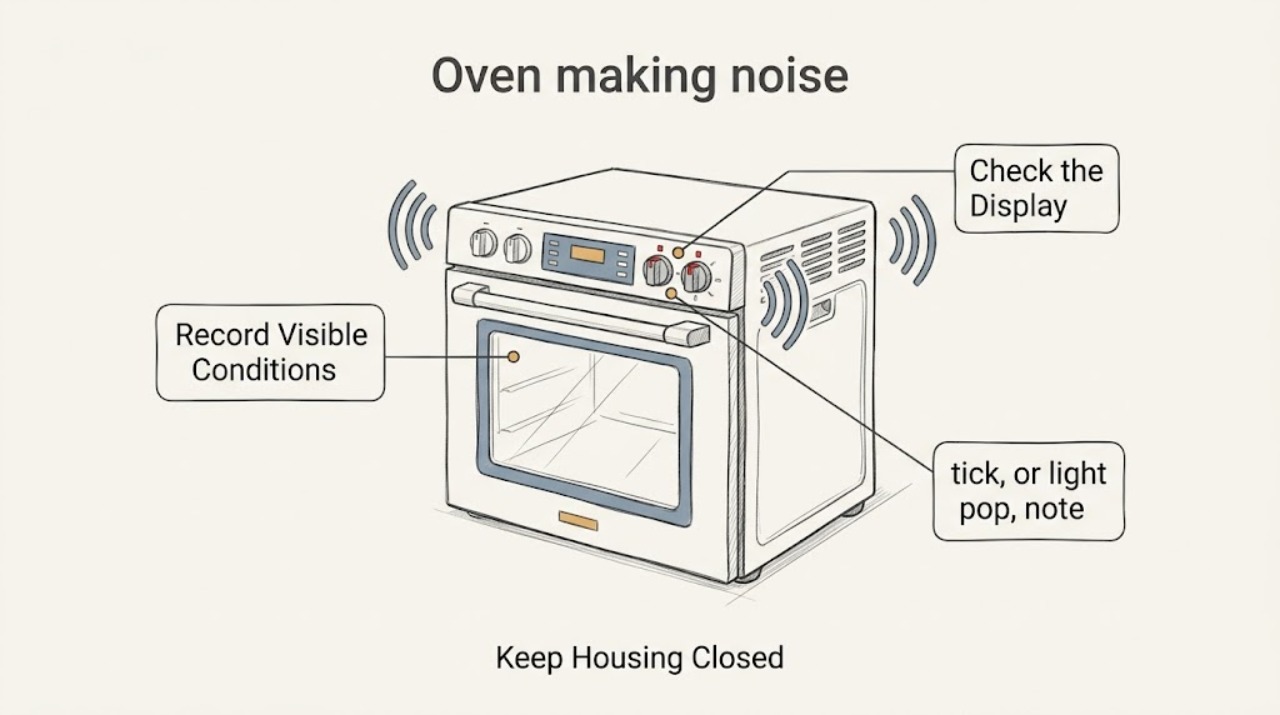
Work through in order
Diagnostic checks
Use only checks that match the exact appliance or system and its official guide.
-
Check 1
Turn the oven mode and temperature controls to off and listen from a safe position. Record whether the sound is a steady airflow, humming, clicking, popping, rattling, scraping, grinding, or a loud electrical buzz; note whether it occurs during preheat, bake, convection, self-clean, cooldown, or while the oven is supposedly off. Stop immediately for smoke, a burning or gas smell, sparks, a hot cord, or visible damage.
Expected result: The sound is scraping, grinding, repeated hard impact, a loud electrical buzz, or it is accompanied by smoke, an odor, sparks, or visible damage.
Next step: Stop using the oven, isolate its external power only from a safe position, and arrange qualified appliance service. If there is a gas smell or active smoke/fire, leave the area and contact the appropriate emergency service; do not open panels or keep listening with the oven energized.
Why this matters
Why: This does not match the normal fan, control, or temperature-change patterns described by Frigidaire and may involve a damaged fan, heating system, wiring, or other unsafe condition.
-
Check 2
If the sound is airflow or a low fan hum, compare it with the operating stage without touching the oven. Note whether the fan starts at preheat, cycles during baking, runs only in a convection mode, or continues for a while after the controls are off; allow the oven to cool naturally.
Expected result: The fan sound follows preheat or baking, or it gradually stops after the oven has cooled.
Next step: Treat this pattern as normal unless the sound changes to scraping, grinding, striking, or an electrical buzz. Use the mode and fan behavior stated in the exact model guide; do not block vents or the fan path.
Why this matters
Why: Frigidaire says an oven fan can run during preheat, come on and off during baking, and remain on after baking until the internal temperature cools. Convection models also use a fan to circulate oven heat.
-
Check 3
If the sound is a click, tick, or light pop, note whether it occurs when the oven reaches temperature, when the heating cycle changes, or during cooldown. On an induction range or range with an induction surface, also note whether a hum or buzz changes with the pan or surface setting; do not place hands on hot cookware to test it.
Expected result: The clicks or light pops coincide with heating and cooling, or an induction hum changes with cookware while the oven and controls otherwise work normally.
Next step: Continue only if the sound remains within that pattern and there is no odor, smoke, error, heating problem, or visible damage. If the sound becomes sharp, continuous, or independent of heating and cooling, stop using the appliance and call service.
Why this matters
Why: Frigidaire describes control clicks, temperature-related expansion and contraction, and some induction cookware hum or buzz as normal operating sounds.
-
Check 4
After the oven is completely cool and the controls are off, remove loose cookware or accessories and check that the removable racks are seated as shown in the model guide. Do not pull a built-in oven out, remove a fan cover, or touch an element. If the sound occurs only with a rack, pan, or accessory in place, identify that item; if it remains with the cavity empty, record its location and timing.
Expected result: The noise disappears when a loose item is removed, or it remains with the cool, empty oven and comes from the rear, top, side, or control area.
Next step: Reseat or remove only the item allowed by the model guide. If the noise remains, do not dismantle the appliance; arrange service and provide the sound recording, location, operating mode, and model information.
Why this matters
Why: A removable item can vibrate against the cavity, while a sound that remains with the oven empty is more likely to involve installed hardware or a fan/control assembly. Frigidaire notes that rack placement and bakeware are model-dependent, so the exact guide controls fit and placement.
-
Check 5
With the oven cool, review the display for an error or temperature warning and compare the noise with the exact Use and Care guide. If the oven is also overheating, underheating, failing to preheat, or repeatedly restarting a fan, do not perform an internal test; record the mode, set temperature, timing, and whether the sound continues after shutdown.
Expected result: A code or temperature problem accompanies the noise, or the abnormal sound returns on every cycle despite correct rack/accessory placement.
Next step: Leave the oven out of service and arrange qualified repair. Do not access live wiring, remove the control panel, lubricate a fan, or bypass a thermal or door safety device.
Why this matters
Why: A persistent noise combined with a heating or control symptom is not just an acoustic preference. Frigidaire directs unresolved temperature problems to model-specific calibration instructions or service, and the same boundary applies when the sound persists.
Use your observations
Decision map
Find the observation that best matches what you see, then follow the next safe action.
-
PATH 01Next step
What you see
A fan runs during preheat, cycles during baking, or continues briefly after shutdown and then stops as the oven cools
Do this next
Use the model's normal mode and keep vents clear. Call service only if the sound changes to contact, grinding, or another abnormal symptom.
Why this path and its safety boundary
Why it matters: This is a documented normal fan pattern for Frigidaire ranges and ovens.
-
PATH 02Next step
What you see
Clicking or light popping follows temperature changes and the oven otherwise heats and controls normally
Do this next
Monitor the pattern. Stop using the oven if the sound becomes a hard impact, continuous electrical buzz, or is paired with smoke, odor, or a heating fault.
Why this path and its safety boundary
Why it matters: Control operation or thermal expansion and contraction can produce these sounds.
-
PATH 03Next step
What you see
An induction-surface hum or buzz changes with cookware while cooking remains normal
Do this next
Use cookware and settings specified for the exact model. Persistent loud noise, a new sound, or a simultaneous control/heating fault needs service.
Why this path and its safety boundary
Why it matters: Frigidaire says some induction cookware can hum or buzz during operation.
-
PATH 04Next step
What you see
The sound is present with the oven cool and empty, or resembles scraping, grinding, striking, or a loud electrical buzz
Do this next
Stop using the appliance and arrange qualified service. Do not remove panels or attempt to reach the fan or wiring.
Why this path and its safety boundary
Why it matters: A removable rack or pan is less likely to be the cause, and installed hardware or electrical components may need diagnosis.
-
PATH 05Next step
What you see
Noise occurs with smoke, burning or gas odor, sparks, visible damage, overheating, or an error code
Do this next
Turn the oven off, isolate power only if safe, leave a gas-smelling or smoking area, and obtain emergency or qualified professional help. Do not run another test cycle.
Why this path and its safety boundary
Why it matters: This is a safety stop rather than a normal operating sound.
Helpful context
Understand the symptom
The same oven may use more than one fan: a convection fan circulates heat in a convection mode, while another fan can cool components and continue briefly after the oven is off. A fan that starts and stops with heating is therefore not automatically a failed motor. The useful distinction is whether the noise follows a normal mode and cooldown pattern or sounds like contact, grinding, or an electrical fault.
Before testing, keep the door closed during preheat and keep hands away from hot elements. Frigidaire's temperature guidance also says to use the correct preheat and refer to the model Use and Care guide for calibration or unresolved temperature problems; those same model-specific instructions govern unusual noises.
Only after diagnosis
Potential parts
- convection or cooling fan assembly
Consider this only when a technician confirms that the noise is from a fan bearing, blade, housing, or motor after normal fan timing and accessory checks are excluded.
Fan assemblies vary by oven and range model; confirm the exact model and manufacturer fit information before ordering. - heating-control relay or electronic control
Consider this only if clicking or buzzing is accompanied by incorrect heating, repeated cycling, an error, or a technician-confirmed control fault.
Control components are model-specific and may require configuration; use qualified installation and exact model documentation. - oven rack support or mounting hardware
Consider this only when a cool, empty-cavity check isolates the rattle to installed rack support or mounting hardware rather than a fan or control assembly.
Confirm the exact cavity and model fit before replacing hardware; do not alter supports that affect rack stability.
When checks do not resolve it
Need a professional?
Call qualified Frigidaire service when a noise persists with the oven cool and empty, the fan scrapes or strikes, the sound is a loud electrical buzz, the oven also has a temperature or control problem, or a code returns. Stop immediately for smoke, sparks, a burning or gas smell, visible damage, or an overheated cord or control area. Do not remove panels, reach near energized or hot parts, lubricate internal components, or bypass a thermal or door safety device.
Safety scope: Do not remove panels, access internal wiring, reach into a fan or hot cavity, lubricate internal parts, or bypass thermal, gas, or door safety devices.
Common questions
FAQ
Is it normal for a Frigidaire oven fan to keep running after I turn it off?
Yes. Frigidaire says the fan can continue after baking and stop once the oven's internal temperature cools. A scraping or grinding fan, or one paired with smoke or an odor, is not a normal cooldown pattern and needs service.
Why does my Frigidaire oven click or pop while heating?
Clicks can come from controls operating, and temperature changes can make parts expand and contract. Monitor the sound only when heating and cooking remain normal; stop using the oven for hard impacts, a continuous electrical buzz, smoke, or a new heating fault.
Could a rack or pan be causing the noise?
It can be if the noise disappears when the cool oven is empty and the removable rack or accessory is reseated according to the model guide. If the sound remains with the cavity empty, have the installed hardware or fan checked rather than removing covers yourself.
When should an oven noise be treated as unsafe?
Stop using the oven for scraping, grinding, repeated hard striking, a loud electrical buzz, smoke, sparks, a burning or gas smell, visible damage, or a noise accompanied by overheating or an error. Isolate power only if safe and arrange qualified service.
Read the exact guide
Official sources
- Oven - Is too HotFrigidaire · Frigidaire range-oven and wall-oven preheating, bakeware, rack placement, calibration, and service guidance
- Ranges - Is it normal for a fan to come on while using my range and when does it stop running?Frigidaire · Frigidaire range and oven fan timing during preheat, baking, and cooldown
- Why does my Induction Range make noises when I’m cooking?Frigidaire · Frigidaire induction range and cooktop normal hum, buzz, clicks, fan, and thermal-expansion sounds
- To set the oven for convection bake:Frigidaire · Frigidaire convection-oven operating sequence and model-specific fan use
Community feedback
Share a repair observation
Share a plain-text repair observation. Accepted observations are published automatically; this page may take a moment to update.