
On this page
Start here
Quick answer
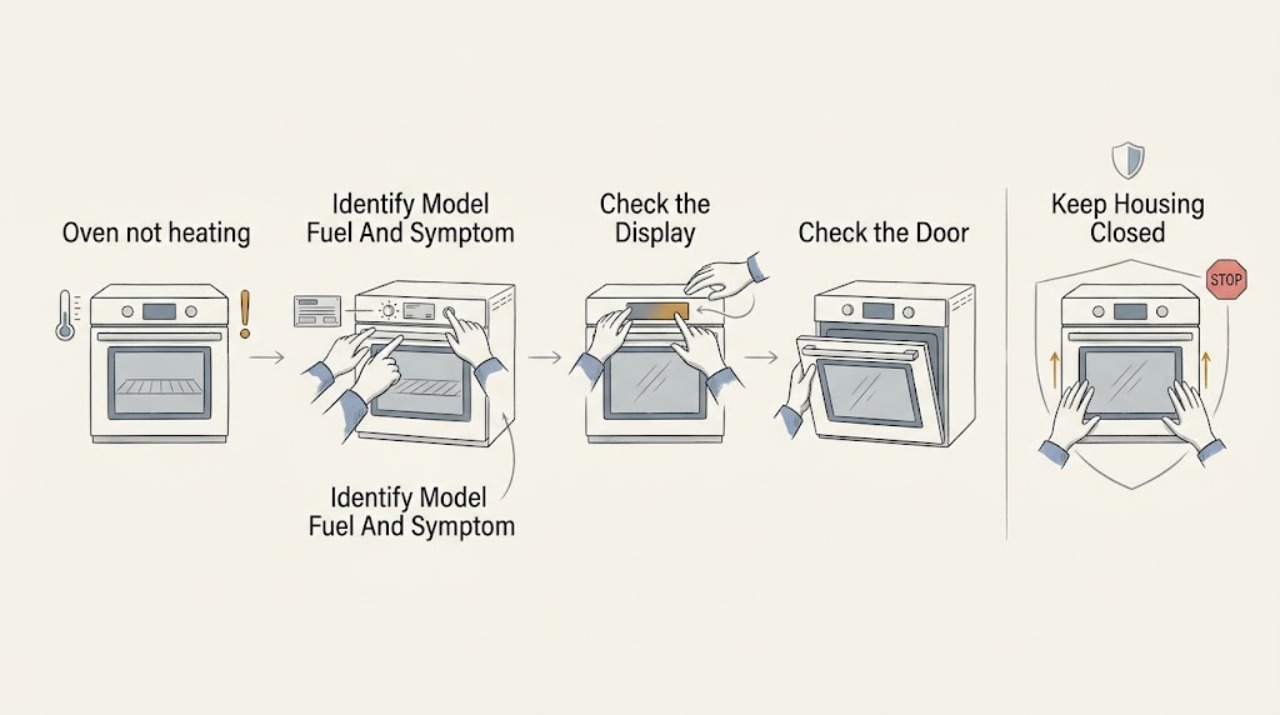
A Wolf oven that is not heating may be in a normal preheat state, an incorrect mode or showroom setting, or have lost power; a thermal cutout, cooling fan, relay or control issue, bake element, ignitor, or gas supply can also be involved. First record the exact model, fuel type, display message, selected mode, and whether the cavity is completely cold or merely below the set temperature. Confirm the door closes, the intended mode is on, and the oven is not in showroom or demonstration mode. Wolf documents a single circuit-breaker power cycle for applicable models, but do not repeat it if the breaker trips, there is smoke, burning odor, gas odor, or electrical damage. If the oven still does not heat, arrange Factory Certified Service rather than opening the cabinet, testing live circuits, handling gas components, or replacing an element or ignitor by guesswork.
Work through in order
Diagnostic checks
Use only checks that match the exact appliance or system and its official guide.
-
Check 1
From ordinary safe access, photograph or record the Wolf model information, fuel type if known, display text, selected cooking mode, set temperature, and the point at which heating was expected to begin; do not remove trim to find a label.
Expected result: Classify the symptom as a blank display, controls that respond but no heat, one mode without heat, all modes without heat, slow or incomplete preheat, or heat lost after self-clean; record whether the cavity is cold or warming.
Next step: Use the matching branch below and give the model, fuel type, display, mode, and timing to Factory Certified Service if the cause is not an external setting.
Stop if: Stop if the label can only be reached by moving a hot oven, removing panels, entering an unsafe area, or touching exposed wiring or gas parts.
Why this matters
Why: A blank display points first to power or control behavior, while a responsive display with no heat narrows the next check to mode, showroom setting, door, fuel-specific ignition, heating components, or control protection. A mode-specific result must not be generalized across Wolf models.
-
Check 2
With the oven cool and the door unobstructed, select the intended mode and temperature exactly as the model's Use and Care Guide describes, then observe the display through one normal preheat; do not use a self-clean cycle as a diagnostic test.
Expected result: Record whether LO or a preheat indication appears, whether the chosen mode is actually active, whether the display shows a fault, and whether the cavity begins to warm or remains cold after the expected preheat state.
Next step: If the oven is warming normally, allow preheat to finish before judging cooking performance. If it remains cold, displays an error, or ignition is abnormal, stop and arrange Factory Certified Service.
Stop if: Stop immediately for gas odor, delayed ignition, an unusual flame, smoke, arcing, burning odor, or a door that will not close safely.
Why this matters
Why: LO during preheat can be normal on Wolf electric models. A correct mode with completed preheat but a cold cavity, a displayed error, or no heat in one or all modes indicates a service path rather than a reason to keep changing settings. If the model is gas, note any ignition delay or absent flame without repeated attempts.
-
Check 3
With the oven off and cool, check from the front that no rack, pan, liner, or food is blocking the door and that it closes completely; then use the exact model-specific controls to confirm the desired mode is enabled and showroom or demonstration mode is not active.
Expected result: Record a fully closing door, a door that is blocked or misaligned, a correct mode, or a showroom or demonstration indication; also note whether all modes or only one mode fail to heat.
Next step: Remove only an obvious cool, loose obstruction without force and retry the documented setting once. If the door does not close, the mode cannot be selected, or showroom mode is not resolved by the model guide, leave the oven unused and request service.
Stop if: Do not force, lift, dismantle, or realign the door; do not run the oven with a door that cannot close fully or with a damaged glass panel or seal.
Why this matters
Why: Wolf lists a blocked door, an unselected mode, and showroom mode among causes of an oven that appears not to heat. A damaged seal, hinge, latch, or door alignment can cause heat loss and needs service; a correct mode with persistent no heat points beyond settings.
-
Check 4
From a dry, safe position, check whether the oven display responds and whether the dedicated home circuit appears tripped; if the model guide permits it and there are no warning signs, perform Wolf's single power reset by switching the circuit off briefly and restoring it, then leave the oven off until the controls are stable.
Expected result: Record blank or responsive controls, a normal breaker, a single reset that restores the display, or a breaker that will not stay on, trips again, smells hot, shows damage, or is near moisture.
Next step: If the reset does not restore normal heating, leave the unit unused and request service. Leave a repeatedly tripping circuit off and use a qualified electrician or appliance technician as appropriate.
Stop if: Do not open the electrical panel or oven cabinet, touch wiring, perform live testing, bypass protection, or reset a breaker repeatedly; stop for smoke, arcing, burning odor, heat, or water.
Why this matters
Why: A blank or unstable display can reflect loss of power or a control problem. A breaker that trips again indicates an unresolved electrical fault, not permission to keep resetting it. A restored display with no heat still requires the mode, fuel, door, and service branches rather than assuming the reset repaired the oven.
-
Check 5
Only for a confirmed Wolf gas oven and only from the normal user controls, note whether the preheat indicator calls for heat and whether ignition occurs within the model's normal sequence; do not remove a burner cover, probe the ignitor, or repeatedly attempt ignition.
Expected result: Record a normal ignition, no ignition, repeated clicking, delayed ignition, a flame that goes out, or gas odor without ignition; never lean into the cavity or use a flame to test for gas.
Next step: Turn the user control off, keep the oven unused, and arrange Factory Certified Service for absent, delayed, unstable, or abnormal ignition. If there is a strong gas odor, leave the area and follow the building's emergency gas-safety procedure from a safe location.
Stop if: Stop immediately for gas odor, delayed ignition or a bang, abnormal flame, smoke, carbon-monoxide alarm, or any need to access the gas train or ignitor.
Why this matters
Why: Wolf lists no gas, no power, ignitor, valve, thermostat, or connection faults among possible gas bake-burner causes. Gas odor without ignition or an ignition delay requires discontinuing use until repair; an absent flame cannot be safely diagnosed from the outside as one particular part.
-
Check 6
Prepare a service handoff containing the model, fuel type, display or error text, mode and temperature, preheat result, door and showroom observations, recent self-clean use, power event, and any safe audio or visual record of the symptom.
Expected result: Confirm that the record describes what happened without any cabinet removal, live electrical test, gas-line work, forced door movement, or repeated ignition or breaker tests.
Next step: Request Factory Certified Service and provide the exact Wolf model and symptom pattern. Let the technician verify isolation, temperature controls, heating or ignition components, and model-specific compatibility.
Stop if: Stop all user troubleshooting when the next step requires cabinet access, electrical measurements, gas-component handling, thermal-cutout work, element or ignitor replacement, or unsafe access around a hot oven.
Why this matters
Why: The timeline helps a certified technician distinguish a setting or power issue from a thermal cutout, fan, element, ignitor, valve, relay, control, or supply fault without asking the owner to make a hazardous diagnosis.
Use your observations
Decision map
Find the observation that best matches what you see, then follow the next safe action.
-
PATH 01Next step
What you see
The display shows a normal preheat state such as LO, the selected mode is correct, the oven warms, and there is no safety warning.
Do this next
Allow the mode to fully preheat before cooking. If the oven remains cold after preheat completes or performance is substantially abnormal, request Factory Certified Service.
-
PATH 02Next step
What you see
The display is blank, controls do not respond, or the circuit has tripped.
Do this next
Check only the accessible, dry power status and perform at most the model-authorized single reset. If the circuit trips again or the display remains blank, leave it off and request qualified electrical or appliance service.
-
PATH 03Next step
What you see
The door is blocked or does not close, the mode is not active, or showroom or demonstration mode is shown.
Do this next
Correct only an obvious cool obstruction or the exact documented control setting once. Do not force the door; request service for latch, hinge, seal, control, or unresolved showroom-mode problems.
-
PATH 04Next step
What you see
The Wolf oven is gas and the bake burner does not ignite normally, ignition is delayed, the flame is unstable, or gas odor is present.
Do this next
Turn the user control off, discontinue use, and arrange Factory Certified Service. With gas odor, leave the area and follow the building's emergency gas-safety procedure from a safe location; do not repeat ignition attempts or inspect gas parts.
-
PATH 05Next step
What you see
The oven has power and the intended mode and door state are correct, but it remains cold, preheat completes without heat, an error appears, or cooking performance remains abnormal.
Do this next
Leave the oven unused and request Factory Certified Service to diagnose the model-specific heating, fan, thermal, relay, control, element, ignitor, or supply path.
-
PATH 06Next step
What you see
There is smoke, burning odor, arcing, a hot or damaged electrical area, a carbon-monoxide alarm, uncontrolled heat, damaged glass, or a repeated breaker trip.
Do this next
Stop using the oven, keep people away, and use the appropriate emergency, electrical, gas-safety, or appliance response from a safe location. Do not restart it to reproduce the problem.
Helpful context
Understand the symptom
Start by separating normal preheat from no heat
A Wolf display showing LO during preheat is described by Wolf as normal, not an error. A cavity that is warming slowly is a different complaint from an oven that remains cold, a preheat indication that completes without heat, or one mode that heats while another does not. Let the oven complete the mode's normal preheat when there is no safety warning, and record the result without opening the cabinet. If preheat completes but the oven is still cold, or cooking remains substantially slower than expected after the manufacturer's instructions are followed, Wolf says service is needed.
Wolf models do not all use the same heating path
Wolf's electric wall ovens, induction ranges, dual-fuel ranges, gas ovens, and convection-steam products have different controls and heating components. Do not infer an electric-element fault from a gas oven symptom or apply a gas-burner procedure to an electric model. For a gas Wolf oven, delayed or absent ignition and gas odor require discontinuing use until repaired. For an electric or dual-fuel oven, the selected oven mode, showroom setting, door, power supply, thermal protection, fan, relay, or bake element may change the service path.
Keep the checks external and model-specific
Wolf's official troubleshooting pages direct the owner to confirm power, mode, door position, and showroom or demonstration settings, then use a brief power reset where the model's instructions allow it. The product Use and Care Guide controls the exact buttons and fuel-specific behavior. Do not remove the oven cabinet, reach behind the control panel, disturb an ignitor or burner, test heating elements, or work around a thermal cutout. Those tasks require trained service because the appliance can contain high-voltage, high-temperature, and, on applicable models, gas hazards.
Safety boundary
Stop conditions
- Stop immediately for gas odor, delayed ignition or a bang, abnormal flame, smoke, carbon-monoxide alarm, burning odor, arcing, damaged glass, or uncontrolled heat.
- Stop and leave the circuit off for a repeated breaker trip, hot electrical area, exposed wiring, moisture near electrical parts, or visible equipment damage.
- Do not open the oven cabinet, access live wiring, handle an ignitor, burner, valve, relay, thermal cutout, or heating element, force the door, or repeatedly reset power or ignition.
Only after diagnosis
Potential parts
- Wolf oven heating element or ignitor
Consider a heating element or gas ignitor only after a qualified technician confirms the applicable fuel type, mode, failed component, and exact model fit; a no-heat symptom alone does not identify either part.
Confirm the exact Wolf model, fuel configuration, electrical or gas specification, and manufacturer-approved fit through Factory Certified Service before selecting any part.
When checks do not resolve it
Need a professional?
Arrange Factory Certified Service when the Wolf oven remains cold after the documented mode, door, showroom, and single power checks; when preheat completes without heat; when an error appears; or when a gas bake burner does not ignite normally. Use emergency gas-safety or electrical help for gas odor, smoke, arcing, a carbon-monoxide alarm, a hot or damaged circuit, or repeated breaker trips.
Have this ready
- Give the technician the exact model, fuel type, display text, mode, temperature, preheat timing, door and showroom observations, recent self-clean use, power events, and safe symptom record.
Common questions
FAQ
Is LO on a Wolf oven proof that it is broken?
No. Wolf describes LO during preheat on applicable electric models as a normal preheating indication. Let the intended mode preheat fully; if the cavity remains cold after preheat completes, request Factory Certified Service.
What should I do if a Wolf gas oven smells like gas but does not heat?
Turn the user control off, discontinue use, and leave the area if the odor is strong or persists. Follow the building's emergency gas-safety procedure from a safe location and arrange Factory Certified Service. Do not repeat ignition attempts or inspect gas components.
Can I replace the Wolf oven element or ignitor myself?
Do not select or replace either part from a no-heat symptom alone. The fuel type, mode, model, and actual failed component must be verified by qualified service, and internal oven work can involve hot surfaces, electrical energy, or gas hazards.
Read the exact guide
Official sources
- Wolf Electric Oven Does Not HeatSub-Zero, Wolf, and Cove · Official Wolf support guidance for electric and applicable range ovens; model-specific controls and fuel behavior remain governed by the Use and Care Guide.
- Wolf Electric Oven Does Not Turn OnSub-Zero, Wolf, and Cove · Official Wolf electric oven power guidance used for external control and single reset context; exact model instructions apply.
- Gas Oven Bake Burner Not WorkingSub-Zero, Wolf, and Cove · Official Wolf gas bake-burner guidance; apply only to a confirmed Wolf gas oven and its model instructions.
- Wolf Oven Temperature IssueSub-Zero, Wolf, and Cove · Official Wolf temperature guidance for residential oven performance; it does not replace a model-specific service diagnosis.
Community feedback
Share a repair observation
Share a plain-text repair observation. Accepted observations are published automatically; this page may take a moment to update.