
On this page
Start here
Quick answer
If a Wolf oven door will not close, turn the oven off and let the door and cavity cool. Check for a rack, rack guide, bakeware, or other object blocking the door path, and confirm that racks and guides are seated as the model guide shows. If this is an M Series oven and a hinge lock is visibly engaged while the door is open, use Wolf's model-specific release guidance only when the model and lever are certain. Do not force or pry the door, handle the hinge assembly, adjust alignment, or replace a gasket by guesswork. A door removed and reinstalled incorrectly, a bent or loose hinge, damaged gasket, unstable door, persistent gap, or post-self-clean lock needs Factory Certified Service. Keep the oven out of use if glass or hinges are damaged, heat escapes severely, or smoke, burning odor, gas odor, arcing, or repeated breaker trips occur.
Before you begin
Safety first
- Keep the oven off for damaged glass, an unstable door, severe heat leakage, smoke, burning or gas odor, arcing, a hot electrical connection, or repeated breaker trips. Do not force the door, bypass an interlock, or open the appliance cabinet.
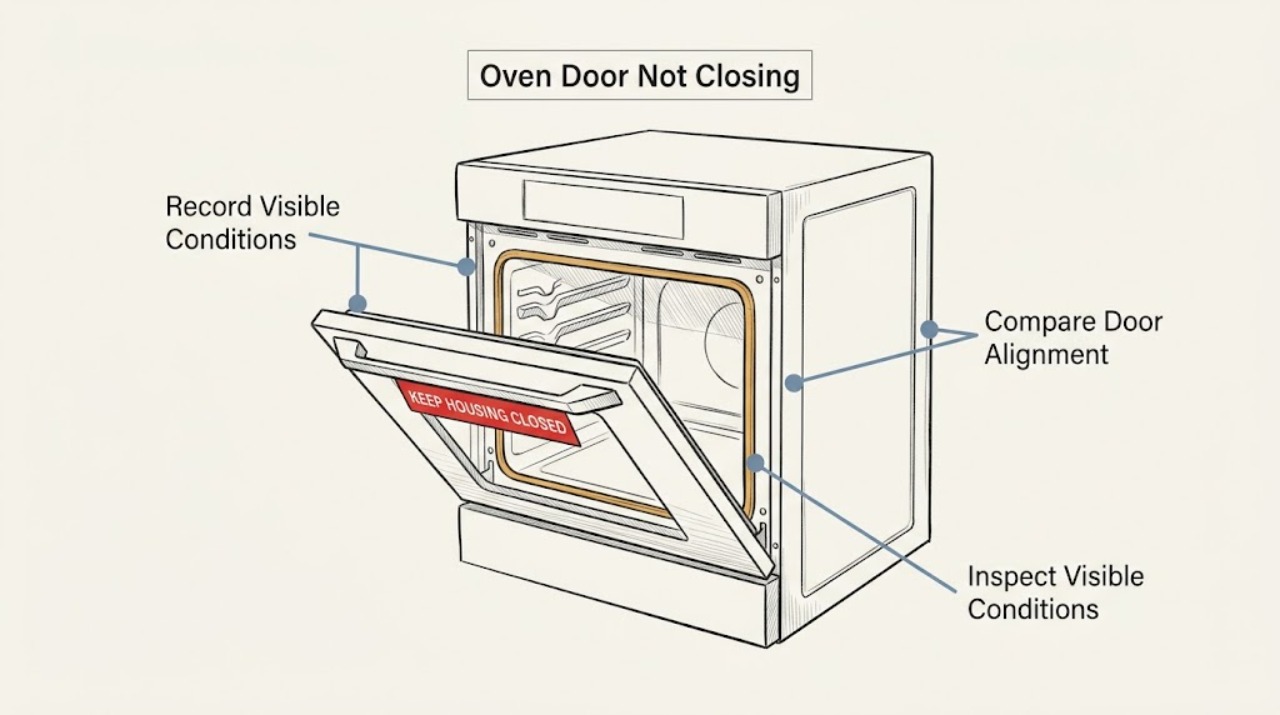
Work through in order
Diagnostic checks
Use only checks that match the exact appliance or system and its official guide.
-
Check 1
Turn the Wolf oven off, wait until the door, cavity, racks, and surrounding trim are cool, and record the model or product line, the size and location of the gap, and whether the symptom started after self-clean, rack cleaning, moving the appliance, or door work. Look from a safe position for smoke, burning odor, gas odor, arcing, damaged glass, or a hot electrical connection; do not continue a test with any of those signs.
Expected result: The door is hot or locked after cleaning, the gap is on one side, the door stops at a repeatable point, the door falls open unusually fast, or a smoke, odor, arcing, glass, or electrical warning is present.
Next step: Keep the oven off. Allow a post-clean oven to complete its normal cool-down without forcing the lock. For any safety warning, damaged glass, unstable door, or persistent gap, keep clear and arrange qualified service or emergency help as appropriate.
Why this matters
Why: Temperature and self-clean can temporarily affect access, while a repeatable gap or unstable movement points toward alignment, hinge, or sealing trouble. Smoke, odor, arcing, damaged glass, or abnormal heat is a safety event rather than a closing adjustment.
-
Check 2
With the oven cool and the door open, inspect the visible door path and hinge areas for a rack, rack guide, bakeware edge, foil, spill residue, or another object that could stop the door. Remove accessible racks and rack guides only as the exact Wolf use-and-care guide describes, then try the door movement gently without applying extra force.
Expected result: A rack or guide is not seated in its intended position, an object touches the door or hinge, or the path is clear but the door still stops at the same point.
Next step: Correct only a clearly visible rack or guide placement issue supported by the matching guide and recheck once while cool. If the path is clear or the resistance remains, stop handling the door and use the service branch.
Why this matters
Why: Wolf calls incorrect rack or rack-guide placement the primary reason for this symptom, and also directs a check for anything blocking the door path or hinge. A clear path with a repeatable stop makes a hinge or installation issue more likely.
-
Check 3
Inspect the gasket and the door perimeter visually while cool. Look for a gasket folded into the closing path, pulled out of its seat, cut, compressed unevenly, or contaminated with residue; compare the door edge to the cavity without pressing the gasket or bending the door.
Expected result: The gasket is visibly displaced or damaged, heat has been escaping around a gap, or the gasket looks normal while the door remains misaligned.
Next step: Do not select a replacement by appearance or attempt a model-uncertain gasket or hinge repair. Leave the oven unused and request service for a displaced or damaged gasket, heat leakage, or a persistent alignment problem.
Why this matters
Why: Wolf notes that gaskets vary by model and improper installation can prevent proper seating and allow heat to escape. A normal-looking gasket does not rule out a hinge or alignment fault.
-
Check 4
If the oven is clearly an M Series model and both hinge levers are visible without reaching into a hot cavity, compare their positions with Wolf's M Series door guidance. Do not guess at the hinge design, touch a spring-loaded assembly, or use this check on another Wolf product line.
Expected result: An M Series hinge lock is visibly in the locked position while the door is open, both levers match the guide's released position, or the product line cannot be confirmed.
Next step: Only when the exact M Series guidance and lever identity are certain, follow that official release direction gently once. If the door does not close immediately, a lever is damaged, or the model is uncertain, stop and arrange Factory Certified Service.
Why this matters
Why: Wolf says an M Series hinge lock can move into the locked position with the door open and prevent closing. The hinge-lock explanation is not a universal Wolf door procedure, and an uncertain model or lever position may indicate a different fault.
-
Check 5
Review the door history and installation condition from a safe standing position: note whether the door was removed, whether the oven was recently installed or moved, whether the appliance appears level, and whether the door sits evenly against the front trim. Do not move a built-in unit or attempt to alter hinge height.
Expected result: The door was recently handled, sits unevenly, the unit appears out of level, the door drops open too quickly, or no installation change is evident but the gap persists.
Next step: Do not make an alignment or hinge adjustment. Give service the model, door history, gap location, and level or movement observations so a qualified technician can inspect the installation and door system.
Why this matters
Why: Wolf directs users to verify that a removed door is properly installed and that the unit is level, but recommends a service technician for door adjustments. A door that falls open too fast may have a damaged spring or damper system.
-
Check 6
If the door was locked after self-clean, confirm that the oven is off and allow the complete model-specified cool-down. If an error or lock message remains after cool-down, record the exact message and use at most one reset only when the matching Wolf guide authorizes it and the area is dry and free of other hazards.
Expected result: The lock releases after normal cooling, the door remains locked, a message returns, or the oven has no lock message and still will not close.
Next step: Use the oven only if the door closes and seals normally. Otherwise leave it off and arrange service; do not pry the door, bypass the latch, repeat resets, or operate through a gap.
Why this matters
Why: Wolf explains that a door may remain locked until self-clean cool-down completes. A persistent lock, error, or mechanical closing fault needs model-specific diagnosis rather than repeated resets or force.
Use your observations
Decision map
Find the observation that best matches what you see, then follow the next safe action.
-
PATH 01Next step
What you see
A rack, rack guide, bakeware edge, or residue visibly blocks the door path or hinge.
Do this next
With the oven cool, correct only the accessible placement shown in the exact guide and recheck once. If resistance remains, stop and arrange service.
Why this path and its safety boundary
Why it matters: Wolf identifies rack and rack-guide placement and path obstructions as common closing causes.
-
PATH 02Next step
What you see
The exact product is an M Series oven and a hinge lock is visibly engaged with the door open.
Do this next
Follow Wolf's M Series release direction only when the model and lever are certain. If it does not resolve the issue immediately, use Factory Certified Service.
Why this path and its safety boundary
Why it matters: An M Series hinge lock can prevent the door from closing when left in the locked position.
-
PATH 03Next step
What you see
The door was removed or the oven was recently installed, moved, or adjusted, and the gap or uneven fit began afterward.
Do this next
Do not guess at hinge or door installation. Keep the oven out of use and arrange qualified service with the model and recent work details.
Why this path and its safety boundary
Why it matters: Door installation or alignment may be incorrect; Wolf recommends technician-led adjustment to protect the gasket seal.
-
PATH 04Next step
What you see
The gasket is damaged, displaced, badly folded, or heat escapes around a door that does not seat.
Do this next
Stop using the oven and request service. Do not fit a gasket by appearance or continue cooking through a persistent gap.
Why this path and its safety boundary
Why it matters: A model-specific gasket or its installation can affect door seating and heat containment.
-
PATH 05Next step
What you see
The door is locked after self-clean but the oven is still hot or cooling is incomplete.
Do this next
Turn the oven off and wait for normal cooling. Never force the door; request service if it remains locked afterward or shows an error.
Why this path and its safety boundary
Why it matters: Wolf states that the lock may remain engaged until the self-clean cool-down completes.
-
PATH 06Next step
What you see
The door falls open too fast, the hinge or glass is damaged, the oven cannot seal, or smoke, burning odor, gas odor, arcing, or repeated breaker trips occur.
Do this next
Stop immediately, keep clear, and arrange qualified appliance, gas, electrical, or emergency help as appropriate. Do not operate or retest the oven.
Why this path and its safety boundary
Why it matters: The door system or appliance may present an injury, fire, gas, or electrical hazard that cannot be safely diagnosed by a closing check.
Helpful context
Understand the symptom
Start with the symptom and the model
Record the Wolf model or product line, whether the door is fully open or only slightly ajar, where the gap appears, and whether the problem began after cleaning, moving a rack, or door work. A door that stops against an object is a different path from a door that sits high on one side, falls open too quickly, or remains locked after self-clean. Wolf door operation and controls vary by product line, so use the matching use-and-care guide for any model-specific step.
Do only cool, external checks
Let the oven cool fully and keep it off before looking along the door edge, rack guides, hinge area, and gasket. Remove only accessible racks or guides as the exact guide permits, and never force a door through resistance. Do not attempt hinge adjustment, door removal, cabinet work, or gasket replacement unless the matching Wolf documentation explicitly authorizes that task; Wolf generally directs alignment and gasket work to a service technician.
A visible gap is a safety boundary
Do not use the oven with a door that cannot seal, a door that drops open, damaged glass, a loose hinge, or a gasket that is pulled out or badly folded. An unsealed door can let heat escape and may affect cooking or surrounding surfaces. If the door is hot, unstable, locked after a cleaning cycle, or accompanied by smoke, burning odor, gas odor, arcing, or a hot electrical connection, stop and arrange the appropriate qualified help.
Safety boundary
Stop conditions
- Stop using the oven for damaged glass, a bent or loose hinge, a door that drops open, a persistent gap, heat escaping, smoke, burning odor, gas odor, arcing, a hot electrical connection, or repeated breaker trips.
- Do not force, pry, slam, or hold the door shut; do not bypass a latch or hinge lock, reach into a hot cavity, or handle a spring-loaded hinge assembly.
- Do not remove or reinstall the door, adjust alignment, move a built-in appliance, or replace a gasket by guesswork. Follow only the exact Wolf guide or arrange service.
- After self-clean, wait for the normal cool-down and never force a locked door. Do not keep operating through a door that will not close and seal.
Only after diagnosis
Potential parts
- door hinge or hinge-lock assembly
Consider this only after service diagnosis confirms a hinge, hinge-lock, or spring or damper fault causing the closing symptom.
Wolf hinge systems vary by product line and model. Confirm the exact model and qualified diagnosis before selecting a component. - oven door gasket
Consider this only when the exact model documentation or a qualified inspection confirms a damaged or improperly seated gasket.
Wolf states that gaskets vary by model, and installation affects seating and heat containment. Do not choose one by appearance alone. - rack guide or oven rack
Consider this only when the exact model guide confirms a bent or missing rack or guide is preventing correct door clearance.
Rack and guide designs differ across Wolf product lines. Confirm the model and the obstruction before replacing anything.
When checks do not resolve it
Need a professional?
Request qualified Wolf appliance service for a persistent closing gap, hinge or latch issue, uneven alignment, a door or gasket installation concern, a returning lock message, or a door that moves abnormally.
Safety scope: Keep the oven off for damaged glass, an unstable door, severe heat leakage, smoke, burning or gas odor, arcing, a hot electrical connection, or repeated breaker trips. Do not force the door, bypass an interlock, or open the appliance cabinet.
Common questions
FAQ
Why will my Wolf oven door not close after cleaning?
Let the oven cool, then check that racks and rack guides are correctly placed and that nothing blocks the door path or hinge. Wolf also lists a hinge or door-installation issue as a cause. If the gap persists, keep the oven off and arrange service rather than forcing the door.
Can a Wolf M Series hinge lock keep the door from closing?
Yes. Wolf says an M Series hinge lock can engage while the door is open and prevent closing. Use the official M Series guidance only when the product line and lever are certain; if the door still will not close, use Factory Certified Service.
Should I adjust a Wolf oven door that is sitting unevenly?
No. Wolf recommends a service technician for door adjustments because incorrect alignment can keep the gasket from sealing. You may check for a visible obstruction, confirm rack placement, and note whether the unit appears level, but do not alter the hinge or move a built-in unit.
Can I replace a Wolf oven gasket myself?
Do not choose or install a gasket without the exact model guidance. Wolf states that gaskets vary by model and that improper installation can affect seating and allow heat to escape; arrange service when the gasket is damaged or displaced.
What should I do if the Wolf oven door is locked after self-clean?
Turn the oven off and allow the normal cool-down to complete. Never force the door. If it remains locked, shows an error, or will not operate normally afterward, leave it off and arrange service.
Read the exact guide
Official sources
- Wolf Oven Door Height AdjustmentSub-Zero, Wolf, and Cove · Wolf ranges and wall ovens listed by the official FAQ; exact installation guidance is model-specific.
- M Series Oven Door Will Not CloseSub-Zero, Wolf, and Cove · Wolf M Series ovens only; do not generalize this hinge-lock procedure to other product lines.
- Wolf Oven Door Gasket ReplacementSub-Zero, Wolf, and Cove · Wolf oven gaskets; mounting and replacement options differ by model and product type.
- Wolf Oven Door Does Not CloseSub-Zero, Wolf, and Cove · Wolf official FAQ; product line and model details can differ.
- Wolf Oven Door Will Not UnlockSub-Zero, Wolf, and Cove · Wolf Dual Fuel, L Series, M Series, and E Series products named by the official FAQ; controls vary by model.
- Oven Door Opening OperationSub-Zero, Wolf, and Cove · Wolf product lines described by the official FAQ; opening behavior varies by line and serial range.
Community feedback
Share a repair observation
Share a plain-text repair observation. Accepted observations are published automatically; this page may take a moment to update.