
On this page
Start here
Quick answer
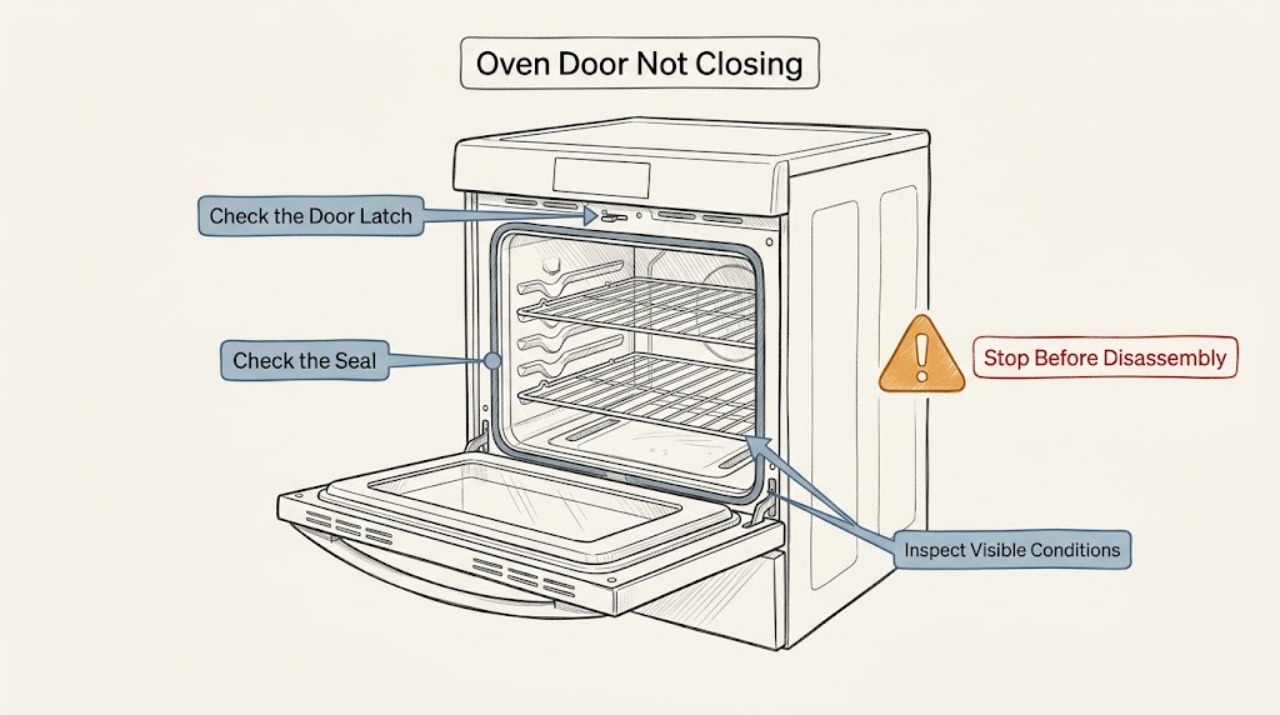
Let a hot GE oven cool before inspecting the door, then remove any pan, rack, foil, or debris that could obstruct the opening. Check that racks are oriented correctly and that a movable oven floor has not shifted forward on models with a hidden bake element. Inspect the gasket, door glass, hinges, and latch for visible damage or misalignment. A small amount of heat or air movement around a closed oven door can be normal, but scorching, smoke stains, a door that sits crooked, or a broken hinge is not. Never force the latch, remove spring-loaded hinges, or operate the oven when the door cannot close safely; arrange qualified appliance service.
Work through in order
Diagnostic checks
Use only checks that match the exact appliance or system and its official guide.
-
Check 1
Turn the oven controls off and let the oven cool completely before touching the door, racks, gasket, or latch; keep children away from the opening while it is hot.
Expected result: If the door begins to move normally only after cooling, heat or a self-clean lock state may have been preventing the expected movement. If it remains jammed or crooked while cool, continue with obstruction and hardware checks.
Next step: Do not test the latch or bend the door while hot. If the door cannot close freely after cooling, leave the oven unused and inspect only the accessible cavity and door surfaces.
Why this matters
Why: GE notes that a warm oven may not release or accept a latch, and a self-cleaning oven can retain heat for a prolonged period. A hot door or latch must not be forced.
-
Check 2
With the oven cool, remove loose cookware and racks one at a time and inspect the opening, rack guides, door edge, and oven floor for a pan, foil, spill, or rack positioned in a way that prevents full closure.
Expected result: The door should close farther with the obstruction removed. If a rack is reversed or an oven floor has slid forward, the door may stop at the same point even though the hinges and gasket look intact.
Next step: Reposition only a clearly loose rack or floor piece according to the owner's manual. Do not pry the floor, remove a hidden element, or force the door against an obstruction.
Why this matters
Why: GE identifies incorrectly positioned racks as a cause of poor sealing and says some models with a hidden bake element can have an oven floor that moves forward and blocks the door.
-
Check 3
Inspect the gasket around the oven opening and the mating door surface after cooling; look for tears, pulled-out sections, hard or flattened areas, grease buildup, or a seal that is folded out of its channel.
Expected result: A torn or displaced gasket can create heat leakage and prevent even closure; a clean, continuous gasket with no contact marks makes the hinge, rack, floor, or latch path more likely.
Next step: Clean only accessible residue with the method in the owner's manual and do not glue, cut, or stretch the gasket. Arrange model-specific service if it is damaged or the door remains uneven.
Why this matters
Why: GE says a damaged or worn gasket can cause major heat leakage and recommends service when the gasket does not seal properly. A new gasket can also feel stiff before it settles, but it should not require force to close the door.
-
Check 4
View the hinges, hinge receivers, door corners, and frame from the side without removing hardware; compare both sides for a hinge that is bent, displaced, or no longer seated evenly.
Expected result: A door that sits crooked, binds on one side, or has a visibly damaged hinge indicates a mechanical alignment problem rather than a simple gasket issue.
Next step: Keep the oven cool and unused, support the door only by its normal handle, and do not remove hinges or attempt to reset spring hardware. Call a qualified appliance technician.
Why this matters
Why: GE identifies a broken or misaligned hinge as a cause of major door leakage and recommends service. Oven hinges can be spring-loaded and may move suddenly when the door is disturbed.
-
Check 5
If the problem is only that the door will not latch for self-clean, confirm the oven is cool and that the latch path is free; do not try to latch the door during an ordinary cooking function.
Expected result: A latch that moves normally after cooling and with a free door path suggests a temperature or control state; a latch that is stuck, bent, or blocked while cool indicates a service fault.
Next step: Follow the exact model manual for a latch state. Never force or pry the latch; stop and arrange service if it does not release or the door cannot close freely.
Why this matters
Why: GE says the oven door should be latched only for self-clean, and a warm oven may prevent locking. Electronic models may show a door message instead of using a visible latch.
-
Check 6
After the accessible checks, close the cool empty oven gently and observe the seal around the perimeter without starting a heating or self-clean cycle.
Expected result: An even closed door with a continuous gasket contact supports an obstruction or temporary latch issue; a persistent gap, visible light path, scorching, smoke staining, or door movement shows that the fault remains.
Next step: Do not operate the oven if the door cannot close safely or the face becomes scorched. Record the model information and arrange qualified service for a repeat or unresolved problem.
Why this matters
Why: GE notes that some airflow and a small amount of door movement can be normal, but major heat leaks, smoke stains, worn gaskets, and hinge problems require service.
Use your observations
Decision map
Find the observation that best matches what you see, then follow the next safe action.
-
PATH 01Next step
What you see
The oven is still hot, the latch is engaged, or the problem began during or after self-clean.
Do this next
Turn the controls off and wait for the oven to cool. Do not force the latch; use the exact model manual or call service if it remains locked or the door cannot close freely.
-
PATH 02Next step
What you see
A pan, rack, foil, spill, or shifted oven floor blocks the door.
Do this next
Remove or reposition only the clearly accessible obstruction using the owner's manual. Do not pry the floor or run the oven against a blocked door.
-
PATH 03Next step
What you see
The gasket is torn, displaced, flattened, or unable to contact the door evenly.
Do this next
Leave the oven unused until the model-specific gasket or door repair is completed; do not glue, cut, or stretch the seal as a workaround.
-
PATH 04Next step
What you see
The door is crooked, a hinge is bent or misaligned, or the door binds on one side while cool.
Do this next
Stop handling the hinge and arrange qualified appliance service. Do not remove spring-loaded hinges or attempt to realign the door by force.
-
PATH 05Next step
What you see
The oven face has scorching or smoke stains, the door opens unexpectedly, or the door still will not close safely after the accessible checks.
Do this next
Stop using the oven, keep it cool, and obtain qualified service before another heating or self-clean cycle.
Helpful context
Understand the symptom
A GE oven door that will not close may be blocked by the cooking cavity, out of position after installation, held by a latch, or physically misaligned. Start with the oven completely cool and the controls off. The door should close freely without force; do not use the self-clean cycle as a workaround for a door that cannot close safely.
Some heat and airflow around a closed oven door are expected during cooking, so a visible gap is not automatically a failed seal. Scorching, smoke staining, a damaged gasket, or an uneven door changes the situation to a service repair.
Safety boundary
Stop conditions
- Stop immediately if the oven or door is hot enough to burn, the latch is stuck, or the door moves unexpectedly; do not force it.
- Stop if the door, hinge, frame, glass, gasket, or oven floor is bent, cracked, loose, or visibly damaged.
- Do not remove spring-loaded hinges, pry the latch, dismantle the door, bypass a door lock, or start cooking or self-clean while the door cannot close safely.
- Stop and arrange qualified appliance service for scorching, smoke stains, a persistent gap, repeated latch failure, or any repair requiring internal wiring or hinge hardware access.
Only after diagnosis
Potential parts
- oven door gasket
Consider this only when the exact model's gasket is torn, displaced, flattened, or confirmed unable to seal after accessible inspection.
Confirm the exact GE model and manufacturer fit information before ordering or installing a gasket. - oven door hinge
Consider this only after qualified diagnosis confirms a bent, broken, or misaligned hinge; a door gap alone does not identify the failed part.
Door hinges and spring hardware vary by model and should be handled according to the manufacturer's service procedure. - oven door latch assembly
Consider this only when the exact model uses a latch and diagnosis confirms it remains stuck or fails to operate after the oven is cool and the door path is clear.
Confirm the model-specific latch design and fit information before ordering; do not bypass the lock.
When checks do not resolve it
Need a professional?
Call a qualified GE appliance technician when the cool door still will not close after removing accessible obstructions, when the gasket or hinge is damaged or misaligned, when the latch remains stuck, or when the oven face shows scorching or smoke stains. Do not operate the oven until a door that cannot close safely is repaired.
Common questions
FAQ
Why will my GE oven door not close all the way?
Start with cooling the oven and removing racks, pans, foil, or debris. Then check rack orientation, a shifted oven floor on applicable models, the gasket, hinges, and latch. A crooked door, damaged hinge, scorching, or a persistent gap needs service.
Is a small gap or some heat around a GE oven door normal?
GE says some airflow and heat around an operating oven door can be normal. It is not normal when the door cannot close freely, heat leakage causes scorching or smoke stains, the gasket is damaged, or the door is crooked.
Can I remove the GE oven door to fix the hinges?
Treat hinge removal and door realignment as service work because hinges may be spring-loaded and can move unexpectedly. Do not remove or force the hardware as a routine check; arrange qualified appliance service.
Read the exact guide
Official sources
- Range & Wall Oven - Oven Temperature Is Not CorrectGE Appliances · GE oven rack placement, heat loss, gasket inspection, and service boundary
- New Range or Wall Oven Door Doesn’t Seal ProperlyGE Appliances · GE new-installation door sealing, gasket settling, and shifted oven-floor obstruction
- Range - Oven Door Will Not LatchGE Appliances · GE oven door latch behavior, self-clean state, and cool-down boundary
- Range & Wall Oven - Oven Gasket Not Sealing ProperlyGE Appliances · GE range and wall-oven door gasket, hinge, and seal behavior
Community feedback
Share a repair observation
Share a plain-text repair observation. Accepted observations are published automatically; this page may take a moment to update.