
On this page
Start here
Quick answer
Turn the Amana oven off and let it cool, then remove anything blocking the door. Check the rack or bakeware, the latch arm and gasket area, and the hinge seating; a bent latch, damaged hinge, broken glass, or door that stays crooked needs professional service rather than force.
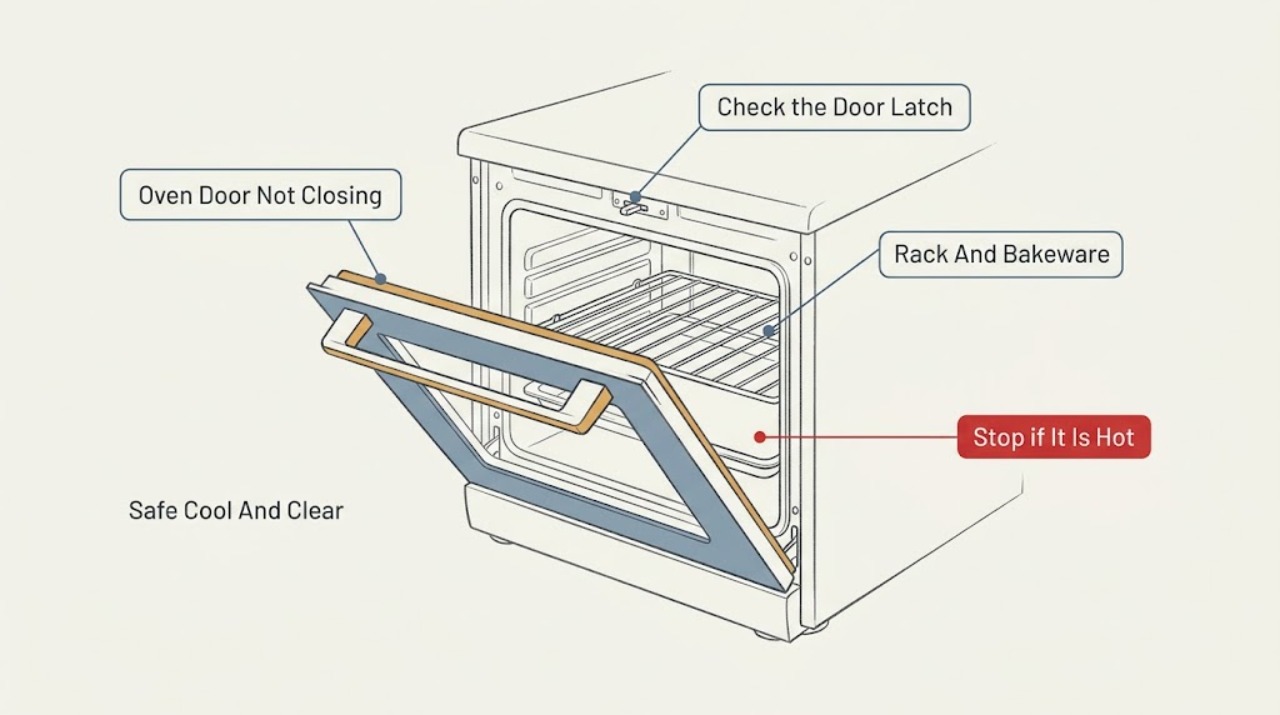
Work through in order
Diagnostic checks
Use only checks that match the exact appliance or system and its official guide.
-
Check 1
Turn the oven off, wait until the cavity and door are cool, and remove pans, dishes, loose packing material, and anything resting against the door.
Expected result: The door closes normally once the cavity is empty, or it still stops at the same point.
Next step: If it still stops, leave the door unforced and continue with the rack and hardware checks.
Stop if: Stop immediately if the door or glass is hot enough to burn, cracked, or falling away from the oven.
Why this matters
Why: A normal closure after clearing identifies a physical obstruction; a repeated stop points to the rack, latch, hinges, gasket, or alignment.
-
Check 2
With the oven cool, slide each rack fully into its guides and check whether a rack, rollout shelf, roasting pan, or oversized dish projects into the door path.
Expected result: The rack is not fully seated, the rollout shelf is not on its guides, or the cookware touches the door; alternatively, the racks and cookware clear the opening.
Next step: Reseat the rack or use correctly sized cookware; if the hardware is clear, inspect the latch and gasket area.
Stop if: Do not force a rack or shelf past a bent guide, and stop if cookware is wedged against the glass.
Why this matters
Why: A rack or dish in the door path can hold the door open even when the hinges are sound. Amana also advises leaving room around bakeware for airflow.
-
Check 3
Open the cool door and inspect the top front of the oven frame above the gasket, the latch arm, and the sealing area for a bent latch, food or soil buildup, or a gasket folded into the opening.
Expected result: The latch arm is bowed up or down, or debris is preventing the door from reaching the frame; otherwise the latch and sealing area look aligned.
Next step: Remove only loose surface debris with the oven cool. If the latch is bent or the door still will not close, stop and arrange model-specific service.
Stop if: Do not bend, pry, or force the latch, and stop if the gasket, glass, or frame is torn or deformed.
Why this matters
Why: A bent lock-latch arm can physically prevent closure, while buildup can block the seal. Appearance alone cannot prove that a latch or hinge is mechanically sound.
-
Check 4
If the door was removed for cleaning or transport, compare both hinge positions with the model instructions and check that each hinge is fully seated in its cavity slot before closing the door.
Expected result: One side has a visible gap or the door sits low, crooked, or does not open to its normal position; or both hinges are seated evenly.
Next step: Only if the door is cool, stable, and you can safely follow the exact model procedure, reseat the door using two hands; otherwise have a technician do it.
Stop if: Stop if a hinge is under spring tension, the door is heavy or unstable, or the hinge cannot be seated without force.
Why this matters
Why: An incompletely seated or unlocked hinge can leave the door misaligned. Amana says a properly installed door has an even gap, and a low side indicates that hinge is not properly installed.
-
Check 5
With the door closed only as far as it moves freely, view the gap along both sides and the top; for a freestanding range, also check whether the appliance rocks or is visibly out of level.
Expected result: The gap is even and the appliance is stable, or one side hangs lower, a notch or space is visible at a hinge, or the range is not level.
Next step: Use the model's installation guidance for a stable range check. If the door remains crooked or the hinge notch is visible, schedule service instead of adjusting the door by force.
Stop if: Do not move a gas or electric range, defeat an anti-tip device, or adjust a loaded or unstable appliance during this check.
Why this matters
Why: An uneven gap or visible hinge notch supports an installation or alignment issue rather than a simple obstruction. A range that is not level can also affect door fit.
-
Check 6
After the low-risk checks, record whether the door is blocked, crooked, latch-bound, or simply fails to seal, and note whether the problem began after cleaning, moving, or a self-clean cycle.
Expected result: The same failure remains with an empty, cool oven and no visible obstruction or mis-seated hinge.
Next step: Stop using the oven if the door cannot close and arrange appliance service with the full model number and the observed symptom.
Stop if: Stop now for broken glass, a door that will not stay attached, exposed sharp metal, overheating, smoke, or a gas odor.
Why this matters
Why: A persistent failure without an obvious external cause can involve a worn hinge, latch assembly, frame, or gasket and cannot be diagnosed safely from appearance alone.
Use your observations
Decision map
Find the observation that best matches what you see, then follow the next safe action.
-
PATH 01Next step
What you see
The door closes after pans, packing, or other items are removed.
Do this next
Use a correctly sized dish and fully seat the rack before the next use.
Why this path and its safety boundary
Why it matters: The obstruction was the immediate cause.
-
PATH 02Next step
What you see
A rack, rollout shelf, or bakeware still projects into the opening.
Do this next
Reseat the rack or remove the oversized item; do not push against the glass to make it fit.
Why this path and its safety boundary
Why it matters: The rack or cookware is keeping the door open.
-
PATH 03Next step
What you see
The latch arm is visibly bowed, blocked, or damaged.
Do this next
Do not bend the latch. Keep the oven out of service and arrange a technician assessment.
Why this path and its safety boundary
Why it matters: The latch path is preventing the door from closing.
-
PATH 04Next step
What you see
The issue began after the door was removed, and one side hangs lower or shows a gap.
Do this next
Follow the exact model door-replacement procedure only if the assembly is stable; otherwise request service.
Why this path and its safety boundary
Why it matters: A hinge may not be fully seated or locked.
-
PATH 05Next step
What you see
The oven is empty and cool, but the door remains crooked or will not close without force.
Do this next
Stop using the oven and provide the model number and symptom history to an appliance technician.
Why this path and its safety boundary
Why it matters: The problem is beyond a simple user obstruction check.
-
PATH 06Next step
What you see
Glass is broken, the door is falling, there is smoke or overheating, or a gas odor is present.
Do this next
Stop, keep people away from the appliance, and use the appropriate emergency or qualified service channel; do not operate the oven.
Why this path and its safety boundary
Why it matters: There is an immediate safety boundary.
Helpful context
Understand the symptom
What the symptom usually means
The door needs a clear path and correctly seated hardware to close. Amana's door guidance separates simple blockage checks from latch inspection, door reinstallation, and range leveling, so the visible gap and the timing of the problem help choose the next check.
Keep the check low risk
Work only with the oven off and cool enough to touch. Look and clean around the door without bending the latch or prying on the hinges. A door assembly is heavy and spring-loaded; if it is loose, damaged, or unsafe to handle, stop and arrange service.
When a normal adjustment is not enough
If removing an obstruction does not restore an even closure, or the door is lower on one side, the cause may be hinge seating, a latch problem, or damage that requires model-specific repair. Do not keep forcing the handle to make the seal meet.
Safety boundary
Stop conditions
- Do not operate the oven with broken glass, an unstable door, or exposed sharp metal.
- Do not bend, pry, or force the latch, hinge, rack, or door to make it close.
- Do not move or adjust an unstable range or defeat its anti-tip protection while troubleshooting.
Only after diagnosis
Potential parts
- oven door gasket
Consider this only if the gasket is visibly torn, displaced, or compressed after the door hardware and obstructions have been checked.
Confirm the complete oven model and the manufacturer's fit information before selecting a replacement. - oven door hinge or latch assembly
Consider these parts only when the door remains crooked or the latch is damaged after correct seating and a technician's diagnosis.
Hinge and latch designs vary by model; verify the exact model-specific part information before ordering.
When checks do not resolve it
Need a professional?
Call a qualified appliance technician if the latch or hinge is bent, damaged, or cannot be seated without force., Arrange service if the oven door remains crooked, will not seal, or still will not close with the oven empty and cool., Stop using the appliance and seek urgent qualified help for broken glass, a falling door, smoke, overheating, or a gas odor.
Common questions
FAQ
Why will my Amana oven door not close all the way?
Common checks include an item blocking the latch, a rack or oversized dish in the door path, food buildup, a bent latch arm, or a hinge that is not fully seated after the door was removed.
Can an oven rack keep the door from closing?
Yes. Amana advises checking that racks and rollout shelves are fully inserted and that bakeware is not too large for the cavity or touching the door.
What if the door became crooked after cleaning?
A hinge may not be fully seated or locked. A correctly installed door should have an even gap; if one side hangs lower, stop forcing it and follow the exact model procedure or arrange service.
Should I bend the latch back into place?
No. A visibly bowed or damaged latch should not be pried or bent by the user; keep the oven out of service and have the hardware assessed.
When should I stop troubleshooting?
Stop for hot or broken glass, an unstable or detached door, smoke, overheating, a gas odor, or any hinge or latch that needs force. Arrange qualified appliance service for a persistent closure failure.
Read the exact guide
Official sources
- Oven Door is Not Closing - Checking the LatchAmana Product Help · Amana oven and range door latch alignment
- How to Determine if the Rack is Keeping the Oven Door OpenAmana Product Help · Amana oven and range rack, rollout shelf, and bakeware clearance
- Door Not Closing - RangeAmana Product Help · Amana range door obstructions, removed doors, and leveling
- Removing and Replacing the Oven DoorAmana Product Help · Amana oven door hinge seating and replacement
- Oven Door Not Aligned - RangeAmana Product Help · Amana range oven door alignment and hinge notch
Community feedback
Share a repair observation
Share a plain-text repair observation. Accepted observations are published automatically; this page may take a moment to update.