
On this page
Start here
Quick answer
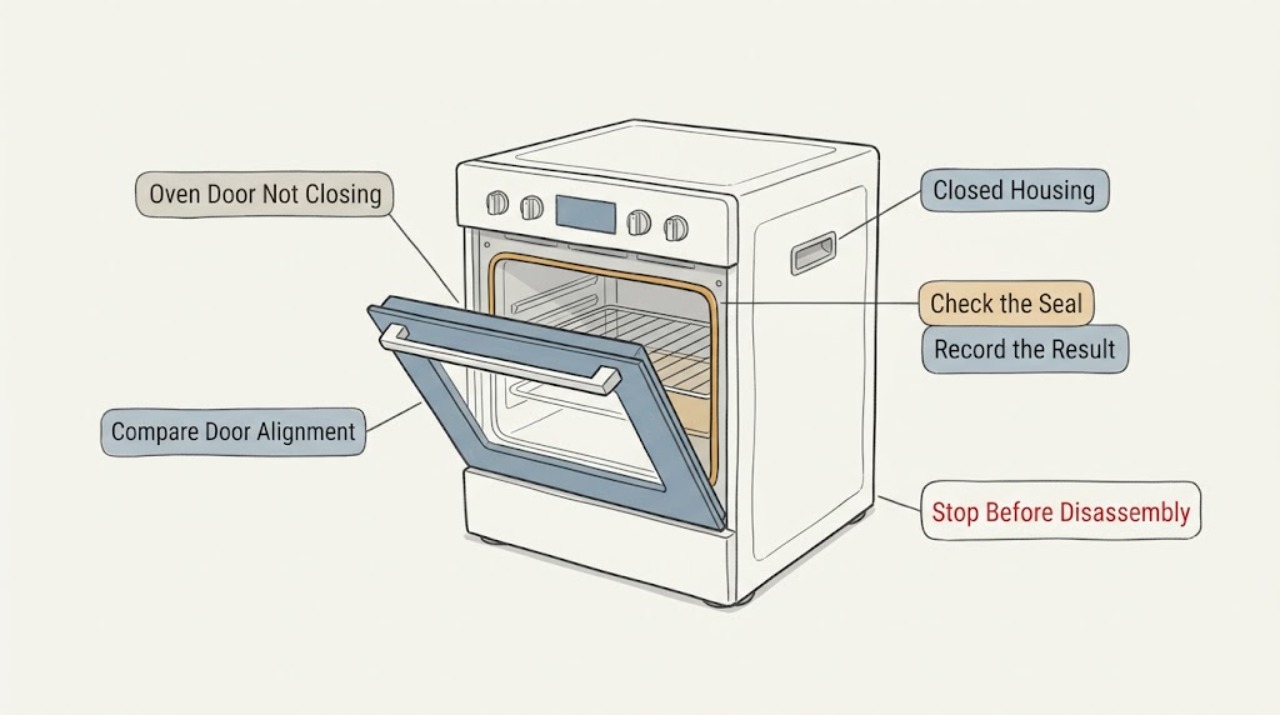
A Hotpoint oven door that suddenly will not close is most often blocked by a rack, grill pan, bakeware, food residue, or the door seal. With the oven cool, remove anything that projects into the opening and check that the racks are fully seated. Then inspect the door edges, gasket, hinges, and latch from the outside for an obstruction, bent alignment, or a visibly damaged part. Do not force the door, remove a hinge, or run the oven with a door that cannot stay closed. If the glass is cracked, the door drops or will not hold itself shut, there is a gas smell, smoke, overheating, or an electrical fault, stop using the oven and arrange qualified service.
Work through in order
Diagnostic checks
Use only checks that match the exact appliance or system and its official guide.
-
Check 1
Stop and leave the oven out of use if the door glass is cracked or loose, the door cannot support itself, the hinge is visibly bent, there is smoke, a gas smell, an electrical odor, arcing, abnormal heat, or a breaker trip. If safe and accessible, switch the appliance off without touching damaged parts.
Expected result: The door or glass is damaged, the appliance is producing smoke or an unusual odor, or the electrical supply is repeatedly operating.
Next step: Do not test the oven again. Arrange qualified appliance service; use local emergency procedures for an active fire or gas hazard.
Why this matters
Why: A damaged or unstable door can expose hot surfaces and can prevent the oven from operating safely; odor, smoke, arcing, or repeated trips may indicate a separate hazard.
-
Check 2
With the oven fully cool, remove the rack, grill pan, bakeware, foil, liners, and any loose item from the cavity. Look along the sill, side rails, door frame, and the space behind the seal for food, hardened soil, packaging, or an accessory projecting into the door path.
Expected result: The door closes normally when the cavity is empty, or a rack, pan, residue, or accessory remains in its path.
Next step: Clean the cool contact area with a soft damp cloth, reseat the rack fully, and retest gently. Do not use the oven until the door closes evenly without pressure.
Why this matters
Why: The door is being held open by an obstruction or a rack/accessory that is not seated in its intended position, rather than by a failed hinge.
-
Check 3
Inspect the door gasket and the matching oven frame without pulling the seal out. Check for a section folded inward, detached, hardened, contaminated, or sitting outside its channel; compare the gap around the door while it is gently resting against the frame.
Expected result: The seal is displaced or damaged, or the door contacts one section of the frame before the rest.
Next step: Clean only accessible residue and consult the model manual or service for seal replacement/alignment. Do not glue, cut, or stretch the gasket and do not operate with a damaged seal.
Why this matters
Why: A displaced seal can physically prevent closure or create an uneven fit. A persistent uneven gap can also indicate hinge or door-frame alignment rather than a seal alone.
-
Check 4
From the side, observe the door as it moves through its normal range without forcing it. Look for one side sitting lower, a door that rubs the frame, a hinge arm that does not move symmetrically, or a latch/catch that is visibly bent or left in the wrong position.
Expected result: The door is skewed, drops, rubs, springs back, or the catch/latch does not line up with the frame opening.
Next step: Stop the mechanical inspection and use the exact Hotpoint manual or qualified service. Do not straighten, lubricate, remove, or restrain the hinge or latch yourself.
Why this matters
Why: The movement is consistent with a hinge, hinge support, latch, or door alignment problem. These components can be model-specific and may be spring-loaded.
-
Check 5
Check the appliance's visible installation position and surrounding cabinet or range body. Look for a recent move, impact, cabinet interference, or a unit that is visibly tilted; confirm that the door is not being pushed sideways by adjacent trim or a drawer.
Expected result: The oven body is not sitting square, the door gap changes when the unit is moved, or surrounding trim is contacting the door.
Next step: Do not pull out a built-in oven or disturb anti-tip or gas/electrical connections. Have installation alignment checked by a qualified technician.
Why this matters
Why: A shifted or tilted installation can change the hinge geometry and prevent a previously normal door from meeting the latch evenly.
-
Check 6
Identify the model or commercial code from the appliance label and use Hotpoint's manual/support path to check the door and self-clean instructions. If the door is locked or the display indicates a cleaning cycle, wait for the oven to cool and follow only the model-specific release procedure.
Expected result: The door problem began after cleaning, removal, an installation change, or a lock cycle, or the manual shows a different hinge/latch arrangement from the one observed.
Next step: Follow the exact manual or provide the model and observed state to Hotpoint service. If the manual does not resolve the condition, stop using the oven.
Why this matters
Why: A model-specific door-lock or reinstallation state can look like a mechanical obstruction; a generic procedure may damage the hinges or lock.
Use your observations
Decision map
Find the observation that best matches what you see, then follow the next safe action.
-
PATH 01Next step
What you see
The door closes when the cavity is empty but not with a rack, pan, or accessory installed.
Do this next
Reseat the rack fully and use cookware that leaves clearance from the door. Remove any loose liner or foil; do not run the oven until the door closes freely.
-
PATH 02Next step
What you see
Food soil or a displaced gasket is visible around the contact area.
Do this next
Let the appliance cool, clean gently, and leave an intact seal in its channel. A torn, detached, or repeatedly displaced seal requires model-specific service.
-
PATH 03Next step
What you see
The door is low on one side, rubs, will not stay shut, or the hinge/catch is visibly bent.
Do this next
Do not force the door or work on a spring-loaded hinge. Stop using the oven and arrange a qualified technician to identify the correct hinge, support, or latch for the model.
-
PATH 04Next step
What you see
The door is affected only during or after a self-cleaning/lock state, or the display indicates a locked cycle.
Do this next
Allow the oven to cool and use the exact model manual's lock procedure. Never pry or force the latch; request service if it remains locked or the door cannot align.
-
PATH 05Next step
What you see
A recent move or installation change left the body tilted or surrounding trim touching the door.
Do this next
Do not pull out the appliance or disturb its connections. Have the installation and leveling checked by a qualified technician.
-
PATH 06Next step
What you see
Glass is damaged, the door is unstable, there is a gas smell, smoke, burning/electrical odor, arcing, overheating, or a repeated breaker trip.
Do this next
Stop immediately, keep the oven out of use, and obtain qualified service or emergency assistance appropriate to the active hazard.
Helpful context
Understand the symptom
Treat the symptom as a door-fit problem first, not as proof that a hinge or latch needs replacement. An item inside the cavity can hold the door open, while a door that sits low, twists, or springs back points toward hinge alignment, the latch, the seal, or the oven's level. The exact hinge and catch arrangement varies by Hotpoint model, so external observations should decide whether a manual lookup or service call is needed.
Let the oven cool before inspecting it. Use only gentle cleaning and visual checks. Do not pry the latch, force the door against resistance, remove the door, or reach into a hinge under spring tension unless the exact model manual explicitly provides a safe procedure for a qualified person.
Safety boundary
Stop conditions
- Stop immediately for cracked or loose door glass, a door that drops or cannot remain closed, smoke, a gas smell, burning or electrical odor, arcing, abnormal heat, or a repeated breaker trip.
- Do not force the door, pry the latch, remove a hinge, pull out a built-in oven, or work on a spring-loaded hinge or live connection.
- Do not operate the oven with a door that remains open, has an uneven unsafe gap, or has a torn or displaced seal.
Only after diagnosis
Potential parts
- oven door hinge or hinge support
Only relevant after a qualified inspection finds a bent, worn, displaced, or improperly seated hinge is causing the door to sit low or fail to meet the frame.
Hotpoint lists multiple oven-door hinge designs; confirm the exact model or commercial code and the manufacturer's fit information before any part decision. - oven door latch or catch
Only relevant when the door path and hinges are aligned but the latch or catch is visibly damaged or cannot engage normally.
Do not substitute by appearance; verify the exact model and have a qualified technician handle spring-loaded or locking components. - oven door seal or gasket
Only relevant when the gasket is torn, detached, hardened, or displaced after the door frame and hinge alignment have been checked.
Seal profiles vary by model; confirm the exact appliance documentation and installation method before replacement.
When checks do not resolve it
Need a professional?
Call qualified appliance service when the door remains misaligned after the cool-cavity and obstruction checks, or when a hinge, catch, lock, or seal is visibly damaged., Use the exact model manual or Hotpoint support when the door was recently removed, the oven is locked after a cleaning cycle, or the installation has shifted., Use urgent local safety or emergency assistance for an active fire, smoke event, or suspected gas leak; do not continue troubleshooting.
Have this ready
- Hotpoint model or commercial code
- Whether the door closes with the cavity empty
- Which side is low or rubbing, if the gap is uneven
- Whether the issue followed cleaning, door removal, moving, or an impact
- Any display state, odor, smoke, glass damage, or breaker operation
Common questions
FAQ
Why will my Hotpoint oven door not close all the way?
Start with the cool cavity: remove racks, pans, liners, and residue, then check the seal and door gap. If the door is low, rubbing, or will not stay shut, a hinge, latch, seal, or alignment issue needs model-specific service.
Can an oven rack keep a Hotpoint door from closing?
Yes. A rack or accessory that is not fully seated can project into the door path. Remove the accessories while the oven is cool, reseat the rack, and test the door gently without pressure.
Should I force a Hotpoint oven door closed?
No. Forcing it can damage the glass, hinge, latch, or frame. Stop if there is resistance, visible misalignment, a damaged seal, or an unstable door, and use the exact model manual or qualified service.
When is a Hotpoint oven door problem unsafe to troubleshoot?
Stop for cracked glass, smoke, a gas smell, burning or electrical odor, arcing, abnormal heat, a door that drops, or a repeated breaker trip. Keep the oven out of use and obtain appropriate qualified or emergency help.
Read the exact guide
Official sources
- Hotpoint Service Oven Repair - HotpointHotpoint · Hotpoint oven repair support, safety-oriented service escalation, and model assistance
- Shop Oven Doors Parts & Accessories - HotpointHotpoint · Hotpoint oven-door component categories and model-code fitment lookup
- Hotpoint Oven Troubleshooting & RepairHotpoint · Hotpoint oven troubleshooting, maintenance guidance, and access to model support resources
Community feedback
Share a repair observation
Share a plain-text repair observation. Accepted observations are published automatically; this page may take a moment to update.