
On this page
Start here
Quick answer
Let the Monogram oven cool, stop its heating or self-clean cycle, and check for a rack, pan, food, or shifted oven floor blocking the opening. Then inspect the door gasket and both hinge sides without forcing or disturbing the hinges. A slightly visible top gap can be normal, but a door that sits crooked, has a damaged seal or glass, shows scorching, or still will not close after an approved visible correction needs service. The exact Monogram model manual controls any door reseating procedure.
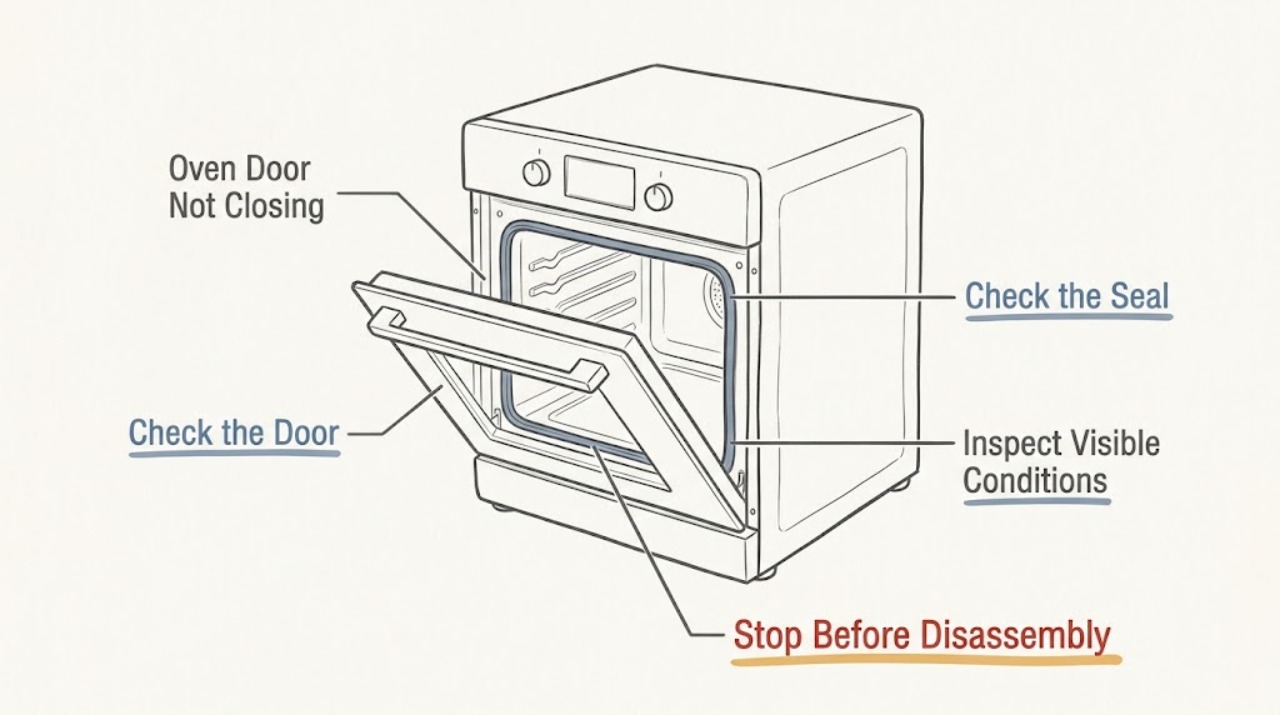
Work through in order
Diagnostic checks
Use only checks that match the exact appliance or system and its official guide.
-
Check 1
Turn the oven off and wait until the cavity, racks, door, and surrounding trim are cool. If a self-clean cycle or another locked cycle is active, follow the model manual's cool-down and unlock instructions instead of pulling the door.
Expected result: The door opens normally when cool, remains locked, or the oven is still producing unusual heat or steam.
Next step: If it remains locked after the documented cool-down, or if heat continues unexpectedly, stop using the oven and arrange service.
Why this matters
Why: A locked or hot door is a safety state, not a closing adjustment. Forcing it can damage the latch, hinges, glass, or gasket.
-
Check 2
With the oven cool, remove only loose cookware or racks that are clearly accessible without forcing the door. Look along the sill, side channels, and inner door edge for a pan, rack end, food spill, or object protruding into the closing path.
Expected result: A rack, pan, spill, or object touches the door, or the opening is clear but the door stops at the same angle.
Next step: Clear only the visible obstruction. If the oven floor appears shifted, use the exact model installation or owner instructions; do not pry the floor or reach toward heating components. If the path is clear and the door still stops, continue to the seal and alignment checks.
Why this matters
Why: A direct obstruction can imitate a hinge or latch failure. GE also notes that on some models a hidden bake-element floor can shift forward and block full closure.
-
Check 3
Inspect the gasket and the frame around the opening with a light touch only after cooling. Check for a folded, displaced, frayed, cut, hardened, or swollen section, and look for grease or food on the rigid frame where the gasket meets it. Do not scrub or wet a woven fiberglass gasket.
Expected result: The frame is dirty but the gasket is intact, the gasket is visibly damaged or displaced, or the sealing surfaces are clean and even.
Next step: Clean the rigid frame with a mild, non-abrasive cleaner on a soft cloth while keeping the gasket dry. Do not pull out or reshape a damaged gasket; arrange service for replacement or refitting.
Why this matters
Why: Food on the frame can hold the door out, while a damaged or displaced gasket can prevent sealing and may require replacement. GE warns that many woven fiberglass gaskets can be damaged by cleaning or moisture.
-
Check 4
View the door straight on and compare the left and right sides, then close it gently without adding force. Look for one side sitting higher, a gap that is wider on only one side, a hinge arm that does not appear symmetrical, or a door that was recently removed during installation or cleaning.
Expected result: The door is square and the top gap is even, or it is visibly skewed, loose, or uneven.
Next step: If the model manual gives a door-reseating procedure and the door is undamaged, follow that procedure with appropriate assistance. Otherwise do not release or adjust the hinges; stop and arrange service.
Why this matters
Why: A small even top gap can be a normal gasket condition, but a persistent one-sided difference suggests door seating, hinge, gasket, or frame alignment trouble.
-
Check 5
Check whether the problem began immediately after installation, a door-cleaning operation, rack adjustment, or self-cleaning. Confirm that the oven is seated and the surrounding cabinet or trim has not shifted visibly; do not loosen the built-in oven or alter its mounting.
Expected result: The issue began after installation or door handling, the cabinet/trim is visibly out of position, or no recent event explains it.
Next step: Use the Monogram model support page to retrieve the correct owner and installation manual. If the built-in unit or door was disturbed and alignment is not restored by an approved visible check, use service rather than moving the appliance.
Why this matters
Why: The installation and door-seating instructions differ by model. A new gasket may feel stiff, while a displaced door after handling can sit unevenly and fail to seal.
-
Check 6
After one permitted correction, close the cool door gently and check that it latches without pressure, sits evenly, and has no visible glass, frame, hinge, or gasket damage. Do not run a cooking or self-clean cycle as a repeated test if the door remains doubtful.
Expected result: The door closes squarely with an even appearance, or it still springs back, leaves a large/uneven gap, leaks substantial heat, or shows scorching or smoke marks.
Next step: If the door is not stable or the face has scorching/smoke marks, leave the oven off and arrange qualified service. If it closes normally, monitor the first use without touching the hot door and stop for abnormal heat, smoke, or odor.
Why this matters
Why: A stable, even closure supports an obstruction or surface issue; a recurring or visibly unsafe condition points to a hinge, latch, frame, gasket, or control problem that cannot be safely diagnosed from the outside.
Use your observations
Decision map
Find the observation that best matches what you see, then follow the next safe action.
-
PATH 01Next step
What you see
A rack, pan, food, spill, or shifted accessible floor is touching the door.
Do this next
Clear the loose obstruction after cooling. Use the exact model instructions for an oven floor; do not pry or work near heating parts.
-
PATH 02Next step
What you see
Food or grease is on the rigid frame, with no gasket damage.
Do this next
Clean the rigid frame gently with a mild, non-abrasive cleaner on a soft cloth and keep the gasket dry.
-
PATH 03Next step
What you see
The sealing material is frayed, cut, hardened, pulled out of position, or otherwise damaged.
Do this next
Do not reshape or scrub it. Leave the oven unused if it cannot seal safely and arrange service for model-specific replacement or refitting.
-
PATH 04Next step
What you see
The door closes and the top gap is small and even on both sides.
Do this next
A small even gap may be normal, particularly with a new gasket. Stop if there is major heat escape, scorching, smoke, or an uneven change over time.
-
PATH 05Next step
What you see
One side is higher, the gap is uneven, or the issue began after door handling or installation.
Do this next
Retrieve the exact Monogram manual. Use only its reseating procedure if the door and hinges are undamaged; otherwise arrange service and do not release the hinge locks.
-
PATH 06Next step
What you see
The latch will not hold, the door springs back, glass or hinge hardware is damaged, the oven stays hot, or scorching/smoke is present.
Do this next
Stop using the oven, keep people away from the hot or damaged door, and arrange qualified appliance service.
Helpful context
Understand the symptom
First decide whether the door is blocked or misaligned
A door that stops at the same point each time may be meeting a rack, pan, food residue, or an oven floor that has moved forward. A door that closes but sits higher on one side, leaves an uneven gap, or springs back points more toward seating, hinge, seal, or frame alignment. Monogram models vary, so use the manual for the model number rather than applying a generic removal procedure.
A visible gap is not automatically a failure
GE Appliances explains that a new oven gasket can be stiff and that a small, even top gap can be normal. The useful comparison is symmetry and performance: a one-sided gap, scorching or smoke marks on the face, a torn or displaced gasket, or substantial heat escaping is not a normal settling concern.
Keep the safety boundary clear
Do not push hard on a hot door, pry the latch, release a hinge lock, lift the door by its handle, or run a self-clean cycle to force a door into place. The door is heavy and a hinge can move suddenly. If glass, hinge hardware, the frame, or the gasket is damaged, leave the oven unused until it is assessed.
Safety boundary
Stop conditions
- Stop immediately for smoke, burning or electrical odor, visible arcing, a hot plug or outlet, repeated breaker trips, uncontrolled heating, scorching on the oven face, or substantial unexpected heat escaping around the door.
- Do not force the door, pry the latch, release or adjust hinge locks, lift the door by its handle, remove a heavy door without the model procedure and assistance, or bypass a door interlock.
- Do not run self-clean or repeated cooking cycles to test a door that is crooked, damaged, unable to latch, or not sealing.
Only after diagnosis
Potential parts
- oven door gasket
Consider this category only when the exact model manual or a technician confirms that the gasket is torn, displaced, or no longer sealing.
Confirm the complete Monogram model and the manufacturer's fit information before ordering; do not assume a gasket from another wall oven fits. - oven door hinge or latch assembly
Consider this category only after a crooked door, failed latch, or hinge fault is confirmed by the exact model documentation or a qualified technician.
Hinge and latch designs vary by Monogram model and door style. Do not select a part from a generic image or bypass the interlock.
When checks do not resolve it
Need a professional?
Arrange qualified appliance service when the door is crooked, the latch or hinge is damaged, the gasket is torn or displaced, the built-in oven has shifted, the door remains locked after the documented cool-down, or the problem persists after one safe visible correction. Service is also required for scorching, smoke, abnormal heat, damaged glass, electrical odor, or any condition that could let heat escape dangerously.
Common questions
FAQ
Is a small gap at the top of a Monogram oven door always a problem?
No. A small, even gap can be normal, especially with a new gasket. A one-sided gap, scorching, smoke, a damaged gasket, or substantial heat escape is a reason to stop and arrange service.
What should I check if the door hits something before closing?
After the oven is cool, look for a rack, pan, food spill, or other visible obstruction. Some models can also have an oven floor that shifted forward during installation; use the exact manual rather than prying or reaching toward heating parts.
Can I clean the oven door gasket?
Check the exact manual first. GE says many woven fiberglass gaskets can be damaged by wet cleaning; clean the rigid frame gently with a mild non-abrasive cleaner while keeping the gasket dry.
Should I reseat the Monogram oven door myself?
Only if the exact model manual provides the procedure, the door is undamaged, and you can follow its safety requirements with suitable assistance. Door designs vary, and the door is heavy; service is safer for a crooked, damaged, or built-in unit.
Can self-clean fix a stiff new oven gasket?
GE notes that a new gasket may become more pliable with use, but self-clean should not be used to force a door that is crooked, blocked, damaged, or unable to latch. Follow the exact manual and use service when alignment is doubtful.
When should I stop using the oven?
Stop for a damaged door or glass, a torn or displaced gasket, a failed latch, a hinge that is not symmetrical, scorching, smoke, abnormal heat, burning odor, visible arcing, repeated breaker trips, or a door that will not close without force.
Read the exact guide
Official sources
- Range & Wall Oven - Oven Gasket Not Sealing ProperlyGE Appliances · GE/Monogram-family range and wall-oven gasket, heat-escape, and service guidance
- Range & Wall Oven - Normal Gap Across Oven Door TopGE Appliances · GE/Monogram-family wall-oven top-gap and alignment guidance
- Range or Wall Oven - Removing Grease Buildup on the Door SealsGE Appliances · GE/Monogram-family wall-oven frame and gasket cleaning guidance
- New Range or Wall Oven Door Doesn’t Seal ProperlyGE Appliances · GE/Monogram-family range and wall-oven gasket and obstruction guidance
- Range & Wall Oven - Removing or Reseating Oven DoorGE Appliances · GE/Monogram-family top-opening wall-oven door seating and hinge safety guidance
- User Manual & Care for ZET2SHSSMonogram / GE Appliances · Monogram wall oven model support, owner manual, and installation resources
Community feedback
Share a repair observation
Share a plain-text repair observation. Accepted observations are published automatically; this page may take a moment to update.