
On this page
Start here
Quick answer
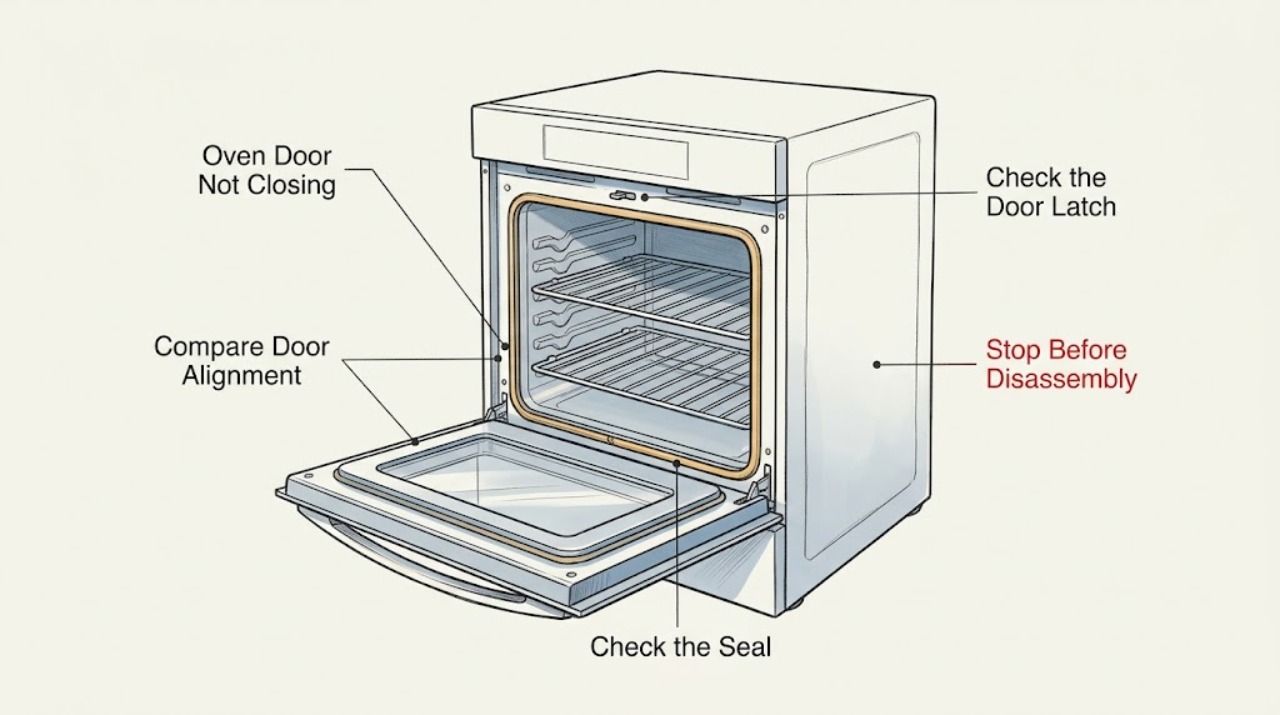
Do not run a Magic Chef oven whose door will not close or seal. Turn the oven off and let it cool completely, then remove only an obvious rack, pan, foil, or food item that is preventing closure. Check the gasket, latch area, hinge arms, and door alignment for visible dirt, displacement, bent metal, or broken glass without forcing the door or removing it. Magic Chef's published range guidance treats the door as heavy and fragile, requires the appliance to be off and cool before door work, and says not to force a door that does not move normally. If a hinge is sprung, the glass is cracked, the door remains misaligned, the latch will not engage, or the door needs removal, arrange qualified appliance service. For a gas model, stop immediately for gas odor, delayed ignition, flame, smoke, or carbon-monoxide alarm; leave the area for a suspected gas leak without operating electronics.
Work through in order
Diagnostic checks
Use only checks that match the exact appliance or system and its official guide.
-
Check 1
Turn every oven control off, keep the door in its current safe position, and wait until the cavity, racks, glass, and hinges are completely cool. If the oven is gas and there is gas odor, hissing, smoke, or a carbon-monoxide alarm, do not operate switches or continue this check.
Expected result: The oven is fully cool with no hazard sign, or there is gas odor, smoke, an alarm, flame, electrical arcing, or another immediate hazard.
Next step: With no hazard, continue with the external obstruction check. For suspected gas leak, leave immediately and seek local emergency or gas assistance from outside; for smoke, flame, arcing, or an electrical fault, keep clear and use qualified service.
Stop if: Stop for gas odor, hissing, smoke, flame, carbon-monoxide alarm, sparks, water near energized parts, or glass that is hot enough to burn.
Why this matters
Why: A hot glass door, spring-loaded hinge, or gas event can injure someone; cooling and making the area safe come before diagnosing alignment.
-
Check 2
With the oven cool, look along the full door opening and remove only obvious external obstructions such as a rack left too far forward, a pan or foil caught at the sill, food debris, or a utensil in the seal. Do not use force or insert tools into the hinge area.
Expected result: The door closes after an item is removed, or it still stops at the same point with the opening visibly clear.
Next step: If the door closes normally, do not run a high-heat cycle until the gasket and latch also appear intact. If it still binds, continue to the seal and hinge inspection without pushing harder.
Stop if: Stop if a rack is bent, a pan has to be forced out, or an obstruction is behind a hinge or panel.
Why this matters
Why: A rack, cookware, debris, or food can physically block the door; a repeatable stop with a clear opening shifts attention to the gasket, latch, hinge, or alignment.
-
Check 3
Inspect the cool door gasket, frame, latch area, and mating surface using a light. Look for a gasket folded out of its channel, hardened or torn sections, grease or debris, a latch that is visibly displaced, or a frame that is bent; clean only accessible residue with a soft cloth appropriate for the model.
Expected result: The gasket sits evenly and the latch looks aligned, or the gasket is displaced/damaged, the latch is bent, or the frame has a visible dent.
Next step: If a gasket is clearly out of its channel and the exact manual permits reseating it, correct only that gentle external issue. For a torn seal, bent latch, dented frame, or uncertainty, leave the oven off and request service.
Stop if: Do not stretch, cut, glue, bend, or bypass the gasket or latch, and do not operate with damaged glass or a door that cannot seal.
Why this matters
Why: A displaced seal or bent latch can hold the door away from the frame and can allow heat to escape even if the door appears nearly closed. A damaged frame or latch is not corrected by pushing the door harder.
-
Check 4
From the side and front, compare both hinge arms and the door edges without touching spring-loaded hardware. Look for a hinge that is at a different angle, a door corner that sits high or low, a loose handle, cracked glass, or a hinge bracket that has moved out of its seat.
Expected result: Both hinges and door edges appear even and the glass is intact, or one hinge is sprung/misaligned, the door is twisted, or glass is cracked or loose.
Next step: If the hinge or glass is damaged, do not attempt alignment, spring repair, or door removal; arrange qualified appliance service. If the hardware looks even but the door still binds, use the model branch for service rather than a force test.
Stop if: Stop immediately for cracked or loose glass, a hinge that snaps or moves unexpectedly, a loose handle, or any need to remove the door.
Why this matters
Why: Uneven hinges, damaged brackets, or broken glass can prevent a safe seal and can release stored spring force. Magic Chef's guidance treats the glass door as heavy and fragile and warns against forcing door movement.
-
Check 5
If the door stopped closing after cleaning or a self-clean cycle, check the exact model manual for a lock or latch state and wait until the oven is completely cool. Do not pry the latch, defeat the lock, or start a self-clean cycle while the door alignment is uncertain.
Expected result: A lock indicator or documented cleaning state is active, the latch remains engaged after cooling, or no cleaning/lock state is shown.
Next step: Follow only the exact model's release instruction. If the latch does not release normally, keep the oven out of service and arrange qualified repair.
Stop if: Do not insert tools around the latch, force a locked door, or operate the oven with the door not fully closed.
Why this matters
Why: Some ovens hold the door in a protected position during a lock or cleaning state; a latch that remains engaged or a door that will not return to its normal position can indicate a control or mechanical fault.
-
Check 6
Record the full model and serial information and use Magic Chef Support or Manual Downloads to locate the correct door, hinge, latch, cleaning, and removal instructions. Do not apply a procedure from a different Magic Chef range or wall oven.
Expected result: The exact manual is available and matches the appliance, or the model cannot be found or the door design differs from the available instructions.
Next step: Follow only the matched manual's low-risk external instructions. If no exact procedure is available, provide the model details to qualified service rather than experimenting.
Why this matters
Why: Magic Chef has multiple oven and range designs; hinge levers, latches, locks, and user-serviceable parts are not interchangeable by appearance alone.
-
Check 7
After an obvious safe obstruction is removed and the door is cool, close it gently once and confirm that it meets the frame evenly, the latch engages as designed, and the gasket is not pinched. Do not run the oven if any corner remains open or if the closure requires pressure.
Expected result: The door closes evenly with light normal movement and intact glass, or it remains open, springs back, rubs, or requires force.
Next step: If closure is normal and no hazard occurred, follow the manual for ordinary use and monitor the first cycle. If not normal, leave the oven off and request qualified service.
Stop if: Stop for any uneven gap, pinched seal, hot-air escape at the door, cracked glass, unstable hinge, gas odor, smoke, or abnormal heat.
Why this matters
Why: A normal gentle closure supports a corrected obstruction; rubbing, spring-back, an uneven gap, or required force indicates unresolved alignment, seal, hinge, or latch damage.
Use your observations
Decision map
Find the observation that best matches what you see, then follow the next safe action.
-
PATH 01Next step
What you see
The door or surrounding area is hot, the glass is cracked, a hinge snaps or shifts, or the door is unstable.
Do this next
Keep people away, do not force or remove the door, and arrange qualified appliance service after the appliance is safe and cool.
-
PATH 02Next step
What you see
Gas odor, hissing, smoke, flame, carbon-monoxide alarm, sparks, or water near electrical parts is present.
Do this next
Stop troubleshooting. For suspected gas leakage, leave without operating electronics and seek local emergency or gas help from outside; for fire or electrical danger, keep clear and use the appropriate qualified response.
-
PATH 03Next step
What you see
A rack, pan, foil, food item, or accessible debris visibly blocks the door and the door closes normally after gentle removal.
Do this next
Keep the rack and cookware within the exact manual's position limits, confirm the gasket is not pinched, and use only a supervised normal cycle once the door seals evenly.
-
PATH 04Next step
What you see
The opening is clear but the gasket, latch, frame, hinge, or door alignment is visibly damaged or the door requires force.
Do this next
Do not operate the oven or attempt a spring, hinge, latch, glass, or frame repair. Arrange qualified appliance service and provide the model and the exact visible symptom.
-
PATH 05Next step
What you see
A cleaning or lock state is displayed and the model manual describes a normal release after cooling.
Do this next
Wait until cool and follow only that matched release procedure. If the latch remains engaged or the door still will not close, stop and request service.
-
PATH 06Next step
What you see
The model cannot be confirmed or the exact door procedure is unavailable.
Do this next
Limit the check to cooling, visible obstruction, and visible damage. Leave the oven out of service and give qualified service the model and door observations.
Helpful context
Understand the symptom
A door that will not close is a stop condition
An open or misaligned oven door can release heat and expose hot surfaces, and a damaged hinge or glass can fail suddenly. Do not hold the door shut, tape it closed, defeat a latch, or use the oven to see whether it still heats. Keep the appliance off until a cool, external inspection shows that the door can close normally.
Use the exact model procedure for any door work
Magic Chef publishes multiple range and oven configurations. Its support pages provide manual and service routes, while the published range manual gives a model-specific example of hinge handling and warns that the glass-front door is heavy and fragile. Treat removal or hinge repair as professional work unless the exact manual clearly identifies it as a safe user procedure.
Only after diagnosis
Potential parts
- oven door gasket
Only consider this category if the exact model's seal is visibly torn, hardened, displaced, or confirmed by qualified diagnosis to prevent even closure.
Confirm the exact model and approved fitment before ordering; do not glue or stretch a seal to make it fit. - oven door hinge or hinge bracket
Only consider this category if a qualified inspection identifies a bent, sprung, or displaced hinge as the cause of an uneven gap or binding door.
Hinges can store spring force and door removal varies by model; use qualified installation and exact model fitment. - oven door latch
Only consider this category if the door is aligned but the latch does not engage or release according to the exact model procedure.
Confirm the model, lock configuration, and service diagnosis before any replacement. - oven door glass or door assembly
Only consider this category when glass is cracked, loose, or the door frame is confirmed damaged; do not operate with damaged glass.
The door is heavy and fragile; use qualified service and exact model compatibility.
Common questions
FAQ
Can I force a Magic Chef oven door closed?
No. Turn the oven off, let it cool, and remove only an obvious rack, pan, food, or debris obstruction. If the opening is clear but the door still needs force, or the hinge, latch, frame, gasket, or glass is damaged, leave the oven off and arrange qualified service.
Why will my Magic Chef oven door not close after cleaning?
A rack or cleaning residue may be blocking the opening, or a lock/latch may still be in its cleaning position. Use the exact model manual after the oven is completely cool. Do not pry the latch or run the oven when the door does not seal evenly.
Is it safe to use a Magic Chef gas oven with a door that does not seal?
No. Do not operate a gas oven whose door is open, misaligned, or damaged. If you smell gas, hear hissing, see smoke or an abnormal flame, or a carbon-monoxide alarm sounds, stop troubleshooting, leave as required without operating electronics, and seek the appropriate local emergency or qualified gas response.
Read the exact guide
Official sources
- CPSC Urges Flood Victims to Take Steps to Prevent CO Poisoning, Electrocution, Explosion and FiresU.S. Consumer Product Safety Commission · Gas-leak and wet-appliance electrical safety guidance
- 24-Inch Freestanding Range User's ManualMC Appliance / Magic Chef · Magic Chef freestanding range door safety, hinge handling, cooling, cleaning, and troubleshooting guidance
- The Magic Chef Help CenterMC Appliance / Magic Chef · Magic Chef product-support categories and model-specific help routing
- SupportMagic Chef · Magic Chef appliance support, model manuals, service requests, parts, FAQs, and product help
Community feedback
Share a repair observation
Share a plain-text repair observation. Accepted observations are published automatically; this page may take a moment to update.