
On this page
Start here
Quick answer
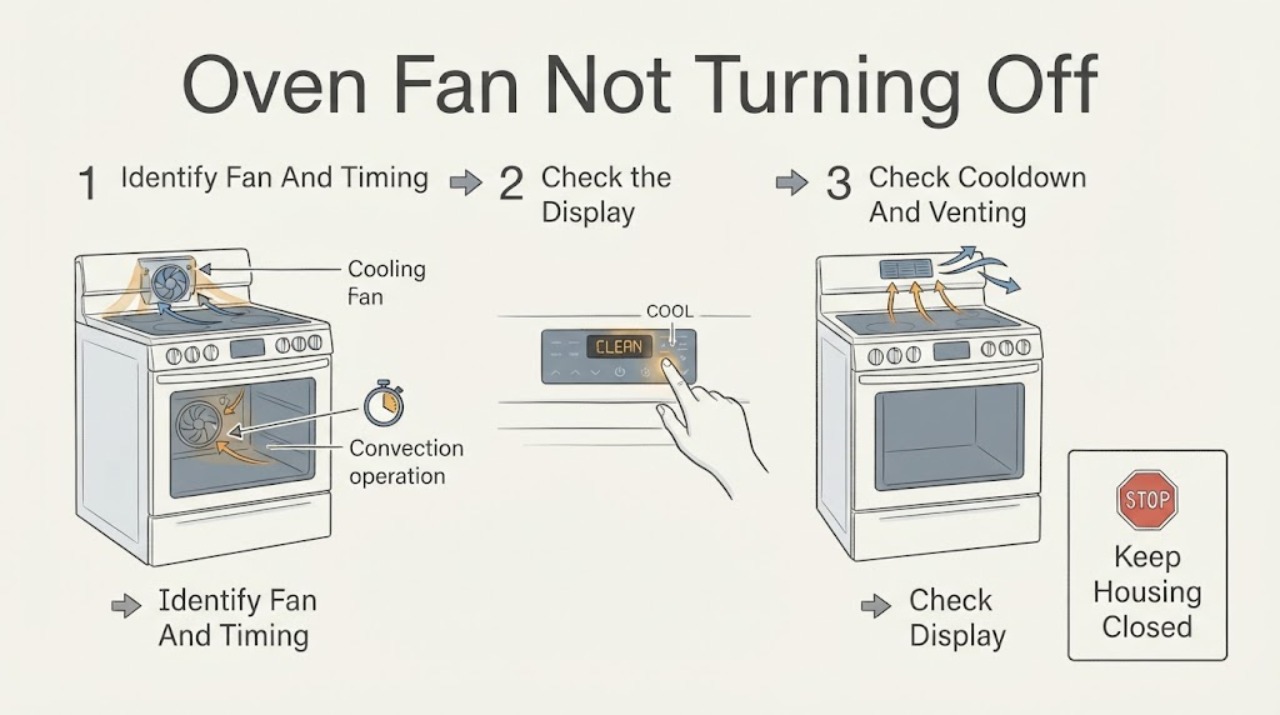
First identify which fan you are hearing. Wolf says the cooling fan is automatic, cannot be switched off manually and may continue after the oven is off while the appliance cools; depending on use and model, fan noise may last up to about 45 minutes or longer. A convection fan is different: on Wolf electric ovens, selecting Bake takes the oven out of Convection Mode, while some gas ranges use a fan switch above the oven door. Do not block the oven intake or exhaust, and do not open panels. If the correct fan control is off but the fan still runs after the appliance has cooled, or the noise is rubbing, scraping, smoke or burning odor, stop using the oven and contact Wolf Factory Certified Service.
Work through in order
Diagnostic checks
Use only checks that match the exact appliance or system and its official guide.
-
Check 1
Note whether the sound comes from inside the oven cavity or from the cooling-air outlet, whether it occurs during preheat/cooking or only after shutoff, and the model and fuel type from the rating label.
Expected result: The fan runs during preheat or cooking, continues after shutoff while the oven is hot, or remains on after a full cool-down; the exact fan location is still uncertain.
Next step: Use the timing and location to follow the matching convection or cooling branch. If the fan cannot be identified, keep the oven closed and use the exact Use and Care Guide rather than changing controls at random.
Why this matters
Why: Wolf says convection and cooling fans can sound similar, and post-use cooling fan operation is often normal; the fan type determines whether a user control exists.
-
Check 2
If the noise is the convection fan, select Bake on a Wolf electric oven to leave Convection Mode, or set the documented convection-fan switch to Off on a compatible Wolf gas range; do not treat the cooling fan as switchable.
Expected result: The convection fan stops when the correct mode or switch is changed, or it continues; the cooling fan continues separately after shutoff.
Next step: If the convection fan stops, normal operation is likely. If it does not, verify the exact model control path once and then stop for service; never bypass or disconnect a fan.
Why this matters
Why: Wolf documents manual control for the convection fan but says the cooling fan turns on and off automatically and has no manual off switch.
-
Check 3
Let the oven cool without blocking the cool-air intake or exhaust, and compare the run time with the cooking temperature, duration and model guidance; do not cover the front/bottom exhaust with trim or a toe kick.
Expected result: The fan stops as the oven cools, or remains audible after the oven has cooled; airflow at an intake or exhaust is obstructed, or it is clear.
Next step: If the fan stops after cooling, treat it as normal post-use cooling. If it remains on after cooling or airflow is obstructed, remove only the external obstruction if safe and arrange service if the fan behavior persists.
Why this matters
Why: Wolf says fan noise can continue after shutoff and that cool-down time varies; blocked exhaust can negatively affect performance and cause damage.
-
Check 4
Only after the convection control is correctly off and the oven is cool, use Wolf's documented one-time circuit-breaker reset and retest; do not repeatedly cycle power or open the control area.
Expected result: The fan returns to normal after the reset, or it continues to run after the reset and cool-down.
Next step: If the fan remains on, leave the appliance off and contact Factory Certified Service. Do not infer a failed relay, sensor or fan motor from the symptom.
Why this matters
Why: Wolf lists a breaker reset as a limited retest for a fan that will not turn off, but continued operation after that step has no further public troubleshooting path.
-
Check 5
Stop using the oven and arrange professional service if the fan makes rubbing, scraping, rattling or high-pitched noise, if smoke or burning odor appears, if the fan will not operate during self-clean, or if the fan remains on after the documented checks.
Expected result: A hazardous or abnormal sign is present, or the fan behavior is normal and the oven cools without abnormal noise.
Next step: For any hazard or unresolved fan fault, keep the oven off and request qualified service. If operation matches the model guide and the fan stops after cooling, no repair is indicated by this symptom alone.
Why this matters
Why: Wolf provides no further user troubleshooting once the fan does not respond to its documented control/reset checks; the guide reserves repair and replacement for Wolf Factory Certified Service.
Use your observations
Decision map
Find the observation that best matches what you see, then follow the next safe action.
-
PATH 01Next step
What you see
The fan runs after cooking while the oven or front/bottom exhaust remains warm, then stops as the oven cools and no abnormal noise is present.
Do this next
Keep intake and exhaust areas clear and allow the appliance to cool. Use the exact model guide if the duration changes materially or the fan never stops.
Why this path and its safety boundary
Why it matters: Wolf describes this as normal automatic cooling-fan operation; there is no manual off switch and no universal shutoff time.
-
PATH 02Next step
What you see
The sound is from the cavity convection fan and changes with Convection/Bake selection or a gas-range fan-switch position.
Do this next
Use the exact electric or gas-range control path once. If the convection fan still ignores the documented control, stop and arrange Factory Certified Service.
Why this path and its safety boundary
Why it matters: The convection fan is manually controlled on applicable Wolf designs, unlike the automatic cooling fan.
-
PATH 03Next step
What you see
The fan is loud, rubbing, rattling or high-pitched, or an intake/exhaust is covered while the fan runs longer than expected.
Do this next
Remove only a safe external obstruction, do not open the oven, and contact qualified service if the noise or extended run continues.
Why this path and its safety boundary
Why it matters: Wolf treats fan noise as model-dependent and says blocked exhaust can affect performance or cause damage; the public guidance does not identify an internal part from noise alone.
-
PATH 04Next step
What you see
The correct convection control is off, the oven has cooled, and the fan remains on after Wolf's single breaker reset, or the cooling fan is not operating during self-clean.
Do this next
Leave the oven off and arrange Factory Certified Service. Do not bypass thermal protection, disconnect the fan or perform live electrical tests.
Why this path and its safety boundary
Why it matters: Wolf says no further owner troubleshooting is available; a persistent or missing cooling-fan condition requires Factory Certified Service.
Helpful context
Understand the symptom
Separate the cooling fan from the convection fan
A Wolf oven can have more than one fan sound. The convection fan circulates air in the cavity and may run during preheat, including in some regular Bake modes. The cooling fan protects components from overheating and can continue after the oven is turned off. Because the task has no model or fuel type, identify the sound by its timing and location before changing a control; do not assume that every fan uses the same switch.
Use the correct model-specific fan control
If the sound is the convection fan, Wolf's general FAQ says an electric oven can be taken out of Convection Mode by selecting Bake. On Wolf gas ranges, the fan switch above the oven door controls the convection fan; the R Series documentation distinguishes Off, On and Cool, with Cool intended to run continuously for faster cooling. The cooling fan is different and has no manual off switch, so do not force a control or disconnect a wire.
Allow normal cooling and keep airflow clear
Wolf says there is no universal cool-down time: ambient temperature, oven temperature and how long the oven ran all affect it. Fan noise may remain audible for up to about 45 minutes on some models, and the insulated cavity can remain warm for several hours. Keep the documented cool-air intake and exhaust unobstructed; do not cover a vent with trim or a decorative toe kick. Heat at the lower/front exhaust can be normal for a Wolf range.
Stop at the service boundary
After the correct convection control is off and the oven has had a reasonable cool-down, Wolf's FAQ lists one circuit-breaker reset and retest. If the fan still will not turn off, Wolf says no further troubleshooting is available and directs the owner to Factory Certified Service. A model-free symptom does not identify a thermostat, fan motor, relay or control-board fault, so do not remove panels or perform live electrical testing.
When checks do not resolve it
Need a professional?
Contact Wolf Factory Certified Service when the fan remains on after the correct model-specific convection control, normal cool-down and the documented single breaker reset; when the fan makes rubbing, scraping, rattling or high-pitched noise; when smoke or burning odor appears; or when the cooling fan does not operate during self-clean. Do not remove panels, bypass thermal protection, disconnect the cooling fan or perform live electrical tests.
Common questions
FAQ
Is it normal for a Wolf oven fan to run after the oven is turned off?
Often, yes. Wolf says the automatic cooling fan runs to prevent overheating and may continue long after shutoff; depending on model and use, fan noise may be audible for up to about 45 minutes or the oven may take several hours to cool. It should stop automatically at a safe temperature.
How do I turn off a Wolf oven fan?
First determine the fan type. Wolf says an electric oven's convection fan can be taken out of Convection Mode by selecting Bake, and applicable gas ranges use a fan switch. The cooling fan has no manual off switch; it turns off automatically after safe cool-down.
What if the Wolf fan keeps running after the oven is cool?
Verify the convection control and airflow are correct, then use Wolf's documented single breaker reset and retest. If the fan still does not turn off, Wolf provides no further user troubleshooting and directs owners to Factory Certified Service. Do not open the oven or disconnect the fan.
Read the exact guide
Official sources
- Convection Fans during Preheat | FAQ | Sub-Zero, Wolf, and CoveSub-Zero, Wolf, and Cove · Official Wolf family guidance for products produced after the stated date and specified range families; exact model should be checked before applying the date distinction.
- Wolf Dual Fueland Induction RangeOven Exhaust from Bottom of Unit | FAQ | Sub-Zero, Wolf, and CoveSub-Zero, Wolf, and Cove · Official Wolf dual-fuel and induction range guidance only; it supports airflow precautions for those families, not every Wolf wall oven.
- Wolf Electric Oven Cooling Fan Operation | FAQ | Sub-Zero, Wolf, and CoveSub-Zero, Wolf, and Cove · Official Wolf electric-oven family guidance; it establishes automatic cooling behavior but not an exact runtime for every model.
- Oven Fan Noise | FAQ | Sub-Zero, Wolf, and CoveSub-Zero, Wolf, and Cove · Official Wolf family guidance; the listed duration is conditional and does not diagnose an internal fan component.
- UCGWolf / Sub-Zero Group · Official Wolf E Series use-and-care guide; safety and service limits are cited only for the documented E Series family, not as a universal model procedure.
- R Series Gas Range Convection Fan Switch Operation | FAQ | Sub-Zero, Wolf, and CoveSub-Zero, Wolf, and Cove · Official R Series gas-range guidance only; it is not generalized to every Wolf oven or range without model confirmation.
- Wolf Electric Oven Convection Fan Operation | FAQ | Sub-Zero, Wolf, and CoveSub-Zero, Wolf, and Cove · Official Wolf electric-oven family guidance; exact mode behavior remains dependent on the product model.
- Wolf Oven Fan Will Not Turn Off | FAQ | Sub-Zero, Wolf, and CoveSub-Zero, Wolf, and Cove · Official Wolf family FAQ; exact electric/gas control behavior remains model-dependent when no model is supplied.
Community feedback
Share a repair observation
Share a plain-text repair observation. Accepted observations are published automatically; this page may take a moment to update.