
On this page
Start here
Quick answer
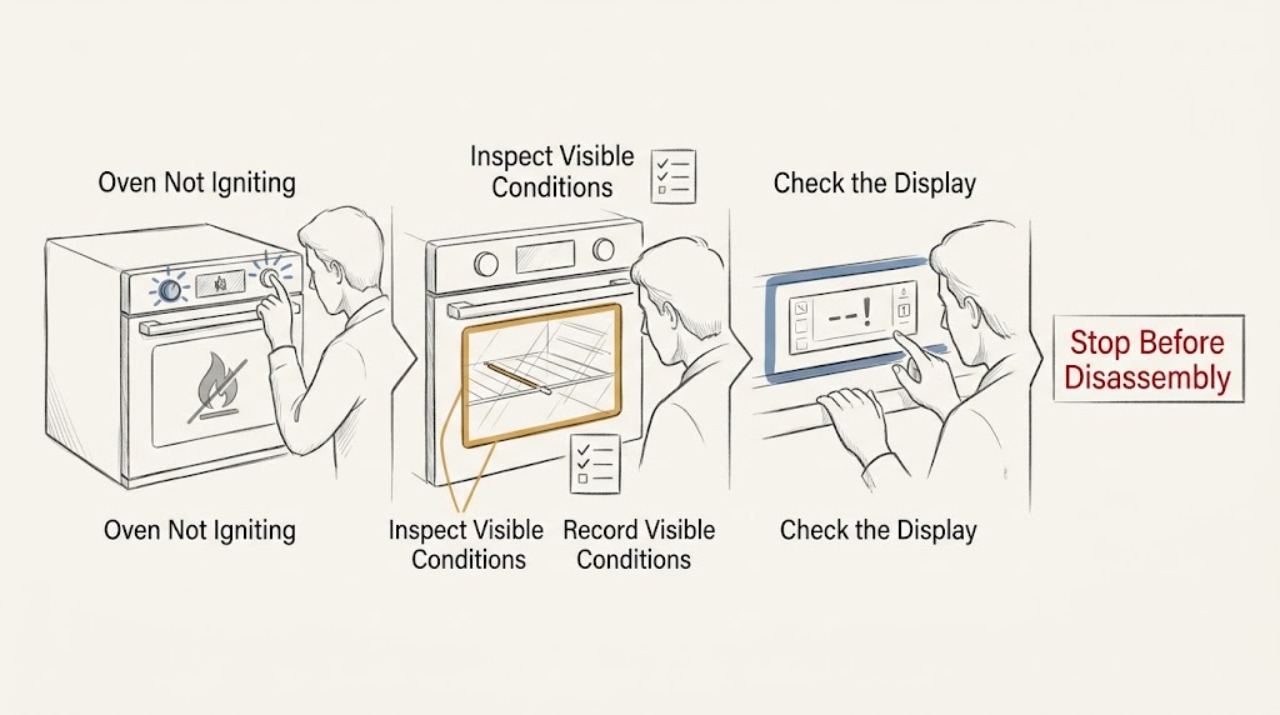
First confirm whether the Wolf oven is gas, electric, induction-range oven, or dual fuel: an electric oven does not use a gas igniter. For a gas Wolf oven, a normal burner may take about 30 to 45 seconds to light, but a gas odor without ignition, delayed ignition, abnormal flame, smoke, or repeated clicking is a stop condition. Record the model, mode, preheat indicator, power status, and exact sequence; use only the matching Wolf guide, perform at most one safe reset where the guide permits it, and send a persistent no-ignition problem to qualified Wolf appliance service.
Work through in order
Diagnostic checks
Use only checks that match the exact appliance or system and its official guide.
-
Check 1
Record the Wolf model line and determine whether the oven is gas, electric, induction-range, dual fuel, or convection steam. Describe the exact symptom as no display, controls unresponsive, no preheat, no flame, or ignition that starts late. Do not remove panels or use a flame to identify the fuel type.
Expected result: A gas bake or broil burner has an ignition sequence; an electric or induction-range oven has no gas flame to light. A blank display is a power or control symptom rather than proof of an igniter fault.
Next step: Use the fuel-specific branch below. If there is a gas odor, smoke, abnormal flame, sparks, or uncontrolled heat, skip all further checks and follow the stop guidance.
Why this matters
Why: Wolf publishes separate paths for gas burner ignition, general operating problems, and electric oven heating. Applying gas advice to an electric or induction-range oven can send the diagnosis in the wrong direction.
-
Check 2
For a gas Wolf oven only, with no gas odor or other hazard, make one normal bake or broil selection using the documented controls and observe from a safe position. Note whether the preheat indicator calls for heat, whether ignition occurs within the documented window, and whether clicking or repeated attempts continue. Do not open the burner compartment.
Expected result: Wolf describes gas oven ignition at approximately 30 to 45 seconds; the preheat indicator can show that the oven is calling for heat. No ignition, a substantially late ignition, or repeated clicking is abnormal evidence.
Next step: Turn the oven control off and discontinue use if ignition is late, absent, accompanied by gas odor, or followed by an abnormal flame. Request qualified service instead of making another ignition attempt.
Why this matters
Why: The timing and indicator separate a normal start sequence from a possible delayed-ignition, ignitor, valve, thermostat, power, or gas-supply service issue. They do not identify which component failed.
-
Check 3
Check the external controls and visible status only: confirm the intended cooking mode, note whether the preheat indicator is steady or flashing, and verify that the display and clock respond. For a dual-fuel control, note any power, Sabbath, or mode indication without trying to bypass it.
Expected result: A preheat indication suggests a call for heat; no display or no response points toward power or control behavior; a flashing indicator or a mode lock may require the exact Wolf guide. A gas oven can have power and still fail to ignite.
Next step: If the controls respond but the burner still does not ignite, leave the oven off and request service. If the controls do not respond, use the power path in Action 4 only when there is no safety warning.
Why this matters
Why: Wolf lists no power, control, relay, thermostat, ignitor, valve, and connection issues as different possible paths. An external control observation narrows the handoff but does not validate internal wiring or gas parts.
-
Check 4
Only when the oven area is dry and there is no gas odor, smoke, spark, abnormal heat, damaged wiring, or breaker problem, turn the unit off at its circuit breaker or electrical supply for the interval specified by the matching Wolf guide, then restore power once. Do not open the electrical enclosure or perform a live test.
Expected result: The display and controls may return and accept one command, or the no-ignition symptom may remain. A breaker that trips again, will not stay on, or shows damage is an electrical stop condition.
Next step: If the oven still will not ignite or the control state returns, keep it off and arrange qualified Wolf appliance service. Do not repeat the reset or try to light the oven without power.
Why this matters
Why: Wolf support guidance uses a brief power interruption for some no-operation or ignition-after-outage conditions. A reset cannot correct a failed ignitor, valve, thermostat, connection, gas supply, or control fault that returns.
-
Check 5
When the oven is cool and power is left off after a failed attempt, make only a visual record of the cavity, door, control area, and any visible flame or residue; do not remove the bottom panel, touch an ignitor or valve, adjust gas fittings, or manually light the oven.
Expected result: A normal-looking cavity does not rule out an internal ignition or gas fault. Soot, an unusual flame pattern, repeated clicking, a gas odor, scorch marks, or a damaged control changes the case to immediate service.
Next step: Leave the oven off and give service the complete sequence, model information, mode, and visible observations. If gas odor, smoke, flame outside the intended burner area, or active electrical danger is present, leave the area and use the emergency path.
Why this matters
Why: Wolf's ignition pages direct a non-igniting or delayed gas oven to discontinue use and service. Internal gas and electrical parts require qualified diagnosis, even when the visible cavity looks clean.
Use your observations
Decision map
Find the observation that best matches what you see, then follow the next safe action.
-
PATH 01Next step
What you see
The Wolf oven is electric or an induction-range oven, so there is no gas burner to ignite.
Do this next
Use the model-specific no-heat or no-operation guide: check the selected mode, display, door, showroom or Sabbath state, and one permitted power reset only when safe. Persistent no heat belongs with qualified appliance service.
-
PATH 02Next step
What you see
A gas bake or broil burner lights within the documented window and the flame is stable, but the oven later cycles normally.
Do this next
Record the successful start and monitor only normal operation. If the burner fails to reignite, the indicator flashes, or the flame becomes abnormal, turn the control off and request service.
-
PATH 03Next step
What you see
The gas oven takes substantially longer than the documented ignition window, never lights, or the ignitor clicks without a stable flame.
Do this next
Turn the control off, discontinue use, and arrange qualified Wolf appliance service. Do not remove the burner panel, adjust gas components, manually light the oven, or keep retrying.
-
PATH 04Next step
What you see
The display or controls are blank or unresponsive, or the failure began after a power interruption.
Do this next
Verify the model-specific power and control path from outside. If the matching Wolf guidance permits it and there is no hazard, perform one brief power reset; if the oven remains unresponsive or still will not ignite, request service.
-
PATH 05Next step
What you see
Gas odor is present without ignition, ignition is delayed with odor, there is an abnormal flame, smoke, fire, sparks, hot wiring, water at controls, or a breaker trips.
Do this next
Stop immediately, turn the oven control off only if it is safe to do so, avoid flames and electrical switching, leave the area for suspected gas or fire, and use the appropriate emergency or qualified service path. Do not relight, reset, search for a leak, or retest.
Helpful context
Understand the symptom
Do not treat every Wolf oven as a gas oven
Wolf sells gas, electric, induction-range, dual-fuel, and convection-steam oven configurations. The word igniting is meaningful for a gas bake or broil burner, but an electric or induction-range oven that does not heat needs a different path. Start by recording the model line and whether the symptom is no display, no response, no preheat, no gas flame, or delayed ignition.
A burner timing clue is not a repair test
Wolf says a gas oven burner normally ignites in approximately 30 to 45 seconds, and a new unit can take longer on its initial ignition. That timing helps describe the symptom; it does not justify repeated attempts, removing a burner panel, adjusting gas components, or manually lighting the oven. A gas odor without ignition or a clearly delayed ignition means discontinue use until repaired.
Keep the handoff useful
Give service the model and serial information, fuel configuration, selected mode, whether the preheat indicator appeared, the time from the call for heat to the result, and any odor, flame, clicking, power, or breaker observation. Wolf's public guidance lists possible ignitor, valve, thermostat, connection, power, and gas-supply causes, but those are service diagnoses rather than parts a homeowner should test or replace.
Safety boundary
Stop conditions
- Stop using the oven for any gas odor without ignition, delayed ignition, abnormal flame, flame outside the intended burner area, smoke, fire, or carbon-monoxide concern.
- Stop for sparks, arcing, a hot or damaged plug or wiring, water at electrical controls, uncontrolled heat, or a breaker that trips again. Leave the area for fire or suspected gas and use the appropriate emergency path.
- Do not manually light a Wolf gas oven without power, remove burner or control panels, adjust gas fittings, touch an ignitor or valve, bypass an interlock, or perform a live electrical test.
- Do not repeat ignition attempts or power resets after a failed safe attempt. Keep the complete display, model, mode, timing, and odor or flame observations for qualified service.
Only after diagnosis
Potential parts
- Wolf gas oven ignitor
Consider this category only if qualified service confirms an ignitor fault after identifying the exact Wolf gas oven and ruling out power, control, valve, connection, and gas-supply causes.
Ignitor type and fit vary by Wolf model line. Confirm the exact model documentation and professional diagnosis before selecting any part. - Wolf gas oven thermostat or valve component
Consider this category only when service diagnosis identifies a thermostat or valve issue; no-ignition symptoms alone do not identify either component.
Gas controls require exact model matching and qualified installation. Do not adjust or replace gas components as a homeowner check.
When checks do not resolve it
Need a professional?
Ask for Wolf appliance diagnosis for no ignition, delayed ignition, repeated clicking, a returning failure after one permitted reset, or a suspected ignitor, valve, thermostat, power, connection, or gas-supply fault.
Common questions
FAQ
How long should a Wolf gas oven take to ignite?
Wolf says a gas oven burner normally ignites in approximately 30 to 45 seconds; an initial ignition on a new unit can take longer. If ignition is substantially late, absent, or accompanied by gas odor, turn the control off, discontinue use, and request service.
Can I manually light a Wolf gas oven during a power outage?
No. Wolf says the oven ignitor requires electricity and that there is no safe way to use the gas oven without power. Turn the oven off during the outage and arrange service if it does not reignite after power is safely restored.
Why does my Wolf oven click but not ignite?
Wolf lists possible ignitor, valve, thermostat, connection, power, and gas-supply causes, but clicking alone does not identify the failed part. Turn the control off, discontinue use if ignition is absent or delayed, and provide service with the model, mode, timing, and any odor or flame observations.
Read the exact guide
Official sources
- Gas Range Use and Care Guide CLEANING, MAINTENANCSub-Zero, Wolf, and Cove · Wolf gas range use and care guide, oven operation, ignition-related status, power, and service information
- Wolf Does Not Operate in One or All Modes | FAQ | Sub-Zero, Wolf, and CoveSub-Zero, Wolf, and Cove · Wolf oven and range power, control, Sabbath mode, mode, breaker, and no-operation troubleshooting
- Wolf Gas Oven Reignition After Power Outage | FAQ | Sub-Zero, Wolf, and CoveSub-Zero, Wolf, and Cove · Wolf gas range oven behavior after a power outage and prohibition on lighting a gas oven without power
- Gas Oven Burner Operation | FAQ | Sub-Zero, Wolf, and CoveSub-Zero, Wolf, and Cove · Wolf gas oven burner ignition timing, delayed ignition, gas odor, and normal reignition behavior
- Gas Oven Bake Burner Not Working | FAQ | Sub-Zero, Wolf, and CoveSub-Zero, Wolf, and Cove · Wolf gas oven bake burner no ignition, delayed ignition, clicking, causes, and service boundary
Community feedback
Share a repair observation
Share a plain-text repair observation. Accepted observations are published automatically; this page may take a moment to update.