
On this page
Start here
Quick answer
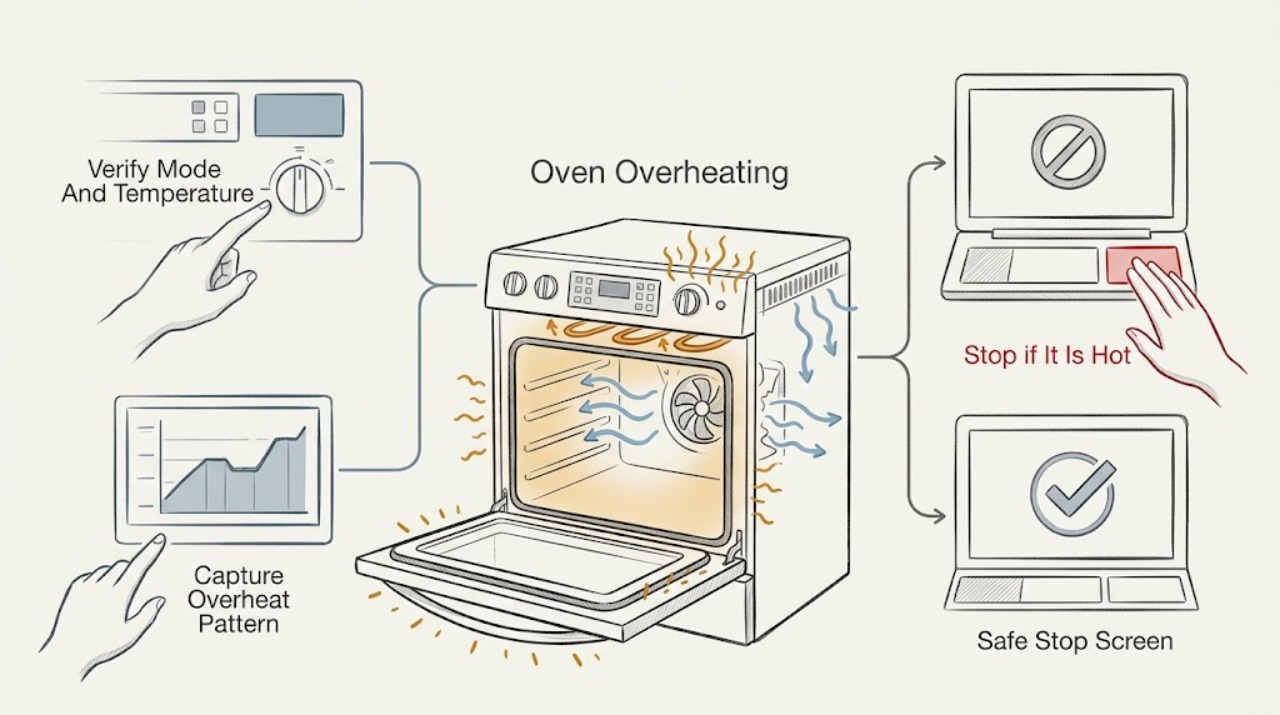
A Wolf oven may feel hot or continue to run its cooling fan after cooking as part of normal heat management, and the internal temperature naturally cycles above and below the setpoint. Treat it as overheating when heating does not stop, temperature control is lost, the cabinet or surrounding enclosure becomes abnormally hot, the fan fails or makes a new severe noise, or there is smoke, a burning smell, gas odor, arcing, or repeated electrical shutdown. First record the model, fuel type, mode, set temperature, display message, food result, and where heat is observed. From a cool, safe position, check the mode, rack and pan setup, door closure, gasket, visible vents, and whether an enclosure door is trapping exhaust. Do not open panels, bypass a thermal safety, use a gas oven for heat, or keep resetting an unexplained fault. Persistent temperature error, recurring shutdown, abnormal fan behavior, gas symptoms, CO alarm, or any smoke or electrical symptom needs qualified Wolf service.
Work through in order
Diagnostic checks
Use only checks that match the exact appliance or system and its official guide.
-
Check 1
From a safe position, record the exact Wolf model or series, fuel type, cooking mode, set temperature, preheat state, time the symptom began, and where heat or smoke is observed.
Expected result: Note whether the heating indicator or burner appears to remain active, whether the cooling fan runs, whether the display changes, whether food burns or cooks unevenly, and whether the heat is inside the cavity, at the vent, around the controls, or in the surrounding cabinet.
Next step: Keep the oven out of use if the pattern is abnormal and use the recorded details to select the relevant branch; do not rerun a hazardous condition.
Stop if: Stop immediately for smoke, fire, burning odor, gas odor, arcing, an unusually hot control area, or a rapidly worsening temperature.
Why this matters
Why: Heat and fan behavior during a documented cooking or cooldown stage can be normal, while heating that does not cycle, abnormal external heat, a warning message, or a sudden food-result change points to a control, fan, gasket, vent, or heating fault.
-
Check 2
If there is no smoke or gas symptom, end the cooking mode using the normal user control and keep clear of hot surfaces; if a gas odor, smoke, fire, or electrical danger is present, leave the area and use local emergency procedures from a safe location.
Expected result: Record whether heating stops, whether only the cooling fan remains, whether the fan is smooth or abnormal, and whether the oven continues to heat or shows an error after the normal stop command.
Next step: Leave the appliance isolated and arrange qualified service for continued heating, failed cooling, or an electrical symptom; evacuate for a CO alarm or suspected combustion hazard.
Stop if: Do not touch a hot control, reach into a hot cavity, operate electrical switches when gas odor is present, or keep cycling power to a nonresponsive oven.
Why this matters
Why: A cooling fan that continues after cooking can protect the oven, but heating that continues, an abnormal fan, or a control that does not respond is not normal cooldown. A gas or CO event overrides all troubleshooting.
-
Check 3
When the oven is cool, compare the displayed mode, set temperature, temperature units, and any Sabbath, dehydration, self-clean, probe, or connected-control state with the exact Wolf guide.
Expected result: Note whether the symptom occurs in one mode or all modes, whether the setpoint is in the intended units, whether a probe or special mode is active, and whether the display contains an exact error or warning.
Next step: Correct only a plainly documented user setting; do not change a calibration offset or special control state by guesswork, and arrange service for a recurring temperature error.
Stop if: Stop if controls are unresponsive, heating continues after the mode is canceled, a warning returns, or the guide does not cover the displayed state.
Why this matters
Why: A mode or unit mismatch can make a correctly functioning oven seem too hot, while a problem across modes, a persistent error, or heat that ignores the selected setting supports a service diagnosis.
-
Check 4
With the oven cool, inspect the user-accessible rack position, cookware, door closure, door gasket, and cavity floor for a displaced rack, oversized pan, damaged seal, foil, or another visible obstruction.
Expected result: Record whether food burns on one side, the door fails to close evenly, the gasket is flattened or damaged, a pan blocks circulation, or a foreign item restricts airflow or temperature rise.
Next step: Remove only a plainly user-removable obstruction when cool and the guide permits it; arrange service for a damaged gasket, cavity, door, or persistent overheating.
Stop if: Do not remove panels, force the door, touch hot glass, scrape insulation, or continue if there is melted material, smoke, broken glass, or uncontrolled heating.
Why this matters
Why: Wolf identifies pan material and size, rack level, mode, door closure, gasket condition, and foreign objects as factors in temperature and cooking results. These observations do not prove that an internal heating control is safe.
-
Check 5
From outside the appliance, inspect whether a cabinet door, trim, cloth, foil, or nearby object is trapping or blocking the Wolf oven's front or other documented exhaust path; compare the installation with the model guide.
Expected result: Note heat or humidity collecting below the door, cabinet discoloration, a blocked grille, a fan that sounds strained, or a clear vent and approved installation arrangement.
Next step: Keep enclosure doors open as required by the exact installation guidance, stop use for damage or persistent heat, and arrange qualified appliance or installation service.
Stop if: Do not dismantle cabinetry, cover or redirect a vent, move a built-in oven, or continue if surrounding materials are hot, warped, smoking, or discolored.
Why this matters
Why: Wolf warns that trapping exhaust heat in an enclosure can damage the unit and create a fire hazard. A clear vent does not rule out a failed fan or internal control, but a blocked or enclosed path needs immediate correction and possibly installation service.
-
Check 6
After a normal user shutdown and from a safe position, listen for the cooling fan and note whether it provides a smooth airflow sound while the oven cools; do not obstruct a grille or touch the fan.
Expected result: Record a smooth fan that continues after shutdown, no fan sound with abnormal retained heat, rubbing or grinding, sudden speed changes, smoke, or a fan that never stops after the oven is cool.
Next step: Leave the oven off and request service for failed, noisy, or abnormal fan behavior; do not attempt to lubricate or replace the fan.
Stop if: Do not reach into a grille, remove a fan guard, bypass a fan safety, or keep using the oven with smoke, burning odor, severe heat, or a nonworking cooling fan.
Why this matters
Why: Wolf says cooling fans run to prevent overheating and may run long after shutdown. A missing, rubbing, or persistent abnormal fan pattern can leave the appliance too hot or indicate a fan or control issue.
-
Check 7
For a gas or dual-fuel Wolf model, screen for gas odor, delayed ignition, abnormal flame, soot, or a CO alarm without opening the appliance; for any model, screen from a safe distance for smoke, arcing, burning electrical odor, or a hot or damaged power connection.
Expected result: Record only safe visible signs and whether a CO alarm sounds or anyone has headache, dizziness, nausea, confusion, or breathing difficulty; do not search for a leak or test a combustion or electrical part.
Next step: Leave for gas or CO symptoms and contact emergency or gas services from a safe location; keep the appliance off and arrange qualified appliance or electrical service for other hazards.
Stop if: Do not use a flame, operate switches near gas odor, re-enter after a CO alarm until cleared, touch wiring, or continue any test after smoke or arcing.
Why this matters
Why: Gas odor, abnormal combustion, or a CO alarm is an evacuation and emergency-service situation, not an oven temperature check. Smoke, arcing, burning odor, or a hot connection is an immediate electrical or fire stop condition.
-
Check 8
Only when there is no active hazard and the exact Wolf guide permits it, apply at most one documented power reset for the recorded control or temperature symptom; otherwise leave the oven isolated.
Expected result: Record whether the display and controls recover and whether a normal, supervised operation has stable temperature, normal fan behavior, and no smoke, odor, abnormal heat, or recurring error.
Next step: Keep the oven out of use and arrange Factory Certified Service if the fault returns, temperature remains abnormal, the fan is affected, or the guide does not authorize the reset.
Stop if: Do not repeat resets, run an unattended test, change calibration, bypass thermal protection, or open the cabinet.
Why this matters
Why: A reset can clear a transient control state but cannot prove a heater, sensor, fan, relay, thermal cutoff, gas, or wiring problem is repaired. A recurring symptom remains a service issue.
Use your observations
Decision map
Find the observation that best matches what you see, then follow the next safe action.
-
PATH 01Next step
What you see
The oven reaches the selected mode, cycles its heat, and the cooling fan runs during or after use without smoke, odor, damage, or loss of cooking control.
Do this next
Follow the exact Use and Care Guide and allow the oven to cool; request service if the fan becomes abnormal or the heat pattern changes.
Why this path and its safety boundary
Why it matters: Wolf documents cooling-fan operation and normal temperature cycling as heat-management behavior.
-
PATH 02Next step
What you see
The problem is limited to a mode, unit setting, rack position, pan, probe, or door and gasket observation, with no uncontrolled heating.
Do this next
Correct only the documented setting or accessible arrangement when cool; stop and arrange service if the oven remains too hot or the gasket or door is damaged.
Why this path and its safety boundary
Why it matters: Wolf lists mode, rack, cookware, door, gasket, and user settings as factors that can change cooking results or the apparent temperature.
-
PATH 03Next step
What you see
Heat is trapped by an enclosure or vent obstruction, or the cooling fan is missing, rubbing, unusually loud, or not shutting down as the oven cools.
Do this next
Stop use, restore only the documented clear-vent arrangement without dismantling anything, and arrange appliance or installation service for any persistent fan or heat symptom.
Why this path and its safety boundary
Why it matters: Restricted exhaust or failed cooling can increase heat around the unit and may damage the appliance or surrounding material.
-
PATH 04Next step
What you see
A gas or dual-fuel model has gas odor, delayed ignition, abnormal flame, soot, or a CO alarm or symptoms.
Do this next
Leave immediately for strong gas odor or CO symptoms, use local emergency procedures from outside or another safe location, and do not reuse the appliance until trained personnel clear it.
Why this path and its safety boundary
Why it matters: This is a combustion and life-safety event, not a temperature-calibration problem.
-
PATH 05Next step
What you see
There is smoke, burning electrical odor, arcing, a hot or damaged connection, repeated protective-device trips, or heat that continues after the normal stop command.
Do this next
Stop use, leave the area for smoke or fire, and arrange qualified appliance or electrical service without opening the oven or repeatedly restoring power.
Why this path and its safety boundary
Why it matters: The likely boundary is an electrical, control, heating, or thermal-safety fault that is not a user adjustment.
-
PATH 06Next step
What you see
The oven remains too hot, cooks unpredictably, shows a recurring message, or the symptom returns after safe visible checks and one permitted reset.
Do this next
Leave the oven off and arrange Factory Certified Service with the model, fuel, mode, setpoint, symptom timeline, display text, and safe observations.
Why this path and its safety boundary
Why it matters: Wolf's guidance treats continuing temperature problems as requiring expert diagnosis; an external reading cannot identify a safe internal repair.
Helpful context
Understand the symptom
Warm does not automatically mean overheating
Wolf ovens retain heat and cycle their heating system to hold a set temperature. A cooling fan can run during use and for a long period after the oven is off. Judge the symptom by control and performance: a fan that follows normal cooling, an oven that cycles, or a warm vent is different from heating that never stops, a cabinet that becomes unusually hot, burned food with a runaway temperature, smoke, or damage around the appliance.
Configuration changes the safe interpretation
Wolf electric ovens, gas ranges, dual-fuel ranges, wall ovens, and connected or steam-equipped models do not share every control, fan, burner, or vent behavior. Use the exact model Use and Care Guide. For a gas model, an overheating complaint must also be screened for gas odor, abnormal flame, delayed ignition, and carbon monoxide. For any model, keep vents clear and never turn a temperature or safety symptom into a cabinet test.
Protect the appliance before checking accuracy
If there is no immediate hazard, check the selected mode, preheat state, rack and pan setup, gasket, and visible airflow path. Wolf notes that cookware, rack level, mode, and door or gasket conditions can change cooking results. Temperature calibration and internal heating controls are service work; an external thermometer can show a difference from the setpoint but cannot authorize opening the oven or adjusting an internal control.
Only after diagnosis
Potential parts
- cooling fan or fan motor
Consider only after qualified diagnosis confirms failed, noisy, obstructed, or incorrectly controlled cooling-fan behavior.
Fan design varies by Wolf series and installation; confirm the complete model and manufacturer service information. - temperature sensor or control
Consider only when a recurring temperature error or verified control symptom is traced to the sensor or control by qualified service.
Do not change calibration or select a control part from a hot-reading symptom alone; verify model fit and diagnosis. - heating element or burner ignition assembly
Consider only after diagnosis identifies an element or gas ignition or burner fault in the confirmed electric, gas, or dual-fuel configuration.
Gas and heating work is professional service; confirm model and fuel type before any part decision. - door gasket
Consider only when the visible gasket is flattened, torn, displaced, or confirmed as the cause of heat loss or abnormal cooking.
Gasket shape and installation differ across Wolf series; confirm the model and service instructions.
When checks do not resolve it
Need a professional?
Stop using the Wolf oven for smoke, fire, gas odor, delayed ignition, abnormal flame, a CO alarm or symptoms, arcing, burning electrical odor, a hot or damaged power connection, uncontrolled heating, repeated protective-device trips, a failed or grinding cooling fan, severe cabinet heat, or visible damage. Leave the area for fire, strong gas odor, or suspected CO exposure and use local emergency procedures from a safe location.
Have this ready
- Give the provider the full model and serial information, fuel type, mode, set temperature, preheat state, display text, food result, location and timing of heat, fan behavior, enclosure or vent observations, and safe photos or recordings.
Common questions
FAQ
Is it normal for a Wolf oven to stay hot after it is turned off?
Yes, the insulated cavity can remain hot and the cooling fan can continue after shutdown as part of normal heat management. It is not normal when heating continues, the cabinet becomes abnormally hot, cooking control is lost, or smoke, odor, damage, or an electrical symptom appears.
Why does my Wolf oven temperature go above the setpoint?
Wolf says residential ovens cycle above and below the setpoint as the thermostat or sensor maintains an average temperature. Mode, preheat, cookware, rack position, door, gasket, and measurement timing also affect the apparent result. Persistent or severe temperature problems need service.
Can a blocked enclosure make a Wolf oven overheat?
It can. Wolf warns that trapping exhaust heat in an enclosure can damage the oven and create a fire hazard. Keep required enclosure doors open and vents clear according to the installation guide, and stop use for warped, discolored, smoking, or unusually hot surrounding material.
What should I do if a Wolf gas oven smells like gas or a CO alarm sounds?
Do not keep testing the oven or search for the leak. Leave immediately for a strong gas odor or a CO alarm, get to fresh air, and use local emergency or gas-service procedures from a safe location. Do not reuse a fuel-burning appliance until trained personnel have inspected and cleared it.
Can I recalibrate a Wolf oven that seems too hot?
Wolf's support guidance says calibration must be performed by Factory Certified Service. First verify the documented mode, rack, pan, door, gasket, and measurement conditions; do not change an internal offset or open the oven as a home test.
Read the exact guide
Official sources
- Wolf Product Turns Off by ItselfSub-Zero, Wolf, and Cove · Wolf oven thermal cutout, cooling fan, control, power, reset, and service boundary
- Install a Wolf Oven in an EnclosureSub-Zero, Wolf, and Cove · Wolf wall-oven enclosure, exhaust clearance, cooling fan, overheating, and fire-hazard guidance
- Wolf Oven Temperature IssueSub-Zero, Wolf, and Cove · Wolf oven temperature cycling, preheat, heating or fan issues, and Factory Certified Service boundary
- Oven Fan NoiseSub-Zero, Wolf, and Cove · Wolf convection and cooling fan sound, normal operation, and service boundary
- Carbon Monoxide Fact SheetUnited States Consumer Product Safety Commission · Carbon monoxide risk from fuel-burning ovens and emergency response to CO alarms or symptoms
- Wolf Electric Oven Cooling Fan OperationSub-Zero, Wolf, and Cove · Wolf electric oven cooling fan operation, retained heat, and overheating prevention
- Electric Oven Temperature CalibrationSub-Zero, Wolf, and Cove · Wolf electric oven calibration, gasket, rack, door, airflow, and Factory Certified Service guidance
- Wolf Oven Temperature Is Too HotSub-Zero, Wolf, and Cove · Wolf oven cooking-too-hot checks for mode, rack, cookware, and service
Community feedback
Share a repair observation
Share a plain-text repair observation. Accepted observations are published automatically; this page may take a moment to update.