
On this page
Start here
Quick answer
Do not pull or force a locked Zanussi washing-machine door. First wait for the programme to finish and for the lock symbol to clear, then check from outside whether the drum contains water and whether the water is still hot. If water remains, use only the drain procedure in the manual for the exact model; if the door is still locked, use an emergency release only when that model's manual confirms it and only after the machine is switched off, unplugged, cool, and fully stopped. A child lock, trapped laundry, a door-detection error, a drain fault, or a failed interlock can all keep the door secured.
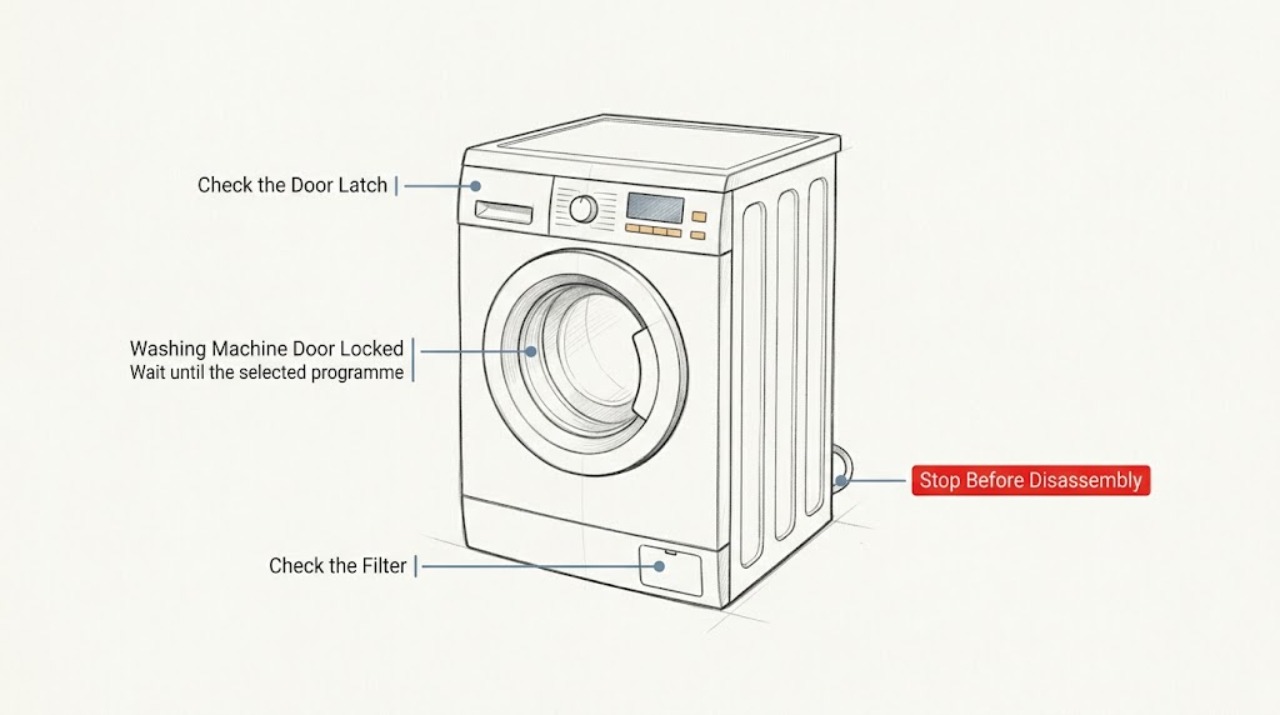
Work through in order
Diagnostic checks
Use only checks that match the exact appliance or system and its official guide.
-
Check 1
Wait until the selected programme has ended, then press Start/Pause or On/Off only as the model manual describes. Watch the lock or key symbol and confirm that the drum has stopped before touching the handle.
Expected result: The lock symbol may clear after the programme, or it may stay active; the drum may be still or the machine may still be completing a stage.
Next step: If the symbol clears and the drum is still, open the door normally. If it remains locked, continue with the water check and do not pull harder.
Why this matters
Why: A short post-cycle delay can be normal, while a moving drum or an active programme means the interlock is doing its safety job.
-
Check 2
Look through the glass and listen from outside for residual water or a drain attempt. Do not open the door, loosen a filter, or start a drain procedure while the water may be hot, the drum is moving, or the machine is powered in an unsafe condition.
Expected result: The drum may look empty, contain visible water, or be too opaque to judge; the display may show a drain or cycle error.
Next step: If water is present or the condition is uncertain, keep the door closed and follow the exact model's safe drain instructions. Stop if water is hot, leaking, or close to electrical parts.
Why this matters
Why: A machine with water inside normally keeps the door locked to prevent flooding. Heat, movement, or an incomplete drain makes an immediate opening unsafe.
-
Check 3
With the machine off and the door closed, inspect the visible door seal, glass edge, latch opening, and nearby clothing for trapped fabric, detergent residue, or a foreign object. Use only a dry, non-sharp cloth for accessible residue; do not pry the latch.
Expected result: A garment or object may sit between the seal and glass, the seal may be folded or torn, or the latch area may look clear.
Next step: Remove only a loose, visible obstruction without force. If the seal, glass, handle, hinge, or latch is damaged, leave the appliance unused and request service.
Why this matters
Why: An obstruction can prevent the door from closing or being detected as closed, while a torn seal, bent latch, or damaged glass points to a mechanical repair rather than a reset.
-
Check 4
Read the display without changing the wiring or opening the cabinet. Record the exact error, beeps or flashes, padlock symbol, programme name, and whether Delay Start or a rinse-hold option was selected.
Expected result: The display may show a key or padlock, a door error such as E40 or E41, a drain-related error, or no code at all.
Next step: Use the exact model manual to clear a child lock or interpret the code. If the code returns after the documented check, stop using the machine and arrange service.
Why this matters
Why: A padlock can indicate a child-safety control; E40/E41 relates to door or lid closure detection on supported Zanussi models. Other codes must be interpreted for the exact model and must not be guessed from a different machine.
-
Check 5
If the drum is empty of water, cool, and fully stopped, switch the machine off, disconnect it from the mains, and wait for the model's manual reset interval before restoring power once.
Expected result: After the single reset, the lock symbol may clear and the machine may respond normally, or the door may remain locked or the same code may return.
Next step: If the lock persists or returns, leave the machine disconnected and request an authorised technician. Do not repeat resets as a substitute for diagnosis.
Why this matters
Why: A reset can clear a transient control state, but it cannot repair a blocked drain, damaged latch, failed interlock, or wiring fault.
-
Check 6
Check the user manual for an emergency door release location and eligibility before attempting anything near the filter flap. Use that procedure only if the manual confirms the exact model, the appliance is off and unplugged, the drum is stopped, the water level is safe, and the load is cool.
Expected result: Some Zanussi models have a release near the fluff filter; other models may not, or may require draining first.
Next step: If any prerequisite is unknown, water is high or hot, the drum can move, or the manual does not confirm the release, do not attempt it; call service and keep the door closed.
Why this matters
Why: An emergency release is model-specific and does not remove the risks from hot water, a moving drum, flooding, or a damaged lock.
-
Check 7
After a safe drain and reset, try one normal programme only if the door closes without force and the manual permits operation. Observe whether the lock engages, water enters, and the cycle advances past its opening stage.
Expected result: The cycle may start normally, stop with a door error, fail to drain, or leave the lock active again.
Next step: Stop the test for a leak, hot water, unusual noise, electrical odor, smoke, or repeated error. Do not run further cycles until a technician clears a persistent fault.
Why this matters
Why: A successful start supports a temporary state or obstruction; a repeated lock, drain failure, or inability to detect closure indicates a fault needing service.
Use your observations
Decision map
Find the observation that best matches what you see, then follow the next safe action.
-
PATH 01Next step
What you see
The programme has just ended, the drum is still, and no water or heat is evident.
Do this next
Arrange qualified service and follow the exact model guidance.
Why this path and its safety boundary
Why it matters: Wait for the lock symbol to clear and open the door normally; a short cooling delay can be normal.
-
PATH 02Next step
What you see
The drum contains water, the water may be hot, or the drain has not completed.
Do this next
Arrange qualified service and follow the exact model guidance.
Why this path and its safety boundary
Why it matters: Keep the door closed. Use only the exact model manual's safe drain route, and stop for heat, leaking water, or water near electrical parts.
-
PATH 03Next step
What you see
A padlock or child-lock indication is displayed and there is no unsafe water or movement.
Do this next
Arrange qualified service and follow the exact model guidance.
Why this path and its safety boundary
Why it matters: Use the exact model manual's child-lock button sequence; do not guess a combination from another Zanussi model.
-
PATH 04Next step
What you see
Laundry or residue is visibly trapped at the seal or latch area.
Do this next
Arrange qualified service and follow the exact model guidance.
Why this path and its safety boundary
Why it matters: Remove only the loose obstruction without force. If the seal, glass, handle, hinge, or latch is damaged, stop and request service.
-
PATH 05Next step
What you see
E40, E41, another error, or the same lock returns after the documented check and one reset.
Do this next
Arrange qualified service and follow the exact model guidance.
Why this path and its safety boundary
Why it matters: Leave the appliance unused and provide the exact code, model, programme stage, water state, and door observations to an authorised technician.
-
PATH 06Next step
What you see
The door opens unexpectedly while water is inside or the drum is washing or spinning.
Do this next
Arrange qualified service and follow the exact model guidance.
Why this path and its safety boundary
Why it matters: Stop the appliance and isolate it safely. Do not use it again until the cause is professionally resolved.
Helpful context
Understand the symptom
A Zanussi door lock is a safety interlock, not a handle problem to overcome with force. It may remain engaged while a cycle is running, while the drum is turning, while water is inside, or briefly while a recently heated lock cools. The exact display symbols and button combinations vary by model, so treat the user manual for the product's model as the authority for any drain or emergency-release procedure.
Keep the machine still while you inspect it. Do not lean or tip it, reach through the door seal, bypass the interlock, remove a cover, or pull a release that is not identified for the exact model. If the door opens while the drum contains water or during a wash or spin stage, stop the appliance and isolate it safely; do not use it again until the cause is resolved.
The useful split is water versus no water, then normal lock timing versus a control or mechanical fault. Once the safe checks are complete, a persistent lock, an error code, a damaged seal or latch, or a door that will not be detected needs an authorised appliance technician.
Safety boundary
Stop conditions
- Do not force, pry, kick, or repeatedly pull the door, and never bypass the door interlock.
- Stop for hot water, visible leaking, a moving drum, a high or uncertain water level, or water near electrical parts.
- Do not tilt the machine, remove a cabinet or lock cover, reach through the seal, or use an emergency release unless the exact model manual confirms it and all safety prerequisites are met.
- Stop for a damaged door glass, seal, handle, hinge, latch, burning or electrical odor, smoke, sparks, unusual noise, or repeated error.
- Do not keep running cycles after a persistent locked-door or drain fault; request an authorised appliance technician.
When checks do not resolve it
Need a professional?
Request an authorised appliance technician when the door stays locked after the drum is cool and empty, the exact model's drain and reset instructions do not resolve it, an error returns, the latch or seal is damaged, the emergency release is unavailable or uncertain, or the machine locks again during a test. Stop immediately for flooding, water near electrical parts, heat, smoke, sparks, or an electrical odor.
Have this ready
- Give the technician the Zanussi model, exact display code or symbol, programme stage, whether the drum contains water, whether the water is hot, the reset result, and any seal, latch, leak, odor, or noise observation.
Common questions
FAQ
How long should a Zanussi washing-machine door stay locked after a cycle?
A short delay after the programme can be normal while the lock cools. Wait for the drum to stop and the lock symbol to clear. If the door stays locked, check the water state and the exact model manual rather than forcing it.
Why is my Zanussi door locked with water inside?
The interlock prevents opening when water remains in the drum. Keep the door closed and use only the exact model manual's safe drain procedure. Hot water, a high water level, leaks, or water near electrical parts require stopping and service.
What do E40 and E41 mean on a Zanussi washing machine?
On supported Zanussi models, E40/E41 indicate that the door or lid is not properly closed or detected. Check for trapped laundry and the child lock as directed for the model; if the code returns, request service instead of bypassing the lock.
Can I use the emergency release on a Zanussi washing machine?
Only when the exact model manual confirms that release and the machine is off, unplugged, fully stopped, cool, and at a safe water level. If any prerequisite is uncertain, do not attempt it; arrange service.
Should I keep running the machine if the door locks again?
No. A repeated locked-door, drain, or door-detection fault can involve the interlock, latch, drain system, sensor, control, or wiring. Leave the machine unused and provide the technician with the display code and water and programme observations.
Read the exact guide
Official sources
- Washing Machine Not Working or Not Turning On – Troubleshooting GuideZanussi · Zanussi washing-machine controls, child lock, door closure, error-code recording, reset, and service guidance
- The door of the washing machine cannot be openedZanussi · Zanussi front-loader washing-machine locked-door timing, water state, emergency opening, safety warnings, reset, and service guidance
- Washing Machine Error Code E40, E41 (4 Beeps / 4 Flashes): Causes & FixesZanussi · Zanussi washer door or lid detection, trapped laundry, overloading, child lock, and service response for E40/E41
- Cleaning the washing machine's rubber seal if it's dirtyElectrolux · Electrolux-group washing-machine door-seal condition, safe cleaning limits, and professional seal replacement boundary
- Opening washing machine's door at the beginning of wash cycleZanussi · Zanussi washing-machine and washer-dryer door timing, water and drum safety, cancellation, and service boundary
Community feedback
Share a repair observation
Share a plain-text repair observation. Accepted observations are published automatically; this page may take a moment to update.