
On this page
Start here
Quick answer
If an Amana oven heats unevenly, first describe the pattern: food may be browning more on top, bottom, or one side, or different pans may simply cook differently. Fully preheat, avoid opening the door, use the rack position recommended for the food, and test with the correct bakeware centered with room for air to circulate. Amana says pan material, rack position, airflow, leveling, and incomplete preheating can all change browning; a single-rack, centered-pan test is more useful than changing several variables at once. Do not judge a cycling oven from one instant thermometer reading or make a blanket temperature change. If the same uneven result persists in a controlled bake-performance test, use the exact model manual for calibration or arrange qualified appliance service rather than opening the oven or testing heating components.
Before you begin
Safety first
- Do not open the control panel, test energized components, alter wiring or gas parts, pull the range without the anti-tip procedure, or continue operating after smoke, gas odor, abnormal flame, or visible component damage.
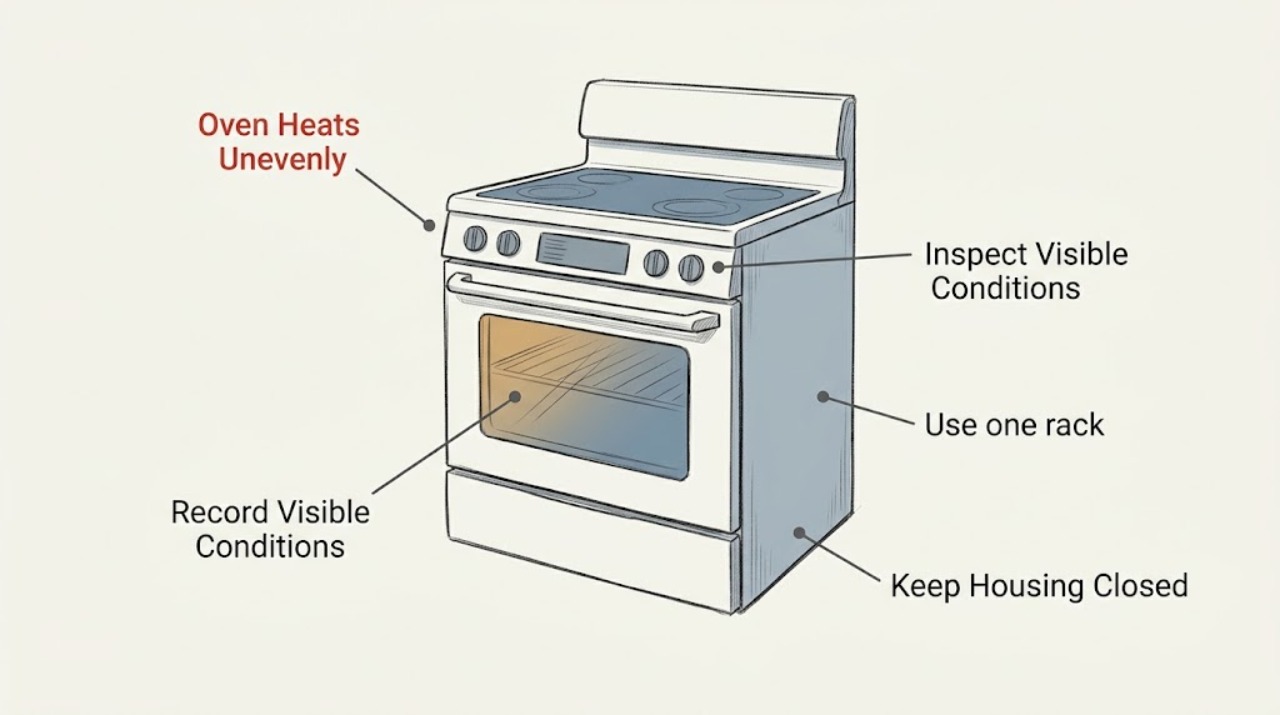
Work through in order
Diagnostic checks
Use only checks that match the exact appliance or system and its official guide.
-
Check 1
Write down the uneven result from one bake: whether the top, bottom, sides, corners, or center differ; whether the problem is browning, doneness, or both; and whether it occurs with every food or only one recipe or pan.
Expected result: The same location is repeatedly over- or under-baked, the top is brown while the bottom is pale, the edge differs from the center, or the result changes with the recipe or pan.
Next step: Keep the food and pan details for a controlled comparison. Do not change temperature, rack, pan, and recipe all at once; continue with full preheat and rack checks.
Why this matters
Why: A repeatable location pattern is more useful for diagnosis than a general feeling that the oven is uneven. A result that changes with pan material, batter, food load, or recipe can be a bakeware or setup effect rather than an oven heating fault.
-
Check 2
Run the oven's normal preheat cycle with the racks positioned before starting. Wait for the preheat signal, place the food promptly, and avoid opening the door during the bake; use the oven light to observe when possible.
Expected result: The result improves after a complete preheat and closed-door bake, or it remains uneven despite the same controlled preheat.
Next step: If the result improves, keep the preheat and closed-door routine. If it does not, continue with rack, pan, airflow, and level checks before considering calibration or service.
Why this matters
Why: Amana says incomplete preheating can leave food too brown on top and undercooked on the bottom, while door openings release heat and affect temperature cycling. Persistence after a controlled preheat makes setup alone less likely.
-
Check 3
Use one rack in the position recommended for the food, then center one pan on that rack. As a comparison, move only the rack to the model-recommended lower or center position for the next test; do not move a pan while it contains hot food.
Expected result: A lower rack improves bottom browning, the center rack gives more even results, or the same hot or cool area remains regardless of rack position.
Next step: Use the rack position that matches the food and exact model guidance. If the same location remains uneven with one centered pan, continue with bakeware and airflow checks rather than repeatedly moving the rack.
Why this matters
Why: Amana identifies rack position as a direct contributor to browning and recommends the center for many baked goods, while a lower position can help food that is pale or undercooked on the bottom. A fixed uneven area across documented positions is more concerning for airflow or oven performance.
-
Check 4
Repeat the test with the recipe-sized pan recommended by the recipe or model guide. Note whether the pan is dark, dull, nonstick, insulated, stainless steel, glass, or ceramic, and leave clear space between the pan, other pans, and oven walls; do not cover the rack or oven bottom with foil.
Expected result: The result changes substantially with pan material or size, pans touch each other or the oven walls, or the same uneven pattern remains with suitable centered bakeware and clear airflow.
Next step: Keep the pan type, size, and spacing consistent for the next comparison. Do not apply a universal temperature correction for a pan difference; use the bakeware guidance and recipe directions for that material.
Why this matters
Why: Amana says pan material changes browning and that hot air must circulate around bakeware; touching pans or walls can create hot spots. Persistence with appropriate bakeware and spacing makes a pan effect less likely.
-
Check 5
Check that the rack is level and that the appliance is level side to side and front to back, using only a cool, empty oven and the model's instructions. Inspect whether a batter or liquid settles to one side in the pan before baking; do not pull the range forward or adjust leveling parts without the Owner's Manual procedure.
Expected result: The rack or appliance is visibly tilted, batter settles to one side, or the rack and appliance appear level while food still browns unevenly.
Next step: Correct only a clearly documented leveling issue using the exact model instructions. If leveling is already correct, do not alter the range feet or anti-tip arrangement; continue with a controlled bake-performance test.
Why this matters
Why: Amana says leveling helps distribute batter evenly and provides a level-rack check. A tilt can look like uneven heating even when the heat pattern is normal; a level setup shifts attention back to pan, airflow, calibration, or service.
-
Check 6
Run a repeatable bake-performance comparison using the same recipe-sized item, pan, rack, temperature, and preheat routine. Record whether it cooks evenly within the recipe's expected time; do not use one instant thermometer reading as the sole test of a cycling oven.
Expected result: The controlled item is evenly browned and done, or it repeatedly shows the same uneven result despite the setup checks.
Next step: If the result remains uneven, consult the exact Amana Owner's Manual for calibration guidance or arrange qualified appliance service. Do not open the control panel, test a heating element, change wiring, or replace a sensor based only on the bake result.
Why this matters
Why: Improvement in a controlled test points to setup, pan, rack, airflow, or leveling rather than a confirmed failed component. A repeatable failure after those checks can justify model-specific calibration or professional diagnosis; Amana says calibration directions are specific to the range or oven.
Use your observations
Decision map
Find the observation that best matches what you see, then follow the next safe action.
-
PATH 01Next step
What you see
The top is brown while the bottom is undercooked, and the oven was not fully preheated or the door was opened often.
Do this next
Repeat with a complete preheat, one rack in the model-recommended position, and a closed door. If the same pattern persists, check pan material and spacing next.
Why this path and its safety boundary
Why it matters: Incomplete preheating or heat loss is more likely than a confirmed component failure.
-
PATH 02Next step
What you see
The result changes when the pan material, pan size, rack position, or food load changes.
Do this next
Keep a recipe-appropriate pan centered on one rack with clear space around it and use the exact model's rack guidance. Compare only one variable at a time.
Why this path and its safety boundary
Why it matters: Bakeware, rack placement, or airflow is influencing browning, so an oven fault is not established.
-
PATH 03Next step
What you see
Batter or liquid settles to one side, the rack is tilted, or the appliance is not level.
Do this next
Use the model's leveling instructions for a cool, empty appliance; do not pull the range or adjust feet without following the Owner's Manual and anti-tip requirements.
Why this path and its safety boundary
Why it matters: Leveling can distribute food unevenly and mimic a heat-distribution problem.
-
PATH 04Next step
What you see
The same location is over- or under-baked with suitable bakeware, clear airflow, a level rack, a full preheat, and a closed door.
Do this next
Use the exact Amana model's calibration instructions or arrange qualified appliance diagnosis. Do not open the oven or replace a sensor or element by guesswork.
Why this path and its safety boundary
Why it matters: A persistent oven performance or calibration issue becomes more plausible, although the bake test alone does not identify a failed component.
-
PATH 05Next step
What you see
The oven's calibration setting is changed but the controlled result remains uneven, or the oven has an error, abnormal heating, smoke, gas odor, or visible element damage.
Do this next
Stop using the affected mode and arrange qualified appliance service. For gas odor or smoke, follow the immediate safety response and do not continue baking tests.
Why this path and its safety boundary
Why it matters: Calibration is not a substitute for diagnosing a component, fuel, electrical, or safety fault.
-
PATH 06Next step
What you see
A controlled bake is evenly done after the rack, pan, preheat, airflow, and leveling changes.
Do this next
Keep the successful rack, pan, spacing, and preheat routine for that food. Recheck the pattern if a different pan or recipe produces a new result instead of replacing parts.
Why this path and its safety boundary
Why it matters: The original complaint was likely caused by a variable in the cooking setup rather than proven uneven oven heating.
Helpful context
Understand the symptom
Define the uneven pattern before changing settings
Top browning with an undercooked bottom, a dark edge beside a pale center, and one pan browning differently from another do not point to the same cause. Record the food, pan, rack, preheat behavior, and location of the uneven result. Then repeat one controlled test with a single rack and centered pan so the next change has a clear meaning.
Do not chase a cycling oven with an instant reading
Amana explains that heating elements cycle on and off to maintain temperature and that a thermometer may not represent the oven's cooking performance at one instant. Use repeatable food results and the model's calibration procedure instead of making a large temperature change from a single reading.
Safety boundary
Stop conditions
- Do not open the control panel, test live wiring or heating components, pull a range forward without the model's anti-tip procedure, or replace a sensor or element based only on uneven browning.
- Stop using the oven and arrange qualified appliance service for smoke, a gas odor, an error code, visible element damage, abnormal flame, repeated scorching, or a door or control that does not operate normally.
- If the same uneven result persists after a full preheat, correct rack and bakeware setup, clear airflow, and a level check, stop making broad temperature changes and use the exact Amana calibration procedure or call for service.
Only after diagnosis
Potential parts
- Amana oven temperature sensor
Consider only after a qualified diagnosis finds a sensor or temperature-control fault following a repeatable uneven-baking result and model-specific calibration checks.
Sensor design and fit vary by Amana model. Confirm the exact model and service diagnosis before selecting a component. - Amana bake or broil heating component
Consider only when qualified service identifies a failed or damaged heating component rather than a pan, rack, airflow, leveling, or calibration issue.
Heating components differ by oven type and model and may involve electrical or gas hazards. Confirm exact model fit and professional installation requirements. - Amana oven control or calibration component
Consider only when the exact model's documented calibration cannot correct a confirmed control or temperature-regulation fault and qualified diagnosis identifies a component to replace.
Control and calibration components are model-specific. Do not select a board or control from a symptom description alone.
When checks do not resolve it
Need a professional?
Arrange qualified appliance service when a controlled bake remains uneven after the exact Amana setup and calibration checks, when calibration does not help, or when there is an error, smoke, gas odor, abnormal flame, visible heating-component damage, or unsafe control behavior. Provide the model number, food and pan used, rack position, preheat routine, repeated result pattern, and any calibration change.
Safety scope: Do not open the control panel, test energized components, alter wiring or gas parts, pull the range without the anti-tip procedure, or continue operating after smoke, gas odor, abnormal flame, or visible component damage.
Common questions
FAQ
Why does my Amana oven heat or bake unevenly?
Start with setup causes: incomplete preheat, frequent door opening, rack position, pan material or size, poor spacing, blocked airflow, or an appliance that is not level. If the same location remains uneven after a controlled single-pan test, use the exact model's calibration guidance or arrange service.
What rack position should I use in an Amana oven?
Use the position recommended for the food and exact model. Amana says the center is commonly best for many baked goods, a lower position can help food that is pale or undercooked on the bottom, and one rack is preferred for most baked goods when possible.
Can the baking pan make an Amana oven look uneven?
Yes. Amana says dark, dull, nonstick, insulated, stainless-steel, glass, ceramic, and light-colored pans transfer or reflect heat differently. Use the recipe-appropriate pan and compare results without changing the pan, rack, and temperature at the same time.
Should I use a thermometer to check my Amana oven temperature?
Do not rely on one instant thermometer reading. Amana explains that the heating system cycles and that a thermometer may not reflect cooking performance at one moment. Use a repeatable bake-performance comparison and follow the exact model's calibration instructions if needed.
When should I call for Amana oven service?
Arrange service when uneven baking persists after full preheat, correct rack and bakeware setup, clear airflow, and a level check; when model-specific calibration does not help; or when there is smoke, gas odor, abnormal flame, an error, or visible component damage. Do not open the oven or replace a component by guesswork.
Read the exact guide
Official sources
- How to Correct Uneven Baking or BrowningAmana Product Help · Amana oven and range product-assistance guidance; rack and bakeware behavior varies by model and food.
- RANGE TROUBLESHOOTING: OVEN TEMPERATURE AND BAKING PERFORMANCE ISSUESAmana · Amana range troubleshooting article; bakeware, rack, airflow, and bake-performance advice should be adapted to the exact model.
- What Bakeware Should be UsedAmana Product Help · Amana oven bakeware guide; material-specific results are guidance and not a universal temperature correction.
- Racks Not LevelAmana Product Help · Amana range rack-level guidance; leveling-leg and anti-tip steps are exact-model specific.
- Possible Causes for Poor Baking ResultsAmana Product Help · Amana oven and range general baking guidance; exact rack positions and settings depend on the model and food.
- Oven Temperature Incorrect (Too Hot or Too Cold)Amana Product Help · Amana range and oven product-assistance article; calibration method and settings are specific to the exact model.
Community feedback
Share a repair observation
Share a plain-text repair observation. Accepted observations are published automatically; this page may take a moment to update.