
On this page
Start here
Quick answer
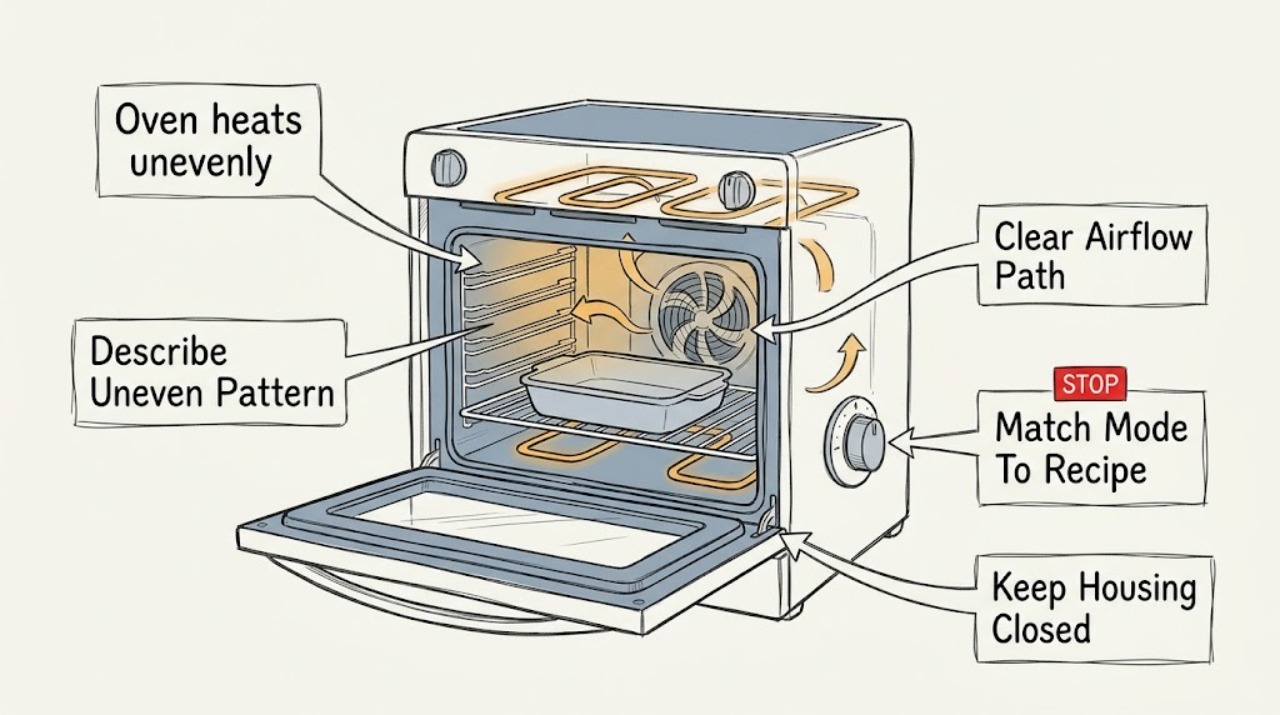
First decide whether the uneven result follows the recipe, rack position, pan, or oven. Use the Bosch mode and rack positions in the exact manual, keep space around the shelf for air movement, avoid covering the shelf with foil or crowding the cavity, and center a single pan. If using convection, confirm the recipe and temperature setting are meant for convection; Bosch notes that convection can cook faster and that some automatic settings change the selected temperature. Rotate a pan only as the recipe and Bosch guidance allow. If the same side or zone stays under- or over-heated with a correct setup, or an element, fan, sensor, or control appears faulty, stop using the affected mode and arrange Bosch appliance service.
Before you begin
Safety first
- This article covers cool external checks, rack and cookware placement, mode and recipe comparison, airflow review, and observation of normal operation. A technician must handle panels, wiring, heating elements, fan assemblies, sensors, controls, and hot or energized diagnosis.
Work through in order
Diagnostic checks
Use only checks that match the exact appliance or system and its official guide.
-
Check 1
For the next safe cooking observation, write down what is uneven: one side browns first, the top or bottom is different, one rack differs from another, the center is different from the edges, or only one pan or recipe is affected. Do not start a special high-heat cycle just to create a test.
Expected result: The pattern follows one recipe or pan, changes with rack position or mode, or stays in the same oven zone across different suitable foods.
Next step: Use the pattern to choose the rack-and-mode check next. If the same zone remains wrong after the setup is corrected, stop compensating with settings and arrange service.
Stop if: Do not touch an element, fan, wiring, or sensor while the oven is hot or energized.
Why this matters
Why: A result that follows the pan, recipe, rack, or mode makes setup, cookware, or airflow more likely. A stable zone error across suitable foods makes an oven heating, fan, sensor, or control issue more likely.
-
Check 2
With the oven cool, place one suitable pan on the rack position specified by the Bosch manual and center it. Leave clear space around the back and sides of the shelf, avoid crowding the cavity, and remove any foil that covers the full shelf or blocks heat movement.
Expected result: The pan was off-center, the shelf was crowded, the back or sides were blocked, or foil covered the shelf; or the documented setup was already correct.
Next step: Correct the placement once and compare one normal cook. If the same area remains under- or over-heated, continue to the mode and recipe check rather than stacking more pans or foil into the test.
Stop if: Do not line the cavity, cover the whole shelf with foil, block vents, or move hot cookware by hand.
Why this matters
Why: A blocked or crowded shelf can interrupt circulation and produce edge-to-edge differences without a failed part. If the documented spacing and placement were already correct, airflow setup is less likely to explain a repeatable zone error.
-
Check 3
Compare the selected Bosch mode with the recipe and the exact model manual. If the result was produced in convection, check whether the recipe expects conventional heat, whether the model has regular or true convection, and whether its automatic setting changes the selected temperature. Use one mode consistently for the comparison.
Expected result: The recipe and oven mode do not match, the oven changed the set temperature under an automatic convection setting, or the mode and recipe are matched.
Next step: Repeat only with the documented mode and recipe instruction, using the same pan and rack placement. If the result remains uneven, continue to the single-pan comparison and service screen.
Stop if: Do not apply a temperature change from a different Bosch model, switch modes mid-cycle to hide a hot spot, or use a cooking mode that the manual does not support for the pan.
Why this matters
Why: A mode mismatch or automatic convection adjustment can change browning and timing without an oven defect. A matched mode with a repeatable uneven zone keeps a hardware branch open.
-
Check 4
Using a suitable low-sided pan and the corrected mode, cook one evenly shaped item in the center rack position. If the recipe permits, rotate the pan once at the documented point and note whether the unevenness moves with the pan or remains tied to one side of the cavity.
Expected result: The uneven result moves when the pan is rotated or changes with the pan, or it remains on the same oven side after the pan is rotated.
Next step: Use the pan result to decide whether to change cookware or request service. Do not keep rotating food to compensate for a fixed zone error.
Stop if: Do not reach into a hot cavity to move a pan if the manual or recipe does not call for it, and stop for smoke, arcing, abnormal smell, or uncontrolled heat.
Why this matters
Why: A result that moves with the pan or changes after rotation makes pan shape, placement, or airflow more likely. A result that stays on the same oven side with a suitable centered pan makes a fixed heat-distribution or component fault more likely.
-
Check 5
With the oven off and fully cool, record any visible element damage, a fan that never runs in a mode that should use it, error message, unusual sound, or a display temperature that behaves differently from the food result. Use the Bosch manual's model-specific temperature or support procedure; do not remove panels or test circuits.
Expected result: An element is visibly damaged, the expected fan is absent or abnormal, an error appears, or no visible component symptom is present.
Next step: Stop using the affected cooking mode and arrange Bosch service for any component symptom, error, or persistent uneven result. If no component symptom is present, provide the documented pattern and setup results to service if the problem remains.
Stop if: Do not touch or bend elements, remove covers, access wiring, bypass a thermal device, or run the oven with exposed or damaged parts.
Why this matters
Why: A visible element fault, missing expected fan action, or error supports a technical problem beyond rack placement. No visible symptom does not clear the element, sensor, fan, wiring, or control because many faults are hidden.
-
Check 6
Stop the affected mode and prepare a Bosch service request when uneven heating persists after the documented rack, airflow, cookware, and mode checks. Record the model, mode, rack position, pan, food pattern, and whether the same oven zone stayed wrong after rotation.
Expected result: The issue clears with the corrected setup, or it remains with the same zone, appears in several modes, or is paired with an error, abnormal fan, or element symptom.
Next step: Use the corrected setup if it is stable and safe. Otherwise leave the affected mode unused and arrange qualified Bosch appliance service with the recorded observations.
Stop if: Stop immediately for smoke, arcing, burning odor, uncontrolled heat, repeated breaker trips, or exposed wiring.
Why this matters
Why: A setup-dependent result supports a cooking-method correction. A persistent, multi-mode, or component-linked result is more consistent with a heating element, convection system, sensor, wiring, or control fault.
Use your observations
Decision map
Find the observation that best matches what you see, then follow the next safe action.
-
PATH 01Safety boundary
What you see
Uneven browning follows one pan or recipe, changes when the pan is centered or rotated, or improves when shelf space and airflow are restored.
Do this next
Use the Bosch manual's rack position and the recipe's mode, keep the cavity open enough for circulation, and change one setup variable at a time.
Why this path and its safety boundary
Why it matters: Cookware shape, placement, rack position, crowding, or mode selection is more likely than a failed oven component.
Safety stop: Do not keep raising heat or cover the shelf with foil to compensate for a setup problem.
-
PATH 02Safety boundary
What you see
The problem appears only in convection, the recipe is written for conventional heat, or an automatic convection setting changes the selected temperature or timing.
Do this next
Follow the exact Bosch mode and recipe instructions, then compare one centered pan. If unevenness remains with a matched setup, move to service assessment.
Why this path and its safety boundary
Why it matters: A mode and recipe mismatch is more likely; Bosch notes that convection changes heat circulation and can cook faster than conventional heat.
Safety stop: Do not borrow a temperature conversion or fan assumption from another Bosch model.
-
PATH 03Safety boundary
What you see
The same oven side, rack area, or food region remains wrong with a suitable pan, correct mode, open airflow, and a documented rack position, or a component symptom appears.
Do this next
Stop using the affected mode and arrange qualified Bosch service; provide the repeatable pattern and all setup changes already tried.
Why this path and its safety boundary
Why it matters: A heating element, convection fan or element, temperature sensor, wiring, or control issue is more likely than cookware placement.
Safety stop: Do not remove panels, test energized circuits, bend elements, or choose a component from uneven browning alone.
-
PATH 04Safety boundary
What you see
Uneven heating is paired with smoke, arcing, a burning odor, uncontrolled temperature, a repeated breaker trip, an error, or loss of fan or control response.
Do this next
Turn the oven off, keep clear of hot or energized parts, and arrange qualified Bosch appliance service. Use emergency help for fire, smoke, or immediate danger.
Why this path and its safety boundary
Why it matters: The safety or control symptom takes priority over recipe adjustments and indicates that continued cooking may be unsafe.
Safety stop: Do not restart the oven to confirm the symptom or continue cooking through abnormal heat or electrical behavior.
Helpful context
Understand the symptom
Separate a cooking setup problem from an oven fault
Uneven browning or doneness can come from a crowded cavity, a blocked shelf, a pan that concentrates heat, a conventional recipe used in convection mode, or a rack position that does not match the Bosch manual. A repeatable hot or cool zone with the same correct setup points more toward a heating element, fan, sensor, or control problem. Change one variable at a time so the result has diagnostic value.
Convection changes both airflow and timing
Bosch describes regular convection as circulating hot air and true convection as adding a heating element behind the fan on applicable models. That difference matters: some recipes need a mode-specific temperature or time adjustment, and delicate foods may rise or brown differently in moving air. Use the model manual and recipe branch before calling a normal convection result a hardware failure.
Persistent zone errors need a service boundary
If food remains uneven after a correct mode, centered cookware, open airflow, and the documented rack position, do not compensate by continually raising or lowering the set temperature. Bosch identifies malfunctioning elements as a reason to seek support. A technician can check the elements, fan system, temperature sensing, wiring, and control without asking the owner to access live or hot parts.
Safety boundary
Stop conditions
- Stop using the oven immediately for smoke, arcing, burning odor, uncontrolled heat, exposed wiring, repeated breaker trips, or a damaged heating element.
- Do not cover the full shelf with foil, block vents or circulation space, remove panels, test energized circuits, bend an element, or bypass a thermal or door safety device.
- Do not keep raising the set temperature or changing modes to hide a fixed hot or cool zone, and do not run a cleaning cycle to test uneven heating.
- If the same zone remains uneven with a correct Bosch mode, rack position, centered suitable pan, and open airflow, stop the affected mode and arrange qualified service.
- If the exact model manual conflicts with a general cooking tip, follow the manual and stop before using an unsupported setting or component procedure.
Only after diagnosis
Potential parts
- Bosch oven heating element
Consider this category only if qualified testing confirms a failed bake, broil, or convection heating element after setup and mode causes are excluded.
Confirm the exact Bosch model, element position, power design, connectors, and manufacturer fit information before ordering. - Bosch convection fan assembly
Consider this category only if the model uses convection for the affected result and a qualified diagnosis confirms abnormal fan operation or a related fan fault.
Confirm the exact Bosch model, fan or motor design, mounting, blade type, and manufacturer fit information before ordering. - Bosch oven temperature sensor
Consider this category only when qualified diagnosis links the persistent temperature pattern or error to the sensor or its circuit rather than an element, fan, wiring, or control.
Confirm the exact Bosch model, sensor type, connector, mounting, and manufacturer fit information before ordering.
When checks do not resolve it
Need a professional?
Arrange qualified Bosch appliance service when uneven heating persists with the model-directed mode, rack position, cookware, and airflow, when it appears in several modes, or when an element, fan, sensor, control, error, or electrical symptom is present. Stop immediately for smoke, arcing, burning odor, uncontrolled heat, exposed wiring, or repeated breaker trips. Panel access and energized or hot-component diagnosis require a technician.
Safety scope: This article covers cool external checks, rack and cookware placement, mode and recipe comparison, airflow review, and observation of normal operation. A technician must handle panels, wiring, heating elements, fan assemblies, sensors, controls, and hot or energized diagnosis.
Common questions
FAQ
Why does my Bosch oven heat unevenly?
Start with recipe and mode, rack position, pan placement, crowding, and airflow. Bosch notes that convection circulates heat differently and that a blocked shelf or full-shelf foil can affect circulation. If the same zone stays wrong with a correct setup, a technical fault is more likely.
Can the Bosch convection setting cause uneven baking?
It can change cooking speed, browning, and heat movement if the recipe expects conventional heat or if the model's automatic convection setting changes temperature. Follow the exact Bosch manual and recipe mode before judging the oven hardware.
Where should I put one pan in a Bosch oven?
Use the rack position in the exact Bosch manual and center a single pan. Keep space around the shelf and avoid crowding so heat can circulate. For multiple racks, follow the recipe and Bosch guidance about spacing and rotation.
Should I cover a Bosch oven shelf with foil to stop hot spots?
No. Bosch warns that covering the entire shelf with foil can block heat circulation. Correct the rack, pan, and mode first; do not use foil to mask a fixed hot or cool zone.
When does uneven Bosch oven heating need service?
Arrange service when the same zone stays uneven with the documented mode, rack position, centered suitable pan, and open airflow, or when an element, fan, sensor, control, error, smoke, arcing, burning odor, uncontrolled heat, or breaker symptom appears. Do not open panels or test hot or energized parts.
Read the exact guide
Official sources
- What is a Convection Oven? | Bosch – How to Use, Benefits, & Cooking Tips for Your Next MealBosch Home Appliances · Bosch consumer cooking guidance; exact modes and settings depend on the oven model and recipe.
- Convection Oven Not Heating Up | Oven Troubleshooting | BoschBosch Home Appliances · Direct Bosch US troubleshooting page for convection ovens; it does not identify a specific failed part without model diagnosis.
- Common Oven Problems and How to Fix Them | BoschBosch Home Appliances · Official Bosch US support overview used for the repair boundary and model-specific support path.
- Oven Temperature Is Not Correct | BoschBosch Home Appliances · Direct Bosch US owner-support page; automatic settings and manual recommendations vary by model.
Community feedback
Share a repair observation
Share a plain-text repair observation. Accepted observations are published automatically; this page may take a moment to update.