
On this page
Start here
Quick answer
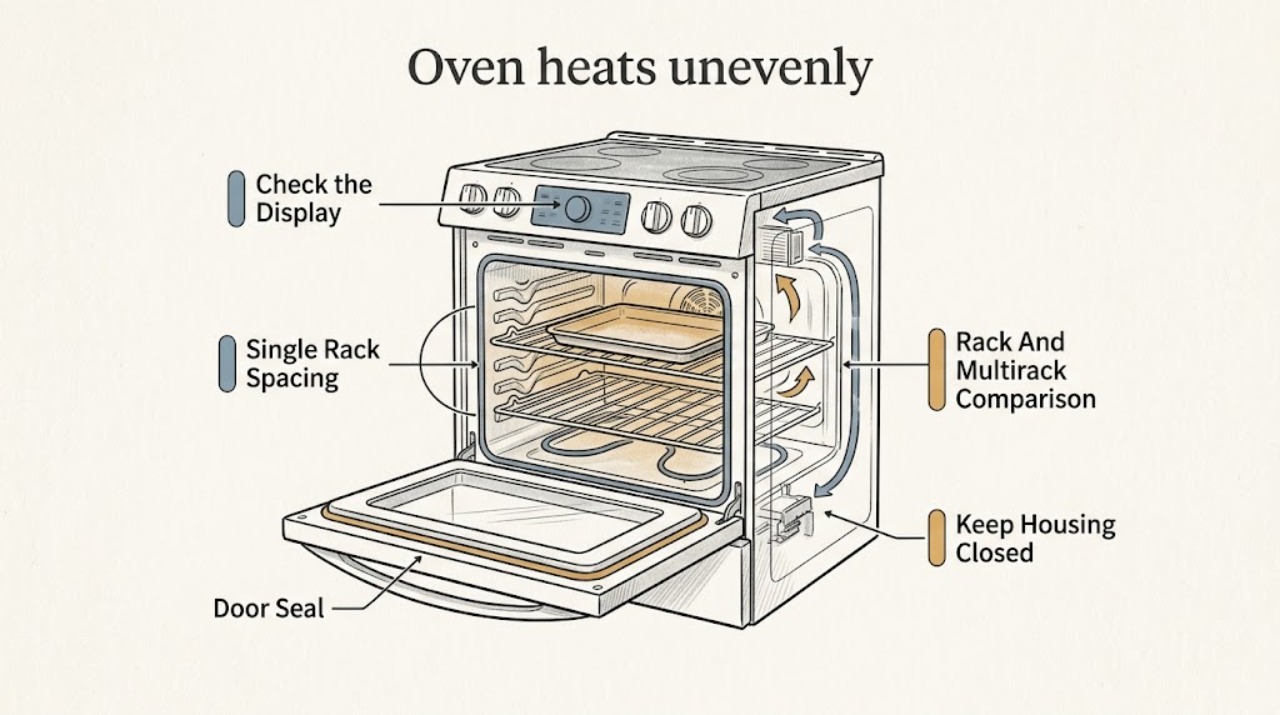
Start by separating a cooking-layout problem from an oven problem: fully preheat the empty Frigidaire oven with the door closed, use the rack position in the model's owner's manual, and bake one tray with food in a single layer and space around each item. Compare the result with the same recipe after checking the bake mode and any model-specific convection conversion. If one side or zone is still consistently hotter or cooler, the door gasket is damaged, preheating is abnormal, a heating element or convection fan is not behaving normally, or a fault code appears, leave the oven off and arrange qualified service. Do not touch heating elements, remove panels, perform live electrical tests, force the door or fan, or use Self Clean as a diagnostic test.
Before you begin
Safety first
- This article covers recording the symptom, normal control selection, arranging racks, spacing food, and cold visual observation. A technician must handle calibration beyond the model manual, live electrical testing, panels, wiring, heating elements, sensors, fan assemblies, door hardware, seals requiring replacement, and control diagnosis.
Work through in order
Diagnostic checks
Use only checks that match the exact appliance or system and its official guide.
-
Check 1
With the cavity empty, select the ordinary bake mode specified by the recipe and fully preheat with the door closed. Record the mode, rack position, the preheat indication or beep, and whether the oven reaches a stable cooking state before the tray goes in.
Expected result: The oven reaches its normal preheat indication, preheating is unusually slow or never completes, or the door has been opened repeatedly before the result was assessed.
Next step: If preheat is normal, continue with one tray and controlled spacing. If it is abnormal, leave the oven off and use the model manual or arrange service rather than changing calibration blindly.
Stop if: Stop immediately for smoke, sparking, a burning smell, runaway heat, a damaged element, or a fault code; do not touch the elements or open an electrical panel.
Why this matters
Why: A complete, closed-door preheat makes a layout comparison meaningful. Slow or incomplete preheat points toward power, sensing, heat-loss, or control concerns; repeated door opening can create a misleading uneven result.
-
Check 2
Bake one tray on a rack position supported by the Frigidaire owner's manual. Keep food in one layer, leave space around each item, and use the same pan and recipe for the comparison.
Expected result: Browning becomes more even when food is spaced and only one rack is used, or the same side or area remains under- or over-browned.
Next step: Keep the improved layout for ordinary baking. If the pattern persists, repeat once with the manual's alternate rack position and document the location of the difference for service.
Stop if: Do not line the oven floor or cover vents with foil, and do not continue using the oven if the door does not seal or heat escapes abnormally.
Why this matters
Why: Improvement with spacing makes blocked airflow, crowding, pan material, or rack position more likely. A repeatable hot or cool area with a controlled tray makes a cavity, sensing, heating, or airflow issue more likely.
-
Check 3
After the one-rack test, compare the result with the manual's recommended rack arrangement for the selected mode. If using more than one rack, keep the trays clear of one another and note which rack and which side of the cavity changes first.
Expected result: Only the multi-rack or lower/upper rack arrangement produces the unevenness, or the same location is uneven in both one-rack and multi-rack tests.
Next step: Use the rack positions and spacing described in the exact manual. If one location remains abnormal with a single, correctly positioned tray, stop repeated recipe tests and arrange service.
Stop if: Do not guess an exact rack position from another model, block the vent, or place cookware where it contacts the door or cavity walls.
Why this matters
Why: A result that changes with rack arrangement is more consistent with air circulation and rack placement than a fixed failed component. A stable location across arrangements deserves a model-specific oven diagnosis.
-
Check 4
If the oven has convection, arrange the rack(s) before selecting convection, verify the selected mode, and follow the exact model's convection-conversion instructions. Compare one ordinary-bake run with one convection run using the same pan and a repeatable food layout.
Expected result: Unevenness occurs only in convection, the fan is silent or abnormal, the display is in a different mode than expected, or both modes show the same fixed hot or cool area.
Next step: Correct only the mode or manual conversion setting that is clearly identified for the model. Arrange service for an abnormal fan or persistent convection-only unevenness; do not attempt fan or wiring repair.
Stop if: Never touch the fan or heating elements while energized or hot, and do not operate with a loose or damaged fan cover.
Why this matters
Why: A convection-only change makes mode selection, conversion, airflow, or fan operation more likely. The same pattern in both modes shifts concern toward rack, heat source, sensor, seal, or power diagnosis.
-
Check 5
Turn the oven off and let it cool fully. Visually inspect the door gasket, door-to-frame contact, visible vent opening, and accessible cavity surfaces for a torn, detached, folded, scorched, or obstructed seal or vent.
Expected result: The gasket is intact and evenly seated, a loose object is obstructing the path, the gasket is torn or detached, the door sits unevenly, or scorching or smoke staining is visible.
Next step: Remove only a loose object that is plainly user-accessible. Leave the oven off and arrange qualified service for seal damage, an uneven door, scorching, smoke staining, or any obstruction that requires disassembly.
Stop if: Do not pull, stretch, glue, cut, heat, lubricate, or replace the gasket as a generic fix; do not remove panels or touch hot surfaces.
Why this matters
Why: A clear, intact seal makes heat loss less likely. A torn or detached gasket, uneven door, scorching, or smoke staining can explain low heat or unsafe leakage and requires a repair decision rather than more baking tests.
-
Check 6
Record whether the symptom is actual temperature error or only uneven browning, and photograph or write down any displayed code before cycling power. If the model manual provides a calibration procedure, use only that model-specific procedure after the physical checks are normal.
Expected result: The oven is consistently too hot or too cool throughout the cavity, only one zone differs, an F-code or door-lock code returns, or no code appears.
Next step: Provide the exact model, mode, preheat behavior, pattern, and code to qualified service. For a thermal or door fault, follow the model's cool-down instructions and keep the oven off until the cause is addressed.
Stop if: Do not perform live voltage tests, bypass a safety device, reset a recurring fault as a repair, or use Self Clean to test heating performance.
Why this matters
Why: A whole-cavity temperature error makes calibration, sensing, power, or control diagnosis more likely; one-zone behavior points more toward airflow, element, or cavity distribution. A recurring code can indicate a fault that should not be cleared repeatedly.
Use your observations
Decision map
Find the observation that best matches what you see, then follow the next safe action.
-
PATH 01Safety boundary
What you see
Unevenness improves with one tray, a single layer, more spacing, or the rack arrangement in the exact manual.
Do this next
Keep the validated layout and mode, and use the model manual for multi-rack placement. Seek service only if a repeatable uneven area remains under the controlled one-rack setup.
Why this path and its safety boundary
Why it matters: Crowding, cookware, airflow, or rack placement is more likely than a fixed failed component.
Safety stop: Do not block vents or continue if the door seal, cavity, or element is damaged.
-
PATH 02Safety boundary
What you see
The same front, rear, side, or rack area is hotter or cooler with a fully preheated, single-rack, correctly spaced tray.
Do this next
Stop repeated cooking comparisons and arrange qualified appliance service with the model, mode, rack, and pattern documented.
Why this path and its safety boundary
Why it matters: A repeatable cavity distribution, heating-element, sensor, fan, seal, or power issue is more likely than recipe placement alone.
Safety stop: Do not remove panels, test live voltage, touch elements, or order a part before the exact cause and model fit are confirmed.
-
PATH 03Safety boundary
What you see
Ordinary bake is acceptable but convection alone is uneven, or the convection fan is silent, intermittent, or abnormal.
Do this next
Verify the model's mode and conversion instructions once; arrange service for abnormal fan behavior or continued convection-only unevenness.
Why this path and its safety boundary
Why it matters: Mode selection, model-specific conversion, airflow, or fan operation is more likely than a general oven-temperature problem.
Safety stop: Do not reach into the cavity to turn, restrain, or inspect the fan and do not run with a loose fan cover.
-
PATH 04Safety boundary
What you see
Preheat is unusually slow, food is broadly underdone, the gasket is damaged, the door contacts unevenly, or the oven loses heat around the door.
Do this next
Leave the oven off when damage or abnormal heat loss is visible and arrange service; provide the preheat behavior and cold visual findings.
Why this path and its safety boundary
Why it matters: Heat loss, inadequate power, door-seal damage, or a control/heating fault is more likely than a rack-only issue.
Safety stop: Do not operate with a torn seal, scorching, smoke staining, exposed damage, or a door that will not close normally.
-
PATH 05Safety boundary
What you see
A recurring fault code appears, the oven overheats beyond the selected setting, or a thermal-runaway indication is present.
Do this next
Turn the oven off, let it cool, record the exact code and model, and follow the model-specific support or service instructions.
Why this path and its safety boundary
Why it matters: This is a control, sensing, or safety fault path, not an invitation to keep recalibrating or cooking through the code.
Safety stop: Do not repeatedly reset, bypass a safety control, use Self Clean as a test, or resume cooking while the code or runaway behavior recurs.
Helpful context
Understand the symptom
Uneven browning is not automatically a failed oven
Food can brown unevenly when a pan blocks airflow, items are crowded, the rack is in an unsuitable position, the door is opened before the oven stabilizes, or a convection recipe is converted incorrectly. Frigidaire's own guidance separates these setup factors from faults such as heat loss through a damaged gasket, inadequate power, calibration problems, or a component that needs service. Reproduce the symptom with one tray and a known rack position before choosing a part.
Use a repeatable bake before comparing hot and cool areas
Record the mode, rack position, preheat indication, pan type, and whether the door was opened. Use a single layer with space between items and keep the door closed during the initial bake. If the result improves when crowding or rack position changes, the oven may be operating normally under a better layout. If the same side, front, or rear remains different after the setup is controlled, the finding is more useful for service than a one-off recipe result.
Convection changes the decision path
On a model with convection, arrange the racks before selecting the mode and use the conversion instructions in the owner's manual. A fan that does not run, makes an abnormal noise, or produces unevenness only in convection mode points to a model-specific airflow or fan diagnosis. Do not reach through the oven opening to test or stop the fan, and do not assume a conversion setting from another Frigidaire model applies to yours.
Heat loss and fault codes need a service boundary
A damaged or detached gasket can let heat escape and contribute to an oven that is not hot enough. With the oven cold, inspect the seal visually without pulling or rubbing it. If preheating is unusually slow, the door does not contact evenly, a heating element is visibly damaged, or an error code returns, stop using the oven and give the technician the model number and the exact symptom. Frigidaire notes that calibration and reset steps vary by model; do not apply a generic adjustment or repeated reset as a substitute for diagnosis.
Safety boundary
Stop conditions
- Turn the oven off and arrange qualified service for smoke, sparking, a burning smell, runaway heat, a recurring fault code, a visibly damaged heating element, or an exposed electrical part.
- Do not touch heating elements, fan blades, wiring, terminals, or internal panels; live electrical diagnosis and component replacement require a qualified technician.
- Do not use the oven with a torn or detached gasket, an uneven or damaged door, scorching or smoke staining, or a door that cannot close and seal normally.
- Do not block vents, line the cavity floor with foil, force the convection fan or door, or use Self Clean as a diagnostic workaround.
- Calibration, reset, convection conversion, and error-code handling are model-specific; use the exact owner's manual and stop when its procedure does not resolve the symptom.
Only after diagnosis
Potential parts
- Frigidaire oven temperature sensor
Consider this category only when a technician confirms that the exact model's sensor or its wiring is inaccurate or faulty after controlled baking and power checks.
Confirm the exact Frigidaire model, sensor design, connector, and manufacturer's fit information before ordering. - Frigidaire oven bake or broil heating element
Consider this category only when a technician confirms a damaged or non-operating element is responsible for the uneven or incomplete heating pattern.
Confirm the exact model, element position, mounting, electrical rating, and manufacturer's fit information before ordering; do not test or replace it as a live appliance. - Frigidaire convection fan motor or assembly
Consider this category only when the exact model supports convection and a technician confirms abnormal fan operation explains a convection-specific symptom.
Confirm the exact model, fan blade and motor assembly, connector, guard, and manufacturer's fit information before ordering. - Frigidaire oven door gasket
Consider this category only when a technician confirms the exact model's gasket is torn, detached, hardened, or unable to seal evenly and is contributing to heat loss.
Confirm the exact Frigidaire model, gasket profile, mounting method, and manufacturer's fit information before ordering.
When checks do not resolve it
Need a professional?
Safety scope: This article covers recording the symptom, normal control selection, arranging racks, spacing food, and cold visual observation. A technician must handle calibration beyond the model manual, live electrical testing, panels, wiring, heating elements, sensors, fan assemblies, door hardware, seals requiring replacement, and control diagnosis.
Common questions
FAQ
Why does my Frigidaire oven heat unevenly?
Start with rack position, crowded food, pan choice, airflow, incomplete preheat, and door opening. If one zone stays different after a fully preheated, single-rack, correctly spaced test, a heating, sensing, fan, seal, power, or control issue becomes more likely and needs model-specific diagnosis.
How can I test uneven browning without taking my Frigidaire oven apart?
Use one tray, a single layer with space between items, a manual-recommended rack position, and a complete closed-door preheat. Record whether the same side or area differs. Do not remove panels, touch elements, test live voltage, or use Self Clean as a test.
Why is my Frigidaire oven uneven only in convection mode?
Verify the exact model's convection mode and conversion guidance and arrange racks before selecting the mode. If the fan is abnormal or unevenness continues only in convection, leave fan and wiring work to qualified service.
Can a damaged oven gasket cause uneven or low heat?
Yes. A torn, detached, worn, or missing gasket can allow heat loss. Inspect it only when the oven is cold and do not pull, stretch, glue, cut, or heat it. A damaged seal, uneven door, scorching, or smoke staining is a reason to stop using the oven and arrange service.
What should I do if an error code appears while the oven heats unevenly?
Record the exact code, turn the oven off, and let it cool. Follow the exact model's Frigidaire instructions; do not repeatedly reset or continue cooking through a recurring code. A thermal-runaway indication or smoke, sparking, or abnormal heat requires prompt service.
Read the exact guide
Official sources
- Oven - Is too HotFrigidaire · Official Frigidaire guidance; calibration steps vary by model.
- Ovens - Why isn’t my food cooked evenly?Frigidaire · Official Frigidaire oven guidance applicable to the symptom; model manual controls the exact rack and mode instructions.
- How do I improve my baking results with my Frigidaire range? Ex. My oven appears to be too hot or I have uneven temperatures.Frigidaire · Official Frigidaire owner guidance; exact rack positions and controls remain model-specific.
- Oven - Is Not Hot EnoughFrigidaire · Official Frigidaire guidance for under-temperature symptoms; exact diagnosis is model-specific.
- Oven Error Codes and Alarms GuideFrigidaire · Official Frigidaire code guidance; displayed codes and reset behavior vary by model.
- Ovens - How do I use Convection Bake?Frigidaire · Official Frigidaire convection guidance; controls and conversion behavior vary by model.
Community feedback
Share a repair observation
Share a plain-text repair observation. Accepted observations are published automatically; this page may take a moment to update.